
Introduction: Seeing the Future on the Ruins of Consensus
On March 8, 2026, as global markets were gripped by the geopolitical uncertainty surrounding Iran and the cracks in the private lending market, Cathie Wood, founder and CEO of ARK Invest, hosted her signature monthly market insights online conference, "In the Cathie Wood." In her hour-long presentation, she offered her characteristically provocative and disruptive perspective on several of the most pressing market issues—from the ultimate fate of oil prices to the "PC moment" of AI, from her insistence on the "spring theory" of the US economy to the power transition between Bitcoin and gold—offering judgments drastically different from the mainstream consensus on Wall Street.
This is more than just market commentary; it's a thought experiment navigating through the fog. It challenges us to consider: when everyone is running in one direction, what does the lone runner in the opposite direction see—a precipice or an undiscovered new continent? When traditional valuation models and macro frameworks crumble in the face of disruptive technologies, do we need a completely new cognitive system to understand this world that is being reshaped?
This article will dissect all the core arguments of this conference with unprecedented depth, combining ARK Invest's annual flagship report "BIG IDEAS 2026," historical data, and in-depth materials from multiple sources to present you with a complete and detailed map of "Cathie Wood Worldview." We will not only be satisfied with "what she said," but also delve into "why she said it," and the consistent, first-principles-based investment philosophy behind it.
Chapter 1: The Fog of Geopolitics and the End of Oil — Why Will Oil Prices Eventually Plunge?
At the start of the meeting, Cathie directly addressed the market's biggest fear – the escalation of the conflict between Iran and Israel. Amidst the widespread panic among mainstream media and analysts that war would cause oil prices to soar to $150 or even $200, she offered a startlingly different prediction: oil prices would not only not spiral out of control, but could even plummet by 50% in the coming years, returning to the $40 per barrel level.
This judgment forms an excellent entry point for understanding ARK's macro framework. It is not a simple contrarian bet, but rather based on a profound understanding of market psychology, technological changes, and the fundamentals of supply and demand.
1.1 "Buy on rumors, sell on facts": The iron law of geopolitics and its historical echoes
Cathie first used an old Wall Street trading adage to analyze the market's short-term reaction. She believes that the market's reaction to geopolitical risks is often irrational and emotionally driven, following a classic pattern: in the uncertainty phase before a conflict breaks out, oil prices rise due to panic buying driven by fear of the worst-case scenario; but once the conflict is resolved, as long as the core destructive force of the conflict does not directly and sustainably paralyze the core facilities in major global oil-producing regions (such as Saudi Arabia's Abqaiq processing plant), the market will quickly return to rationality and re-examine the supply and demand fundamentals.
“What we’re seeing is a classic case of ‘buying on rumors, selling on facts.’ The market has already priced in the worst-case scenario before the event even occurs, and may even have overpriced it. When it turns out that the world didn’t end and the tanker is still sailing, then mean reversion of prices is inevitable.” — Cathie Wood
Drawing lessons from history, she reviewed several Middle East crises over the past few decades, from the Iran-Iraq War to the Gulf War, and the numerous local conflicts in recent years. She observed that short-term surges in oil prices are often temporary, and the long-term trend is ultimately determined by economic and technological fundamentals. She judged that the current situation in Iran is yet another replay of this pattern. Unless an extreme "black swan" event occurs, such as a complete and prolonged blockade of the Strait of Hormuz, the potential for further increases in oil prices is very limited.
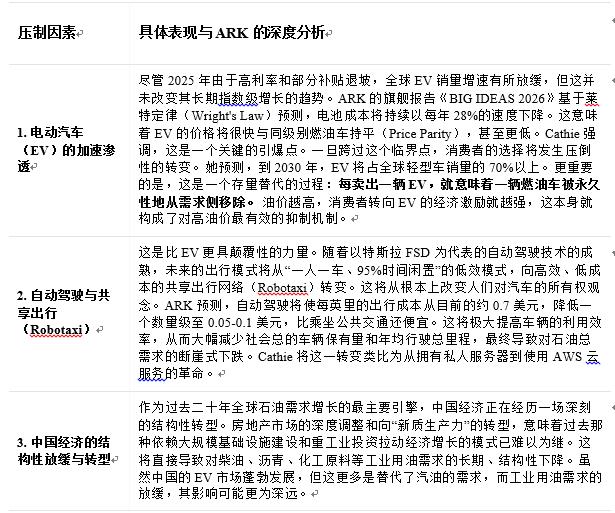
1.2 The "Triple Suppression" on the Demand Side: An Irreversible Structural Revolution
Cathie's deeper and more disruptive logic in being bearish on oil prices stems from the structural and irreversible "triple pressure" occurring on the demand side. These three forces together form a powerful negative feedback loop that will continuously weaken global dependence on oil in the long term.
1.3 The Rise of "Non-OPEC" Players on the Supply Side: Shale Oil Revolution 2.0
On the supply side, Cathie also sees disruptive changes. She believes that the mainstream market view focuses too much on the OPEC+ production cut alliance and its internal power struggles, while systematically underestimating the enormous technological advancements and production capacity flexibility of non-OPEC oil-producing countries, represented by US shale oil.
"The shale oil revolution 2.0 is underway. Unlike the 'wild growth' of a decade ago, this time it is technology-driven. Thanks to AI, big data analytics, and more advanced horizontal drilling technology, shale oil extraction efficiency and cost control have reached unprecedented levels. The United States is now the de facto 'swing producer' in the global oil market, with its rapid-response production capacity sufficient to offset most of OPEC+'s production cut efforts and set an effective 'ceiling' for global oil prices."
ARK's research indicates that the break-even price in major U.S. shale oil producing regions (such as the Permian Basin) has fallen to the $40-50 per barrel range, with some high-quality wells even lower. This means that even if oil prices fall sharply, most production capacity can still be profitable and continue operating. This strong supply elasticity forms the core basis for Cathie's bearish view on oil prices.
In conclusion, Cathie Wood's assessment of oil prices is a typical "ARK-style" long-term forecast based on first principles. It cuts through the short-term noise of geopolitics, pointing directly to the fundamental forces driving the changing global energy landscape—technological innovation (EVs, autonomous driving, AI-driven shale oil extraction) and structural changes in the macroeconomy (China's economic transformation). She believes that the long-term fate of oil as an "old energy source" being gradually replaced is irreversible. For investors, this means being wary of the "value trap" in traditional energy stocks and actively embracing disruptors who are taking a leading position in new energy and new modes of transportation.
Chapter Two: The "Cracks" and the "Cockroach Theory" in Private Credit — An Ongoing Crisis
If her assessment of oil prices is a "thought experiment" at the macro level, then Cathie's warning about the private credit market is more like a "live report" of an ongoing crisis. She astutely grasped the deeper implications of the landmark event of BlackRock's $26 billion private credit fund (BCRED) restricting withdrawals, linking it to the classic "cockroach theory" and issuing a resounding alarm.
2.1 “When you see a cockroach…”: From isolated incidents to systemic risks
Cathie quoted an old Wall Street adage: "When you see one cockroach, there are probably more in the kitchen." She believes that BlackRock's BCRED fund withdrawal restrictions are that "cockroach" that crawled out of the shadows and was exposed to the spotlight. While it is certainly unsettling, what is even more frightening is what it foreshadows—the entire $2 trillion private lending market, this behemoth that has grown wildly in the past decade of zero interest rates, may be suffering from widespread systemic liquidity problems and valuation bubbles.
"This is not an isolated incident. It is the tip of the iceberg of a structural problem. In the past decade of 'free money' with zero interest rates and quantitative easing, the private credit market has never experienced a real high-interest-rate stress test. Now, the test has come, and we are seeing the first crack."
The private lending market emerged rapidly in the post-2008 financial crisis era, filling the vacuum left by traditional banks tightening credit under stricter regulations (such as the Dodd-Frank Act). These funds bypassed the public markets, lending directly to mid-sized enterprises, leveraged buyouts, real estate projects, and other investments, promising attractive yields higher than those on public market bonds to investors (primarily wealthy individuals and institutions like pension funds). However, behind these high yields lay a lack of liquidity and transparency.
Core contradiction: Fatal liquidity mismatch
Private lending products suffer from an inherent flaw: liquidity mismatch. Their assets typically consist of illiquid loans, often maturing over several years and lacking secondary market trading, while the liabilities offer seemingly flexible quarterly redemption options to attract investors. This "semi-liquid" design appears perfect in stable markets, but becomes a ticking time bomb during periods of stress.
2.2 The "Double Blow" of Rising Interest Rates: Simultaneous Deterioration of Assets and Liabilities
Cathie precisely analyzed how the Federal Reserve's aggressive interest rate hike cycle, which began in 2022, dealt a fatal "double blow" to the private credit market:
1. Deterioration in Asset Quality (Credit Risk Exposure): Many borrowers receiving private credit are so-called "zombie companies" that could barely survive in the era of zero interest rates by constantly refinancing. However, in a high-interest-rate environment, their interest burdens soar, refinancing becomes extremely difficult, and the risk of default rises sharply. This directly leads to a rapid deterioration in the quality of the underlying assets held by private credit funds.
2. Investor Redemption Pressure (Liquidity Risk Outbreak): As yields on risk-free assets such as short-term government bonds surged to over 5%, the extra yield (interest rate spread) from private lending paled in comparison. Savvy investors began reassessing the risk-reward ratio, questioning whether it was worthwhile to bear such significant liquidity and potential credit risk for that small extra return. Therefore, they began seeking redemptions, shifting funds to safer, more liquid assets.
When the flood of redemption requests exceeds the quarterly redemption limit set in the fund contract (usually 5% of the fund's net assets), the fund manager has to invoke the "gating" clause to suspend or restrict withdrawals. This is exactly what happened with BlackRock's BCRED fund. Prior to this, Blackstone's larger real estate investment trust (BREIT) had also triggered the redemption limit multiple times, but the market did not pay enough attention at the time.
2.3 Public Market vs. Private Market: A Valuation Revealed
Cathie further pointed out that the crisis profoundly exposed the fatal weakness of opaque valuations in the private market, and staged a shocking "revelation" of valuations.
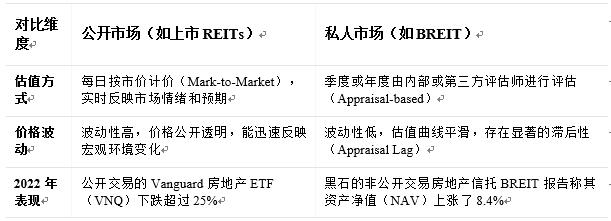
Cathie sharply questions the logical absurdity of such a huge performance disparity. The intrinsic value of the same commercial real estate (office buildings, shopping malls) cannot change so drastically simply because its ownership structure is publicly traded or private. She argues that the smoothed valuations in the private market are more like a carefully maintained "illusion," providing a better customer experience when the market is rising, but masking the true decline in asset value during market downturns and giving investors a false sense of security.
"The public market is honest; it forces you to face reality every day, no matter how harsh. The private market, on the other hand, allows you to live in a beautiful lie before a crisis arrives. But when liquidity dries up and investors want to rush out, the lie is ruthlessly exposed. What we are seeing now is the moment when the lie begins to crumble."
Conclusion: Cathie's warning about private lending reflects a profound rethinking of the "alternative investment" boom fueled by global central bank easing over the past decade. She argues that in the relentless pursuit of high yields, the market has systematically underestimated liquidity and valuation risks. With the continued high-interest-rate environment, the cracks in the private lending market will widen, and more unscrupulous entities will emerge, potentially triggering a chain reaction and threatening the broader financial system. This also reaffirms ARK's investment philosophy of focusing on highly liquid, publicly traded, disruptive innovative companies, because in a crisis, the ability to "sell" is itself a priceless value.
Chapter 3: Claude AI's "PC Moment" and the Singularity of the Productivity Revolution
After revealing the potential risks to the macroeconomy, Cathie turned the conversation to what excites her most and is at the heart of the ARK investment universe—technological innovation, particularly artificial intelligence. She shared a powerful real-world example from within the ARK finance team, vividly illustrating how Anthropic's Claude 3 series of AI models brought about a "PC moment" comparable to the birth of the personal computer (PC), and based on this, predicted an upcoming productivity explosion that will reshape the global economy.
3.1 "Six months' work done in minutes": A worldview-changing moment
The protagonist of the story is an employee on ARK's finance team, who is neither a programmer nor an AI expert. Over the past six months, he had accumulated a backlog of tedious and time-consuming financial reporting, data analysis, and automation tasks. In one experiment, he decided to give these tasks a try and dumped them all on the Claude 3 Opus model.
The results shocked and delighted the entire team:
• A leap in speed: Projects that were originally expected to take months to code, test, and complete were all processed by Claude in just a few minutes. This is not a 10% or 20% efficiency improvement, but a speedup of thousands or tens of thousands of times.
• Stunning output quality: The output goes beyond just runnable code or raw data; it includes beautifully formatted charts and tables ready for presentation reports. The model not only accomplishes its task but also optimizes the presentation.
• Amazing accuracy: The team members manually checked the calculations with disbelief, including basic addition and subtraction as well as complex percentage calculations, and the results were completely correct without any omissions.
"Our team was stunned. It was like when we first saw VisiCalc (the world's first spreadsheet software) running on the Apple II in the 80s. Before that, financial analysts would spend days building models with paper, pen, and calculators. VisiCalc reduced that process to minutes. You know, at that moment, you realize the world is going to change. That was a real PC moment, a moment when productivity tools went from 'toys' to 'weapons'."
This case vividly demonstrates the qualitative leap that has occurred in the capabilities of Large Language Models (LLMs). It is no longer merely a chatbot or information retrieval tool, but a powerful, general-purpose productivity engine capable of understanding complex, multi-step tasks and generating high-quality, structured, and actionable output. This signifies that AI is beginning to truly empower every white-collar worker, regardless of their technical background.
3.2 The "Illusion" of the Employment Report and the "Truth" of Productivity: Unraveling the Mystery of Macroeconomic Data
Cathie demonstrated her unique ability as a macro-thinker by connecting this micro-level observation to a huge "puzzle" in macroeconomic data—the U.S. Bureau of Labor Statistics (BLS) employment data has been frequently and significantly revised downward over the past year.
She points out that while the monthly nominal job growth figures (especially those from institutional surveys) appear robust, subsequent revisions and cross-validation with household survey data reveal that actual job growth is far less optimistic. However, at the same time, U.S. real GDP growth has maintained remarkable resilience. There exists a clear contradiction between these two phenomena that cannot be explained by traditional economic theory.
Cathie's explanation: A "quiet" productivity revolution
The only plausible explanation is that productivity has achieved an unexpected and explosive growth. That is, with fewer people, and even with layoffs in some sectors, the same or even more economic output has been achieved. And the unsung heroes behind this "quiet" productivity revolution are artificial intelligence, represented by Claude and GPT-4.
“If you revise down employment figures but keep GDP unchanged, the only mathematical result is that productivity must rise. This is not speculation; it’s an accounting identity. We believe that AI is penetrating every corner of the economy in unprecedented and silent ways, from software development to customer service to financial analysis, and macroeconomic data is only just beginning to capture the tip of the iceberg of this massive transformation.”
ARK's research predicts that, thanks to the convergence and synergy of five major innovation platforms—AI, robotics, blockchain, gene sequencing, and energy storage—the average annual productivity growth rate in the United States is expected to leap from the mediocre 1-2% level of the past few decades to a "supersonic" range of 4-6% or even higher. This will be a game-changing macroeconomic backdrop, implying higher non-inflationary economic growth, lower neutral interest rates, and explosive growth in corporate profits.
3.3 The Power of Deflation: A Paradigm Shift from "Bad Deflation" to "Good Deflation"
This technology-driven productivity revolution also forms the core pillar of Cathie's controversial yet unwavering "deflationary" theory. She repeatedly emphasizes that markets and the Federal Reserve must learn to distinguish between two fundamentally different types of deflation:
• Bad Deflation: Caused by a collapse in aggregate demand, such as the Great Depression of the 1930s. It manifests as a vicious spiral of falling prices and wages, massive bankruptcies, and soaring unemployment; it is a cancer of the economy.
• Good deflation: Caused by technological progress and rapid cost reduction. It manifests as a decrease in the price of goods and services, while their quality, functionality, and accessibility significantly improve. Consumers' actual purchasing power increases, and corporate profit margins expand due to increased efficiency and market growth. The electrification of the late 19th century and the internet revolution of the late 20th century both brought about such "golden ages."
Cathie firmly believes we are at the dawn of an unprecedented era of "good deflation" led by AI. According to ARK's model, AI training costs are decreasing at a rate of 75% annually, while inference costs are declining at an even more dramatic rate. This will unleash a massive wave of innovation and disruptively impact the cost structures of all traditional industries.
In conclusion, Cathie's optimism about AI goes far beyond simply praising a new technology; she examines it within a grand historical and economic framework. She believes AI is the singularity that will ignite the next Kondratiev wave (a technological economic paradigm), a key force in mitigating the "bad deflation" caused by debt cycles and bringing about "good deflation" that fosters prosperity, and the cornerstone of ARK's entire investment strategy. For investors, understanding this means shifting their focus from short-term macroeconomic fluctuations and interest rate games to disruptive innovation companies that can position themselves favorably in this long-term trend and exponentially reduce costs and create value.
Chapter 4: A "Contrarian Indicator" for Macro Markets — A Disruptive Asset Outlook
In the final part of the meeting, Cathie once again offered a series of "contrarian predictions" for key macro assets such as the US dollar, yield curve, gold, and Bitcoin, which differed significantly from the mainstream market consensus. These predictions, seemingly isolated, are in fact all unified under her macro worldview of "technology-driven, deflationary".
$4.1: From "Collapse Theory" to "Return of the King"
In recent years, with the US federal debt exceeding $34 trillion and the global call for "de-dollarization" growing louder, the "dollar collapse theory" has become almost a mainstream narrative. However, Cathie firmly believes that the dollar will not only not collapse, but may instead experience a strong bull market in the coming years, surprising all the short sellers.
Her logic is rooted in an analysis of comparative advantage in the global economy:
1. Relative Economic Performance: The Cleanest Dirty Shirt: Cathie uses the classic "cleanest dirty shirt" metaphor. She argues that despite its own numerous problems, the US's leading position in key innovation areas such as AI and blockchain is overwhelming compared to Europe and Japan, which face severe aging populations and structural rigidities, and China, which is undergoing a difficult economic transformation and a real estate crisis. This innovative vitality will continue to attract the world's best talent and smartest capital, providing solid fundamental support for the US dollar.
2. Safe-haven demand in a deflationary environment: If the global economy, as ARK predicts, enters a technology-driven "good deflation" or low-inflation environment, the opportunity cost of holding cash (especially the US dollar as the global reserve currency) will be significantly reduced, and its real purchasing power may even increase. During periods of heightened uncertainty, global demand for safe, highly liquid assets will increase, and the US dollar and US Treasury bonds will remain the undisputed top choice. The "safe-haven" attribute of the US dollar will once again be highlighted.
3. Interest Rate Differentials and Capital Flows: Although the market widely expects the Federal Reserve to begin cutting interest rates in the second half of 2026, Cathie believes that due to the relative strength of the US economy and better-than-expected productivity growth, the magnitude and speed of rate cuts may be lower than market expectations. Compared to other major economies (such as the European Central Bank and the Bank of Japan), the US interest rate level may remain relatively advantageous for some time to come, which will continue to attract arbitrage capital inflows into dollar assets.
4.2 Yield Curve: The Inverted "New Normal" and Historical Lessons
For a long time, an inverted yield curve (where short-term Treasury yields are higher than long-term Treasury yields) has been considered the most reliable warning sign of an economic recession. However, since mid-2022, the US Treasury yield curve has remained deeply inverted, but the predicted severe recession has yet to materialize, leaving many economists and market participants puzzled.
Cathie put forward a highly disruptive hypothesis: in a technology-driven era of "good deflation," an inverted yield curve may become the new normal, or even a sign of economic health, rather than a harbinger of recession.
Her historical basis is the period from the late 19th century to 1929. During the First Technological Revolution, driven by electricity, telephone, and the internal combustion engine, the US economy experienced decades of rapid growth and sustained "good deflation." During that "Gilded Age," the US yield curve was inverted for most of the time, averaging an inversion of about 100 basis points. Cathie explains that the logic behind this is:
• Short-term interest rates reflect strong nominal GDP growth and high rates of return on capital driven by technological revolution.
• Long-term interest rates reflect market expectations of prolonged deflation (or extremely low inflation) in the future.
Cathie believes we are entering a remarkably similar era. Technologies like AI will exert persistent deflationary pressures, suppressing long-term interest rates; while robust productivity growth will support higher short-term interest rates and economic dynamism. Therefore, a persistent yield curve inversion may no longer be a sign of recession, but rather a unique macroeconomic marker of innovation-driven prosperity.
4.3 Gold and Bitcoin: The Transfer of Power as a "Store of Value"
Regarding safe-haven assets, Cathie reiterated her strong preference for Bitcoin relative to gold. She believes that the primary driver of gold's rise in 2025 will not be ordinary investors seeking an inflation hedge, but rather strategic purchases by sovereign nations (particularly China and Russia) driven by deep concerns about the weaponization of dollar assets (such as freezing Russia's foreign exchange reserves). This is a geopolitically driven safe-haven behavior.
However, for individual and institutional investors, Cathie believes Bitcoin is a far superior long-term store of value compared to gold. She presents a key comparative framework:

“Bitcoin is a peaceful revolution. It is quietly completing a power transfer from analog to digital value storage. For the younger generation who have grown up in the internet and digital world, they are more willing to believe in the certainty of mathematics and code than in the promises of any centralized institution or government.”
ARK's research shows that adding a small amount of Bitcoin (1% to 5% of a portfolio) to a traditional 60/40 stock/bond portfolio can significantly improve the Sharpe ratio (risk-adjusted return) without significantly increasing risk. Cathie calls Bitcoin "digital gold" and the ultimate "financial insurance," a strategic allocation that every investor should consider.
Chapter 5: Conclusion and Investment Implications — Finding the Future Amidst Disruption
Cathie Wood's March market insights painted a unique yet logically sound and self-contained picture of the future. In this vision, technology is the primary driver of history, deflation is the long-term underpinning of the economy, and disruption is the only constant theme. Ultimately, the prices of all assets will be reassessed around these first principles.
For investors hoping to navigate the market's uncertainties and grasp the pulse of the times, the following key insights can be gleaned:
1. Embrace volatility while focusing on a five-year long-term future: ARK's investment philosophy requires investors to possess exceptional psychological resilience and cognitive fortitude, capable of withstanding significant short-term volatility and market criticism in exchange for exponential returns over a five-year investment cycle. Don't be swayed by short-term noise such as geopolitics or monthly inflation data; instead, focus on long-term technological trends that can exponentially change the world.
2. Beware of "value traps" and seek "super power-law" growth in "growth oases": In the face of disruptive innovation, many seemingly cheap and reasonably valued leading stocks in traditional industries are actually fatal "value traps." They face the risk of being overwhelmed by new technologies and business models. The real opportunities lie in innovative companies that are creating new markets and defining new rules, even if their short-term valuations seem high. The essence of investing is to find the very few winners in these "growth oases" who can achieve "super power-law" growth.
3. Establish a completely new macroeconomic analysis framework: We may be at a historic turning point in a macroeconomic paradigm shift. Economic principles that have been considered definitive for decades (such as the Phillips curve and the indicative significance of the yield curve) may be losing their effectiveness. Investors need to establish a new analytical framework, one that incorporates technological innovation (and the resulting cost reduction curve and productivity explosion) as a core variable.
4. Viewing Bitcoin as an indispensable strategic asset: Regardless of whether one fully agrees with all of Cathie's arguments, allocating Bitcoin as a strategic asset independent of the traditional financial system and possessing "financial insurance" attributes is moving from the periphery to the mainstream. In a world full of uncertainty, the value of holding an asset that is not controlled by any single entity and has absolute scarcity will become increasingly prominent.
Ultimately, what Cathie Wood and her ARK Invest represent is an almost religious belief in the future. This belief has made them legendary in bull markets and has also caused them immense suffering in bear markets. But no matter how the market changes, they always adhere to their first principle: investing in disruptive innovation is investing in the future itself. For each of us living in this era of great change, understanding their thinking, whether we agree or disagree, will be a valuable cognitive upgrade.
WeChat: battle000000

References
1. ARK Invest. (2026, March 8). In the Know With Cathie Wood: Iran, Private Credit, Claude, and More. YouTube. https://www.youtube.com/watch?v=Q2gBVQ7NqyY
2. ARK Invest. (2026, January 15).Cathie Wood's 2026 Outlook: The US Economy Is A Coiled Spring. https://www.ark-invest.com/articles/market-commentary/cathie-woods-2026-outlook
3. ARK Invest. (2026). BIG IDEAS 2026. https://ark-invest.com/big-ideas-2026/
4. Benzinga. (2026, March 8). Cathie Wood Warns Of 'Cracking' Confidence In $2 Trillion Private Credit Market. https://www.benzinga.com/markets/private-markets/26/03/51144971/cathie-wood-warns-of-cracking-confidence-in-2-trillion-private-credit-market
5. MIT Sloan Management Review Middle East. (2026, March 9). Claude AI Can Do Months of Work in Minutes, Says Ark Invest's Cathie Wood. https://www.mitsloanme.com/article/claude-ai-can-do-months-of-work-in-minutes-says-ark-invests-cathie-wood/
6. Yahoo Finance. (2026, March 8). Cathie Wood warns oil could plunge 50%. https://sg.finance.yahoo.com/news/cathie-wood-warns-oil-could-160138642.html