
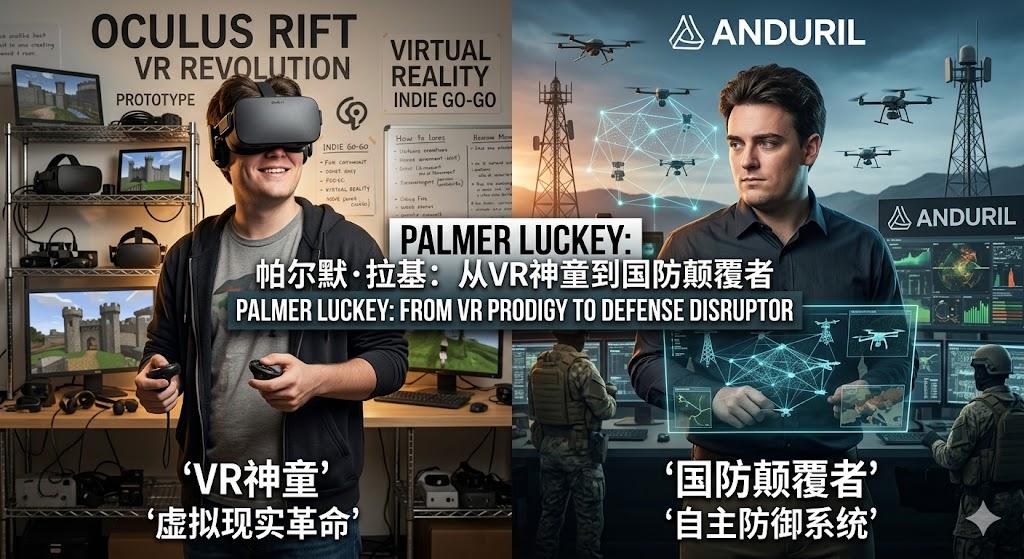
Introduction: When Silicon Valley "heretics" stormed the Pentagon
In October 2025, when Palmer Luckey, dressed in a Hawaiian shirt and flip-flops, once again sits in Joe Rogan's podcast room, he will no longer be the Silicon Valley golden boy known merely as the "founder of Oculus VR." More than a decade has passed since he sold his garage-born VR (virtual reality) company to Facebook for a staggering $2 billion. Now, he returns with a new and more controversial identity—the founder of defense technology company Anduril Industries, an "intruder" attempting to completely disrupt the US and even global defense industry with Silicon Valley's speed, efficiency, and mindset.
This three-hour dialogue was far more than a simple clash between technology and military strategy. It unfolded like a gradually revealing panorama of history, depicting how a highly gifted "outsider" transformed from a builder of virtual worlds into the creator of some of the deadliest weapons in the real world. The conversation spanned the evolution of VR, the chronic problems of defense procurement, the future of great power competition, the landscape of AI warfare, and even extended to profound metaphysical realms such as UFOs, extraterrestrial life, human consciousness, and "simulation theory." Logan's open-ended questions and Luckey's candid and unreserved answers combined to create a highly information-dense and intellectually stimulating brainstorming session.
This article aims to provide a systematic and structured in-depth analysis of this interview. We will not merely relay the content of the conversation, but strive to uncover the underlying logic, insights, and warnings. The notes will be divided into five chapters, starting with Palmer Luckey's legendary personal experiences, gradually delving into his revolutionary vision for the defense industry, his predictions of future warfare, his unique insights into Sino-US geopolitics, and his profound reflections on technological ethics and the future of humanity. Through detailed chapter analysis, tabular presentation of key information, and extraction of core viewpoints, this note will strive to present readers with a complete, multifaceted, and controversial portrait of Palmer Luckey, and reveal what the "defense revolution" he led means for our time.
“My goal in founding Anduril is to save taxpayers hundreds of billions of dollars every year.” — Palmer Luckey [1]
This opening declaration is both Luckey's ambition and the key to understanding all his actions. He is challenging a behemoth comprised of century-old giants, rigid bureaucracy, and inefficient processes—the "military-industrial complex." He is relying on disruptive innovation based on first principles, a method already proven in the VR field. This note will take you into the inner world of this "Quentin Tarantino of the defense industry," witnessing a disruptive transformation underway that concerns national security and the future.
Chapter 1: From the Garage to the Metaverse —The Origin and Evolution of the VR Revolution
Before delving into Anduril's grand vision for defense, we must first trace Palmer Luckey's origins—Oculus VR. This is not only because Oculus's success provided him with the capital and prestige to launch Anduril, but more importantly, his growth experience, technological philosophy, and innovative methodology in the VR field were almost entirely replicated in his venture into defense technology. Understanding Oculus is key to understanding the origins of Anduril's methodology.
1.1 "The world's best head-mounted display designer"
At the start of the conversation, Luckey unabashedly declared himself "the world's best head-mounted display designer, bar none." This confidence was not unfounded; it stemmed from the remarkable talent and focus he displayed from a young age.
• A child prodigy: Luckey started tinkering with VR headset prototypes in his garage at the age of 14, and by 16 he had created the first version of the Oculus Rift. He was obsessed with disassembling, modifying, and optimizing various electronic devices, and had a huge private collection of electronic components, which laid the material foundation for his rapid iteration and prototyping in the future.
• A stroke of goodwill: His talent quickly caught the attention of legendary programmer John Carmack, co-founder of id Software (developers of Doom and Quake), in niche VR enthusiast forums. After testing Luckey's prototype, Carmack praised it on his blog as "the best VR experience the world has ever seen," an endorsement that propelled Luckey and Oculus into the spotlight. Subsequently, Carmack resigned from id Software to join Oculus as Chief Technology Officer (CTO), working alongside his "idol," a story that became legendary in Silicon Valley.
• Entrepreneurship and Acquisition: At 18, Luckey officially founded Oculus; at 19, the product was officially launched. A few years later, Facebook (now Meta) acquired the young company for a staggering $2 billion (plus a follow-on payment of $1 billion). This event is considered a landmark moment in VR technology's transition from a geek toy to the mainstream consumer market, and it also brought Luckey enormous wealth.
This experience reveals several key elements of Luckey's success: extreme passion and focus, deep technical expertise, an unwavering pursuit of first principles (not content with existing solutions, but creating from scratch), and the ability to leverage community and network effects to amplify his influence. These qualities reappeared in his later defense entrepreneurship.
1.2 The Cambrian Explosion of VR: From Gaming to Fitness
In the interview, Luckey and Logan spent a considerable amount of time discussing the evolution of VR technology in the fields of gaming and fitness. This was not only a review of the past, but also a foreshadowing of the broad prospects of VR as a general-purpose technology platform.
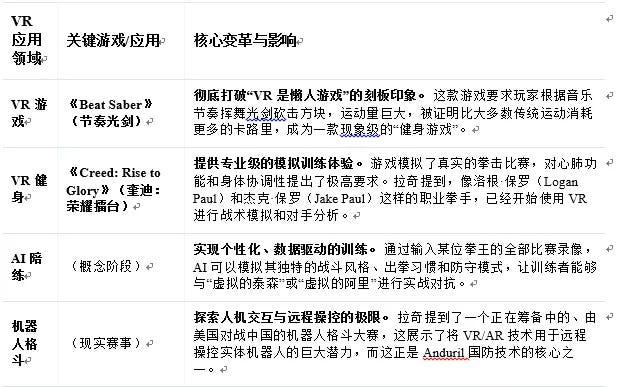
This discussion reveals that Luckey's understanding of VR goes far beyond its role as a mere entertainment device. He views it as an "extension of the body" and a "sensory proxy." Whether it's exercising through VR or controlling robots in combat, the essence is projecting human intentions and actions into the virtual or physical world with unprecedented fidelity. This concept of "human-machine integration" forms the philosophical foundation for his subsequent designs of the "EagleEye" soldier helmet and AI-powered unmanned combat aircraft.
1.3 From “Floating Computation” to Sensory Deprivation: An Exploration of the Ultimate Immersion
The conversation begins with a seemingly far-fetched "weird story": a friend of Lucky's is trying to build an "underwater floating computing device" — programming in a saltwater-filled floating tank using a waterproof keyboard, mouse, and VR headset.
This seemingly crazy, geeky idea led to Luckey's ultimate reflection on "immersion." He believes that if it's impossible to perfectly simulate all the sensations the body experiences in a virtual world, then the best compromise is to "make you forget the existence of your own body."
• Sensory deprivation: The flotation chamber eliminates the sense of touch and gravity through salt water at the same temperature as human skin. Sight and hearing are also deprived in the dark and quiet environment.
• VR Takeover: In this state of "sensory vacuum," VR devices can completely take over your visual and auditory input, thereby creating an unprecedented and purely immersive experience.
Logan added from a neuroscience perspective that the human brain is constantly processing various inputs from the environment (posture, the feel of clothing, spatial distance, etc.), all of which consume a significant amount of "background computing power." By shielding these inputs, the floating pod greatly frees up the brain's cognitive resources, allowing it to focus more on thinking and creation.
This brief but crucial topic reveals that Luckey's pursuit of technology has penetrated to the "neural" and "conscious" levels. He is not content with simply creating a virtual world that "looks" like one; he attempts to fundamentally "deceive" or "bypass" the human sensory system to achieve the most complete human-machine integration. This relentless pursuit of fundamental principles is precisely his core competitive advantage that enables him to disrupt traditional industries.
From a teenager soldering circuit boards in a garage to a billionaire contemplating programming in a floating pod, Palmer Luckey's first chapter is filled with legendary tales. However, as he shifts his focus from building virtual worlds to the battlefields of the real world, a larger and more dangerous storm is just beginning to brew.
Chapter Two: The Anduril Revolution — Overthrowing the Military-Industrial Complex
If Oculus's success was Palmer Luckey building a new virtual world with code and hardware, then the founding of Anduril was his attempt to reshape an outdated, bloated, and extremely inefficient physical world—the US defense industry—using the same methodology. In interviews, he made no secret of his disdain for the industry and his ambition to replace it. This chapter will delve into Anduril's revolutionary concepts, business model, and its impact on traditional defense giants.
2.1 "Saving money for taxpayers": Entrepreneurial motivation based on first principles
Luckey repeatedly emphasized that his primary goal in founding Anduril was to "save taxpayers hundreds of billions of dollars annually." This was not just a public relations statement, but a conclusion he reached after in-depth observation of the defense procurement system. He believed that the existing system had fundamental structural flaws, leading to enormous waste of resources.
• Cost-driven vs. Demand-driven: The traditional business model of defense contractors is essentially "cost-plus." The government sets a vague requirement, and contractors drive up the total project cost by constantly increasing R&D personnel, extending development cycles, and piling on complex features, because their profits are directly tied to costs. This results in countless expensive "golden toilet" projects—products that are costly, bulky, and often fail to meet actual battlefield needs.
• Anduril's Model: Luckey took the opposite approach. Anduril employed a Silicon Valley-common "in-house R&D, fixed price, product-oriented" model. The company invested its own R&D funds to quickly develop products that met specific operational needs, and then sold them to the government at a fixed, highly competitive price. This model forced the company to pay extreme attention to cost control and development efficiency, as any cost overruns would directly erode its profits.
"(In the traditional model) the more people you hire and the longer it takes, the more money you make. This goes against the principle of delivering high-quality products quickly and efficiently. Our model is that we invest hundreds of millions of dollars upfront, and if no one buys what we make, we're finished." — Palmer Luckey
• “Killing” Failed Projects: Lage praised the courage of reformist officials, including the new Secretary of the Army, Dan Driscoll. They began publicly halting costly and ineffective projects, such as the multi-million dollar “robotic vehicles” that were easily destroyed by drones costing only a few hundred dollars each. This shift in the upper echelons created historic opportunities for “intruders” like Anduril.
2.2 "Software-Defined Hardware": The Devastating Impact of Silicon Valley Methodology
Anduril's disruption of the defense industry lies in placing "software" at the core of its designation like never before. Traditional weapon platforms (such as aircraft and tanks) are hardware-driven, with software merely an adjunct to the hardware, resulting in lengthy and expensive upgrade cycles. Anduril, on the other hand, views weapon systems as "platforms where hardware serves software."
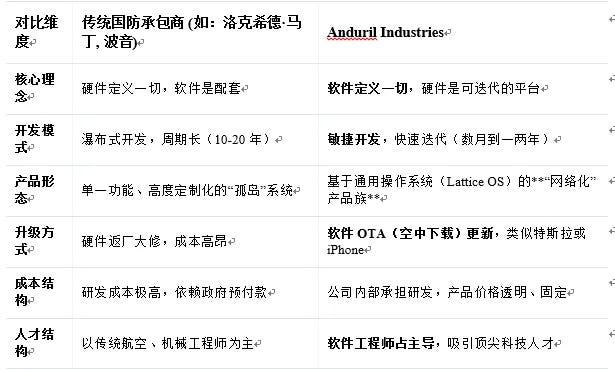
Lattice OS: Android's equivalent of Android
Lattice is the underlying operating system for all Anduril products; it's like a military version of "Android" or "iOS." It's an AI-based command and control platform that can fuse data from different sensors (radar, cameras, drones, satellites) onto a unified battlefield situation map and autonomously perform target identification, threat assessment, and task allocation.
• Interoperability: Any device connected to the Lattice system, whether it's Anduril's own drones or the military's existing F-35 fighter jets, can become a node in the network, enabling real-time information sharing and collaborative operations.
• Autonomy: Lattice can automatically process massive amounts of information, push the most critical intelligence to human commanders, and even autonomously control weapon systems to intercept or attack under authorization, greatly shortening the time of the "Observe-Judgment-Decision-Action" (OODA) cycle.
This "software-defined hardware" model allows Anduril to launch generation after generation of smarter and more powerful weapon systems at a speed and cost unmatched by traditional defense giants. This is a classic example of "dimensional reduction attack".
2.3 "Don't let tech CEOs decide foreign policy"
When discussing Anduril's business model, Larch clearly drew a red line: technology companies should focus on technology development, while the decision-making power on national security and foreign policy must and can only be in the hands of elected governments.
He strongly opposes a tendency toward "corporatocracy," where CEOs of large technology companies decide which countries to sell weapons to or under what circumstances to use them.
"Do you want a world where tech CEOs decide foreign policy?... That's the most cyberpunk, the most dystopian thing I can imagine. You can't vote them out." — Palmer Luckey [1]
He believes that Anduril's role is to provide the government with the most advanced, reliable, and economical tools, and how these tools are used is entirely up to the government to decide based on national interests and the legal framework. This clear division of responsibilities is both a respect for democratic institutions and a shrewd business strategy, allowing Anduril to avoid getting embroiled in complex political turmoil and focus on its core competency: technological innovation.
By combining Silicon Valley's innovative model with a deep understanding of national security needs, Anduril is reshaping the defense industry landscape. It's not just a company, but a movement—a revolution aimed at using efficiency, transparency, and the power of software to combat a century-old network of powerful and entrenched vested interests.
Chapter 3: Future Warfare Vision — AI Swarms, Smart Helmets, and the "China 27" Rule
Palmer Luckey's vision for future warfare doesn't remain at the level of abstract theory; rather, it's embodied in concrete, deployable weapon systems through Anduril's product line. In a conversation with Logan, he vividly depicted a future battlefield landscape comprised of AI, unmanned systems, and super soldiers. Behind all of this lies a clear and urgent strategic guiding principle—the "China 27" rule.
3.1 The "China 27" Rule: Prepare for the Worst-Case Scenario
The "China 27" rule is the highest strategic principle guiding all of Anduril's R&D activities. Its core principle is that all systems developed by the company must assume that China will take action against Taiwan in 2027, and ensure large-scale deployment and combat readiness by then.
• Strategic urgency: Lachish argues that setting the R&D cycle beyond 2030 is pointless, as it may be too late. He points out that Chinese leaders face a fleeting "political window" and increasingly serious demographic and economic problems, making the motivation to resolve the Taiwan issue in the short term exceptionally strong.
• The "boiling frog" blockade strategy: He predicts that China is most likely not to adopt a direct military invasion, but a gradual, comprehensive blockade disguised as civil law enforcement. For example, it could impose customs controls on ports under the pretext that "Taiwanese exported goods are not properly labeled with their country of origin," and then gradually escalate to a comprehensive blockade of airspace and sea areas, slowly strangling Taiwan's economy and supply of goods until it surrenders without a fight.
• Designed for “tomorrow’s” wars: Based on this assessment, Anduril focuses on developing weapon systems that can be rapidly and mass-produced and effectively counter blockade and area denial strategies. This contrasts sharply with traditional defense giants’ penchant for developing long-cycle, high-cost “decisive weapons” (such as aircraft carriers).
3.2 Anduril's "Trident": Reshaping Land, Sea, and Air
In the interview, Larch detailed Anduril's core products, which together form a "trident" for dealing with future conflicts.
1. FQ-44 "Banshee" in aerial combat against AI
• AI-powered Unmanned Combat Aircraft: Anduril beat Boeing and Lockheed Martin to win a contract with the U.S. Air Force to develop its first truly AI-powered unmanned combat aircraft. This aircraft is capable of operating in conjunction with human pilots, performing reconnaissance, electronic warfare, and even air-to-air combat missions.
• Revolutionizing Air Combat: Luckey points out that unmanned aircraft have completely changed the tactical manual of air combat. Without the need to consider the physiological limits of pilots (such as G-force tolerance) and their safety, AI fighters can perform a variety of "suicidal" high-risk maneuvers, such as turning at G-forces far exceeding human limits, or deliberately entering a stall spin during dogfights to shake off their opponents. "All these tactics are on the table…autonomy changes the game."
2. The Barracuda cruise missile and its mass production
• Designed for production: The Barracuda is a low-cost, mass-producible cruise missile. Its core design philosophy is "designed for existing factories, not for the perfect factory you wish you had." It has 90% fewer parts than traditional missiles and requires only 10 common tools found in any car manufacturing plant for assembly.
• The shift in strategic deterrence: This means that, in the event of a conflict, the United States could rapidly and massively produce Barracuda missiles in auto factories like those used for tank production during World War II. This would fundamentally change the logic of deterrence—deterrence would no longer depend solely on how many expensive missiles you have "stockpiled," but rather on how quickly you can "produce" an overwhelming number of missiles.
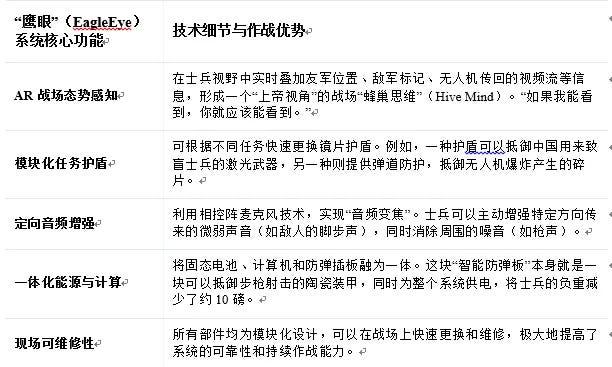
3. The EagleEye Helmet and Super Soldiers
"Hawkeye" is a personal combat head-mounted display system designed by Luckey himself, intended to replace Microsoft's failed IVAS project. He proudly proclaims himself "the world's best head-mounted display designer," having successfully resolved all the core flaws of the IVAS project.
“If you are concerned about the ethics of weapons, then you should be studying them. Outsourcing this work to people who have no moral concerns does not give you any moral high ground.” — Palmer Luckey [1]
Through the "Eagle Eye" system, Luckey not only demonstrated his profound expertise in the VR/AR field but also conveyed a deep ethical perspective: those who truly care about technological ethics should not shirk their responsibilities but actively engage in it to ensure that technology is used for just and righteous purposes. This provides a strong moral justification for his involvement in the defense industry.
From the top-level strategy of "China 27" to specific products such as AI fighter jets, mass-produced missiles, and super soldier helmets, Anduril is building a complete, closed-loop, and highly collaborative future warfare system. At the core of this system are software, data, and AI, foreshadowing a fundamental transformation in warfare comparable to the shift from cold weapons to gunpowder.
Chapter Four: Geopolitical and Cultural Observations — "The World's Arsenal" and "Ideological Weapons"
Palmer Luckey's thinking extends far beyond technology and business. In his conversation with Logan, he demonstrated keen insights into global geopolitics, the industrial strength of major powers, and cultural differences. He believes that future competition will not only be a contest of military hardware, but also a comprehensive battle of industrial production capacity, national will, and ideologies.
4.1 “World Policeman” vs. “World Arsenal”: The Repositioning of U.S. National Strategy
Lachle offered sharp criticism of current U.S. diplomatic and military strategy. He argued that the U.S. attempt to play the role of "world policeman" is not only costly and ineffective, but also strategically unsustainable. He proposed a clear alternative: the U.S. should cease acting as "world policeman" and instead become "the world's gun store."
• Core logic: Rather than sending American troops (boots on the ground) to distant battlefields after a conflict breaks out, it's better to provide allies with sufficiently advanced and numerous weapons before conflict occurs, enabling them to defend themselves. This not only significantly reduces the military and political risks for the United States but also more effectively deters potential aggression.
• Lessons from Arms Sales to Taiwan: Using Taiwan as an example, he pointed out that the delivery of promised weapons by the United States has been delayed for many years, resulting in Taiwan's defense capabilities being unable to materialize in time. He believes that this "empty promises" approach actually encourages aggressors to seize the window of opportunity and take action.
The essence of deterrence: The strategy of "becoming the world's arsenal" is essentially about transforming America's industrial capabilities into a more reliable and cost-effective deterrent. It sends a clear signal to potential adversaries that any act of aggression will face a heavily armed and well-prepared defender, thus significantly increasing the cost of aggression and the risk of failure.
4.2 The Contest of Industrial Bases: From Automobiles to Aircraft Carriers
Larch keenly recognized that the outcome of modern warfare ultimately depends on a nation's industrial base. He issued a stern warning by comparing the manufacturing strengths of China and the United States.
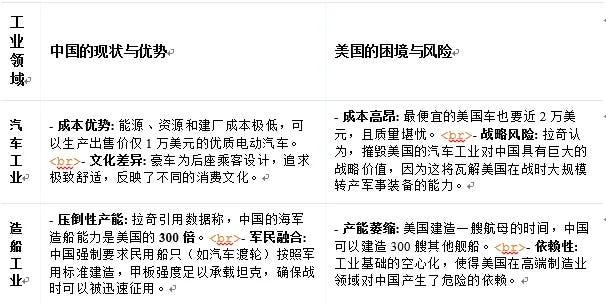
"China has 300 times more naval shipbuilding capacity than the United States." — Palmer Luckey [1]
This striking data comparison reveals the core of Lachish's anxiety: technological advantages in hardware, if they cannot be translated into economies of scale in production, will become meaningless in a protracted war of attrition. This is why he made "mass production in automobile factories" a core design criterion when designing the Barracuda missile.
4.3 Theories of "Ideological Weapons" and "Death Internet"
According to Larch, what is more powerful and disruptive than hardware weapons are "ideological weapons"—the ability to influence the will of enemy citizens and soldiers through propaganda, information control, and psychological manipulation.
• A Lesson from Russia: He shared a startling anecdote from the early days of the Russo-Ukrainian War. Many Russian pilots sent to Ukraine were told they would be welcomed as "liberators" by the Ukrainian people, and even given a grand military parade. One downed helicopter pilot had a dress, a pair of ballet shoes, and 50 condoms in his luggage, believing he would be wildly popular with local women. This darkly humorous story profoundly reveals the terrifying power of a state propaganda machine, capable of even allowing highly educated elite pilots to live in a completely fabricated reality.
• America's "Self-Reflection": Lach also bluntly pointed out that the United States made similar mistakes in the Middle East wars, "peddling" a false narrative about "liberation" and "democracy" to its soldiers and the public. "It's easy for us to laugh at that stupid Russian soldier, but we ourselves are no better."
• The "Dead Internet Theory": Looking to the future, he believes this information warfare will escalate further. He mentions the "Dead Internet Theory," which states that in the near future, the vast majority of public content on the internet—forum posts, social media comments, news articles—will be generated by AI bots, rather than posted by real people. "Ultimately, there will be almost no real human interaction on the internet; only bots arguing with each other." This AI-dominated public opinion environment provides unprecedented convenience for state-level psychological manipulation and cognitive warfare.
• Cultural Differences and Speech Control: He also observed significant differences in how different cultures view freedom of speech. In the UK, tens of thousands are arrested each year for making "offensive" comments about immigration on social media, while the majority of the British public remains indifferent or even supportive. In China, most people consider discussing sensitive historical events from over thirty years ago to be "making trouble out of nothing." These cultural differences make Western societies particularly vulnerable to information warfare from authoritarian states.
Larch's observations expanded the concept of war from the physical space to the cognitive and cultural spaces. He warned that if a country loses its strong industrial base and is simultaneously infiltrated and manipulated ideologically by an enemy, even the most advanced weapons cannot save it from ultimate defeat.
Chapter 5: Beyond Military Industry — UFOs, AI Companions, and the Ultimate Future of Humanity
If the first four chapters portray a pragmatic, tough, and national security-focused defense entrepreneur, then in the final part of the dialogue, Palmer Luckey reveals another side of himself as a "Silicon Valley prodigy": an explorer filled with curiosity about the ultimate questions of the universe, life, and consciousness. His discussion with Logan, ranging from UFO sightings to animal communication, gene editing, and simulation theories, adds a strong science fiction and philosophical dimension to this hardcore military technology dialogue.
5.1 UFOs, USOs, and "Detachment from Civilization"
As a defense expert with top-notch military technology and information channels, Larch's views on UFOs (Unidentified Flying Objects)/UAPs (Unidentified Anomalous Phenomena) are particularly noteworthy.
• Multiple Sensor Confirmation: He is skeptical of most UFO footage because signals from a single sensor (such as a camera or radar) are easily faked or caused by equipment malfunction. However, he showed great interest in a video of a Hellfire missile presented at a recent congressional hearing because the event was confirmed by multiple sensors: the camera saw the target, the missile's seeker locked onto the target, and the missile did indeed detonate. This makes the event far more credible than ordinary eyewitness reports.
• USO (Unidentified Submersible Object): Latch shared more sighting reports of "Unidentified Submersible Objects" from the waters near Catalina Island, California. These reports come from witnesses from different eras and backgrounds (including Navy personnel), but the descriptions are strikingly consistent: an unidentified object plunges into the sea at extremely high speeds and steep angles, and "seamlessly" changes shape in the air and water without any deceleration or splash.
• “The X-Files After Retirement”: He joked that his ideal after retirement is to become a self-funded “X-Files” investigator, using his wealth and skills to unravel these ultimate mysteries that plague humanity.
• The “Breakaway Civilization” Hypothesis: The dialogue also touched on some more subversive theories, such as whether there exists a “Breakaway Civilization” that possesses technology far beyond our current level? Are the “Chariots of the Gods” in ancient mythology relics of prehistoric high technology? These imaginative discussions reflect Larch’s ongoing exploration of the boundaries of human knowledge.
5.2 Animal Enhancement Program and Interspecies Communication
Luckey's thirst for exploration didn't stop at extraterrestrial civilizations; he also turned his attention to our closest "neighbors" on Earth—animals. He revealed that he had actively lobbied the renowned XPRIZE Foundation to establish an "Uplift" award, aiming to enhance animal intelligence through technologies such as gene editing, enabling them to engage in meaningful communication with humans.
• XPRIZE for Interspecies Communication: While the "Animal Advancement" initiative was shelved due to its ethical controversies, a more moderate version—the "Interspecies Communication" award—is on the horizon. This award aims to utilize AI technology to decode the "language" of highly intelligent animals such as dolphins and whales, and to achieve verifiable and repeatable two-way communication.
• The Revelation of Alex the Parrot: He mentions the famous story of Alex the African Grey Parrot. This parrot not only possessed a vast vocabulary but also exhibited abstract thinking and existential confusion. Before its death, it asked its owner, "What will happen? Where am I going?" This suggests that a bird with a very small brain can also possess a level of consciousness approaching that of a human infant.
• “Upgraded” Us: This topic leads to a deeper philosophical question: If we can “upgrade” the intelligence of animals, is it possible that we humans ourselves have been “upgraded” by a more advanced civilization? This thought experiment shakes the traditional view that “humans are the pinnacle of evolution” and opens up room for imagination for theories such as “external intervention” or “intelligent design”.
5.3 The driving force of innovation and "healthy nostalgia"
From UFOs to animal intelligence, these seemingly unrelated discussions ultimately return to a core question: What is the essence of human innovation?
• The pursuit of novelty: Larch believes that humanity possesses a genetically ingrained, perpetual quest for "novelty." Societies that cease innovation and become stagnant ultimately stagnate and decline. This intrinsic driving force may be the fundamental reason why human civilization has been able to continuously evolve.
• “Healthy Nostalgia”: At the same time, he also advocates a kind of “healthy nostalgia.” He believes that reminiscing about the good things of the past is not simply about retro style, but a way of drawing inspiration from history and restoring excellent designs and values. He cites American cars from the 1960s as an example, which were full of artistry and individuality, while today’s cars are increasingly like soulless “subscription appliances.”
This tension between "extreme innovation" and "classic inheritance" constitutes another aspect of Lucky's complex worldview. He is both a disruptor focused on the future and a "conservative" who cherishes the spirit of the golden age of the past.
Conclusion: The Double Revolution of Silicon Valley Heretics
The conversation between Palmer Luckey and Joe Rogan is like an epic tale brimming with information, chronicling the intellectual trajectory of a "heretic" era. From the virtual construction of the VR world to the real-world disruption of the defense industry, and finally to the ultimate questions about the future of humanity, Luckey presents an extremely complex, contradictory yet self-consistent figure. He is both a billionaire wielding capital and power, and a teenager in flip-flops chasing his dreams in a garage; both a ruthless realist calculating the power struggles of great nations, and a dreamer gazing at the stars, exploring the mysteries of life.
His revolution was twofold:
1. A Revolution in Technology and Business Models: He used Silicon Valley's agile development, software-defined, and user-centric concepts like a sharp scalpel to precisely cut into the massive and cumbersome body of the "military-industrial complex." Anduril's success proved that even in the most traditional and closed industries, disruptive innovation still has the power to change the game.
2. A Revolution in Thought and National Will: He challenged the strategic inertia prevalent in American society in the post-Cold War era. Through the "China 27" rule, he forcefully brought an imminent threat, one that many had deliberately avoided, to the forefront. He called on the United States to rediscover its industrial spirit and national will as the "arsenal of democracies" in order to address an increasingly dangerous world.
At the end of the conversation, when Logan excitedly accepted Luckey's invitation to experience those "big guys" firsthand at Anduril's firing range, the whole story seemed to complete a perfect loop. The VR pioneer who once let Logan experience shooting in the virtual world was now going to take him to feel the power of AI weapons in the real world. This was not just the end of a podcast, but more like the prelude to a new era.
Palmer Luckey's story is one of talent, ambition, controversy, and responsibility. He chose the most difficult and dangerous path, attempting to find a way to the future for his country and his beliefs at the intersection of human creativity and destructive power. Whether you see him as a savior or a warmonger, you cannot deny that this "heretic" from Southern California is profoundly changing our world in an unstoppable way.
WeChat: battle000000