Original article | Odaily Odaily( @OdailyChina )
Author|Golem ( @web3_golem )
Whether Trump is a competent president is hard to say, but he is definitely an excellent financial market operator.
On March 23, Trump once again engaged in his bizarre maneuvers regarding the US-Iran conflict. At 19:05 Beijing time, he posted on Truth Social that the US and Iran had held productive talks over the past two days and had postponed all military strikes against Iranian power plants and energy infrastructure by five days.
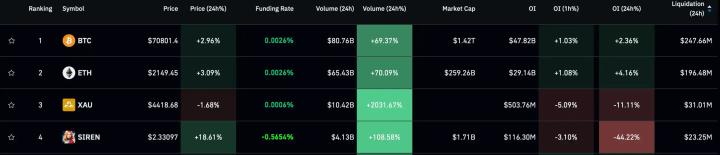
Following this statement, gold, which had plummeted in the previous days due to inflation concerns and rising expectations of global interest rate hikes, rebounded instantly. According to Gate.com data, after Trump's post, gold, which had fallen for a day, rebounded by more than $200, and S&P 500 futures also rose by nearly 4%. At the same time, Brent crude oil fell from a low of $113 per barrel to a low of $97, a drop of more than 14% .
But less than an hour later, Iranian media jumped out to debunk the claim, stating that there had been no direct or indirect contact between the US and Iran. Iran's Tasnim News Agency even quoted a senior Iranian security official as saying that Trump's remarks were a form of "psychological warfare."
Faced with this setback, Trump attempted to brush it off with a dismissive statement that he "didn't know what the Iranian media was saying." To onlookers, this was just another instance of Trump's signature TACO (Trump Always Chickens Out), but for traders, it was a mixed bag. This combination of events caused market volatility exceeding one trillion dollars within hours.
According to The Kobeissi Letter, 15 minutes before Trump posted his statement, a large buy order for S&P 500 futures with a nominal value of $1.5 billion appeared inexplicably in the market. Because the order was so large, it directly boosted the S&P index by about 0.3% within one minute. And 15 minutes later, the trader/institution that opened the $1.5 billion position pocketed $60 million .

Besides the trader who reaped huge profits, there were also traders in the market who accurately timed the market top. According to the Financial Times, also 15 minutes before Trump's post, approximately 6,200 Brent crude and West Texas Intermediate crude futures contracts were sold off, with a notional value of $580 million .
Making large-scale purchases or reductions in positions before major market news announcements is less like news trading and more like classic insider trading. However, whether the source can be traced back to Trump is debatable. After all, this isn't the first time Trump has done something like this. Iranian scholar Seyed Mohammad Marandi wrote on the X platform, " Every week when the market opens, Trump makes these kinds of statements to suppress oil prices , and even the five-day deadline he sets coincides with the energy market's closing time."
In other words, those trades that appear to involve insider trading may actually be the work of top traders who have figured out Trump's tactics. It wouldn't be surprising if Wall Street were to study Trump himself as a separate market trading indicator, because this isn't the first time he's used this method to influence the market, and it's been remarkably effective each time.
Last year's tariff controversy was the most typical example. On April 7, 2025, US stocks were being battered by Trump's reciprocal tariff policies when news suddenly broke that the White House was preparing to suspend tariffs on most countries except China for 90 days. The Dow Jones Industrial Average surged by about 800 points as soon as the news came out, but the White House subsequently denied it as "fake news," and the Dow Jones Industrial Average eventually closed down 629 points that day.
Few people suspected that the rumor was spread by Trump's stakeholders at the time, but the answer soon came out.
On April 9th, Trump first shill his own stocks on Truth Social, saying, "THIS IS A GREAT TIME TO BUY!!! DJT." A few hours later, he announced a new tariff policy, essentially identical to the "fake news" circulating in the market two days prior: a 90-day suspension of "reciprocal tariffs" on countries that had not taken retaliatory measures, but an increase in tariffs on China to 125%. The market rallied again, with all three major US stock indices rising, marking a significant single-day rebound unseen for several days.
A mediocre trader can only create one wave of price increases with one piece of positive news, while Trump can create two waves with one piece of positive news.
In today's war-torn environment, every word spoken by the leaders and official media of both sides in the conflict naturally carries price leverage. A tough statement can cause gold to surge, while a conciliatory statement can cause risk assets to rebound immediately, demonstrating the phenomenon of "words becoming law" in the financial markets.
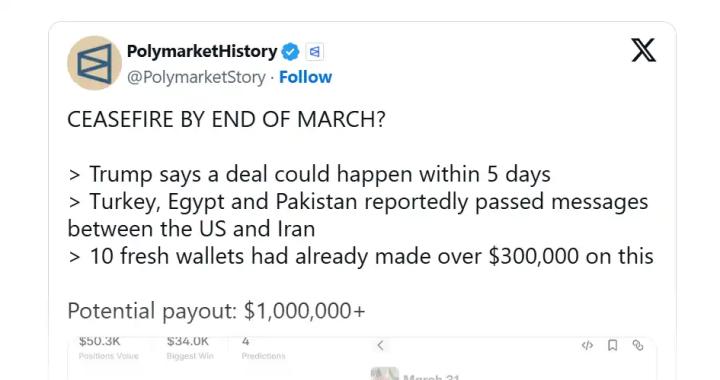
Even prediction markets, which claim to be ahead of the curve , can be completely fooled by a master strategist like Trump. According to Odaily Seer , after Trump posted that US-Iran talks had made good progress, the probability of a "US-Iran ceasefire by March 31" event on Polymarket quickly rose to 54%. However, after it was discovered to be a hoax, the probability quickly dropped back to 16%, and is currently at 12%.
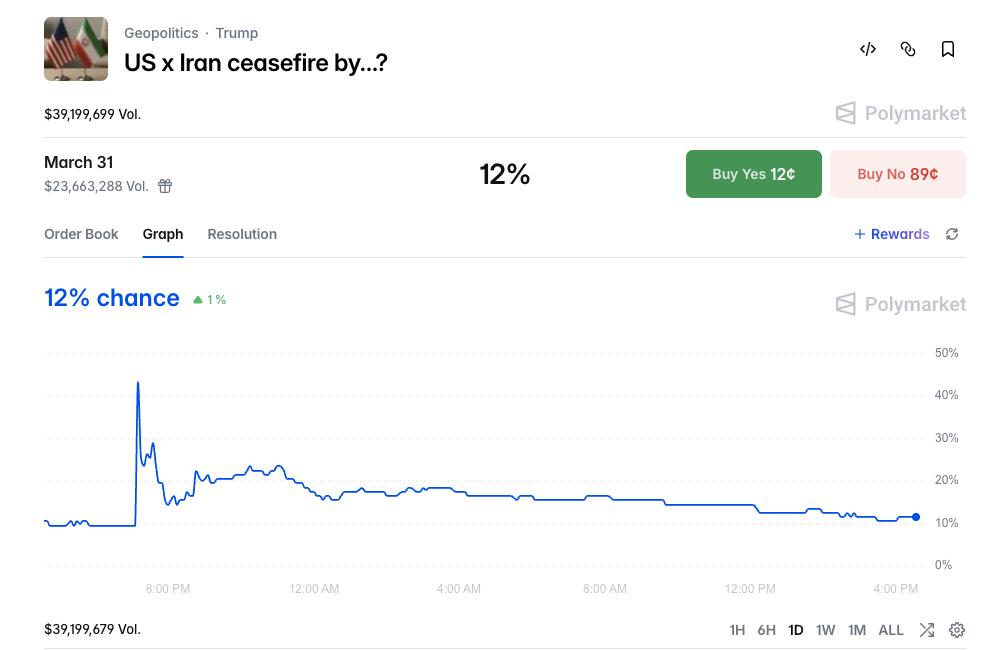
Did Trump intentionally manipulate the market? The answer is definitely yes. But was he just doing it for money? If you look at it that way, you're overlooking another, even more profitable deal—the political benefits behind the stock market surge. As a businessman, Trump understands this economic calculation better than anyone.
During his 2024 presidential campaign, Trump promised to usher in a new era of economic prosperity if he won the election. However, economic development takes time, and economic prosperity is inherently a subjective concept for ordinary people—having money to spend equates to prosperity, while lack of money signifies a lack of prosperity. Therefore, Trump urgently needed an immediate indicator to demonstrate to voters that he was achieving results, and a booming stock market became the perfect "substitute" for economic prosperity .
During Trump's first term, he repeatedly touted the record highs of the Dow Jones and S&P 500, practically using the stock market as a personal performance indicator. However, whenever Trump used rhetoric to influence the stock market, he had to appease not only individual investors but also the capital and business owners behind them, as they were often already or would eventually become Trump's political donors.
This scenario has already played out in the crypto space . Trump was previously dubbed the first "crypto president" of the United States because, during the 2024 US election year and in the early stages of his presidency in 2025, he frequently extended olive branches to the crypto industry, such as participating in crypto industry conferences, making various crypto promises, and enacting crypto-friendly laws. Each time, these actions boosted the crypto market. In return, the crypto industry reciprocated Trump's support with the support of tens of millions of American voters and hundreds of millions of dollars in political donations from crypto companies.
Trump's decision not to manipulate the market for profit allowed him to exploit legal loopholes. Numerous U.S. lawmakers and regulators have previously accused Trump of profiting from manipulating the cryptocurrency market, but these accusations have ultimately fizzled out because there has been no direct evidence that Trump gained economic benefits from the market.
Following the farce on March 23, some accused Trump of insider trading. White House spokesman Kush Desai stated that the White House does not tolerate any official illegally profiting from insider information, provided there is evidence. However, the "profiting" referred to here mostly refers to economic gain. Trump, on the other hand, has long since distanced himself from the family business, retreating into the background and manipulating complex political and business tactics within legal loopholes.
This is where Trump's true "brilliance" lies. He knows that in this world, power trumps money; but he also understands how money, in turn, influences the power structure.