Author: Curry
Original title: AI leads to layoffs, but OpenAI is hiring salespeople.
AI companies are hiring on a large scale for "ground promotion"—the shovels have been made, but people still need to teach others how to dig.
Recently, a wave of anxiety about AI-related unemployment has swept across the internet in both the East and the West.
Block laid off 4,000 people, the CEO said AI can do your job; Pinterest cut 15% of its staff, the money to be invested in AI; Dow Chemical laid off 4,500 people, citing increased automation…
The situation isn't calming down in China either. NetEase is rumored to be replacing outsourcing with AI, iFlytek has denied rumors of large-scale layoffs, and ByteDance is reportedly optimizing its non-AI departments by 20% every six months…
According to statistics, in the first three months of 2026, the global technology industry laid off more than 45,000 people, of whom nearly 10,000 were specifically attributed to AI.
Against this backdrop, the Financial Times reported last Friday that OpenAI plans to expand its workforce from 4,500 to 8,000 by the end of the year.
3,500 new jobs. An AI company is saying it doesn't have enough staff?
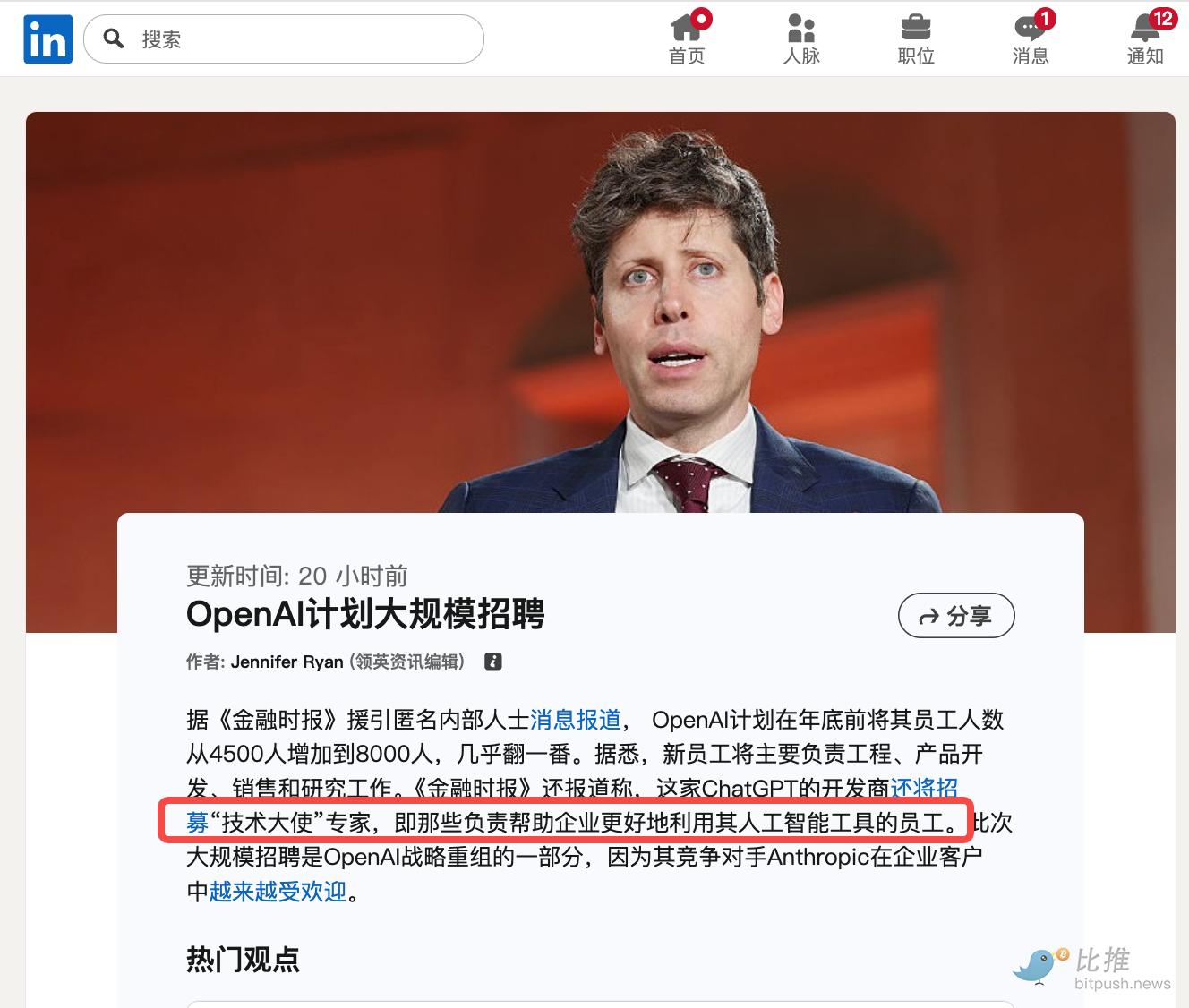
A quick look at OpenAI's job postings reveals that while engineers and researchers are being hired, another category is equally prominent: Partner Manager, Enterprise Sales, GTM (Market Entry Strategy) team, and a new position mentioned in the report called Technical Ambassadorship.
Tech ambassadors specialize in teaching enterprise clients how to use AI.
Therefore, OpenAI is not recruiting people to make AI stronger; it is recruiting people who can get others to pay for AI.
Winning over the client is better than winning over the model.
ChatGPT has 900 million weekly active users, but most of them don't pay.
For consumers who have already paid, OpenAI is also operating at a loss: the computing power cost consumed by each heavy user exceeds the $20 monthly fee. This year, it projects revenue of $25 billion and a loss of $14 billion.
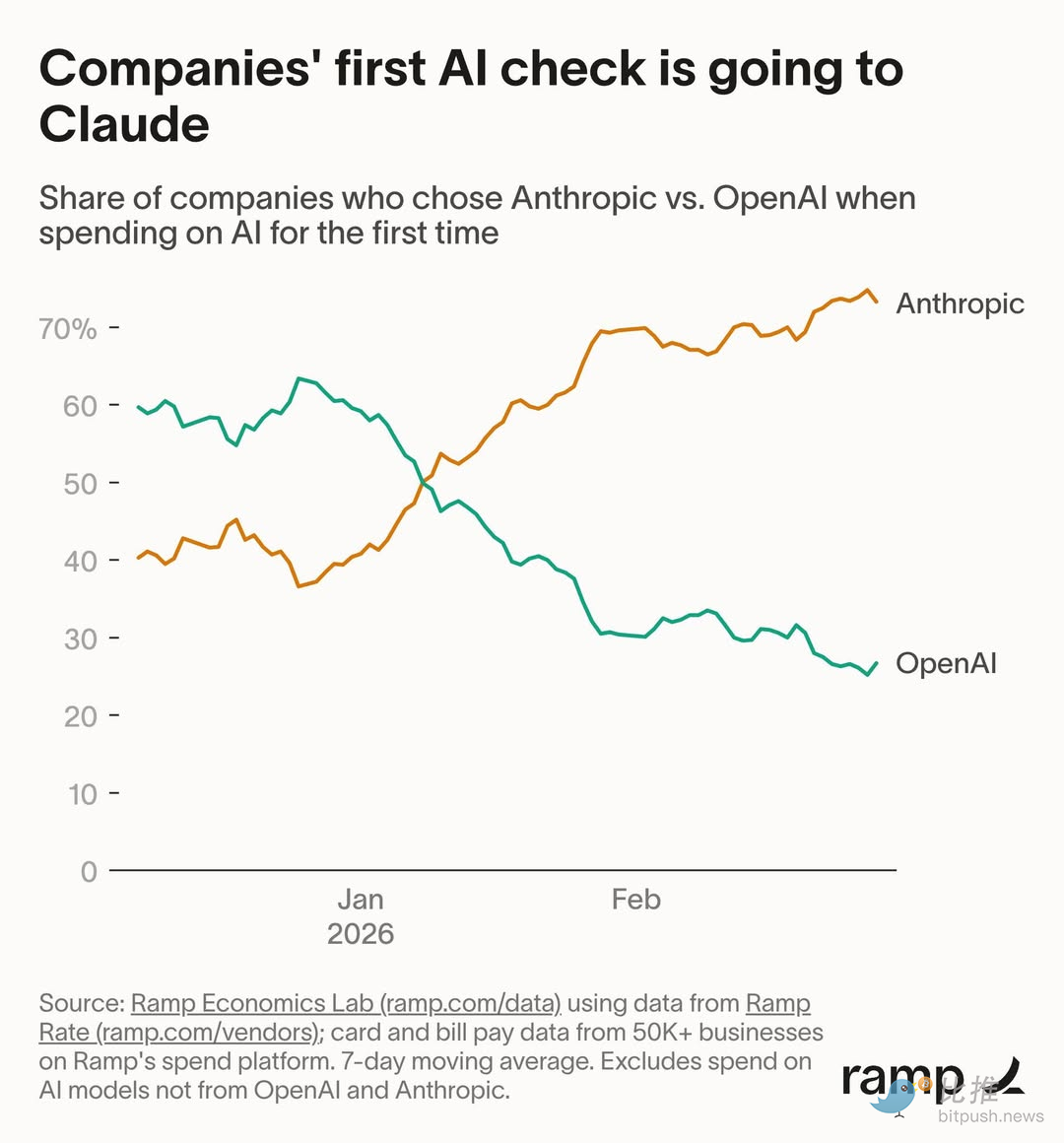
Consumers drive traffic, while enterprise clients drive profits. And enterprise clients are flocking to Anthropic's Claude.
Ramp's data shows that Anthropic captured 73% of the market share among companies making their first purchase of AI tools. Ten weeks ago, this figure was evenly split between the two companies.
Last December, Altman sent a "code red" memo to all employees, suspending all non-core projects such as advertising and shopping assistant, and concentrating all company resources on the ChatGPT experience.
The immediate trigger was that Google Gemini 3 outperformed ChatGPT in multiple tests, but the deeper anxiety lies on the enterprise side: Anthropic is embedding Claude into customers' codebases and workflows, and once it's set up, the migration costs start to snowball.
Models can be iterated, but customers won't come back on their own. You can't rely on AI to give advice when trying to win over customers; someone has to actually go and knock on their doors.
The shovel cannot sell itself.
AI can write code, provide customer service, and perform data analysis, but there's one thing it can't do:
I persuaded a company's technical lead to sign an annual contract to buy my services.
For individuals using AI, downloading an app is sufficient; you can uninstall it anytime if you're not satisfied. However, using AI in enterprises is a different story. Data security audits, internal process reengineering, compatibility with existing systems, and employee training—any bottleneck in any of these areas can stall the project.
This isn't a problem that can be solved by benchmarking models; someone needs to sit in the client's meeting room to make progress.
OpenAI has clearly figured this out. It's not just hiring salespeople; the FT reports it's in talks with private equity firms like TPG and Brookfield to form joint ventures specifically to help companies implement AI. The essence of this business is still about getting people involved.
The story of Block is telling the same thing.
Less than three weeks after laying off 4,000 people, the company started bringing them back. A design engineer was told it was a "mistake" to lay off employees, and a technical lead threatened to resign after discovering that no one could take over key tasks after the entire team was cut. Only then did the company bring some people back.
Dorsey himself left a message in the layoff letter: We may have laid off the wrong people…
AI has indeed caused anxiety about layoffs, but if the lifeblood of a company is cut off because of AI, it's clearly going too far. Even in a company where the CEO publicly claims that AI can replace most employees, there are still areas where AI cannot keep up.
AI excels at replacing tasks that can be clearly defined, but "making an organization believe it needs AI and then helping it use it" is precisely something that cannot be clearly defined.
In every technological revolution, people say "those who sell shovels make the most money." The same applies to AI; the consensus is that companies that build infrastructure are guaranteed profits regardless of market conditions, so there's no need to worry about who wins or loses.
But OpenAI's current predicament shows that even if the shovel is made, someone still needs to teach others how to use it. And this "teaching" process cannot be accomplished by the shovel itself.
Ground sales: A secure job amidst AI anxiety
If you look at the people laid off and the people hired in this round together, you'll find a dividing line.
Of the 4,000 people Block cut, a large portion were engineering and operations positions that were expanded during the pandemic, performing tasks that could be described in a standardized way. Of the 3,500 people OpenAI newly hired, the majority were in sales, customer success, and partner management, performing tasks that could not be documented in process documents.
What OpenAI is doing has a very old name: ground promotion.
Sending people to the client's office, sitting down, listening to their needs, connecting to the system, and monitoring its launch. Whether it's a technical ambassador or a partner manager, just change the English; essentially, it's no different from Meituan sending people door-to-door to persuade restaurant owners to install POS machines during the O2O war ten years ago.
This line of reasoning doesn't only apply to these two companies.
Shopify's CEO told employees this year that if they want to add staff, they should first prove that AI can't do the job. Klarna laid off 700 customer service staff the year before last, saying AI was enough, but quietly brought them back last year. The CEO admitted that they "moved too fast" on AI.
What's the difference between being laid off and being rehired?
Jobs that are likely to be laid off share a common characteristic: their tasks can be broken down into clearly defined inputs and outputs. Writing a piece of code, responding to a work order, generating a report—the boundaries are clear, and AI happens to excel at this.
The characteristics of on-the-ground sales are exactly the opposite. Helping a financial client integrate AI into their compliance system and helping a game company use AI for content generation are two completely different projects. The people sitting opposite you are different, so the solutions will be different. This can't be written as a prompt.
AI isn't eliminating all jobs; it's re-pricing them. Jobs that can be explained in a single sentence are becoming cheaper, while those that can't be explained are becoming more expensive.
Three years ago, a company that could change the world with a single paper now has to hire thousands of people to knock on doors one by one.
If you're worried about whether AI will replace you, the answer may not depend on your industry, but on whether your job can be explained in a single sentence.
The parts that can be clearly explained are no longer very safe.
Twitter: https://twitter.com/BitpushNewsCN
BitPush Telegram Community Group: https://t.me/BitPushCommunity
Subscribe to Bitpush Telegram: https://t.me/bitpush