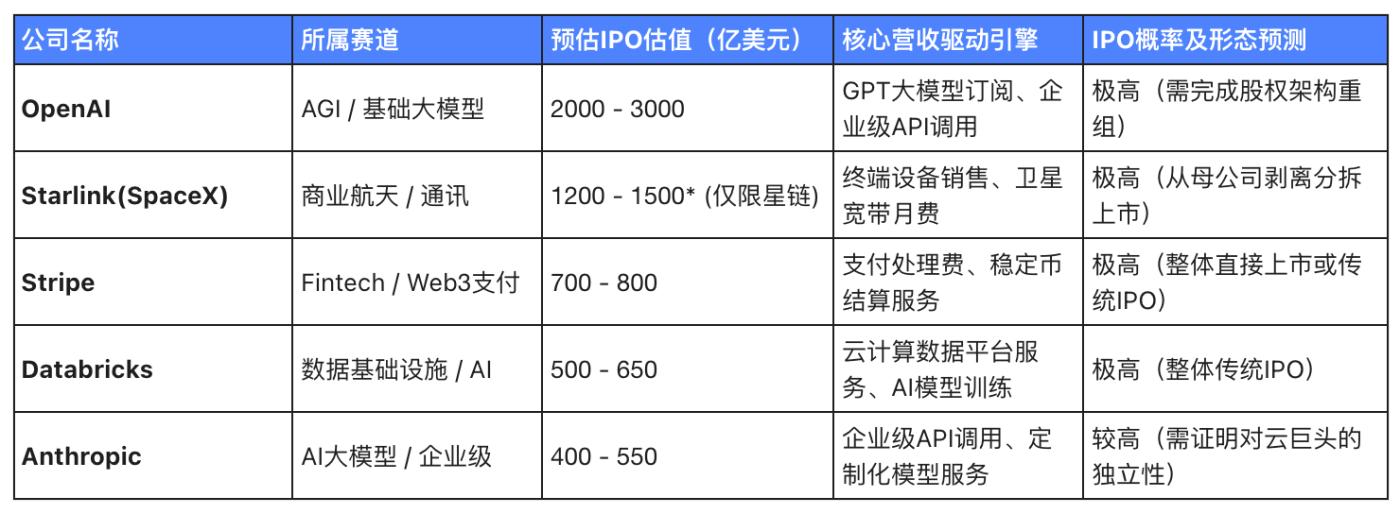
In this capital feast, SpaceX, OpenAI, Anthropic, Databricks, and Stripe are undoubtedly the crown jewels. They not only represent the highest technological barriers in their respective fields, but their IPOs will also profoundly reshape the secondary market's pricing model for "growth and profitability."
Article author and source: 0x9999in1, ME News
2026 Macroeconomic Outlook: The Liquidity Inflection Point and the "Coming of Age" of Super Unicorns
Standing at the historical juncture of 2026, global capital markets are witnessing an unprecedented wave of "Mega-IPOs." Following the painful period of interest rate hikes from 2022 to 2024, and the steady progress of the Federal Reserve's rate-cutting cycle in 2025, global macro liquidity has moved beyond the most severe tightening phase and entered a relatively mild and ample new normal. Simultaneously, underlying technologies such as artificial intelligence (AI), commercial spaceflight, and next-generation financial technology (Fintech) have completed a perilous leap from "technological breakthroughs" to "commercialization" over the past three years.
According to long-term tracking data from ME News Think Tank, the total valuation of unlisted tech giants currently stockpiled in the primary market exceeds $3 trillion. These private giants, which have undergone multiple rounds of financing and have valuations ranging from tens of billions to hundreds of billions of dollars, face extremely high liquidity exit pressures from their venture capital (VC), private equity (PE), and sovereign wealth funds. The fact that 2026 is widely regarded as a "super IPO year" is not accidental, but rather an inevitable result of the resonance between technological maturity, macro liquidity, and the capital cycle.
In this capital feast, SpaceX, OpenAI, Anthropic, Databricks, and Stripe are undoubtedly the crown jewels. They not only represent the highest technological barriers in their respective fields, but their IPOs will also profoundly reshape the secondary market's pricing model for "growth and profitability." This article will dissect these five giants in depth, analyzing their business logic, financial fundamentals, and IPO prospects, providing decision-makers with highly forward-looking assessments.
A Panoramic Analysis of the Five Giants: Valuation Reshaping and Commercial Moats; OpenAI: The "Pricing Anchor" and Governance Game of General Artificial Intelligence
As the undisputed pioneer of this wave of generative AI, OpenAI's potential IPO in 2026 is undoubtedly the most anticipated focus of the global capital market. Its valuation exceeded $150 billion in a funding round at the end of 2024, and if it goes public in 2026, its market capitalization could very well reach $250 billion to $300 billion.
Key takeaway: OpenAI's IPO will be the ultimate pricing in the AGI (Artificial General Intelligence) narrative, but its structural risks and governance challenges will be the biggest test for secondary market investors.
From a fundamental perspective, OpenAI has proven its unparalleled ability to generate revenue. By the end of 2025, driven by both enterprise and consumer (Plus subscription) demand from its GPT-4/GPT-5 series models, its annualized recurring revenue (ARR) had surpassed the $10 billion mark. However, behind this exponential growth lies astronomical capital expenditures (CapEx). Computing costs, electricity consumption, and the ever-increasing salaries of top talent have kept it in a state of structural loss.
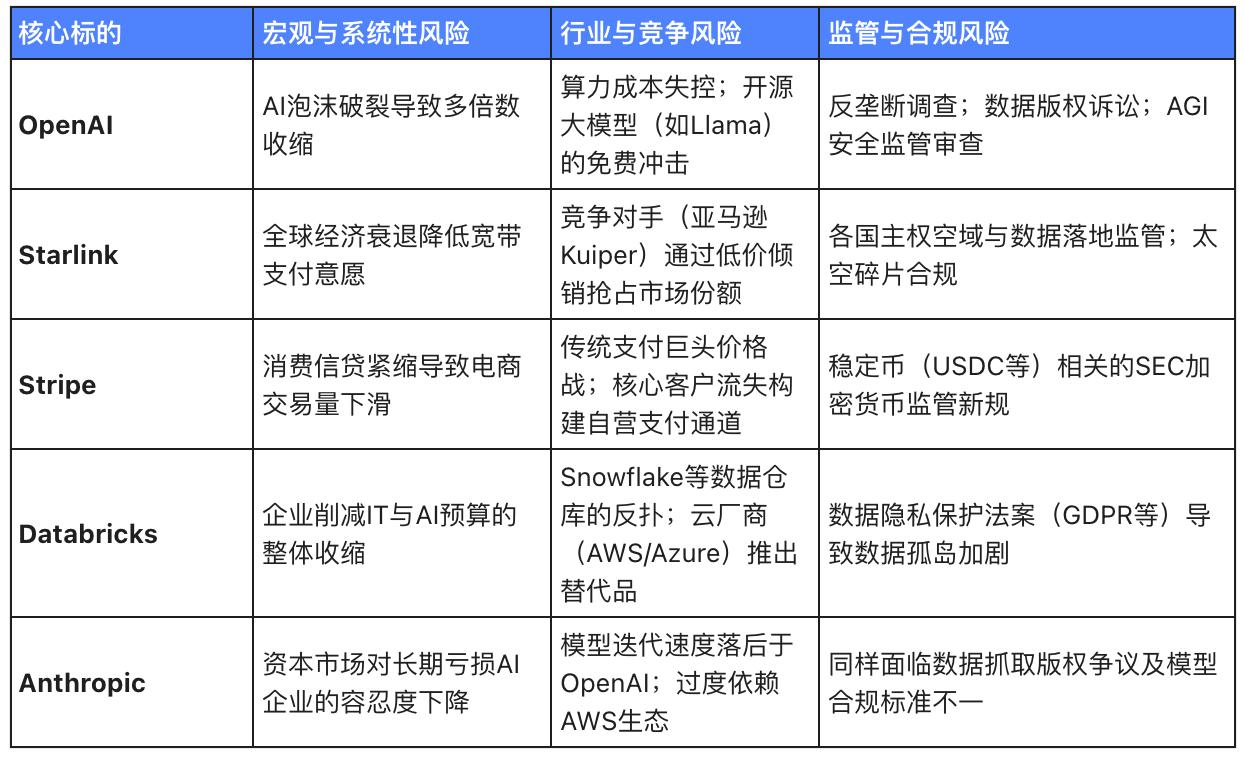
ME News Think Tank believes that OpenAI's core challenge in the public market is not being surpassed technologically, but rather the complex agreement deeply tied to Microsoft's unique "capped-profit" structure. The secondary market is accustomed to pricing in clear equity structures and unlimited shareholder returns. For OpenAI to successfully complete its record-breaking IPO, it must fully restructure into a traditional for-profit company by 2026. Furthermore, as global regulators increasingly scrutinize AI antitrust, data copyright, and security, OpenAI will bear the highest regulatory premium as an "industry leader." Its IPO is not merely a financing round, but a litmus test for the transfer of AI power to the public.
Anthropic: The Defensive Lord of Enterprise AI and the "Security Premium"
If OpenAI is the spear that charges into battle, then Anthropic is the sturdy shield that focuses on "Constitutional AI." Backed by massive capital from Amazon and Google, Anthropic's current private valuation remains between $40 billion and $50 billion.
Key takeaway: Anthropic's IPO logic is a "defensive B2B game," with its core barrier being deep penetration into industries with high compliance requirements. However, due to the weakness of the consumer market, its valuation ceiling will be significantly lower than OpenAI's.
Anthropic's Claude series models demonstrate exceptional stability in long text processing, code generation, and logical reasoning, exhibiting very low rates of hallucination. This makes them the preferred choice for "compliance-intensive" sectors such as finance, healthcare, and law, where data privacy and accuracy are paramount. From 2025 to 2026, Anthropic's commercialization path became increasingly clear, with its API calls in the enterprise market achieving a year-on-year growth of over 300%.
However, Anthropic's hidden concern lies in its over-reliance on its strategic investors (such as using AWS computing power). In the public market, investors will rigorously scrutinize its ability to generate its own revenue. Our assessment is that Anthropic's IPO in 2026 will attract a large amount of institutional capital that is optimistic about the underlying AI infrastructure but wary of OpenAI's aggressive style. It enjoys a unique "safety premium," but it is unlikely to obtain the valuation multiplier brought by explosive growth in the consumer market.
SpaceX: The Monopolist of Interplanetary Infrastructure and the Stripping of its "Cash Cow"
SpaceX is currently the world's only "hard technology monopoly giant." Under Elon Musk's leadership, its valuation surpassed $200 billion in 2025. However, market expectations for SpaceX's IPO in 2026 are more focused on the separate listing of its satellite internet business, Starlink.
Key takeaway: SpaceX, with its full-service business model, does not have the short-term urgency for an IPO, but Starlink, as a "money-printing machine," will have its spin-off listing become the most certain and cash-flow-rich super IPO in 2026.
The data doesn't lie. As of 2026, Starlink had surpassed 8 million active users globally, covering a vast network of needs ranging from broadband in remote areas, maritime, and aviation to governments and militaries worldwide. Starlink not only achieved positive free cash flow (FCF), but its EBITDA margin is also approaching that of traditional telecom giants (approximately 40%). With the extremely low launch costs of the Falcon 9 and the successful routine deployment of Starship, Starlink boasts unit economics unmatched by any of its global competitors, such as Amazon Kuiper.
We believe that SpaceX's parent company carries the ultimate vision of Mars colonization, and such an exploration with an extremely long cycle and a very high risk of failure is not suitable for being subject to the pressure of Wall Street's quarterly financial reports. Therefore, taking Starlink, which has strong utility attributes and stable cash flow, to the public market can provide the parent company with tens of billions of dollars in interest-free liquidity for Starship development, while also meeting the exit needs of early investors. Starlink's IPO is essentially pricing in human-made near-Earth orbit digital infrastructure.
(Note: Starlink's valuation is a reasonable estimate of the portion of SpaceX's overall valuation.)
Databricks: The Data Foundation for the AI Era and the Victory of the "Water Seller"
Among all the giants preparing for an IPO in 2026, Databricks undoubtedly boasts the most solid fundamentals and the most mature financial model among software companies. As a pioneer in the integration of data warehouses and data lakes, its latest valuation is around $43 billion.
Key takeaway: Databricks is the most stable "water seller" in this AI wave. Its IPO isn't about selling future dreams, but about monetizing current, concrete needs.
The training and inference of AI models essentially involve processing massive amounts of high-quality data. Databricks has precisely targeted this essential need. By acquiring MosaicML and launching a series of generative AI tools, Databricks has successfully transformed its unified data analytics platform into the infrastructure for enterprises to build large-scale models on their own. By the end of 2025, its annual recurring revenue (ARR) had far exceeded $3 billion, and it maintained an extremely high net revenue retention rate (NDR).
Compared to its arch-rival Snowflake, Databricks' deep roots in the open-source community (such as the inventors of Apache Spark) and its absolute advantage in unstructured data processing give it greater momentum in the AI era. The logic behind investing in Databricks is very clear: regardless of whether OpenAI, Anthropic, or the open-source Llama ultimately wins the battle for large models, enterprises will need Databricks' platform to cleanse data and fine-tune models. Its IPO will be a significant indicator of the evolution from traditional SaaS (Software as a Service) to AI-SaaS.
Stripe: The Ultimate Battlefield of Fintech and the Revival of Web3 Payments
Stripe is the "oldest" unicorn on this list. Founded in 2010, the payment giant missed the peak of the tech stock valuation bubble in 2021 (when its valuation reached as high as $95 billion). After experiencing valuation adjustments and internal pain, it has now returned to the spotlight in an extremely healthy state, with its current valuation stable between $65 billion and $70 billion.
Key takeaway: Stripe's IPO marks the soft landing of the last super unicorn in the ZIRP (zero interest rate policy) era. Its biggest highlight is no longer its simple e-commerce payments, but its strategic heavy investment in Web3 and stablecoins.
In the traditional payments sector, Stripe is already a true giant, with its total transaction volume (TPV) exceeding $1.5 trillion by 2025, generating over $10 billion in net revenue and consistently achieving profitability under GAAP standards. However, its traditional payments business faces fierce competition from strong rivals like Adyen and PayPal, and its growth rate has slowed.
What revitalizes Stripe's 2026 IPO narrative is its deep integration with crypto assets, particularly stablecoins, for settlement. By supporting global B2B and B2C payments using stablecoins like USDC, Stripe is disrupting the traditional SWIFT system's cross-border payment friction. This not only significantly improves its profit margins but also injects new potential into its valuation. Stripe's listing will be seen by the market as a successful example of the seamless transition from traditional fintech to the next-generation value internet (Web3).
Financial Perspective and Key Indicator Derivation
To more intuitively illustrate the potential valuation systems these five giants might encounter in the public market, we have constructed the following financial projection matrix based on public disclosures and reasonable extrapolations from 2024-2025. In the capital market of 2026, the price-to-sales (PS) ratio will show significant divergence: pure AI concepts will continue to enjoy high premiums, while software and Fintech will place greater emphasis on free cash flow.
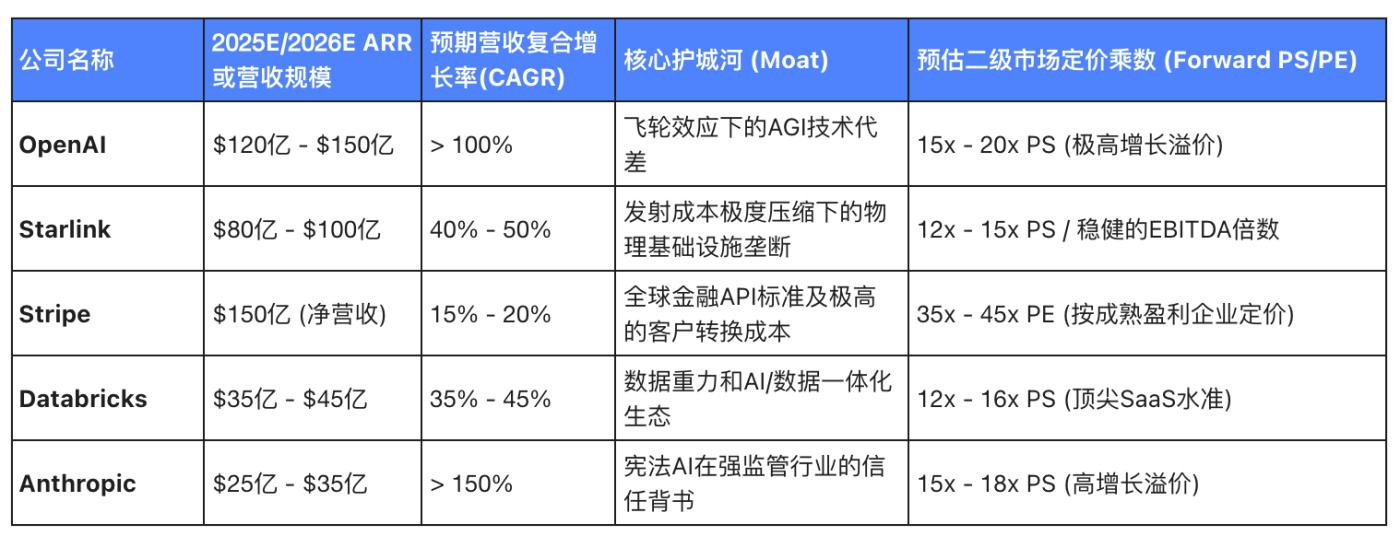
(Data source: "ME News Think Tank" based on industry average growth rate and publicly released corporate financing press releases, not actual audited data)
A major test of liquidity in the capital markets: the spillover effects of mega-IPOs
The collective listing of these five giants in 2026 will not only be a milestone in corporate development history, but will also trigger a dramatic reallocation of funds in the global public market. This "siphoning effect" requires high vigilance from policymakers.
- Passive reshaping of index weights : Once OpenAI, SpaceX (Starlink), and Stripe successfully go public, their massive market capitalization will lead to their rapid inclusion in core broad-based indices such as the S&P 500 and Nasdaq 100. This means trillions of dollars in passive ETF funds will be forced to sell other traditional constituent stocks (such as some underperforming traditional software or old consumer sectors) and buy these new giants. This passive rebalancing will exacerbate market polarization.
- The drain on liquidity from small and medium-sized technology companies : Within a limited pool of macro liquidity, the drain on liquidity from trillions of dollars in IPOs is inevitable. Institutional investors' book-building funds will be highly concentrated on these leading companies, resulting in an extremely sluggish IPO environment for mid-tier SaaS or AI companies valued between $1 billion and $5 billion in 2026. The market will exhibit a typical "winner-takes-all" scenario.
- The deregulation and rebirth of the primary market : The enormous wealth released by the successful IPOs of these giants will flow back into the hands of VC/PE partners (GPs) and limited partners (LPs). After this capital, frozen for 5-8 years, regains liquidity, it will most likely be reinvested in earlier and more cutting-edge sectors (such as embodied intelligence, quantum computing, and nuclear fusion), thus initiating a new round of technological innovation cycle after 2027.
Conclusion: Who will lead the next decade?
In conclusion, the 2026 mega-IPO feast represents a comprehensive reckoning and revaluation of humanity's decade-long sprint in algorithms, computing power, aerospace engineering, and financial infrastructure. Among these five companies, we believe Databricks and Stripe will offer the best certainty and margin of safety , making them high-quality targets that traditional institutional investors can confidently price using existing DCF (discounted cash flow) models.
OpenAI and Starlink, on the other hand, are "Alpha" assets that will define the future direction of human civilization. Their valuation logic no longer relies solely on historical financial data, but rather on the capital market's belief in the grand narratives of "machines replacing human brainpower" and "humans becoming a multi-planetary species." Their volatility will be extremely high, but they also hold the potential to grow into the next era's "Apple" and "Microsoft."
For decision-makers and investment institutions in the secondary market, the core strategy for 2026 should not merely be "subscribing to IPOs," but rather a deep understanding of the value reassessment that these giants' IPOs will bring to the entire technology industry chain. In this transition between old and new eras, the difference in perception is the greatest moat.
Message Quote:
- Bloomberg LP (2025). The Next Trillion-Dollar Wave: Analyzing the 2026 Tech IPO Pipeline . Bloomberg Intelligence Report.
- Wall Street Journal. (2025). SpaceX Weighs Starlink Spin-Off as Cash Flows Turn Positive . WSJ Financial News.
- Sequoia Capital. (2024). The AI Revenue Imperative: Why Infrastructure Will Win the Decade . Tech Investment Outlook.
- Financial Times. (2025). Stripe's Crypto Pivot: How Stablecoins Resurrected the Fintech Giant's IPO Dream . FT Markets Insight.