Table of Contents
ToggleIn 2011, Clifton Collins, a beekeeper who grew cannabis in County Galway, Ireland, spent approximately $30,000 to buy 6,000 bitcoins. At that time, one bitcoin was worth about $5.
He didn't trust exchanges, so he distributed 6,000 BTC into 12 wallets, storing 500 BTC in each. He then printed the private keys on A4 sheets of paper, stuffed them into the aluminum lid of a fishing rod box, and hid them in a corner of his rented apartment.
From beekeeper to cannabis farmer, and then to early BTC believer
Collins' story, placed in 2011, is not surprising at all. Back then, the main users of Bitcoin were the underground market. He converted the money he earned from selling marijuana into Bitcoin, stored it in batches offline—his operational logic was flawless, if he hadn't been caught.
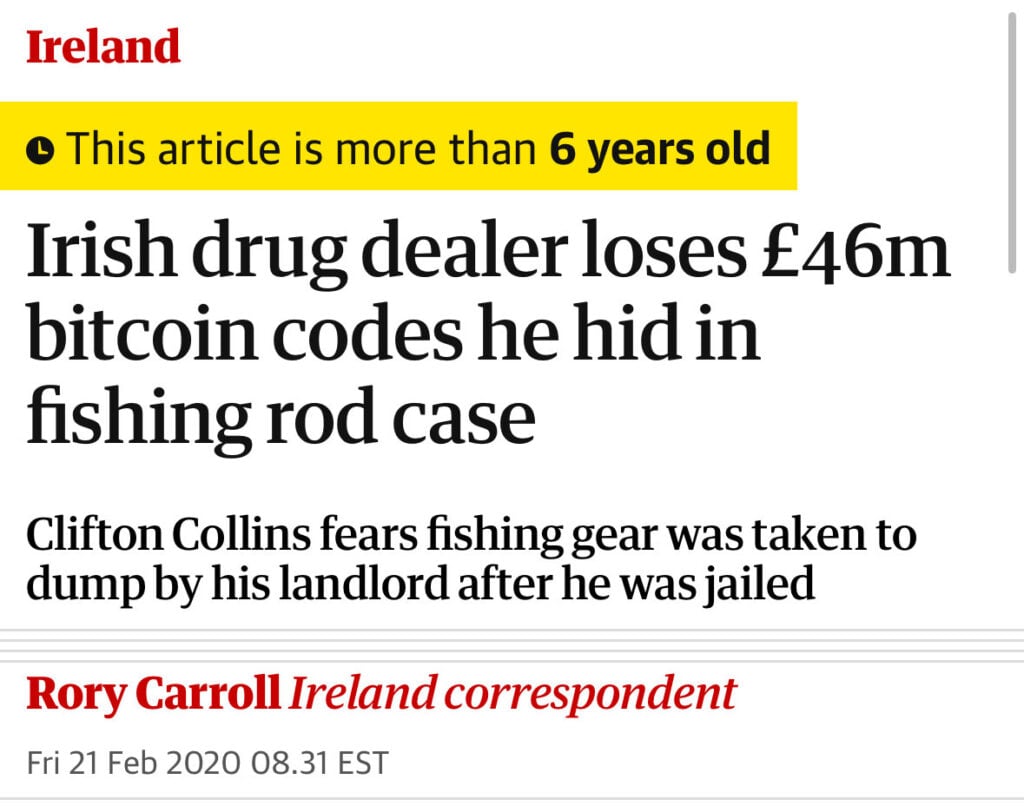
In 2019, Collins was arrested. The Irish Criminal Assets Service (CAB) searched his residence. During police questioning, he claimed that he hadn't seen the fishing rod box since the burglary. Additionally, documents may have been lost during police clearing of the house after his arrest.
Those items likely ended up in a landfill. And the fishing rod case containing the private key might be inside too…
The court later ruled that the Bitcoin was proceeds of crime and confiscated it. CAB theoretically took over the addresses of 12 wallets, but did not have the private keys. On paper, the Irish government owned 6,000 BTC; in reality, this money was locked on the blockchain and no one could access it.
The government's dilemma: The money is right in front of them, but they can't get it.
For the next few years, the situation remained stagnant.
6,000 BTC lay quietly in those 12 addresses, their price soaring from a few thousand dollars to over $100,000. CAB watched the account balance grow larger and larger, yet remained completely inaccessible. Collins himself claimed that the private key had long been lost, and he had no idea how to retrieve it.
By 2025-2026, the market value of these 6,000 Bitcoins had approached $378 million . If Collins hadn't been arrested, his initial investment of $30,000 would now be worth $378 million—a return of 75,600 times .
Technical cracking doesn't mean finding the private key.
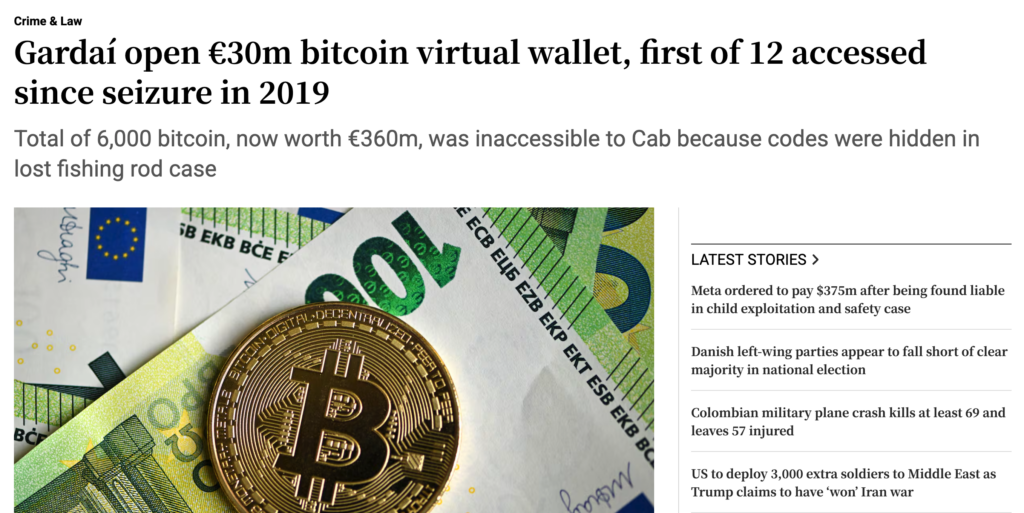
A turning point came recently. The Irish Criminal Assets Service partnered with Europol, the European Cybercrime Centre (EC3), which provided advanced decryption technology and professional resources, and successfully cracked one of the wallets.
500 BTC (the first of 12 wallets) has been transferred to Coinbase, worth approximately $32 million.
However, there is one detail to note: the official statement never said "the private key was found," but used the term "technical cracking," without clearly explaining how it was cracked.
The author speculates that Collins has been saying "I lost my private key and I don't know where it is," but this successful cracking suggests two possibilities: either he is lying, or his wallet is of poor quality and may contain some vulnerabilities, or he actually has his private key recorded elsewhere.
Currently, authorities are attempting to replicate this hacking method on the remaining 11 wallets. If all are successful, the Irish government will recover over $328 million in Bitcoin assets at once.