Author: TechFlow TechFlow
"In 2026, Huobi HTX will definitely go all out; I've prepared a big surprise."
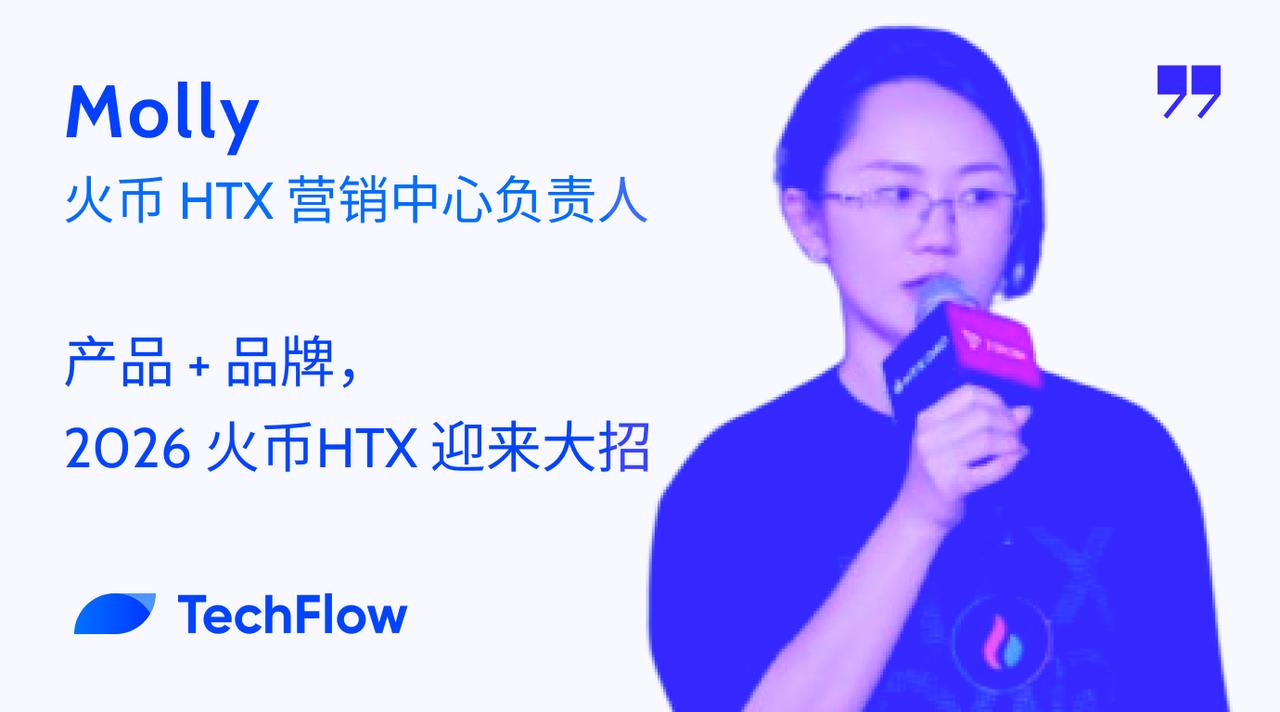
At the Huobi HTX annual meeting before the Lunar New Year, Justin Sun, as the leader of Huobi HTX, shared his strategic vision for 2026, while Molly, the head of Huobi HTX Marketing Center next to him, was responsible for better implementing and communicating these "big moves".
With curiosity about the "big move," as Huobi HTX Marketing Center enters its third year, we had an in-depth conversation with Molly, attempting to explore the strategic thinking and action path of this established exchange in the new cycle.
"2026 will definitely be a year in which Huobi HTX achieves a leapfrog breakthrough in both brand and product dimensions."
This was Molly's most confident statement during the entire interview. In fact, this rationality and composure permeated the entire interview, making it especially valuable in the crypto marketing world, which is rife with anxiety about traffic.
Exchanges prioritize "tickets" in their marketing, and facing "traffic anxiety," Molly stated:
Blindly chasing traffic can backfire; we must maintain deep thinking amidst the noise.
In practice, Molly also stated that she is willing to spend her time on things that seem less related to traffic: refining the product experience, practicing "user first," resolving user issues one by one, and refusing to make excuses in every public opinion crisis. Regarding branding and marketing, Molly believes:
During the initial stages of building Huobi HTX Marketing Center from scratch, I did experience confusion and disarray. However, the more I handled, the more I realized that honesty, openness, and transparency are the best public relations practices. This confidence stems from my belief that both Sun and Huobi HTX will consistently uphold their principles and remain true to their original aspirations, which also allows me time to consider more things that can truly drive the industry's development.
However, Molly still left some questions unanswered regarding 2026:
It's not convenient to talk about the "big move" right now, but we will usher in a new period of breakthroughs, both in terms of brand and product.
In this episode, let's follow Molly's story to explore her unique Chinese management philosophy and brand methodology, and further understand Huobi HTX's globalization ambitions for 2026.
TechFlow TechFlow: Welcome back, old friend Molly. What have you been up to lately?
Molly:
Because I've been working with my colleagues in the marketing department to finalize Huobi HTX's brand plan for the whole year, I've been mainly busy with two things lately:
One aspect is breaking down the brand's annual goals. I've been leading the team in various brainstorming meetings lately, constantly refining and refining this year's brand positioning and objectives. For example, if we want users to feel that Huobi HTX is "warm," how do we define "warmth"? How do we specifically make users perceive it? These all require us to refine specific execution strategies.
On the other hand, I'm busy sorting out and building the team's talent capability model. I need to restructure the team, assess everyone's abilities, and determine if the current team has the capability to achieve this year's goals. If not, should I train internally or recruit new talent externally? This is also a question I'm currently considering.
Overall, we have quite a lot to do this year.
TechFlow TechFlow: February 2026 marks the second anniversary of the official establishment of Huobi HTX Marketing Center. In these two years, you have led your team through many tough battles and achieved a series of successes. Could you please share some of the "darkest moments" you have experienced in the past two years? What is the most worthwhile achievement to share?
Molly:
Regarding the "darkest hour," I think it mainly stemmed from the self-challenge I faced when I first took over the job.
Two years ago, I was on a business trip in Egypt. Because of the six-hour time difference, I had to get up around 3 a.m. to attend a meeting that was supposed to be at 10 a.m. in China. In that hazy early morning, the meeting suddenly announced the establishment of a marketing center, with me as the person in charge.
For me at the time, this was a huge challenge. On the one hand, I was simultaneously serving as HTX DAO Ambassador, Huobi HTX official spokesperson, and head of Huobi HTX Marketing Center. With these three roles in hand, I had to lead the team, work on projects, handle a large amount of execution work, and think about how to balance and allocate the work of the three roles.
On the other hand, during the initial stage of Huobi HTX Marketing Center, I faced a situation of "internal and external troubles": as the official spokesperson, I was the one who directly faced users and negative public opinion. At the same time, the new team needed to go through the process of going from 0 to 1. Many processes and mechanisms were not perfect, and no one could give me very clear guidance. So during that period, I was under a lot of psychological pressure, and for half a year, I worked more than 14 hours a day.
But I've always believed in the saying: everything is difficult at the beginning , but once rules and habits are established, everything will become smoother and smoother. It's like learning to ride a bicycle; at first, you're always clumsy and disorganized, but once you master your balance, you can ride with ease.
After about 10 months of adjustment, by the end of 2024, I suddenly had a feeling of "a glimmer of hope after darkness": the processes were running smoothly, talent was being developed, and the team was able to take on more responsibility... At this point, I had survived what was called the darkest hour.
As for the "most worthwhile achievement to share," I think it's "this very moment."
Two years ago, we were confused and overwhelmed. But now, not only has our team grown and we dare to pursue higher goals, but we are also better able to take a broader industry perspective to do more things related to brand internationalization and globalization. For example, we recently reached cooperation agreements with universities such as Tsinghua and Peking University, focusing not only on exchange business, but also on exploring the integration of AI technology and blockchain from an industry-driving perspective.
Right now, I feel like I'm holding a lot of good cards, and I'm thinking about how to play them in combination to build a bigger blueprint. This is something that gives me a great sense of accomplishment.
In addition, our team is growing steadily. From being at a loss at the beginning, we are now familiar with the strengths of each member of the team, how tasks should be assigned, and we have witnessed team members gradually becoming able to stand on their own. This sense of control and confidence in the future is one of my greatest achievements.
TechFlow TechFlow: After two years of frontline experience, what new insights have you gained about "exchange marketing"?
Molly:
What I want to share more is my change in mindset.
When I first became the marketing manager and spokesperson, my first reaction to negative public opinion was often to feel nervous and subconsciously try to calm things down as quickly as possible.
But now, I'm more composed because my approach has shifted from "finding tricks" to "the essence of things": understanding the cause and effect of a situation, and then communicating honestly in language that users can understand. The more cases I handle, the more I realize that honesty, openness, and transparency are the best public relations strategies. Attempts to cover things up often backfire, while laying things out in the open makes users more receptive.
This confidence stems from the core values of Huobi HTX. Since joining Huobi HTX, both Sun Ge and the team have given me a sense of very positive values. Looking back over the past two years, I've handled every public opinion issue, FUD (Fear, Uncertainty, and Doubt) or event, and I've never been proven wrong. On the contrary, the more I handle, the more confident I become.
So now, I know that whatever happens, the problem won't be too big, because I can feel Huobi HTX's commitment to upholding its bottom line and staying true to its original aspirations.
My core takeaway from exchange marketing is this: as long as you uphold the bottom line and your starting point and core values are correct, the overall direction won't go astray. We have the confidence to do things based on solid principles, allowing us to move forward by returning to the essence, rather than relying on tricks to maneuver.
TechFlow TechFlow: Exchange marketing has always been very competitive and seems to be increasingly focused on "traffic". As the head of Huobi HTX Marketing Center, do you experience "traffic anxiety" when faced with a wide variety of exchange marketing strategies?
Molly:
To be honest, I used to have anxiety about data usage, but I don't anymore.
For example, a few days ago, Brother Sun posted something about Huizhou, and a colleague asked me if I wanted to ride the wave of popularity. My answer at the time was: any traffic I get by piggybacking won't belong to me anyway. Although I eventually took the advice and participated in the sharing based on my own experience, this small incident reflects my current attitude towards traffic.
I admit that I was very anxious in the early days when I first took over the marketing center. At that time, I wanted every event and every promotion to be seen by more people, and I also wanted my influence to grow. In pursuit of traffic, we tried many methods, such as massive advertising campaigns, collaborating with top KOLs, and even considering using some unconventional and unusual tricks to generate traffic.
But why is this anxiety gone now? There are three main points to consider:
First, traffic is a double-edged sword; blindly chasing it can easily backfire. In the past two years, we've seen many competitors or individuals do things that aren't morally sound in their pursuit of attention, only to suffer the consequences and become slaves to traffic. If we don't view traffic rationally, the harm it brings often far outweighs its positive value.
Second, traffic can't stay at its peak forever; the key is whether it's "worth it." We can't stay excited indefinitely, nor can we expect every event and every tweet to be a viral hit—that doesn't align with objective laws. Moreover, if the event itself offers a poor user experience, pushing it forward could lead to an even greater public relations disaster.
So now I'll first consider whether this matter is worth full exposure. If it is, I'll concentrate all resources on promoting it; if not, then I'll do normal publicity. For exchanges, what's more important is ensuring that every time they appear in the public eye, the information they convey is positive and valuable; I think that's enough.
Third, sometimes "slow and steady wins the race," and we need to maintain deep thinking amidst the noise. If we're constantly caught up in traffic anxiety, we become very restless and lose the ability to think deeply. When I stop focusing excessively on traffic, I can calm down and become an observer, watching those people or projects that once had huge traffic, and looking at their outcomes over a longer period. You'll find that much of the initial hype is fleeting.
So I often tell the team not to be impatient. We need to be willing to spend time polishing good products and content. When we have truly created something good, then we can concentrate our energy to promote it. This is a more sustainable and effective strategy.
TechFlow TechFlow: Many projects have turned "female leaders" into a traffic driver, which has also inadvertently reinforced the public's stereotype of "female Web3 executives." How do you understand the role of "Head of Marketing Center at Huobi HTX"? As a female Web3 executive, what kind of spirit do you hope to demonstrate to the industry?
Molly:
Actually, I've thought about this issue very seriously. When I'm managing my own social media matrix, I've also made a core principle clear to my team: I hope that through my actions, people will develop a positive impression of Web3 and the crypto industry.
I believe we cannot simply enjoy the halo and traffic that a title brings, but must also bear the responsibility behind that identity. When you stand in the spotlight representing a group or a company, people will define the entire platform, group, or industry through you. Therefore, we cannot act arbitrarily, but should set an example.
Specifically, I break this responsibility down into three levels:
First, I have a responsibility to those outside the industry. I represent Web3 practitioners. I hope to convey to those outside the industry that we, like builders in traditional industries, are a group of people who work diligently, strive hard, and adhere to long-term values.
Secondly, I have a responsibility to those within the industry. I represent Huobi HTX's corporate culture. When facing clients, KOLs, and the media, my every word and action will naturally be associated with Huobi HTX's corporate culture. Therefore, I must constantly exercise self-discipline and strive for self-improvement to maintain the company's brand image.
Thirdly, there is the responsibility associated with the label of "female manager." The outside world is full of curiosity about female managers, such as how they balance family and work, the interplay of emotion and reason, and issues of gender equality. I believe we should cherish the benefits that the label brings, but we must never abuse it. In my work, I am particularly careful to avoid showing favoritism towards female employees, because the workplace is about reason and facts; one cannot demand special privileges simply because someone is a woman. I hope to break down stereotypes about women through objective and professional performance.
In summary, the role I play actually carries several layers of labels, and the weight of these labels varies depending on the person I'm interacting with. But the core question remains the same: what values do I ultimately want to convey? I hope these values are positive and have a guiding significance.
TechFlow TechFlow: Whether it's community responses or social media sharing, we often hear the phrase "users first" from you, and we often see you actively participating in the community. But this is actually a difficult thing, because if "users first" is not put into practice, it will become a grand but empty slogan.
Therefore, I would like to ask you to share why you emphasize "user first" more than "embracing traffic"? From a practical perspective, what are the gains and losses in balancing "embracing traffic" and "user first"? And how do you and your team specifically practice "user first"?
Molly:
In fact, "customer first" may sound like a marketing strategy or a politically correct phrase at first glance, but if you understand it deeply, you will find that it is a very good working guideline.
I believe that speaking with facts is more convincing than reasoning, and the USDE wealth management case I recently handled is a very good example.
During the Chinese New Year holiday, we launched a USDE wealth management promotion with an annualized return of 15%. I promoted the promotion on the 19th, and Brother Sun also shared it on the 20th, urging everyone to pay attention. However, the very next day, the wealth management product was suddenly taken down. This angered users, and I was also very angry, so I went directly to the business department.
After understanding the situation, the business department felt that the matter was not very serious because:
First, this investment product was originally scheduled to be taken offline on the 17th, but it was postponed to the 19th. Second, this is a stablecoin investment product, and the so-called price difference is available on other platforms, so it will not cause any loss to users. At most, they will only earn a little less, and users who invested earlier will still make a profit. In addition, this product is not made by our platform. The interest rate changes are determined by the project team. It will be taken offline once the budget is spent. Moreover, the platform has hundreds of investment products every day, and it is difficult to notify each one.
Although these objective reasons are valid, I still pointed out very seriously at the time: we should put ourselves more in the user's perspective.
First, are there enough notification points for product announcements? In this age of information overload, users can't possibly remember the end time of every announcement. Few users can rationally accept being suddenly removed from the platform without receiving any notification. Second, the logic of not being taken down on time on the 17th, and then suddenly being taken down on the 22nd, is illogical.
Based on the above communication, we conducted an in-depth review and reflection with the business department. On the one hand, we acknowledged the oversight and provided welfare subsidies to all users who complained about the poor experience. On the other hand, we optimized the mechanism. We stipulated that all major financial management adjustments in the future must be notified by email and relevant departments in advance. We will also further optimize the prompts at the product level in the future.
I think this incident perfectly embodies the "user first" principle:
Often we find ourselves in situations where we have "many reasons to give," but we choose to consider the user's situation and perspective, and comprehensively cover both product and human aspects.
When we encounter problems, we shouldn't look for excuses, but rather reflect and adjust from a user-first perspective. If the user experience is poor or we suffer losses, then we've made a mistake. My understanding of "user-first" isn't just about big issues, but about being reflected in everything we do and putting it into practice, so it doesn't become just empty words.
TechFlow TechFlow: Through this series of efforts, and with the hard work of you and your team, what kind of Huobi HTX brand image do you hope to establish in the minds of users?
Molly:
I'm actually quite simple; we just want users to think we're "honest and reliable," and that's enough for us.
Specifically, users can resolve their issues by contacting us, and they won't feel that we are lying or making excuses.
It's not easy to do all this, but we will keep at it.
TechFlow TechFlow: In just two years, under your leadership, Huobi HTX Marketing Center has expanded from 2 people to dozens. What were your selection criteria for building the team during the initial stages of Huobi HTX Marketing Center's development? We also see that you posted recruitment tweets on social media. Have your selection criteria changed at this stage? Does the new position indicate the next steps for Huobi HTX Marketing Center?
Molly:
The selection criteria are indeed different at different stages.
To be honest, when we started from scratch, all we needed was people. At that time, I hadn't figured out how to run a marketing center myself, so the criteria were very simple: someone who was quick-witted and not too stupid was fine.
But things are different now. Now I break down the roles. Currently, I divide the entire marketing system into 6 business lines, with different standards for each role.
For example, the marketing strategy position is the brain of the entire marketing center. My requirements for this position are: no one can be bound by convention. I don't need obedient people, but rather people with critical thinking and a spirit of challenge. Everyone needs to have ideas, courage, and innovation, while also having the experience to rationally evaluate and execute ideas.
For the social media matrix role, my first requirement is dedication and commitment, with updates guaranteed even on holidays. Secondly, social media involves the most contact with users, who can directly experience the team culture and atmosphere through the content. Therefore, this role cannot be too rigid; employees need to enjoy chatting with users, be witty, and have a strong personality. Additionally, we have many social media activities, and prizes must be distributed promptly, so employees must also have strong execution skills.
Although the standards differ for different positions, I have one unified requirement for all members: don't think about lying down, but really want to do things.
I am someone who refuses to be passive and give up. Even though many people tell me not to take things too seriously, I still hope to accomplish something. So I don't want anyone on my team to think that "getting along with Molly means you can slack off like a relative."
I hope everyone has goals and ambition. Your goals don't have to be grand; I can assign relatively simple tasks. But you absolutely cannot have a "just going through the motions" mentality. Conversely, I will give many opportunities to those who are ambitious, have desires, and genuinely want to do things.
Regarding the recent recruitment announcement, the previous round of hiring was primarily to fill vacancies, as some positions needed to be filled due to personnel changes. However, we have another round of recruitment plans recently because I am developing a larger brand strategy, and we need to recruit a new group of people in the direction of brand upgrading and globalization. This also means that we will be placing more emphasis on brand communication this year.
TechFlow TechFlow: What do you consider your management style to be? Do you see yourself as a "wolf pack" leader in your team's eyes?
Molly:
I actually have a relatively mild management style. In recent years, I've grown to appreciate Chinese culture more and more. A couple of days ago, I shared two quotes that I think encapsulate the two core values of Chinese culture, which also happen to be my approach to managing my team.
One is "As heaven maintains vigor through movement, a gentleman should constantly strive for self-improvement," and the other is "As earth's nature is receptive, a gentleman should cultivate virtue and bear all things with magnanimity."
This means we should have a spirit of hard work and perseverance, be as strong as the sky, and have the courage to explore and challenge the unknown. Regarding team management, I hope everyone can continue to grow here.
Our team has grown very quickly. This is my fifth year at Huobi HTX, and many members have been with me for a long time. I often tell everyone that I hope that three years from now, when you look back on yourselves, you will feel a great sense of accomplishment, rather than worrying about being left behind by the times. Every quarter, I also have in-depth discussions with everyone to reset our goals and give everyone new directions for development.
The second point is about tolerance. The earth is vast and gentle, with a high tolerance, leaving room for all things to grow. In team management, we must allow mistakes to happen.
At work, while I often point out their problems, I don't dismiss someone based on a single incident. I frequently tell them that making mistakes is normal; anyone who wants to do something will inevitably make mistakes. What I truly care about is whether they realize the problem and grow after making a mistake. If they improve, then in my eyes they have potential and are worth developing. Therefore, I hope to create an environment in the team where they can take risks, make mistakes, and truly grow.
TechFlow TechFlow: When it comes to Crypto marketing, Justin Sun is a benchmark figure: What kind of person is Justin Sun in your eyes? In terms of work, what is the best experience you have learned from Justin Sun?
Molly:
I've known Brother Sun for over three years, and my understanding of him has changed a lot.
At first, I found him hard to understand; he was too "abstract" and didn't like to explain himself. But after working with him for a while, I realized that he was actually quite aggrieved about many things. Later, I gradually understood: he didn't need everyone's understanding, and no one needed to understand him; he just focused on doing what he believed was right.
After working together for three years, I feel more confident because I know he wouldn't intentionally do anything wrong, and many negative impressions from the outside world actually have little to do with him personally.
For example, everyone was paying a lot of attention to Meme last year, and SunPump, which Sun created in 2024, was an important starting point for Meme to form an economic closed loop and generate a lot of buzz. So when Meme was particularly popular on the BSC chain last year, many people asked me to talk to Sun and ask him to exert his influence like others and lead everyone to ride the wave.
When I spoke with Brother Sun, he felt that such matters should be left to the market and didn't want too much personal influence to intervene. At the time, many people didn't understand, but Brother Sun didn't explain. He believed that many things require the right timing, location, and people, and need to conform to the laws of the market economy, so he preferred to leave it to the market.
This is also the thing I learned most from him: respect the laws of development and allow everything to happen.
As the saying goes: Man proposes, God disposes.
So now I have a more peaceful mindset when doing things. I will try my best, but if the result is just that, I can accept it calmly and won't interfere excessively.
This is especially evident in business promotion. In the past, when I promoted wealth management products or new assets, I would hire many people to promote them. Although the products were indeed good, I later realized that this was actually an irresponsible behavior because you are interfering with other people's judgment and decision-making. So later, my promotion of wealth management products focused more on objective presentation, letting users see that the product has investment potential, but without creating FOMO, and trying to allow everyone to make judgments in a relatively rational environment.
TechFlow TechFlow: At the recently concluded Huobi HTX Annual Meeting, Justin Sun revealed: In 2026, Huobi will definitely go all out, and I have prepared a big move.
What is this ultimate move? Is it convenient to share it at the moment?
To better prepare for this major move, what will be your key priorities for 2026?
Molly:
It's not convenient to reveal the big move yet, but it's certain that 2026 will be a year in which Huobi HTX achieves a leap forward in both brand and product development.
On the brand side, we will be making significant moves in marketing and traffic this year.
Product improvements will be the focus. As I shared before, at the annual meeting, the R&D team presented a three-year product upgrade and iteration plan.
As summarized at the annual meeting: Huobi HTX experienced many ups and downs in 2022 and 2023. 2024 was a year for Huobi HTX to hone its internal skills and solidify its foundation. In 2025, we achieved steady growth, and in 2026 and 2027, we will usher in a new period of breakthrough.
This is very meaningful to me because users' experience is the most direct indicator of whether a product is good or not. At the annual meeting, the boss also stated that the R&D team would hire more people if needed, even expanding by 50%, as long as the product is improved. This represents a significant investment of manpower and resources, so I have high expectations for Huobi's overall product upgrade this year.
TechFlow TechFlow: You're often on the front lines, so you might have a more acute sense of market sentiment. In the current bleak market, how has the market crash changed your work? And do you think we've reached the "bottom"? What are your thoughts on the market outlook for 2026?
Molly:
Firstly, the overall impact of the crash on me was not significant, but it triggered a lot of strategic thinking in me.
I believe the current crypto is still in the "narrative era," lacking real-world applications. Unlike Taobao, WeChat, and TikTok, it hasn't permeated our daily lives, forming a true economic loop. If funds are simply poured in endlessly without generating returns, this model is unsustainable. Based on this thinking, I've adjusted the team's focus this year. I will build a team that truly understands content and technology to do more meaningful things.
On the one hand, we will further focus on practical application of technology, becoming a true builder. For example, we will collaborate with universities and the developer ecosystem to explore how to truly apply blockchain and AI technologies. I don't know if we can succeed, but I feel that as someone with resources, it's necessary to push this forward.
Second, reject "garbage time" and focus on creating high-quality content. Everyone feels the current situation resembles "garbage time" in a basketball game, with Twitter flooded with gossip, drama, and arguments. But these arguments rarely yield results and only distract the industry. I don't want the team to get caught up in this inefficient battle for traffic. Instead, we need to calm down and use our resources and expertise to create more in-depth, high-quality content for those who truly need it to discuss.
Frankly, it's hard to predict market trends. The global situation is changing too rapidly, unlike the clear-cut picture during last year's US election. But I'm not really concerned about whether this is the bottom; I'm more concerned about whether this industry has a future.
My investment logic is simple: investing is about the future, not the present. As long as I believe in the future of an industry and the current price is acceptable, I'll buy in. I don't need to worry too much about what will happen in 2026. As long as the direction is right, I'm willing to grow with it.
TechFlow is a community-driven in-depth content platform dedicated to providing valuable information and insightful thinking.
Community:
WeChat Official Account: TechFlow TechFlow
Subscribe to our channel: https://t.me/TechFlowDaily
Telegram: https://t.me/TechFlowPost
Twitter: @TechFlowPost
Add the assistant's WeChat ID to join the WeChat group: blocktheworld
Donate to TechFlow TechFlow and receive blessings and a permanent record.
ETH: 0x0E58bB9795a9D0F065e3a8Cc2aed2A63D6977d8A
BSC: 0x0E58bB9795a9D0F065e3a8Cc2aed2A63D6977d8A