It has been over a year since the Bitcoin spot ETF was approved. BlackRock, Fidelity, and VanEck are scrambling to buy Bitcoin. As the world's largest asset management firms made a move, the media cheered. "Institutions have finally acknowledged it."
However, there is something strange.
As of March 2026, Bitcoin exchange holdings stood at 2.21 million BTC, marking a seven-year low. 69% of respondents stated that they hold Bitcoin or have no plans to sell, despite severe market turbulence. The average purchase price for long-term holders (LTH) is approximately $38,900. Currently in the $70,000 range with an average return of 74%, these holders are not selling.
In other words, the Bitcoin available on the market accounts for just over 20% of the total. The rest is locked up. Inside the wallets of OG holders, motionless for years.
Institutions cannot be unaware of this. There is no way BlackRock's risk analysis team cannot read on-chain data. They entered knowing this. Why?
This is where the real story begins. This is not a matter of economics, but of game theory.
Introducing the player
There are three types of players sitting at the table for this game.
Player 1 — OG Holders (Early Holders): These are the people who mined Bitcoin or bought it at a bargain price between 2009 and 2015. Their average acquisition cost was hundreds to thousands of dollars. At current prices, their return on investment is hundreds of percent. Their strategy is simple: HODL . Not selling is their most powerful weapon.
Player 2 — Institutional investors BlackRock, Fidelity, and MicroStrategy, as well as strategic reserves from various governments. They have entered the market with tens of billions of dollars. However, there is actually no supply available for purchase. This is because the Bitcoin released into the market accounts for only 20% of the total.
Player 3 — Individual investors (retail investors) are the last entrants in the game. They buy at the highest prices, have the least information, and are the most vulnerable to emotion. I will reveal their role in this game at the end of the text.
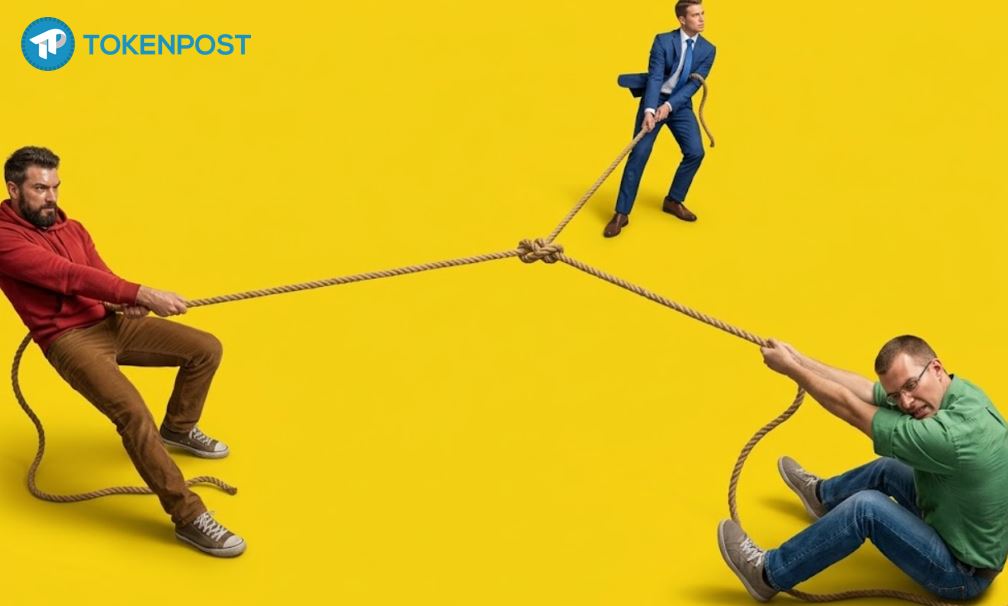
Round 1 — Game of Chicken: OG Holder vs. Agency
In economics, there is the concept of the Chicken Game. Two cars drive toward each other. The one who turns the steering wheel first loses. If neither side turns, both die.
This game is currently taking place between OG holders and institutions in the Bitcoin market.
Let's consider this from the perspective of an OG holder. I bought Bitcoin for $1,000. Now it is $70,000. Should I sell? Selling would result in a profit. However, if I sell in bulk, the price will plummet, and the value of my remaining holdings will vanish. More importantly, I know that the price is bound to keep rising unless I sell, because the supply is tied up.
Let's consider this from the institutional perspective. I need to buy Bitcoin. Clients want it, I have launched an ETF, and I have promised a certain volume. However, there is no supply to buy. OG holders are not selling. Unless I raise the price, they will never sell.
The outcome is predictable. Institutions turn the wheel first. They raise the price to pull out some of the holdings from OG holders. OG holders sell a portion, while the rest continue to hold on at a higher price.
In this chicken game, OG holders have a structural advantage. The person who doesn't have to sell is always stronger than the person who has to sell.
Round 2 — Prisoner's Dilemma: Among OG Holders
However, there is a game even among OG holders. This is the classic Prisoner's Dilemma.
Let's assume that OG holders A and B each have 100,000.
- If neither A nor B sells → Price continues to rise → Both make maximum profit
- If only A is sold → A realizes profit, the value of B temporarily decreases
- If you sell only B → the opposite case
- If you sell both → Price crash → Both lose money
The rational choice is cooperation, that is, not selling either.
In fact, on-chain data proves this. While short-term holders continue to sell at a loss out of fear, long-term holders are moving in the exact opposite direction, actively expanding their positions. OG holders are implicitly cooperating, even though they have never met or reached an agreement. Bitcoin's 'HODL culture' is, in fact, the most successful social mechanism for creating a cooperative equilibrium in this prisoner's dilemma.
Round 3 — Nash Equilibrium: Why This Game Continues
Economist John Nash said that equilibrium is a state where no player has an incentive to change their strategy.
The Bitcoin market is currently in exactly that state.
- It is best not to sell the OG holder → Don't sell
- It is best for the organization to live → It continues to live
- When these two actions coincide → prices rise in the long run
- If the price rises → OG holders have an incentive not to sell further, and institutions have a reason to buy more.
This Nash Equilibrium reinforces itself. To break it, an external shock is required. Things like war, regulation, or a macroeconomic crisis. Currently, the war in Iran and stagflation are candidates for that shock.
Round 4 — The Institutions' Real Strategy: Buying Infrastructure, Not Volume
This is where the institutions' true ulterior motives are revealed. What they are buying might not be Bitcoin.
The Bitcoin held in the BlackRock ETF (IBIT) is held by Coinbase Custody. Fidelity has built its own custody. What does this mean?
OG holders hold the volume. However, institutions control the infrastructure: custody, payment rails, and regulatory frameworks. While individuals hold the assets, pricing and distribution structures are increasingly shifting into the hands of institutions.
Is this planned, or a natural result?
It is difficult to answer. However, the result is clear. The contradiction between Bitcoin's decentralization ideology and the increasingly centralized financial infrastructure is growing. Wall Street is overlaying a new system on top of the system designed by Satoshi Nakamoto.
Round 5 — Then what is the ant in this game?
I will be honest.
In game theory, the 'Last Mover' is in the most disadvantageous position because they enter after all information has already been reflected in the price.
If retail investors buy Bitcoin at $70,000, who does that money go to? It is either volume released by OG holders realizing partial profits or volume released by institutions adjusting their positions. Both groups are people who acquired the cryptocurrency at a much lower price than retail investors.
This is the harsh truth of this game. Retail investors may not be players, but rather providers of liquidity. Of course, if Bitcoin continues to rise, retail investors can also make a profit. However, that is not winning the game, but merely a byproduct obtained simply because the game continues.
Final question: Can this game end?
Nash equilibrium is not eternal. There are three scenarios.
Scenario A — An OG holder breaks the alliance. A major OG holder begins a panic sell. It is the moment of choosing betrayal in the Prisoner's Dilemma. A chain of sell-offs begins, and institutions start selling as well. This is the beginning of a true structural decline. Currently, the war in Iran, soaring oil prices, and stagflation are increasing the incentive for this betrayal.
Scenario B — Institutions completely take over the infrastructure. A structure is established where institutions completely control the price, despite the existence of holdings by OG holders. Bitcoin ceases to be a decentralized currency and becomes a new commodity for Wall Street. This is the scenario that Bitcoin maximalists fear the most.
Scenario C — Equilibrium persists. OG holders continue not to sell, institutions continue to buy, and the price trends upward in the long term. This is the scenario that the most people want to believe in. It is also a pattern that Bitcoin has historically demonstrated repeatedly.
We don't know which scenario will become reality. But one thing is certain.
Participating in this game without understanding it is a completely different game from participating in it with an understanding.
Where are you sitting right now?
Real-time news... Go to TokenPost Telegram
Your greatest risk is not the market. It is yourself.
Check My Investment DNA →<Copyright ⓒ TokenPost, unauthorized reproduction and redistribution prohibited>