On March 25, Meta notified approximately 700 employees of their departure, affecting five departments including Reality Labs, Facebook social media, recruiting, and sales. On the same day, the SEC disclosed an executive stock option plan, awarding stock options linked to a $9 trillion market capitalization to six core executives. This marks the first time Meta has granted stock options to its executives since its 2012 IPO.
While laying off employees, Meta also launched the most aggressive executive incentive plan in Silicon Valley history. These two actions taken on the same day are not contradictory, but rather two sides of the same strategy. The AI race doesn't need more people, it needs more expensive people and more machines.
With fewer people, each person becomes more "valuable".
2022 was Meta's peak year for employees, with a total of 86,482. That year, Zuckerberg bet everything on Metaverse, hiring like crazy, but the annual revenue actually dropped from $117.9 billion the previous year to $116.6 billion. Revenue per employee plummeted to a low of $1.35 million.
What happened next is well-known. In November 2022, 11,000 people were laid off, and another 21,000 were laid off in 2023, resulting in the company losing a quarter of its workforce. Zuckerberg named 2023 the "Year of Efficiency."
The results of this efficiency are evident in the numbers. According to Meta's Q4 2025 financial report, the company had 78,865 employees by the end of 2025, nearly 8,000 fewer than its peak. However, during the same period, annual revenue grew from $116.6 billion to $201 billion, an increase of 72%. Revenue per employee soared from $1.35 million to $2.55 million, an increase of 89%.
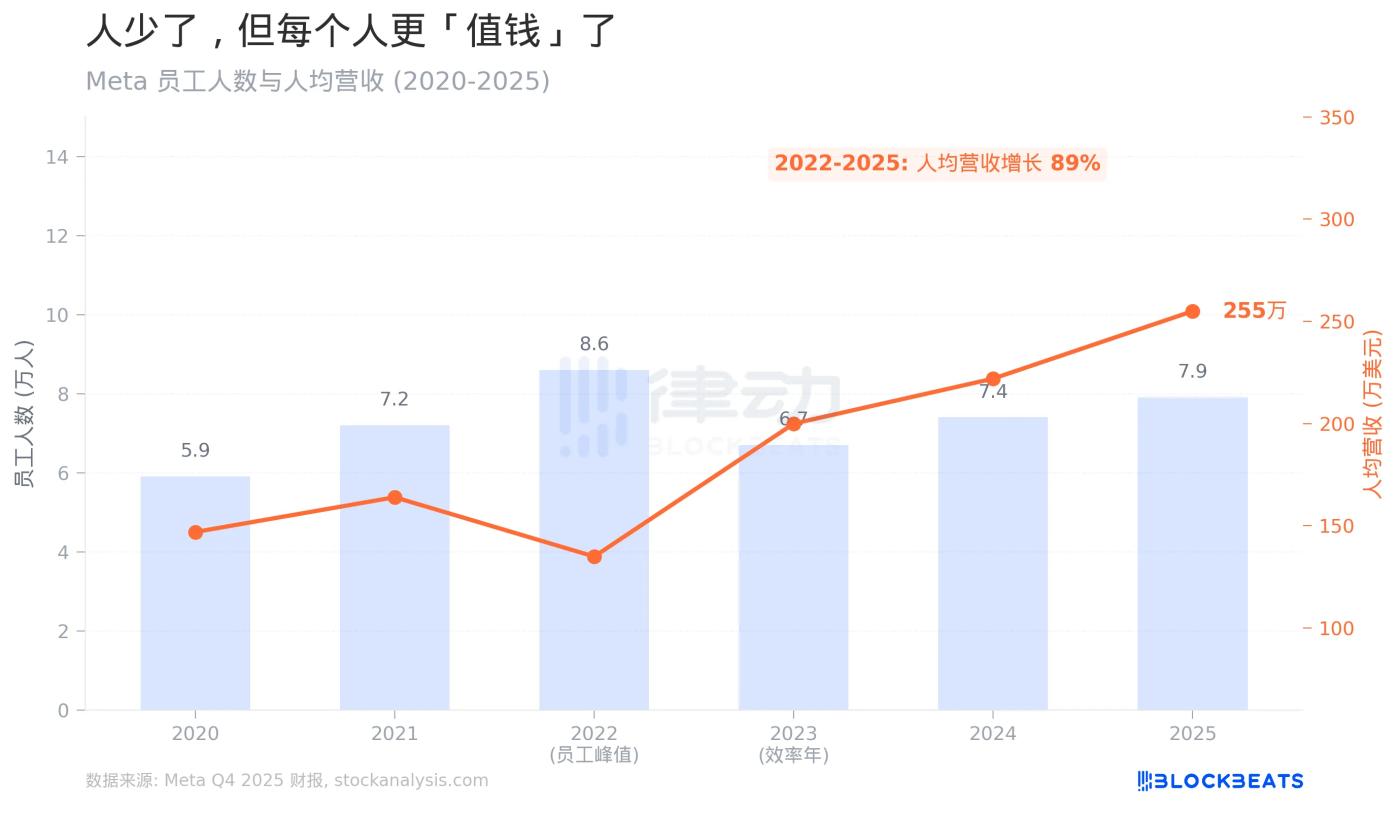
The meaning of these figures is straightforward. Meta made more money with fewer people. In 2022, the marginal revenue from adding one employee decreased, but by 2024 and 2025, the revenue increase from removing one employee actually increased. This is a typical scale effect for tech companies, but Meta accelerated this process through layoffs.
This is the background to the 700-person layoff in March 2026. According to The Register, this is Meta's second round of layoffs this year, following the reduction of approximately 1,000 people at Reality Labs in January. NBC News, citing sources familiar with the matter, reports that there may be even larger cuts, potentially affecting up to 20% of the total workforce, or approximately 15,000 people, which would reduce Meta's total workforce back to 2021 levels.
Zuckerberg's exact words during the January earnings call were that the plan was to "flatten teams" so that outstanding individual contributors could complete projects that previously required large teams. A Meta spokesperson's response was also formulaic, stating that "teams are regularly reorganized or adjusted to ensure they are in the best position to achieve their goals."
Continue betting on the AI arms race
Where did the money saved from layoffs go? A glance at capital expenditures will make it clear.
According to the Q4 2025 financial reports and public guidance of the companies, Amazon, Google, Microsoft, and Meta's combined capital expenditures in 2026 will reach approximately $650 billion, representing a year-on-year increase of approximately 130%. Specifically, Amazon's expenditures are approximately $200 billion (a year-on-year increase of 167%), Google's are approximately $175 billion to $185 billion (a year-on-year increase of 140%), Microsoft's are approximately $145 billion annualized (a year-on-year increase of 127%), and Meta's are $115 billion to $135 billion (a year-on-year increase of 73%).
According to CNBC, this is the largest single-year capital expenditure in the history of the tech industry. The combined AI infrastructure investment by four companies in one year exceeded Sweden's annual GDP.
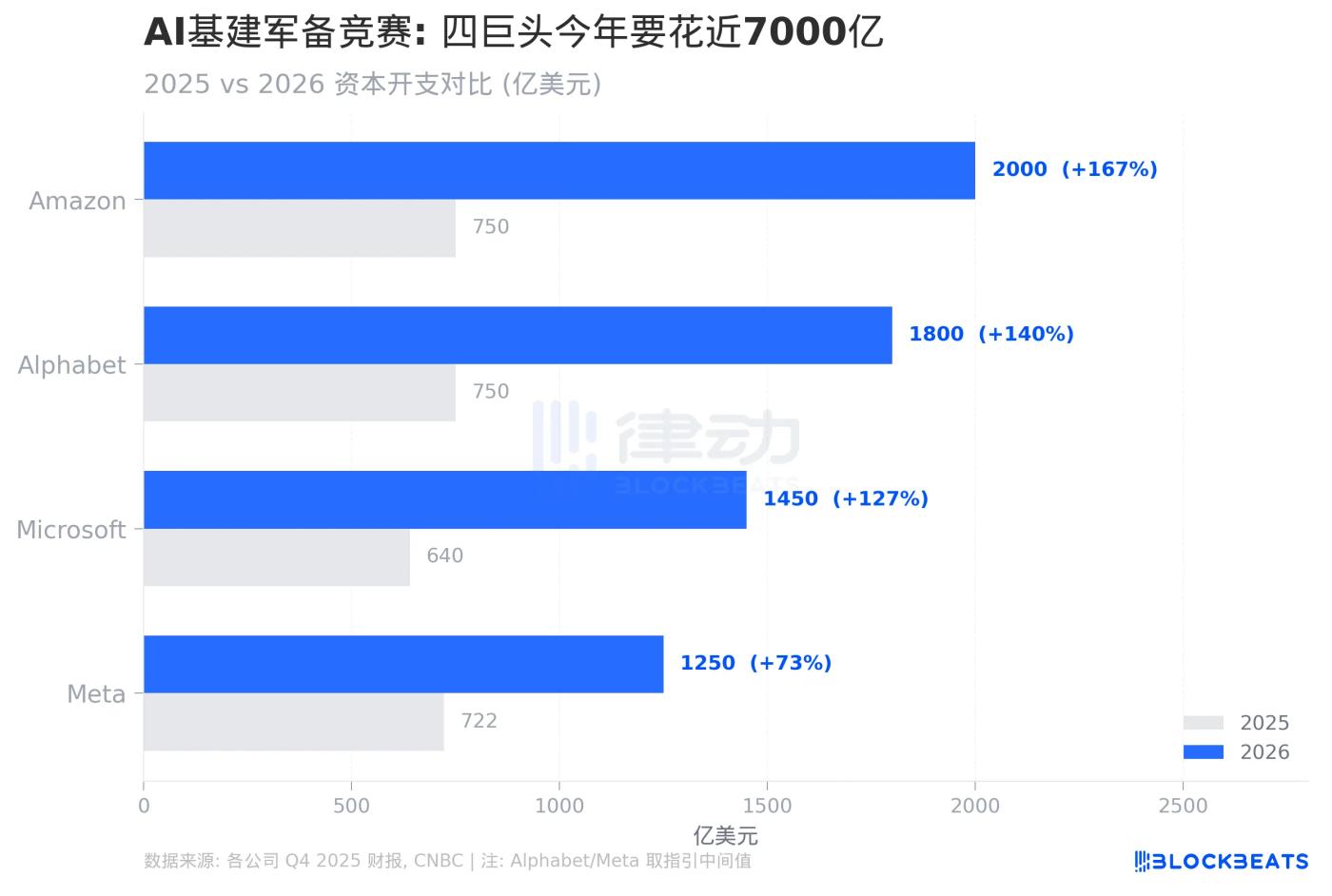
Meta ranks fourth in absolute terms, but the density of this investment is astonishing relative to its size. Using a median of $125 billion, the AI infrastructure investment per Meta employee is approximately $1.59 million, close to 62% of its revenue per employee ($2.55 million). In other words, Meta invests an average of $62 in data centers for every $100 it earns.
The cost of this investment is also immediate. According to CNBC, citing Barclays analysts, Meta's free cash flow will decline by nearly 90% in 2026. Amazon is even more aggressive; Morgan Stanley predicts Amazon will experience approximately $17 billion in negative free cash flow in 2026. All four giants are doing the same thing: trading today's cash flow for tomorrow's AI infrastructure.
A $9 trillion bet
Let's look at the stock option plan. According to SEC filings and analysis by Motley Fool, the plan covers six executives: Chief Technology Officer Bosworth, Chief Product Officer Cox, Chief Operating Officer Olli-Wan, Chief Financial Officer Susan Lee, Chief Legal Officer Mahoney, and Vice Chairman McCormick. Zuckerberg is not on the list; his super-voting stock holdings already eliminate the need for additional incentives.
The options' exercise conditions feature a tiered price threshold. According to Motley Fool, the lowest exercise price is $1,116 per share, requiring an 88% increase in the stock price from the current level of approximately $615. The highest tier is $3,727 per share, corresponding to a market capitalization of approximately $9 trillion, six times the current $1.5 trillion. The options have a five-year vesting window, expiring before 2031. If Meta does reach a market capitalization of $9 trillion, Motley Fool's calculations suggest that the top four executives (Bosworth, Cox, Olli-Wan, and Susan Lee) would each potentially gain approximately $2.7 billion.
The message of this plan is clear. Meta isn't giving bonuses to executives; it's using stock options to bind its core team to an extremely aggressive growth target. With a current market capitalization of $1.5 trillion and a target of $9 trillion, Meta is betting on the $7.5 trillion difference that AI can create.
Consider the scale. $9 trillion is roughly equivalent to the combined market capitalization of Apple and Nvidia. No company in the world has ever reached that market capitalization. Meta gave its core executives five years to attempt a figure that doesn't exist in the history of human business.
A formula
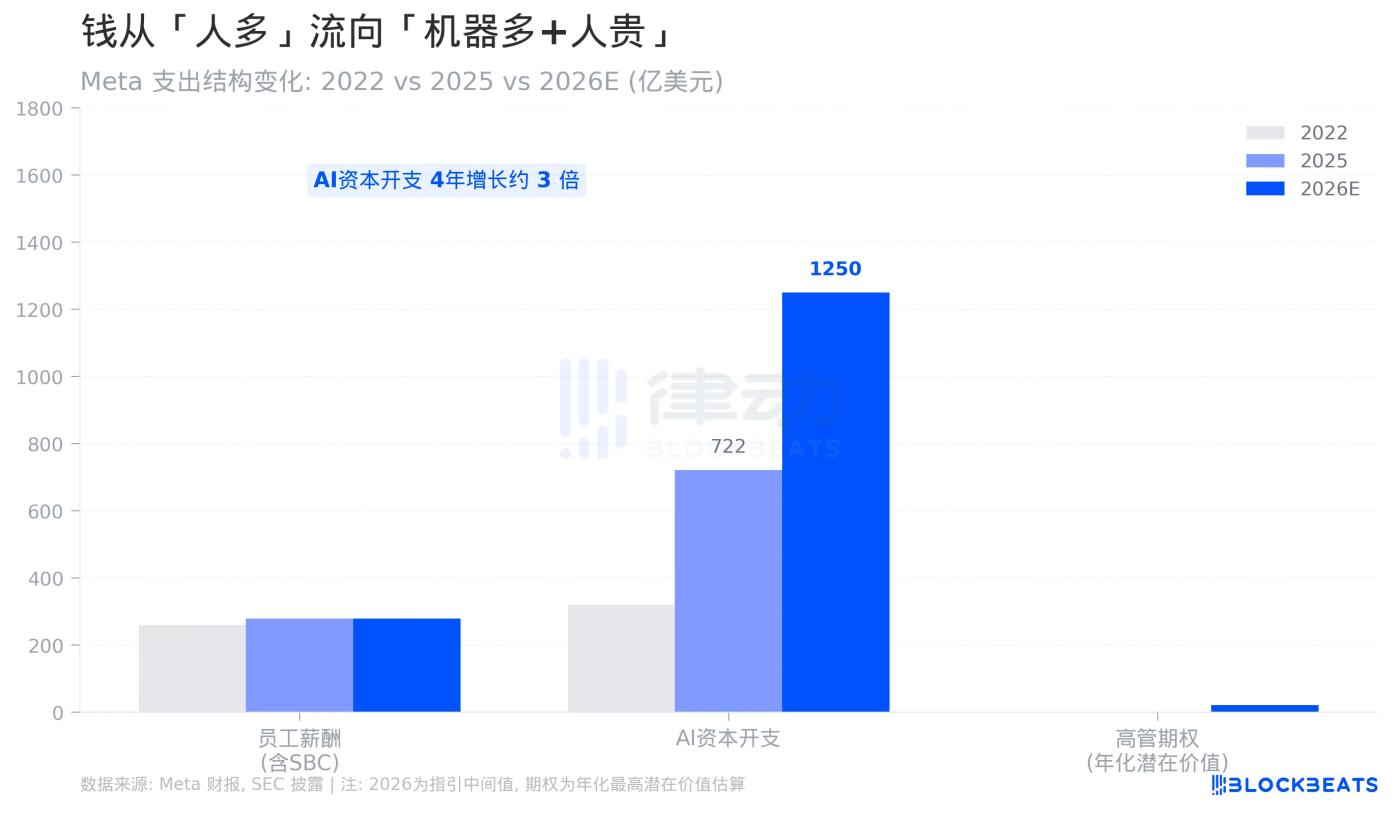
Looking at these three things together, Meta's logic is a simple resource allocation formula. Total employee compensation (including stock options) remained relatively stable in 2022 and 2026, hovering around $26-28 billion. However, AI capital expenditure surged from $32 billion to $125 billion, roughly tripling in four years. Simultaneously, a brand-new executive option pool emerged, locking up the six core individuals for the next five years.
According to Benzinga, Meta's equity incentive expenses in 2025 are estimated at around $42 billion, already consuming most of its free cash flow. Signing bonuses for AI researchers are in the nine figures, with researchers poached from OpenAI reportedly receiving signing packages worth $100 million. The contrast between these figures and the 700 laid-off employees speaks volumes about Meta's pricing logic for "people."
The money saved by laying off 700 people is roughly equivalent to one and a half days of Meta's AI infrastructure spending.