Some people are born to trade, while others are born to be the ones who get taken advantage of (this might not be a joke).
In recent years, taking the MBTI personality test has become a basic internet activity. Some people use it to explain why they are socially anxious, some use it to determine if they are suitable for dating, and it can even determine whether someone is "more suited to working overtime or lying down." Simply put, it does a very useful thing—it helps people acknowledge a reality: many behaviors are actually already written into their personality.
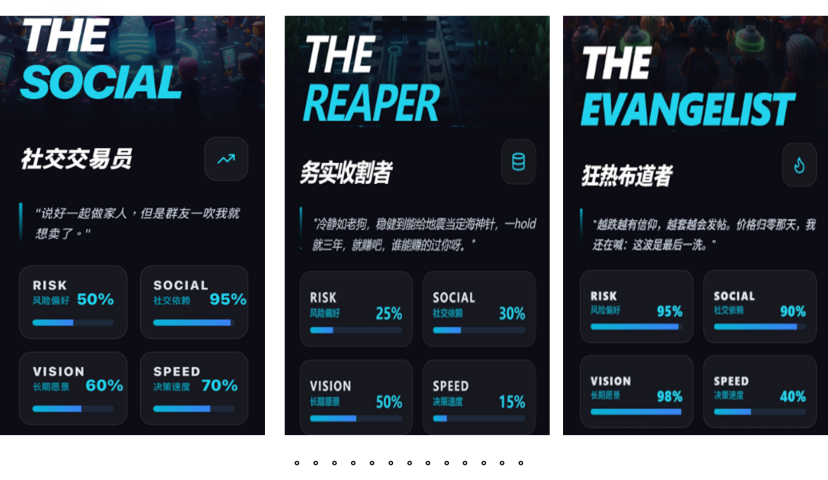
But it becomes even more interesting if we apply this logic to the trading market.
Because here, "personality differences" don't cause communication problems, but rather real financial gains and losses.
Some people will instinctively rush in when they see the price rising.
Some people instinctively pretend to be dead when they see a decline.
Even those who have lost so much they're numb will still tell themselves: wait a little longer, it'll rebound soon.
These reactions are often not decisions made after careful consideration, but rather conditioned reflexes.
So you'll find a somewhat cruel phenomenon: some people lose money not because they lack skills, but because they are inherently bad at doing this.
In the same market situation, some people made money, while others posted screenshots on their social media saying, "I got a lesson again."
The most amazing thing about the trading market is:
The market information is publicly available, the candlestick charts are identical, and the news is released simultaneously.
But the results are never the same.
Some people make steady profits during market fluctuations, while others repeatedly suffer losses in the same fluctuations. Still others manage to buy precisely at the highest point every time, then take a screenshot and post it in the group saying, "How did I catch a falling knife again?"
Over time, you'll realize a very real problem:
Many people don't lack trading skills; they just keep repeating the same mistakes.
Some people are the type who "buy the dip as soon as prices rise".
Some people belong to the "fight to the bitter end" type.
Some people fall into the classic "make a little money and run, lose a little money and hold on" pattern.
These patterns are like a hidden personality setting; once formed, they operate automatically.
You think you're making decisions based on market conditions, but often you're just executing your default program.
WEEX Labs suggests: First, figure out "what kind of person" you are.
Because of this, a rather interesting trend has recently emerged: traders can also test themselves.
It's not about testing technical skills or market judgment, but about testing something more fundamental— what kind of trader are you?

For example, a " trading personality test " recently launched by WEEX AI Labs is a typical example.
The questions it asked were very simple, such as:
• When the market suddenly crashes, is your first reaction to buy more shares or to close the app?
When you are making consecutive profits, do you continue to add to your position, or do you start to become more cautious?
• When a strategy fails, do you adjust the rules, or gamble that it will come back?
The final result is often not "what you should buy", but a more sobering answer: how you usually lose money.
Of course, this kind of test won't help you double your money overnight, nor will it predict the next bull market.
But it can at least help you see one fact clearly—
The market changes every day.
Your own trading style may not have changed for many years, right?