Against the backdrop of Real-World Assets (RWA) gradually becoming an important development direction in the blockchain industry, ECVault recently announced the official launch of its Web2.5 + RWA on-chain treasury system. This system revolves around two core ideas: "lowering the barrier to entry" and "introducing high-quality assets," attempting to bridge the gap between traditional assets and the on-chain world, providing a new structural solution for asset allocation.
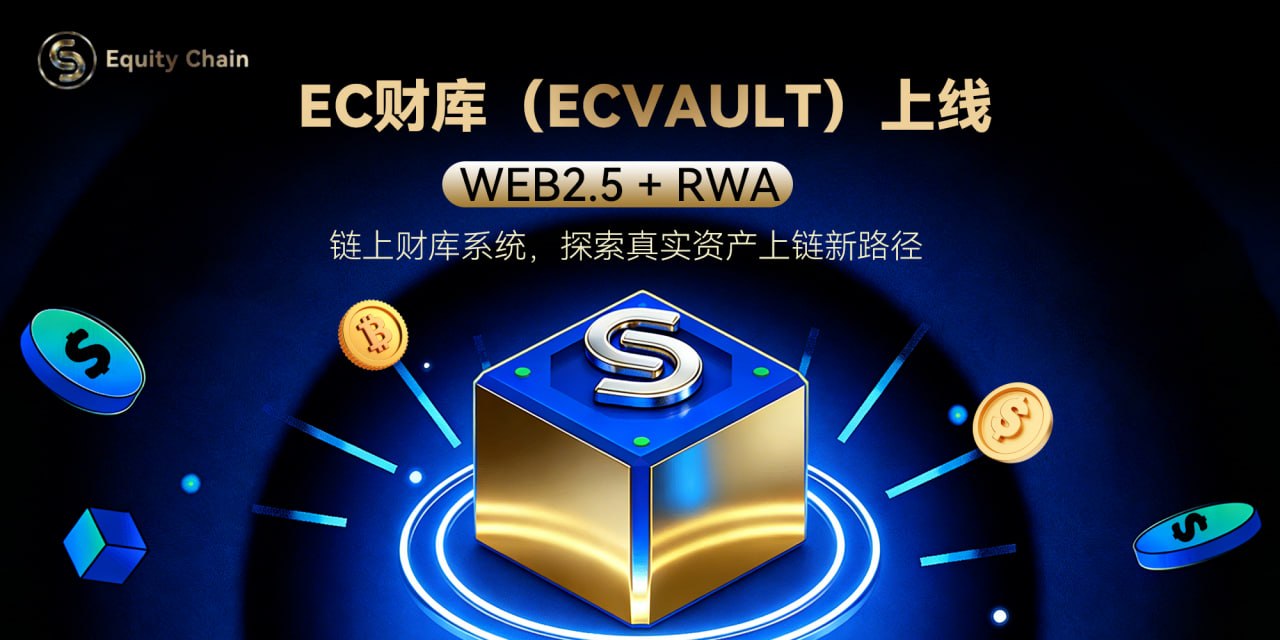
According to reports, EC Treasury sets the user participation threshold at 100 USDT. Through the on-chain treasury mechanism, it integrates asset management and allocation processes, enabling more users to access and participate in asset allocation opportunities that were previously mainly targeted at institutions or high-net-worth individuals.
The RWA (Real-Wait Asset) space is heating up, and the demand for on-chain asset allocation is gradually emerging.
In recent years, with the maturation of blockchain infrastructure and the gradual clarification of the compliance environment, RWA (Real World Assets) has become one of the key areas of focus in the industry. By mapping real-world assets on-chain, RWA attempts to improve asset transparency and liquidity, while expanding its global configurability.
However, from an industry practice perspective, RWA still faces several challenges, including:
Insufficient disclosure of asset information
• High investment threshold
• The profit distribution mechanism is not transparent.
• There is a structural gap between on-chain and real-world assets.
Against this backdrop, how to achieve "on-chain, circulate, and distribute" assets has become a key issue in the current development of RWA.
Constructing a three-tiered architecture of "Web2.5 + RWA + on-chain treasury"
EC Treasury proposes an overall architecture centered on "Web 2.5 implementation layer + RWA + on-chain treasury system", attempting to solve the above problems through layered design.
in:
• Web 2.5 Layer: Serving as a transitional structure between real-world business operations and blockchain, balancing traditional business logic with on-chain execution mechanisms.
• RWA Layer: Responsible for on-chain mapping and structured representation of real-world assets, related rights and interests, and cash flows.
• On-chain treasury system: Unified management of assets, and completion of allocation, transfer and incentives on the blockchain.
The project team stated that the structure is designed to reduce friction during the asset on-chain process, while improving the operability and composability of assets on the chain.
The shift from a "high-barrier entry" model to one that allows for "participatory configuration"
Traditional primary markets have long had high barriers to entry, making it difficult for ordinary users to participate in the early stages of high-quality asset allocation. Furthermore, there is a lack of transparency in asset information access and profit distribution mechanisms.
EC Treasury incorporates a low-barrier-to-entry participation mechanism in its design and achieves unified asset management through an on-chain treasury. According to the project team, its operational logic can be summarized as follows:
Assets enter the treasury → The treasury is integrated into the ecosystem → The ecosystem distributes profits.
This mechanism aims to improve the transparency of the asset allocation process and provide participants with a clearer path while ensuring a clear structure.
Focusing on high-growth assets, the first batch covers technology and cutting-edge fields.
Regarding asset selection, EC Treasury stated that it will focus on companies with growth potential over the next 3 to 5 years and prioritize targets that are representative of their respective industries. The first batch of assets includes:
Unitree Robotics (a company in the robotics and intelligent manufacturing field)
• OpenAI (an artificial intelligence technology company)
SpaceX (commercial spaceflight company)
The project team stated that it will gradually expand the scope of assets based on market developments and asset valuation standards.
Technical foundation: Built on the modular L1 public blockchain ENI
The EC Treasury system runs on the modular L1 public blockchain ENI. Official data shows that the network has high performance and scalability, and supports EVM ecosystem compatibility.
On the technical level, ENI primarily provides:
High throughput capacity (supports large-scale transaction processing)
Real-time settlement capability
Modular architecture facilitates system expansion.
• Compatibility and support for existing Ethereum ecosystem tools
In addition, a points incentive mechanism has been introduced into the system to encourage users to participate in ecosystem activities and improve overall activity.
From "asset on-chain" to "asset networking"
The EC Treasury team stated that its exploration direction is not only to achieve on-chain mapping of assets, but also to establish connection relationships between assets through on-chain treasuries.
In this model, assets no longer exist as isolated entities, but rather enter the ecosystem through a unified structure, forming interconnected relationships within the system. This process is described as a shift from "asset on-chaining" to "asset networking."
The project team believes that this model helps improve asset liquidity and collaborative efficiency, and provides more stable value support for the on-chain economy.
Promoting global market layout
In terms of development planning, EC Treasury has launched a globalization strategy. According to disclosed information:
• Second quarter of 2026: Starting from Hong Kong, expand into the Asia-Pacific market and gradually enter the Middle East and Europe and the Americas.
• Short-term goal: To achieve approximately $100 million in TVL (Total Value Locked).
• Medium- to long-term goal: To build a larger-scale on-chain asset network
About ECVault
ECVault is a Web2.5 + RWA on-chain treasury system built on the ENI public chain. It is committed to promoting the on-chain mapping and structured allocation of real-world assets and exploring the application of blockchain technology in the real economy.