AI-driven predictive financial infrastructure is achieving a structural breakthrough.
As the global financial system continues to move towards digitalization and intelligence, the logic of market operation is undergoing a profound restructuring. It is gradually evolving from a "passive reaction trading system" based on historical data and experience to a "prediction-driven financial structure" based on data modeling, probability extrapolation, and forward-looking decision-making. This change brings not only optimization at the efficiency level, but also a fundamental upgrade to the entire way financial resources are allocated.
Under this macro trend, Infinite Galaxy Protocol (IGP), as a new type of protocol that integrates AI prediction engine, decentralized finance protocol and liquidity structure reshaping capabilities, is moving from the early operation and verification stage to a more decisive development stage—the token ecosystem consensus co-construction stage—after completing about two months of market operation and continuous optimization.
This phase is also seen as an important milestone in the deep integration of the TRT and AOT ecosystems. With the upgrade of the protocol algorithm and the further strengthening of the dual-token synergy mechanism, the overall ecosystem of Infinite Galaxy Protocol will gain stronger endogenous driving force and long-term value carrying capacity.
Two-month operation cycle: a critical transition from mechanism verification to structural closure
Compared to project paths that rely on narrative-driven approaches, Infinite Galaxy Protocol enters the real market environment immediately after its launch. Through continuous mechanism optimization and structural calibration, the protocol gradually forms an inherent synergy between liquidity capacity, revenue distribution logic, and user behavior feedback, thereby driving the entire system from "functional existence" to "structural establishment".
In its actual operation, the protocol transforms on-chain funds into a recyclable liquidity structure through an automated market-making mechanism and a value mapping algorithm. At the same time, it realizes the mapping process of AOT to stable value units through a revenue settlement mechanism, thereby reducing the impact of market price fluctuations on actual returns from a mechanism perspective and making returns more continuous and predictable.
At the same time, by introducing the linkage logic between liquidity contribution and holding stability, the system has enhanced the retention capacity and depth of funds within the protocol to a certain extent, so that liquidity is no longer a short-term behavior, but gradually evolves into a structural component. This also makes IGP exhibit certain system stability characteristics in the early stages.
Ecological consensus phase: From "operating system" to "network structure"
As the basic operation phase gradually stabilizes, the Infinite Galaxy Protocol enters the stage of building an ecosystem consensus. The core change in this stage is that the protocol no longer relies solely on internal mechanisms to maintain its operation, but instead gradually incorporates participants into the entire network structure through a multi-layered incentive structure and node system, thereby realizing the transformation from a "single-point system" to a "collaborative network".
In this structure, the protocol creates an inherent closed loop between revenue distribution, liquidity incentives, and network expansion through the linkage between the basic revenue module, the vortex engine incentive module, and the network incentive module. Furthermore, through node quantity limits, level mapping mechanisms, and network hierarchical reward structures, it promotes the ecosystem's gradual transition from early participation to an organized and structured network expansion process.
This evolutionary path from "mechanism-driven" to "structure-driven + consensus-driven" is often an important indicator of a protocol's transition from the product stage to the ecosystem stage.
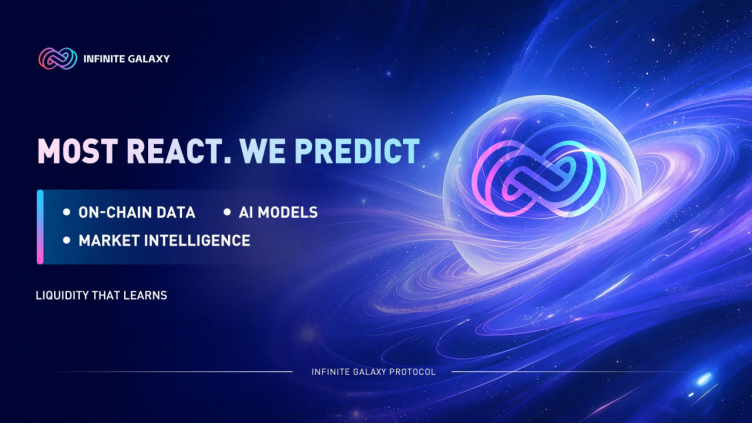
AI Prediction Coupled with Liquidity: A Structural Restructuring of Financial Efficiency
From a technical architecture perspective, the core innovation of Infinite Galaxy Protocol lies not in a single functional module, but in its construction of a system framework that deeply couples predictive capabilities with liquidity structure, enabling capital allocation to shift from passive response to active scheduling.
IGP accesses on-chain transaction data, market behavior data, and external information sources through the data and signal layers. It combines time series models (LSTM and Transformer), sentiment analysis models (NLP), and trend judgment models in the AI prediction engine to perform probabilistic modeling of the future market. The prediction results are then directly applied to liquidity allocation and parameter adjustment, enabling liquidity itself to have a forward-looking scheduling capability, rather than just being a passive receiving tool.
Building on this foundation, the prediction and liquidity coupling layer further enables dynamic allocation of funds and risk adjustment, while the economic and governance layer completes value carrying and system governance through the dual-token system and DAO mechanism, making the entire protocol form a complete closed-loop structure consisting of "data-prediction-liquidity-value".
Dual-token model: A layered design for stability and growth momentum
At the economic model level, Infinite Galaxy Protocol separates value carrying and incentive mechanisms through a dual-token system of AOT and TRT, thereby establishing a balance between system stability and scalability.
Among them, AOT, as the core value token, undertakes key functions such as protocol governance, value mapping, and revenue bearing. Its design goal is to gradually enable it to have long-term value support capabilities through deflationary mechanisms and value anchoring logic. TRT, on the other hand, serves as an incentive token, mainly used for ecosystem incentives, liquidity driving, and behavior activation. It maintains system activity through continuous release and circulation, thereby forming a dual-drive structure of "value accumulation + incentive expansion".
Under this structure, in conjunction with LP pool support, automated market making mechanism, and transparent on-chain execution logic, the protocol establishes a relatively stable operating framework between fund flow paths and value distribution mechanisms, making the entire economic system more sustainable and verifiable.
Industry Perspective: The Key Position of Prediction Markets and DeFi Integration
From an industry structure perspective, Infinite Galaxy Protocol is situated in one of the most promising intersections in the current evolution of the financial system, namely the fusion node of prediction markets and decentralized finance.
On the one hand, DeFi, as an on-chain financial infrastructure, is continuously carrying the migration of global funds to decentralized systems and gradually forming a new liquidity structure. On the other hand, prediction markets are evolving from information tools into "future pricing mechanisms," the essence of which is to transform uncertainty into tradable probabilistic assets. When the two are combined, it means that the logic of fund allocation will shift from "based on the past" to "oriented towards the future."
Against this backdrop, IGP embeds AI prediction capabilities into the liquidity system, enabling prediction results to directly participate in fund allocation, thereby achieving a structural improvement in financial efficiency to a certain extent. This is also an important direction that distinguishes it from traditional DeFi protocols.
Value Prospects: A Leap from Structural Establishment to Ecological Expansion
As the Infinite Galaxy Protocol enters the stage of building ecosystem consensus, its development logic is also undergoing a key transformation, gradually transitioning from an early stage centered on mechanism verification to a growth stage driven by ecosystem expansion and consensus strengthening.
In this phase, user roles will no longer be limited to single participation behaviors, but will gradually be integrated into the node system and network structure, becoming part of the ecosystem. The source of value will also evolve from a single revenue logic to a multi-dimensional value system composed of liquidity, network structure, and protocol operation.
This shift from "participation" to "co-construction" is usually a key watershed moment for whether an agreement can enter a long-term development track.
Conclusion
With the continuous penetration of AI technology into the financial sector, predictive capabilities are becoming an important variable affecting market efficiency and resource allocation, and a new financial structure centered on prediction is gradually taking shape.
The Infinite Galaxy Protocol is attempting to build an infrastructure model that deeply integrates predictive capabilities, liquidity structures, and value systems. As the ecosystem consensus phase begins, the system structure will be further strengthened, network collaboration capabilities will continue to improve, and it is expected to bring participants a more stable and sustainable value space in the future.