Author: Kyla Scanlon , Macro Analyst
Compiled by: Felix, PANews
Macro analyst Kyla Scanlon recently published a lengthy article arguing that the "optimization" narrative peddled in contemporary society is essentially escapism. It turns the body, self, and beliefs into tradable assets, creating a dependence on "quick fixes" while never addressing the systemic root causes. Details are as follows.
I had to start trying an elimination diet because my gut was self-consuming, which was apparently destroying my thyroid and preventing it from absorbing any nutrients. To fix this, I had to stop eating wheat, dairy products, corn, eggs, tomatoes, peanuts, coffee, soy, cocoa, sugar, and many other things (this isn't a juice detox or anything fun; it's an action I had to take to stop my body from attacking itself). I had to keep a record of what I ate and how I felt, and then assess what I could eat from that.
If there's a quick fix (like an injection), I'll try it. I don't know what's wrong with me; I only know I had several vials of blood drawn, and modern science tells me that something is very wrong with my body.
But interestingly, part of the problem is that I always try to take shortcuts. Last year I was traveling for 40 weeks straight, and on some days I survived on oat bars and about 14 cups of coffee. I also ran like crazy, worked like crazy, and slept very little because I felt completely invincible. After all, I used to be a "efficiency machine."
For a time, I was like that, but not anymore. It turned out I wasn't really optimizing anything; I was just avoiding what I was actually doing, like sleeping. What I needed wasn't to keep pushing myself, but to start figuring out what was making me sick. This is the exact opposite of what we've been taught.
"Smegglutination"
Americans love optimization. So when something promises to let us optimize further or provide near-instantaneous fixes, it's hard to refuse. Our identity is almost entirely built around "efficiency."
People now have a very strong desire for control, a desire that permeates every corner of the digital and physical world.
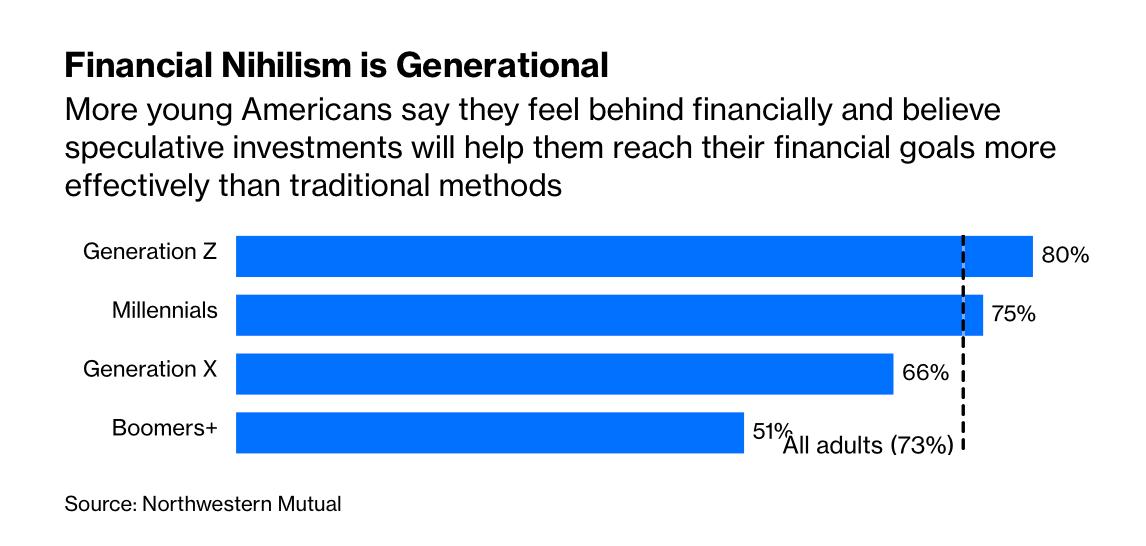
- I think this is actually a response to financial nihilism. People no longer believe that the underlying economy will serve them, and instead resort to speculation, gambling, or other seemingly quick ways to achieve stability.
- According to a Northwestern Mutual survey, 80% of Generation Z and 75% of Millennials feel left behind, a feeling that drives them to engage in speculation.
- The same applies to social media: if you struggle to build relationships in real life, the online world offers a kind of alternative, but people are increasingly uneasy about the collective reliance on social media.
Following this, some industries emerged, monetizing this nihilism by offering promised solutions. But the solutions will never materialize, because nihilism and the spirit of renunciation must persist for these products to survive. This aligns with the views of Ivan Illich in *The Limits of Medicine*. Illich points out that the healthcare system itself creates disease because it makes people dependent on professional interventions rather than committed to maintaining health. This effect exists in all optimization tools, which create dependence on "fixative measures" rather than addressing the root cause. An "optimization economy" cannot bring a sense of control because "despair" is itself its market operating condition, and pursuing control through optimization is itself a form of loss of control.
Our tools are also too focused on the individual. As Raymond Williams wrote in his 1975 book, *Television: Technology and Cultural Form*:
The early era of public technologies, exemplified by railways and urban lighting, is being replaced by a technology whose name has yet to be satisfactorily found: a technology that serves a lifestyle that is both mobile and home-centered: a form of mobile privatization.
Williams describes a shift from infrastructure serving everyone to technologies built around mobile, private individuals. The shift from railroads to peptides is a shift from "we build for everyone" to "you can buy for yourself."
A truly effective example of a personal optimization tool is Ozempic (semaglutide, a weight loss/blood sugar lowering drug). Some people use it for medical reasons, while others openly admit to using it for beauty. To be clear, Ozempic is an excellent technology that does address real-world problems faced by individuals, but it doesn't address collective issues such as the food system and healthcare accessibility.
This also marks a shift. We can truly take control of certain aspects of the human body with time and resources. What we now possess is "Ozempic" optimization, or "Ozempicization," of everything. We now have a suite of peptides and various other forms of "magic injections" that can save you effort, discomfort, and complexity. Everything can be optimized. Everything can be controlled.
Control the body
The body has always been a place of control because it is a system that still responds to external inputs. But today, various systems are hostile. Economics and institutions often ignore individual plight, but the body does not.
It's no surprise that Bryan Johnson's multi-million dollar "eternal youth" experiment has garnered widespread attention. Bryan Johnson possesses something everyone craves—complete control over the outcome. The allure of "immortality" lies in this sense of control: control over your nutrition, supplements, and lifespan. And for the audience, that's precisely its appeal: in an era where everything feels out of control, the body becomes something that can be managed.
This pattern is all too common. Personally, during my university years, my father became seriously ill, I developed a severe eating disorder, and I tried to regain control of everything. When all external factors become uncontrollable, control over the body becomes the last line of defense (regardless of gender). Throughout humanity, many ultimately resort to body control. And this form of control is gradually becoming a form of content consumption.
Clavicular is a rising streamer known for his "bone-crushing" and "maximum visual appeal" in a self-constructed WWE-like universe. His universe has its own language, a battle for the title of "Number One Man" (determined by an online leaderboard). He is obsessed with his appearance and with control.
"Maximizing physical attractiveness" simulates a value (status, charisma) that these individuals may not possess economically. It's a form of control over the body to compensate for their lack of economic control. This phenomenon also appears in health culture, peptide drugs, cosmetic surgery, and various enhancement methods. It satisfies an individual's desire to become healthier or stronger, but it also serves economic purposes—another form of control.
The buzzword in Silicon Valley right now is "agency," which is essentially a veneer for a desire for control. Optimization is the process, control is the goal, and "agency" is brand building. In the startup world, the meaning of "agency" is ambiguous, but it does suggest that someone will somehow force the world to submit to their will.
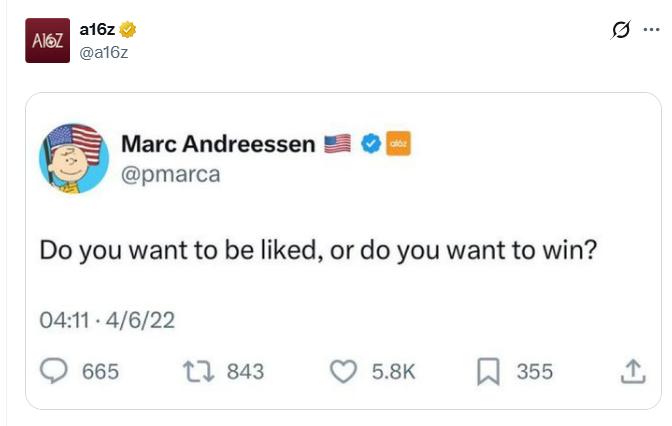
Cluely is a company that wholeheartedly embraces this philosophy, arguably the ultimate boss of the "startup economy." Their initial idea was "fraud" (later evolving into AI note-taking), and they've raised millions of dollars. For them, "fraud" is "agentic," and as Sam Kriss writes in his article "Child's Play," it truly is "Silicon Valley's hottest commodity."
The future belongs to those with specific personality traits and sexual psychological disorders. AI may be faster at programming than you, but humans still possess an advantage: autonomy, or rather, a high degree of autonomy. Highly autonomous people are those with strong initiative.
Their actions stem from a fear of permanently relegating themselves to the bottom of society and becoming useless in the age of AI. Clearly, the way to avoid either of these situations is to "constantly follow trending topics online."
Bryan Johnson's approach is highly autonomous and heavily reliant on the internet. He has been experimenting with supplements and hallucinogens and strictly adhering to a diet and exercise plan. This is perhaps the greatest degree of control (or autonomy) anyone can have over their own body. In fact, he is trying to achieve such control that he almost plays the role of God in a sense.
People have to ask themselves:
- Do I believe his claim that we can live forever?
- Do I believe his body is a testament to the concept?
- Do I believe that the content he continues to create is sufficient to prove the credibility of this project?
This quickly evolved into a faith market, and Bryan Johnson became an asset. The same was true of Cluely, where investment was based on belief—a belief in control and autonomy. But once the body (or, in terms of autonomy, the mind) becomes an object that can be optimized, the self becomes an asset class. It's primarily driven by narrative, and once this happens, you've fallen into the logic of a faith market.
Market of Faith
Prediction markets and cryptocurrencies follow the same logic: betting on narratives rather than fundamentals, and gaining autonomy through participation. Belief markets promise a way out of limitations (both physical and financial). They monetize the fear of being left behind, specifically through:
- I died while others were still alive.
- I didn't cheat when others were cheating.
- I was poor when others were rich
All of this signifies an ongoing shift:
- Old capitalism emphasized production capacity, that is, the ability to manufacture products.
- Financial capitalism emphasizes cash flow rights, that is, the right to claim future returns.
- We might call the value of faith-based capitalism narrative dependence, which means keeping enough people immersed in a story for a long time so that the story can maintain its influence.
Belief markets need to create an illusion of easy participation to survive. They peddle the message, "You can do it too." Coinbase's Brian Armstrong shares a similar mindset with Bryan Johnson. He's also passionate about longevity and biohacking (and prediction markets), and believes that aging should be avoidable in the future.
This philosophy is also reflected in his products. Coinbase's prediction market slogan, simply put, is "Take back control." Its prediction market competitor, Kalshi, advertises "Make your descendants proud of you."
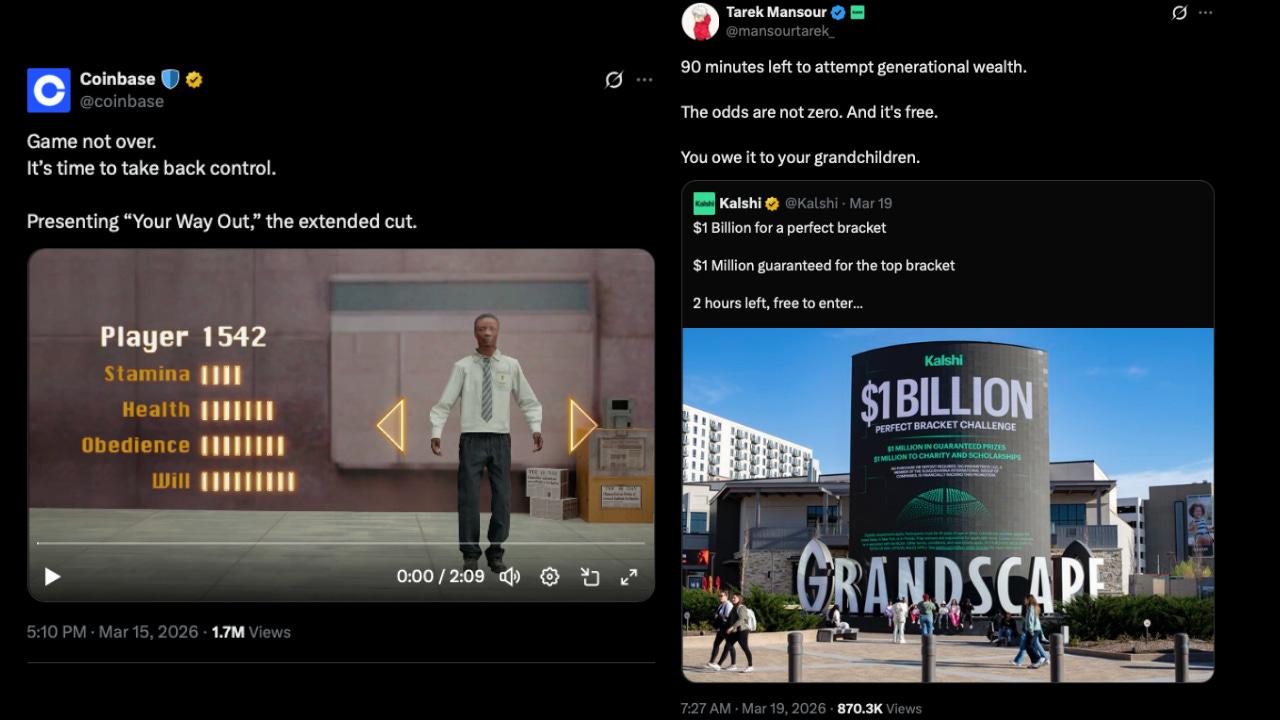
Take control of your future with a friendly neighborhood betting app. The founder of another prediction market app, Novig, once said that only 20% of their users make money, claiming that this is far higher than other companies in the industry. This doesn't sound like control, nor does it sound like the future.
Everyone is chasing gold. Everyone is trying to get rich quick and easy, as Allison Schrager wrote, "Grab the next hot spot and then pray for good luck."
The pervasive lack of rules, coupled with promises of regaining control that are never fulfilled, is the exploitative nature of the faith market. There is a vast chasm between the promise of freedom and the actual outcome (enormous losses, even less freedom than before).
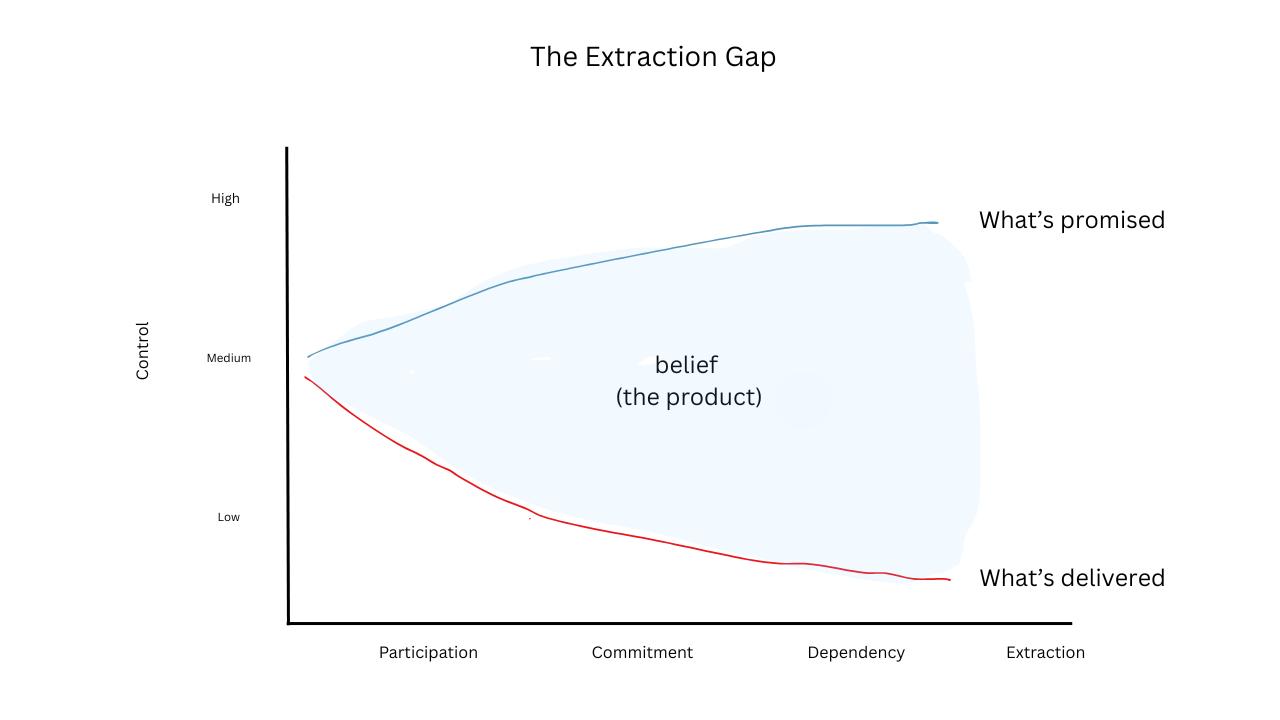
More illustrative than mathematics
Every "systemic failure" solution that promises a sense of control is packaged as a product that traps you in a deeper predicament you were trying to escape.
Case Study of the "Male Circle"
The exploitative logic of the faith market will migrate to any place where there are desperate people, and the "male circle": this online world that promotes masculinity, is a microcosm of this despair. I believe that the audience of the "male circle" is actually smaller than imagined, but it vividly demonstrates the desire for control, the faith market and its subsequent exploitation, and the novelty economy.
Louis Theroux's documentary, *Into the Men's Circle*, captures these belief markets in a thought-provoking way. It exposes the paranoia of broadcasting one's personal life to thousands of people. The men in the film fear being seen as insignificant, poor, weak, and unattractive, so they create imaginary enemies in their minds (Louis himself becomes one of them) and obsessively try to escape the "Matrix."
Streamers in the "male-dominated" (and other) circles are essentially like exhibits in a zoo. People throw treats into their "cages" and ask them to dance (for example, on Twitch and Kick, streamers can receive tens or even hundreds of dollars for answering questions, doing backflips, etc.).
This leads to the emergence of "bad habit signals" (catering to our darkest side), as viewers demand even crazier things, and broadcasters respond with even crazier behavior. This insane content is edited, published, and shared with the aim of going viral. Sometimes these clips are taken-out interviews, incitement of anger, or even worse, and everyone angrily shares them, ultimately spreading virally and further disintegrating society on the margins. You can even easily earn millions of dollars just from these video clips.
"Male-centric" online influencers are essentially pyramid scheme leaders. They recruit young men and women into their trading courses or brokerage firms, taking a cut of the profits to compensate for their pain and despair.
Prediction market Polymarket is doing something similar with its new referral program. Influencers on the prediction market are rewarded for bringing in new users to the platform, receiving a cut of the fees generated by those new users. Polymarket also follows a "male-centric" messaging strategy. As Stuart Thompson, David Yaffe-Bellany, and Mike Isaac wrote in The New York Times, they "amplify unverified claims and baseless conspiracy theories from the Trump administration" with the aim of "attracting young men who are highly likely to become paying customers."
They teach people it's easy, simple: just watch the oil price chart, see if there's a "Triple Witching Day" (PANews note: refers to the day when stock index futures, stock index options, and individual stock options all expire simultaneously in the US stock market; market volatility usually increases significantly around "Triple Witching Day"), or bet on snowfall, or bet on the Oscars, and most importantly, bet on yourself, and you can become a millionaire like me. Yes, you have to have it all easily because everything is so easy now. But that's not the case. As Benjamin Fogel wrote about Andrew Tate, a leader of the "male-dominated" movement:
He represents a new kind of capitalism that has no illusions about progress. To Tate and his fans, the entire system is a fraud, and the only way to succeed is to suppress others and climb to the top.
Tate is a central figure in the "male circle," and he never pretends to have done anything beneficial. He readily accepts his "plunder, exploitation, and ruthless pursuit of fame and fortune" because it's all a deception. He has a point. Fogel also points out:
The decade-long period of slow growth following the financial crisis gave rise to a "working economy" characterized by an unstable gig economy. This economic model, touted as empowering, was in reality merely a way to subsidize the income of the poor. Today, "working" has become completely equal. From Amazon dropshipping to cryptocurrency day trading, anyone can participate.
So, can you really condemn the "patriarchal circle" as "a scam, the strong preying on the weak," while simultaneously cheering for excessive stock buybacks or leveraged buyouts (extracting value by saddled with massive debt and layoffs in acquired companies)? The "patriarchal circle's" strategy is: extract value from the weak, assume no responsibility, and then shift the target; while the private equity model is: identify undervalued assets, improve operational efficiency, and return capital to shareholders. Is there really such a big difference between the two?
Chaos and nihilism are products of this regressive world, not symptoms. Those peddling "agency" profits in a world where no institution is trusted, because distrust is precisely the market environment that makes their product a necessity. Tate needs the system to be a scam, Polymarket needs uncertainty to be the norm; the worse the situation, the more effective their sales pitches.
Theroux interviewed "male-dominated" fans with heartbreaking experiences (as have some male-dominated creators), who suffered from homelessness, the loss of their fathers, and unemployment. They watched people like HSTikkyTokky because they wanted to emulate him; they wanted to be rich.
This behavior is merely a facade, but the message it conveys is effective. People believe it because they are inherently driven by a desire to find quick and easy solutions to these enormous and daunting problems. As Fogel wrote:
All of this has nothing to do with the progressive vision of capitalism, which sees capitalism as a system that increases productivity by creating labor-saving technologies or producing tangible goods. Instead, it peddles a consumerist ideology that breeds debt, anxiety, and loneliness.
Anxious and lonely people crave control. The "male-dominated world" extracts value from despair by exploiting the exotic. AI does the same thing, but it doesn't need a desperate person performing for a desperate audience. It replaces reality with a synthetic feeling. We've shifted from "exploitation through the exotic" to "simulation through the exotic."
Spectacles and War
We tend to seek control in every aspect of life, including access to information. Amanda Mull once wrote an article about “monitoring the situation”: People (myself included) are addicted to screens, trying to piece together all sorts of information. And there is indeed a lot of information to sort through: war, partial government shutdowns, unstable fiscal policies, weak labor markets, high prices, and so on. Browsing platforms like Twitter and reading open-source intelligence (OSINT) information gives us a sense of control and comfort. As Mull aptly put it:
If you could precisely adjust the algorithm of the information flow, you might be able to achieve a complete "witnessing," making you feel involved and even in control. After all, there is ample evidence that those who threw the bombs were also monitoring the same information flow as you.
We monitor the situation because monitoring itself creates a sense of involvement, and the government exploits this, replacing the real situation with sensationalism. Throughout the war, the White House relied entirely on AI-generated memes for communication, such as "Fruit Love Island" (an AI-generated TikTok account that used fruits to depict TV drama scenes), combining video game visuals with bombing scenes. According to Politico, a senior White House official expressed a similar view:
"Bro, we've been working on creating some really cool memes."
First it's a farce, then a tragedy, or something similar.
But just as individuals use various means to simulate control, institutions are increasingly resorting to novelty to simulate stability they can no longer guarantee. Novelty is the solution because seriousness requires accountability, accountability requires consequences, and consequences require institutions willing to implement them. Currently, such institutions do not appear to exist.
The Federal Reserve is on the sidelines, doing what it can in the current situation. The government is partially shut down. Corruption is spreading through the sewers and overflowing from the vents. Diplomacy has been replaced by memes. Iran and the United States have been waging war on Twitter. The Speaker of the Iranian Parliament tweeted:
We know what's happening in the paper oil market, including the companies hired to influence oil futures. We've also seen a broader propaganda offensive. But let's see if they can translate that into "actual fuel" at gas stations, or print out gasoline molecules!
This is an irony of the financialization of the United States and Trump's handling of this war (no fighting during trading hours, but a major battle on the weekend, an endless show). He's right: you can't win a war by sending emojis (although the market seems indifferent to all of this at the moment).
As Juliette Kayyem wrote in The Atlantic about the long lines at the Transportation Security Administration (TSA) and the plane crash at New York's LaGuardia Airport:
These two crises, seemingly independent, are in fact interconnected: both are the result of governance approaches neglecting governance efforts. [...] The Trump administration, during its term, focused on creating false threats while ignoring many real threats, such as the ongoing weakening of departments and systems designed to protect the public, including air travelers.
Public safety is no longer a given—Americans are increasingly realizing that they can no longer take public safety for granted.
This administration focuses only on false threats. Baudrillard, Debord, Postman, and others foresaw all of this. People are now witnessing its arrival. But the real crisis has arrived. This is an economic war, with 25% of global oil trade and nearly half of urea (agricultural fertilizer) at risk. Oil prices could soar to $200 a barrel, triggering another inflationary spiral even more severe than the COVID-19 pandemic. And what is all this for? People are dying. Such enormous risks, seemingly just for… participation?
In such a world, what can people do besides striving to control what they can, pursuing optimization, and demonstrating "proactivity"? When uncertainty becomes the dominant force, and the paths leading in different directions are unclear, people naturally seek quick expedients and simple solutions. What else can they do?
return
It feels like if Trump had an "Ozempic" for geopolitics, he would have injected it by now. But we don't yet have a "polypeptide" for the economy, at least not yet. Faced with years of instability, the cultural response is understandably to seek quick fixes that seem to optimize but actually evade the root causes.
- These solutions only address the symptoms, not the root cause (I feel like things are getting out of control).
- However, it did not address the root cause of the problem (the breakdown of the economic upswing).
The pain that drives people to flock to "male circles," predict markets, and speculate is real. But the entire model is built on nothingness.
Raymond Williams wrote in 1961, “Every aspect of our personal lives is fundamentally affected by the overall quality of life,” yet we insist on viewing things from a purely personal perspective. So-called “personal control” is not true control. True control transcends the individual level, meaning affordable, well-functioning institutions—as Kayyeem put it, a truly effective government. What is being peddled now is a sense of personal control created through gambling, hacking, push notifications, subscription services, and optimization.
The reason we can't solve problems isn't a lack of tools or information, but because our methods (adding, optimizing, measuring) aren't suited to solving the problem (finding the root cause of the problem). Do the slow, tedious work, and don't be overconfident. Perhaps the economy (like the human body) needs a process of elimination. People are trying this approach, like the chief savings officer at Mamdani in New York. What expenses can we cut to function more healthily?
Williams also writes that true radicalism lies in making hope possible, not in making despair persuasive. Despair is extremely persuasive and highly profitable in the present moment. Hope, on the other hand, works without you feeling despair.
Related reading:Goldman Sachs interprets "How long will the Iran war last": The market has only traded "inflation," not "recession."