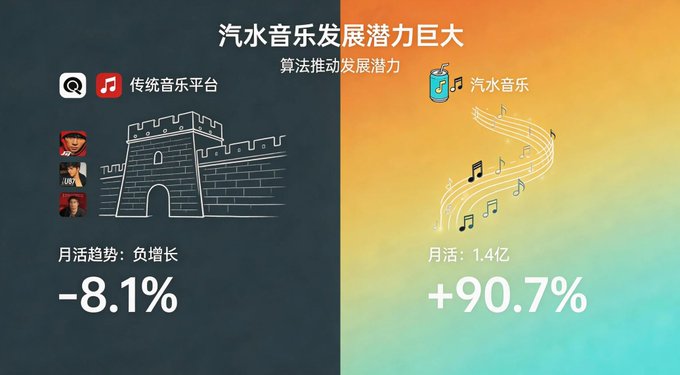
Ishort TME for a long time, and the logic is very simple: the data discrepancy is obvious. On March 18, TME released its financial report, and its Hong Kong-listed shares plummeted by 21.82% in a single day, while its US-listed shares fell by 24.65%. The essence of this sharp drop is that the soft drink exposed Tencent Music's true colors. Just like how Hongguo Short Drama dealt a devastating blow to iQiyi, Youku, and Tencent Video, it restructured the entire industry's business logic by offering free content and targeting lower-tier cities. I. Data: The rise and fall of soft drinks music. At the end of 2025, monthly active users reached 140 million, a year-on-year increase of 90.7%. During the same period, all three major TME apps experienced negative growth. Kugou -8.1%, QQ Music -2.8%, Kuwo -8.0%. II. Incremental Users: Uncovering 500 Million Users Beneath the Iceberg. The overlap between users of soda and QQ Music and NetEase Cloud Music is only 2%-3%. More than 40% of soda users had never used QQ Music or NetEase Cloud Music before. This isn't about grabbing existing customers; it's about activating a growth market that TME (Trade Managers' Entertainment) couldn't even see. III. Copyright Expiration: The Billion-Dollar Moat Becomes a Shackle "Whoever gets Jay Chou gets the world"—this statement was true before 2021. In 2021, regulators halted exclusive copyright agreements. TME is still spending 12 billion yuan annually to maintain its existing copyright library. What it's buying isn't growth, but rather "keeping existing users from leaving." Even more fatal is the change in consumer logic. Generation Z no longer pays for "timeless classics," but consumes for "the emotions of the moment." 86% of the top 1000 most popular songs on Douyin (TikTok) originated from Douyin. A viral hit from three months ago is more fitting for the current scene than a classic from twenty years ago. With only 1/10 the cost, soda can generate low-cost, incremental hit songs through the industrialized production of viral TikTok hits and the participation of 330,000 original musicians. Algorithm-based distribution efficiency has replaced the monopoly of exclusive content. Whether or not Jay Chou exists is far less important than whether a free hit song that resonates with the current mood can be accurately promoted. With only 1/10 of the cost, the soft drink company created a super app with hundreds of millions of monthly active users in a market that TME neither saw nor cared about.
This article is machine translated
Show original

From Twitter
Disclaimer: The content above is only the author's opinion which does not represent any position of Followin, and is not intended as, and shall not be understood or construed as, investment advice from Followin.
Like
Add to Favorites
Comments
Share
Relevant content