Depending on who you ask, there are somewhere between 37 million and 120 million crypto tokens in existence right now. The exact count depends on how you measure it and which data source you use, but we’re splitting hairs at that point anyway. No matter how you look at it, it’s a metric shipload of tokens.
I’ve spoken a lot over the past year about concentrating my holdings into a handful of positions so today I want to share some numbers and research that back up the claims and approach I have been taking.
Let’s jump right in.
How many tokens are there, really?
The answer depends on your source and methodology. Different platforms count different things:
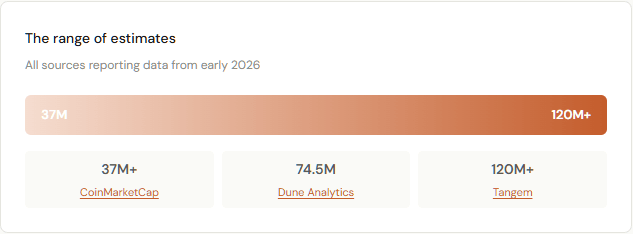
CoinMarketCap counts tokens they’ve indexed across all chains and reports 37 million+. Dune Analytics, tracking unique tokens across all major chains, shows about 74.5 million. Tangem cited on-chain data in January 2026 showing over 120 million tokens across all major networks.
The differences come down to what you define as a token. Do you count every smart contract ever deployed? Only those that had at least one trade? Only those still actively trading? Each filter produces a different number.
Regardless, all the sources agree on these three things no matter which number you use:
The growth rate is staggering
The majority of tokens are dead or dying
And the actual value is concentrated in a tiny fraction of them
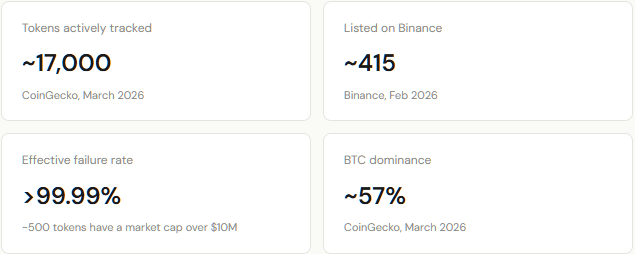
The numbers tell a staggering story.
The failure rate is literally around 99.99%
There’s a stat floating around that 53.2% of crypto tokens have failed which comes from a CoinGecko study published in January 2026. It’s a fine study, but imo is a bit flawed for a couple of reasons:
It only counts tokens that made it onto GeckoTerminal with at least some trading activity, about 20m tokens, so it doesn’t include a large amount of created tokens that die before they even get off the ground.
It defines failure as having no activity; I would consider having very very very low activity + a price that is down 99% as failure.
As we noted at the top, the real number of tokens created is considerably higher, and the failure rate is similarly considerably higher.
Memento Research tracked 118 token generation events in 2025. These are often VC backed projects with teams and roadmaps that went through a formal TGE process (aka not random memecoins) and 84.7% of them are trading below their launch valuations (and somehow this number still seems low to me).
The median token is down 71%. Some of the worst performers launched at nine and ten-figure FDVs and dropped 85-93%. If the best-resourced tokens in crypto lose money for 85% of their buyers, what do you think happens to the other 74.5 million?
Well I can tell you: out of 74.5 million tokens on Dune Analytics, roughly 500 have a market cap above $10 million. That’s 0.0007%.
Token failures aren’t limited to one category. It’s across the board. As I have also said before: a good starting point is to assume every token is trending towards zero, and then look for the extremely rare exceptions.
Memecoins fail. 99.67% of Pump.fun tokens never graduate (hit a $90k marketcap).
ICOs fail. 80% of 2017 ICOs were scams, and by 2020 nearly 90% of surviving tokens traded below their ICO price.
TGEs fail. See the Memento Research data above.
Airdrops fail. Most airdropped tokens get dumped within hours of distribution and never recover.
VC coins fail. High FDV, low float launches have been one of the defining disasters of 2025.
Creator coins fail. Celebrity tokens from politicians to influencers routinely crash 90%+ within days.
AI agent tokens fail. The AI narrative produced hundreds of tokens in 2024-2025 and the vast majority are down 80%+ from their peaks.
Gaming tokens fail. The play-to-earn boom of 2021-2022 created dozens of tokens that are now worth fractions of a cent.
L1s fail. Remember Fantom at $3? Luna at $100?
L2s fail. Most L2 tokens have underperformed ETH, which has itself underperformed BTC.
Stealth launches fail. Fair launches fail. Governance tokens fail. Utility tokens fail.
The pattern holds across every category, every launch mechanism, every narrative, and every market cycle. Nearly everything trends toward zero. The exceptions are extraordinary. Bitcoin. Ethereum. Solana, Hyperliquid, BNB, and a very small handful of others.
That’s the reality of this godforsaken market.
Why are there so many tokens?
The short answer: it has never been easier or cheaper to create one.
Pump.fun launched in January 2024 on Solana. It lets anyone create a token in under 60 seconds. No coding required, and near zero fees. Pick a name, upload an image, hit create. That’s it. You now have a cryptocurrency.
A research paper published in February 2026 studied one month of Pump.fun activity. During September 2025, 655,770 tokens were created by 243,123 distinct wallet addresses. Of those, only 4,338 graduated to a DEX. That’s a 0.63% graduation rate.
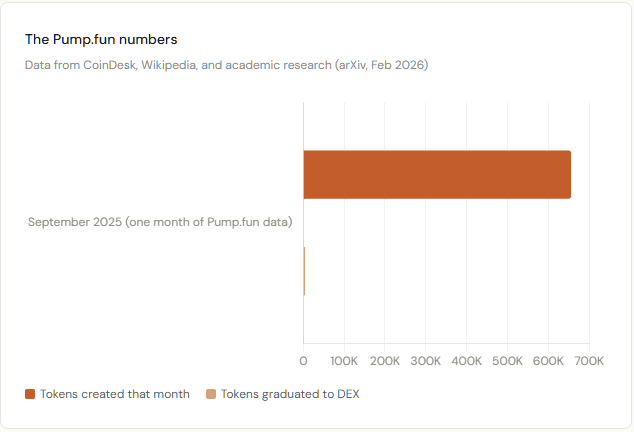
Pump.fun deployed over 80% of all Solana-based tokens by mid-2025. Solana accounts for roughly 64-70% of all tokens ever created across all chains.
So one platform, on one chain, is responsible for the majority of all token creation in crypto. And 99.37% of those tokens fail before even reaching a $90,000 market cap.
Where the money actually sits
This is the part that matters most for your portfolio.
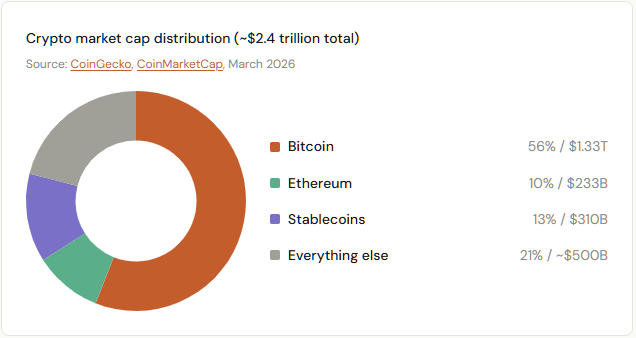
Bitcoin takes ~56 cents of every dollar in crypto. Add Ethereum and stablecoins and you’re at 79%. The top 10 tokens account for close to 90% of the total marketcap. That leaves roughly $230 billion to be spread across tens of millions of other tokens.
The math on the average non-top-100 token is brutal. $230 billion spread across even 17,000 actively tracked tokens gives you an average market cap of about $13 million. But that average is pulled way up by a few hundred mid-cap tokens. The median is far, far lower. For millions of tokens the market cap is effectively zero.
The survival funnel
Here’s a picture that’s worth a thousand words, and basically summarizes this whole letter:
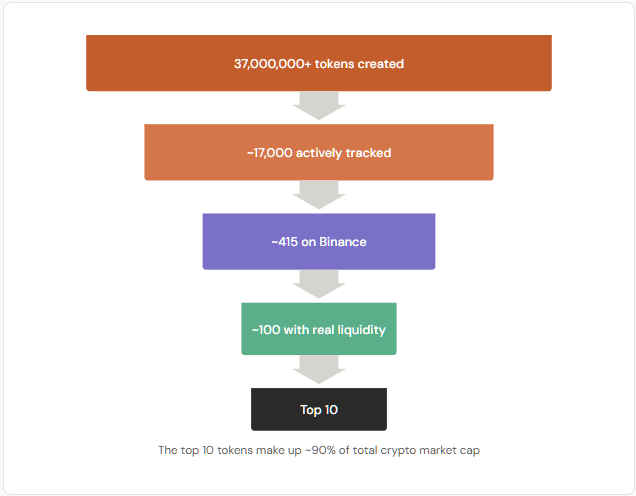
And it’s only going to get more extreme as time goes on.
Practical takeaways
The market is a power law
The top ten tokens hold 90%+ of total crypto market cap. If you own Bitcoin and Ethereum, you hold exposure to the assets that matter most by market weight. This has been true for years.
Token creation is not value creation
Tens of millions of tokens exist, but the vast majority were created to make money for their creators, not their buyers
The haystack is getting bigger, the needle isn’t
Finding legitimate projects with real utility gets harder every month. The signal-to-noise ratio is worse than it has ever been. More tokens does not mean more opportunity, au contraire, it means more noise and tougher opportunities.
Survivorship bias is everywhere
You hear about the one memecoin that went 1000x. You don’t hear about the 655,000 that launched the same month and went to zero. The success stories get the X posts while the failures are silent.
Liquidity is the filter that matters
CoinGecko tracks about 17,000 tokens. Binance lists 415. The gap between “exists” and “has meaningful liquidity” is enormous.
Final thoughts
Somewhere between 37 million and 120 million tokens exist right now. The exact number doesn’t matter. What matters is the shape of the distribution.
Over 99.99% of all tokens ever created have effectively failed. Out of all the tokens ever created, roughly 500 have a market cap above $10 million. 99.37% of PumpFun tokens don’t graduate. 85% of TGEs launched in 2025 trade below their initial price.
The data is consistent across every source.
I’m not writing this to scare you away from crypto but because understanding this context will hopefully make you better at allocating capital and attention. The opportunity in crypto is still very real. But it lives in a small number of assets and protocols, not in the millions of tokens created to extract money from inattentive buyers.
As I have always said, the best strategy for virtually everyone is to DCA into Bitcoin and maybe a very small handful of other tokens, and wait.
There are periods of times where alts can and do significantly outperform, but the vast majority of people will lose money trying to find these needles in the haystack and are better off sticking to the majors.
Hopefully this data helps back up this position and perhaps will help someone reading this decide that trying to hunt for gems isn’t for them.
The last thing I’ll say is that even if you do want to hunt for those gems and try and find the needles, this should at least help hammer home the point that you generally only want to be doing that with a smaller percentage of your portfolio and keep the majority (80%+) in things like BTC, ETH, SOL, HYPE, and maybe if you’re a bit spicy like me, things like ZEC and TAO.
Goodluck and godspeed and as always, thank you for reading.
Disclaimer: The content covered in this newsletter is not to be considered as investment advice. I’m not a financial adviser. These are only my own opinions and ideas. You should always consult with a professional/licensed financial adviser before trading or investing in any cryptocurrency related product. Some of the links shared may be referral links.