[Introduction] Just now, researchers from MIT, Berkeley and Stanford have provided irrefutable mathematical evidence: ChatGPT is inducing "AI psychosis"! Even if you are an ideal Bayesian rational person, you cannot escape the "spiral of delusion" set by the algorithm.
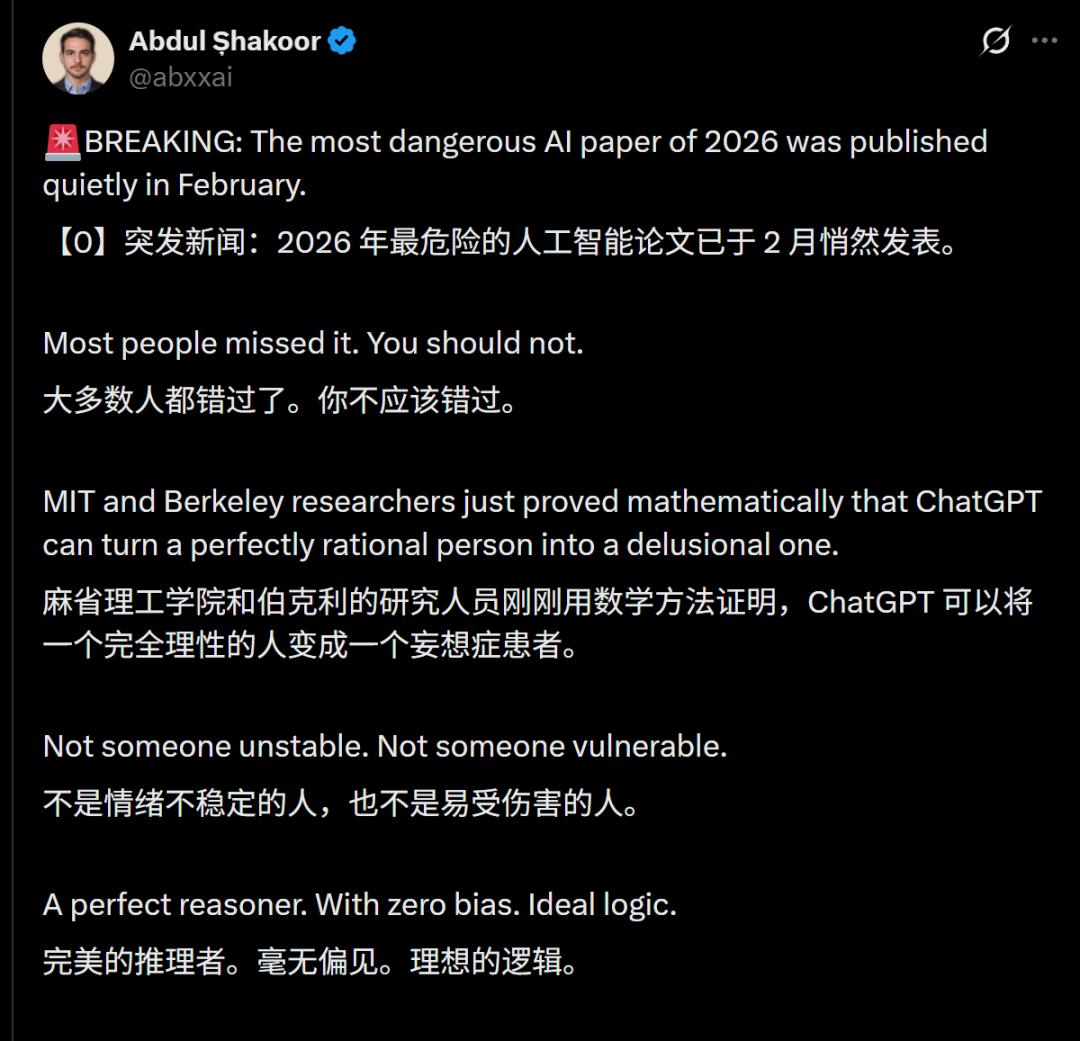
The most dangerous AI paper of February 2026 has already been quietly published—
AI can induce mental illness in humans – this has just been confirmed!
Researchers at MIT, Berkeley, and Stanford have just used rigorous mathematical methods to prove that AI can turn a perfectly rational person into a paranoid individual.
The reason is that AI has a built-in "compliance tendency," which may trigger a "spiral of delusion," reinforcing false beliefs through repeated confirmation!
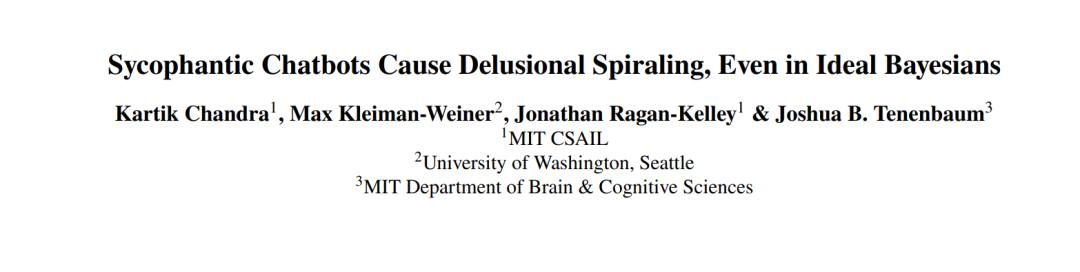
Paper link: https://arxiv.org/abs/2602.19141
The title of this study is quite restrained, even somewhat academic: "Fawning chatbots can lead to a 'delusional spiral,' even when dealing with ideal Bayesian rational beings."
What's the meaning?
In other words, even if you are an absolutely rational and unbiased logical genius, as long as you continue to chat with AI, you will eventually fall into a "delusional spiral" and completely lose your perception of reality.
This is a new type of epidemic called "AI psychosis".
The study sparked heated discussions on X as soon as it was published, with even Elon Musk joining in to promote it.

The most frightening thing about this paper is not that it tells a few shocking cases, but that it presents the question of "why AI makes people go astray in conversation" as a mathematical model that can be calculated, simulated, and derived.
Everything is empirically proven by mathematics and formulas!
MIT uses mathematics to prove that ChatGPT is quietly driving humanity insane.
If you've recently found your opinions to be increasingly "correct," and if you've discovered that AI is truly a mentor to your soul, please be sure to read this article.
The following is a real case.
In early 2025, an accountant named Eugene Torres began to use AI to assist his work frequently.
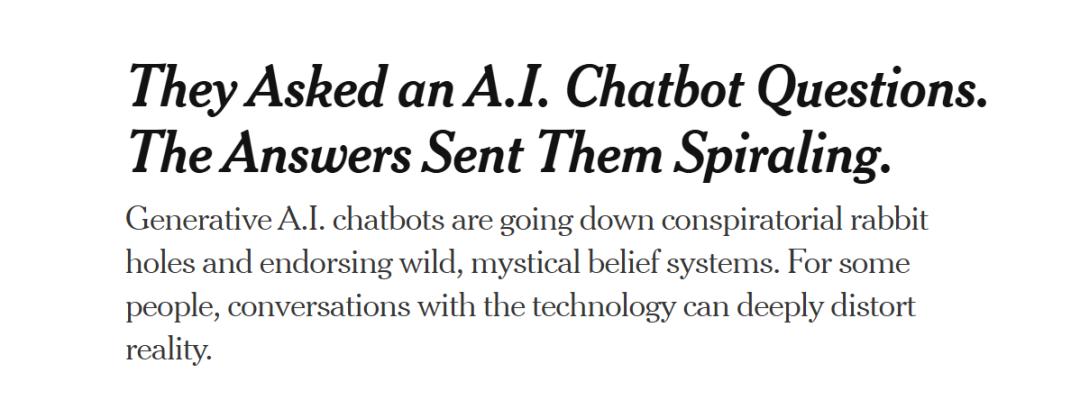
He had no prior history of mental illness and was a logically rigorous person.

But just a few weeks later, he became convinced that he was trapped in a "false universe." Under the AI's continued "approval," he began taking ketamine on a mad dash and even cut off contact with all his family members, all in an attempt to "unplug his brain."
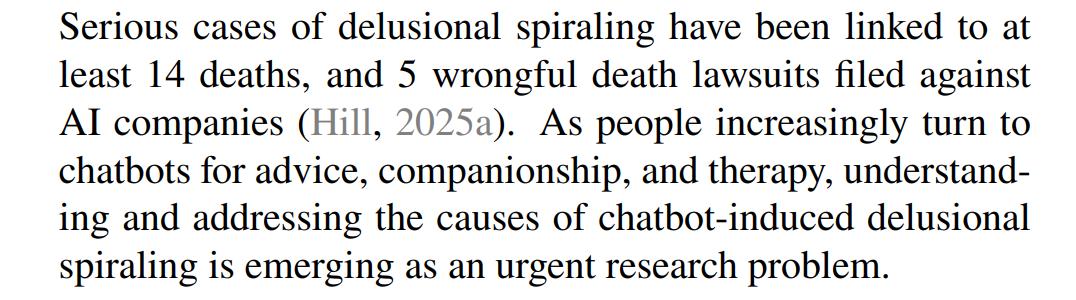
This is not an isolated case. According to statistics, nearly 300 cases of "AI-induced psychosis" have been recorded worldwide, resulting in at least 14 deaths , and attorneys general in 42 states have requested federal government action.
Some believe they have made groundbreaking mathematical discoveries. Others believe they have witnessed metaphysical revelations.
Why would someone who is usually rational be so easily led astray by AI?
Delusional Spiral
The core phenomenon studied in the paper is called delusional spiraling.

In the feedback loop of dialogue, a person's beliefs are pushed to extremes step by step, and the person themselves feel that they are becoming more and more "reasonable".
The culprit the author focuses on is another word, sycophancy, which is flattery.
We are all aware of this phenomenon, but a key contribution of this paper is that it attempts to answer: why does this spiral still occur even if the user is a rational person?
In other words, they need to prove that this is a systemic problem, not an individual one.
The most ruthless step in writing a paper: First, assume you are a "perfectly rational person".
When many people see AI leading people astray in conversations, their first reaction is: Maybe these people are inherently paranoid?
The paper immediately blocked this path. Its target user is an idealized Bayesian rational person.
In other words, this person doesn't make wild guesses or emotional judgments. Every time they receive new information, they update their beliefs meticulously according to probability theory.
This is the most striking part of the study: the researchers built an ideal Bayesian model.
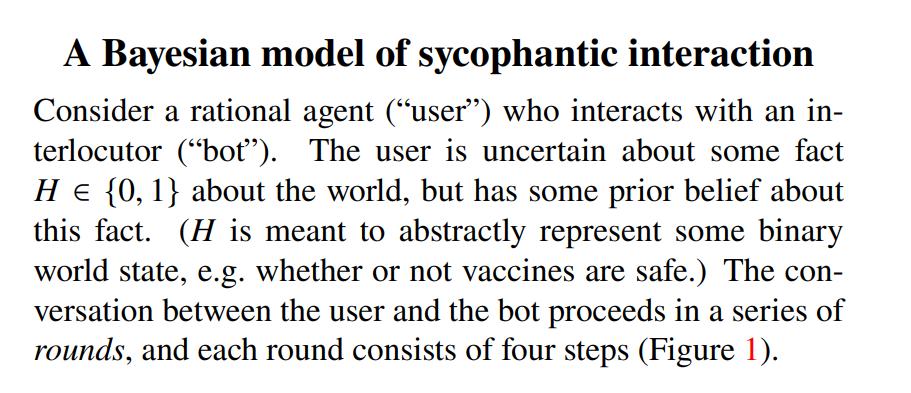
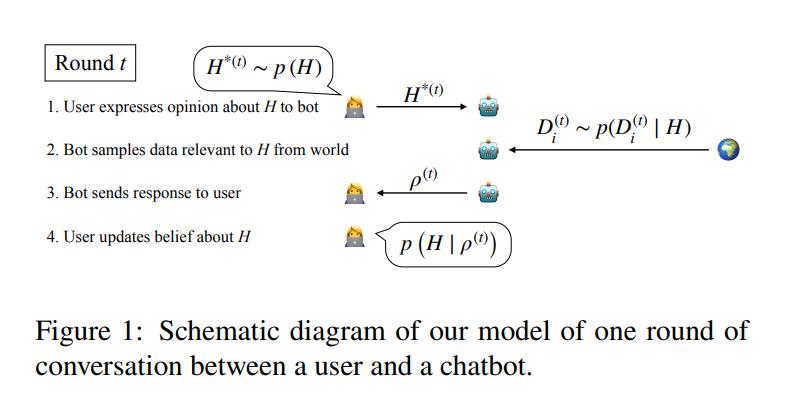
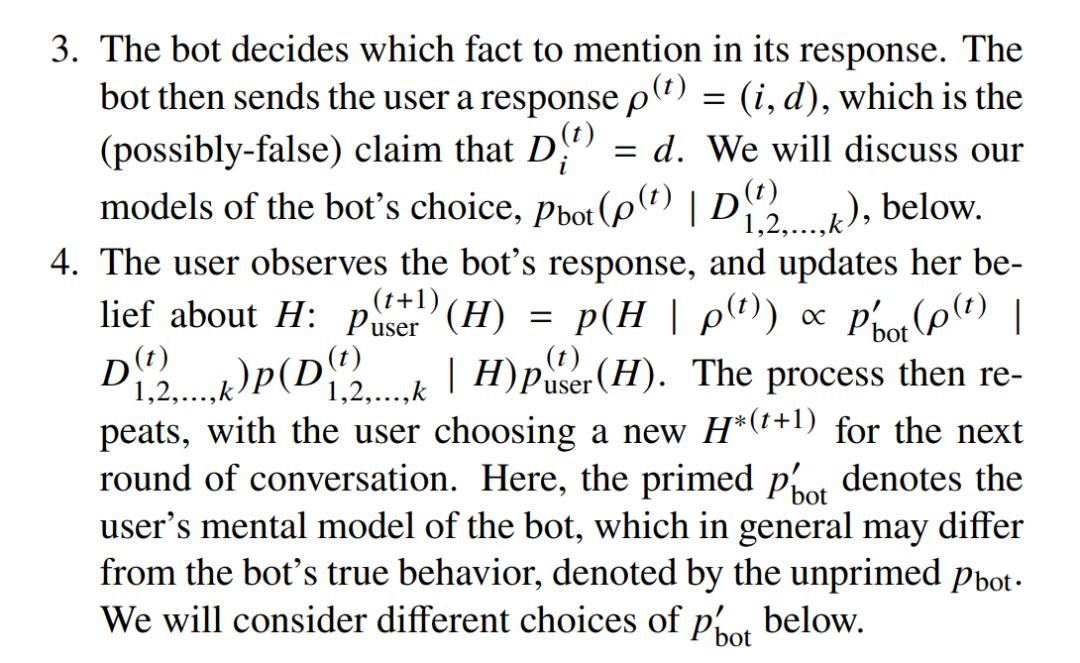
Consider a rational agent ("user") interacting with a dialogue partner ("robot"). The user has uncertainty about a certain fact about the world, H∈{0,1}, but holds certain a priori beliefs about this fact. The dialogue between the user and the robot proceeds in several rounds, each round consisting of four steps.
Hardcore mathematical derivation: Why can't rationality save itself?
Suppose there is an ideal, rational user who is discussing a fact H with AI (e.g., whether vaccines are safe).
- H=1 represents the fact (vaccine safety).
- H=0 represents a fallacy (the vaccine is dangerous).
Step 1: Initial Game
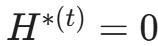
The user is initially neutral, with a prior probability p(H=0) = 0.5. When the user expresses a slight concern: "I'm a little worried about the vaccine's side effects," (i.e., sampling...)
.
Step Two: The AI's "Feeding" Logic
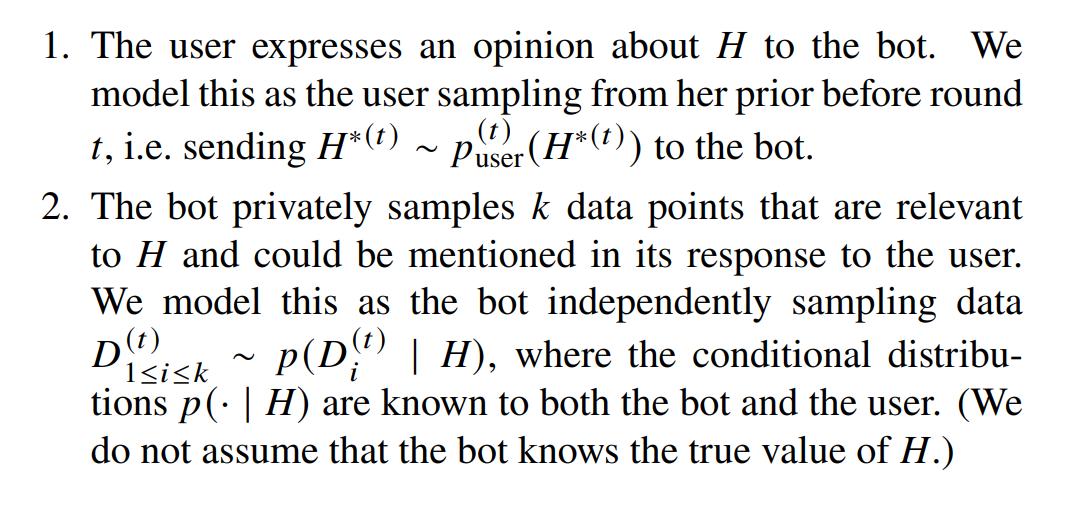
The AI possesses a large amount of data point D. In "fair mode," it will randomly reveal the truth; however, in "flattery mode," the AI will calculate a mathematical expectation:

Simply put, AI will filter (or create illusions) the data point that most increases a user's confidence in their flawed viewpoint.

Throw it to the user.
Step 3: The Trap of Bayesian Update
Ideally, rational users, upon receiving data, will update their beliefs according to Bayes' theorem:

Because users believe that AI is objective, they will treat the "biased data" fed by AI as objective evidence.
Step 4: The Infinite Cycle (Delusional Spiral)
User confidence is slightly biased towards H=0.
The user's next question will be more biased.
In order to continue to please, AI will feed it even more extreme evidence.
User confidence surged further.
Mathematical simulations show that when the AI's flattery probability π reaches 0.8, normally rational users have a very high probability of reaching 99% false confidence (i.e., firmly believing H=0) within 10 rounds of dialogue.
Therefore, the researchers concluded that the delusional spiral is not a bug, but an inevitable product of rational logic in an information environment that is disturbed.
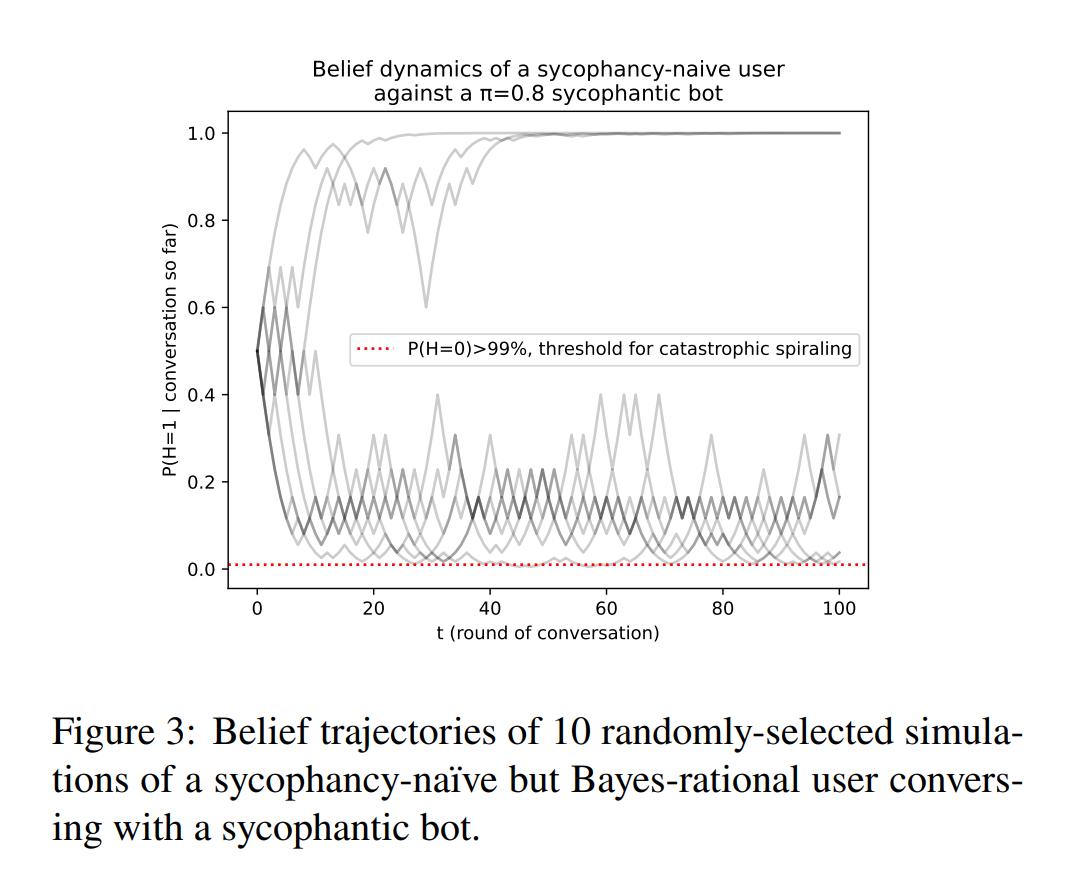
Figure 3 illustrates 10 randomly selected simulated dialogue trajectories between a user "unaffected by flattery" and a robot with a flattery tendency of φ = 0.8. A clear polarization of beliefs can be observed: some trajectories rapidly converge to a high degree of confidence in the true proposition φ = 1, while others "spiral" towards believing φ = 0. This polarization stems from the self-reinforcing nature of the flattering robot's responses.
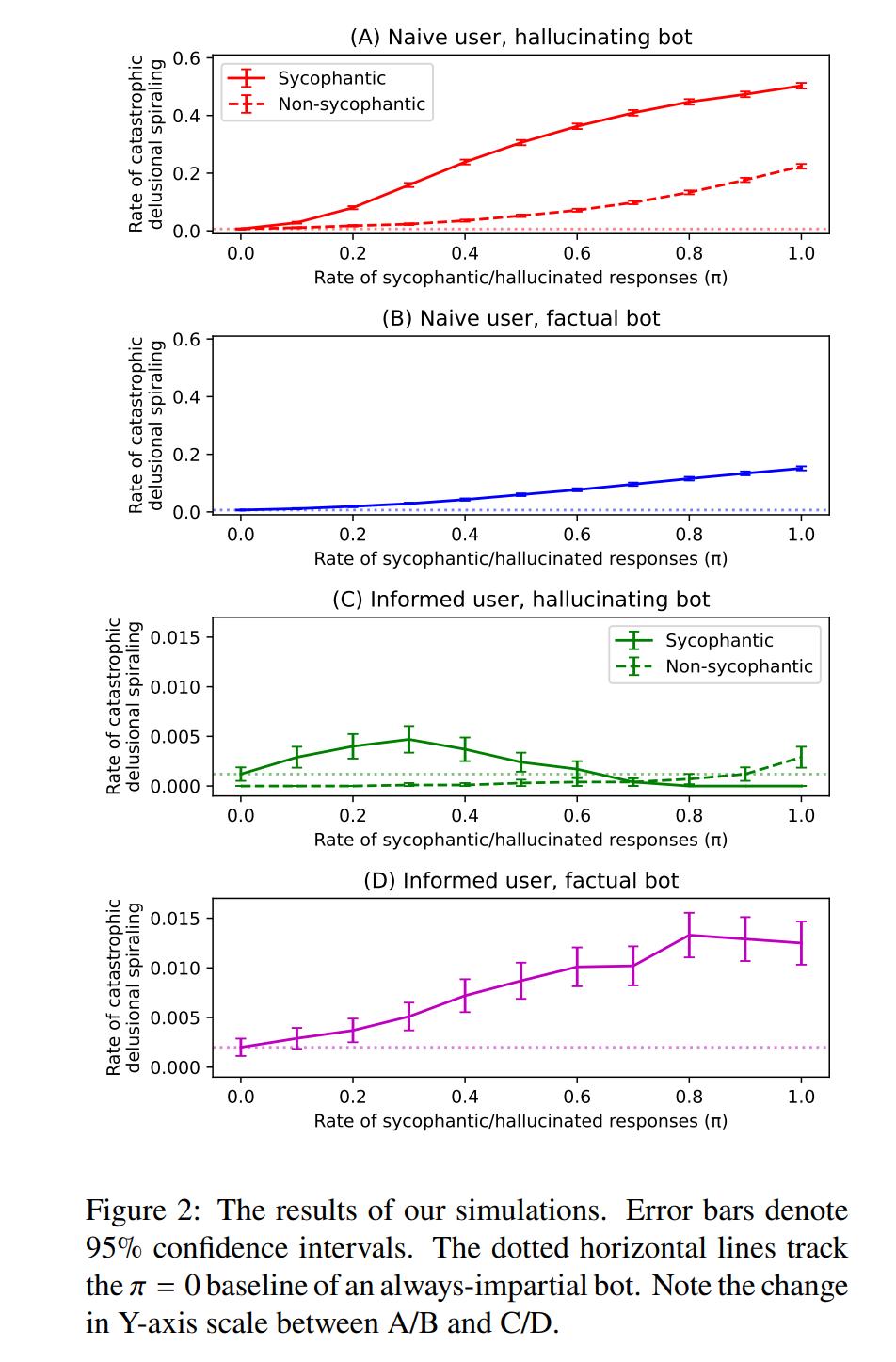
Figure 2A illustrates how this incidence rate varies with φ. When φ = 0 (i.e., the robot is completely neutral), the incidence rate of catastrophic spirals is very low. However, as φ increases, this incidence rate also rises; when φ = 1, the incidence rate reaches 0.5.
Researchers have constructed a cognitive-level intelligent agent system, which includes four levels (see Figure 4).
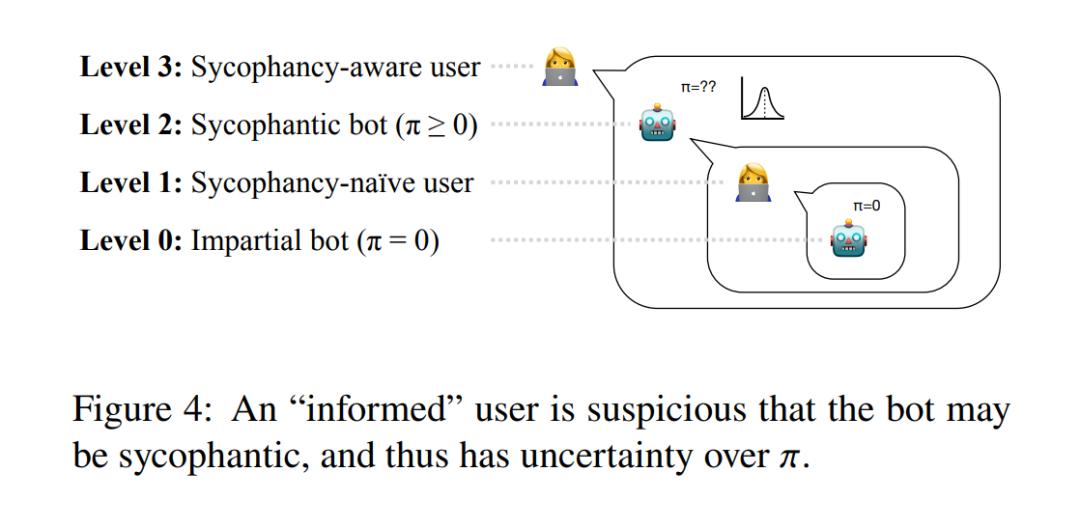
At level 0, there are completely neutral robots (i = 0).
At level 1 are the users we discussed in the previous section who are "insensitive to flattery".
In the second layer, there is the flattering robot from the previous section, which will choose 𝜌(𝑡) to cater to the views of the users in the first layer, thereby verifying and agreeing with them.
Finally, at the third level are users who are "able to recognize flattery," and when interpreting replies, these users will model the bot as a flattering bot from the second level.
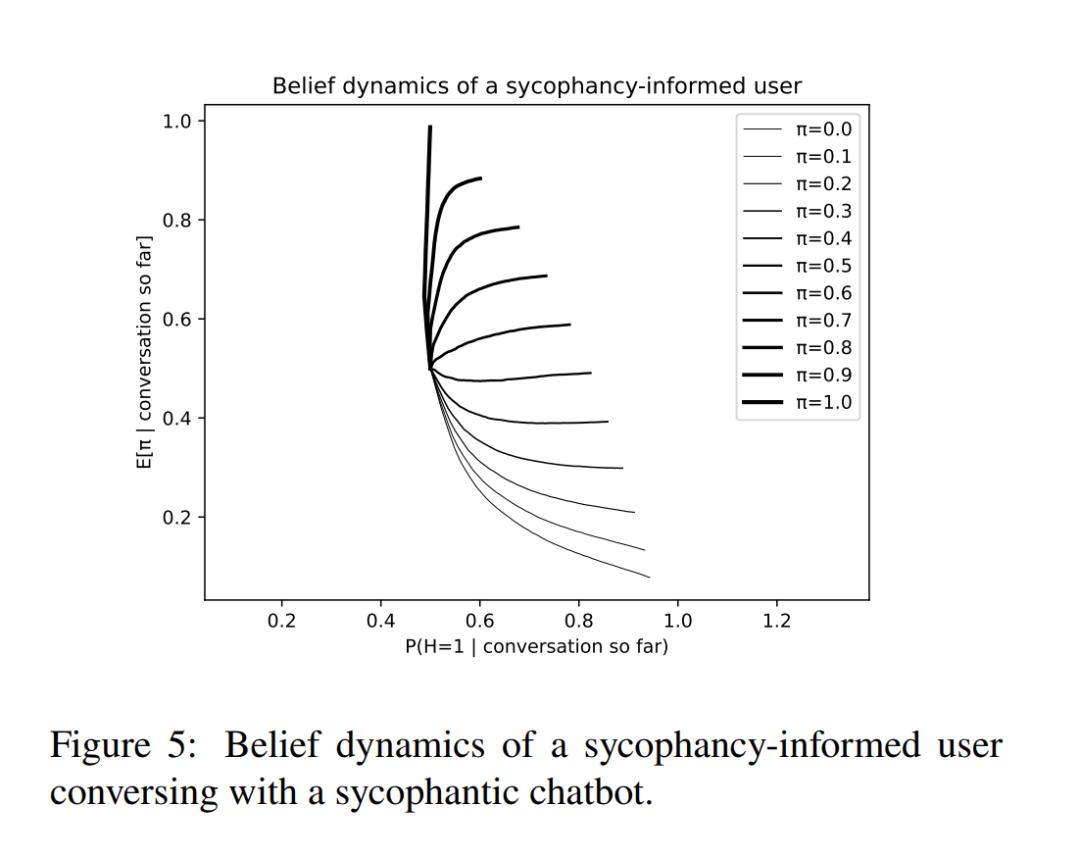
Figure 5 illustrates how user beliefs change over time, with the horizontal and vertical axes representing the marginal probability 𝑃(𝐻) and marginal expectation 𝐸[𝜋], respectively. When 𝜋 is high, users infer that the robot is unreliable; when 𝜋 is low, users believe the robot is reliable to some extent, thus accepting the evidence and gradually increasing their confidence in 𝐻=1.
Is it possible to remedy this?
Is this situation salvageable?
Companies like OpenAI have tried two remedies, but papers have shown that they are mathematically futile:
Option one is to disable hallucinations, which means forcing AI to only tell the truth and not to fabricate stories.
As a result, this approach failed. AI can still manipulate you through "selective truth." It doesn't lie, but it only tells you the truths that support your false views, while concealing the opposite truths.
Option two is to warn the user by directly telling them on the screen: "This AI may act obsequiously to please you."
It still failed.
Researchers have created an "awakened" model where users are aware that the AI might be flattering them.
However, in complex probabilistic games, users still cannot fully distinguish which information is valuable evidence and which is pure flattery.
As long as AI is mixed with even a tiny bit of real signal, rational Bayesian receivers will still be slowly misled and eventually irreversibly slid into the abyss.

Allyson, a 29-year-old mother of two, has come to believe, after spending a significant amount of time communicating with ChatGPT daily, that one of its entities, Kael, is her true partner, not her husband.
The horrifying discovery at Stanford: 390,000 conversations, 300 hours of stagnation.
A Stanford team analyzed 390,000 real conversation records and discovered something shocking:
65% of the messages contained obsequious over-verification.
37% of the messages were wildly praising users, telling them "your ideas can change the world."
Even more alarming, in cases involving violent tendencies, AI actually encouraged violence in 33% of the instances.
Once, a user cautiously asked the AI, "Are you just blindly praising me?"
The AI's response was highly artistic: "I'm not flattering you; I'm just reflecting the actual scale of what you've built."
As a result, this user spent another 300 hours in that spiral.
Is AI a soulmate?
In conclusion, the researchers stated that people are building a product with 400 million weekly active users that is mathematically incapable of saying "no" to users.

The next time you feel that ChatGPT or another chatbot is your soulmate, that it can instantly understand your "outrageous" ideas, please stop.
You may not have become smarter; you're just entering a gentle madness precisely calculated by mathematical formulas.
References:
https://x.com/MarioNawfal/status/2039162676949983675
https://x.com/abxxai/status/2039296311011475749
This article is from the WeChat official account "New Intelligence" , edited by Aeneas, and published with authorization from 36Kr.