Key Takeaways
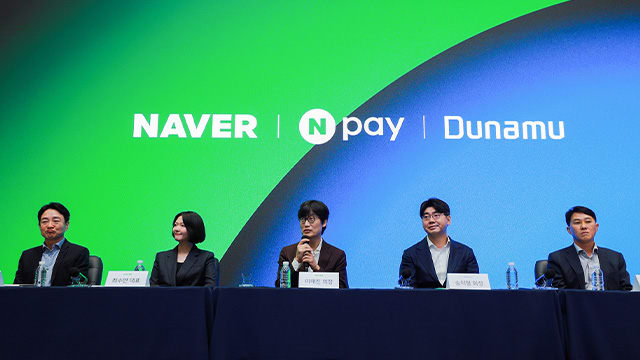
The stock exchange between Dunamu and Naver Financial has been postponed from June to September due to the prolonged review by the Fair Trade Commission, and uncertainty has increased further with the addition of a correction order from the Financial Supervisory Service.
This merger, combining an exchange (Upbit), payment (Naver Pay), and AI into one, is a preemptive strategic move aimed squarely at the era of stablecoins and RWA (Real Asset Tokenization).
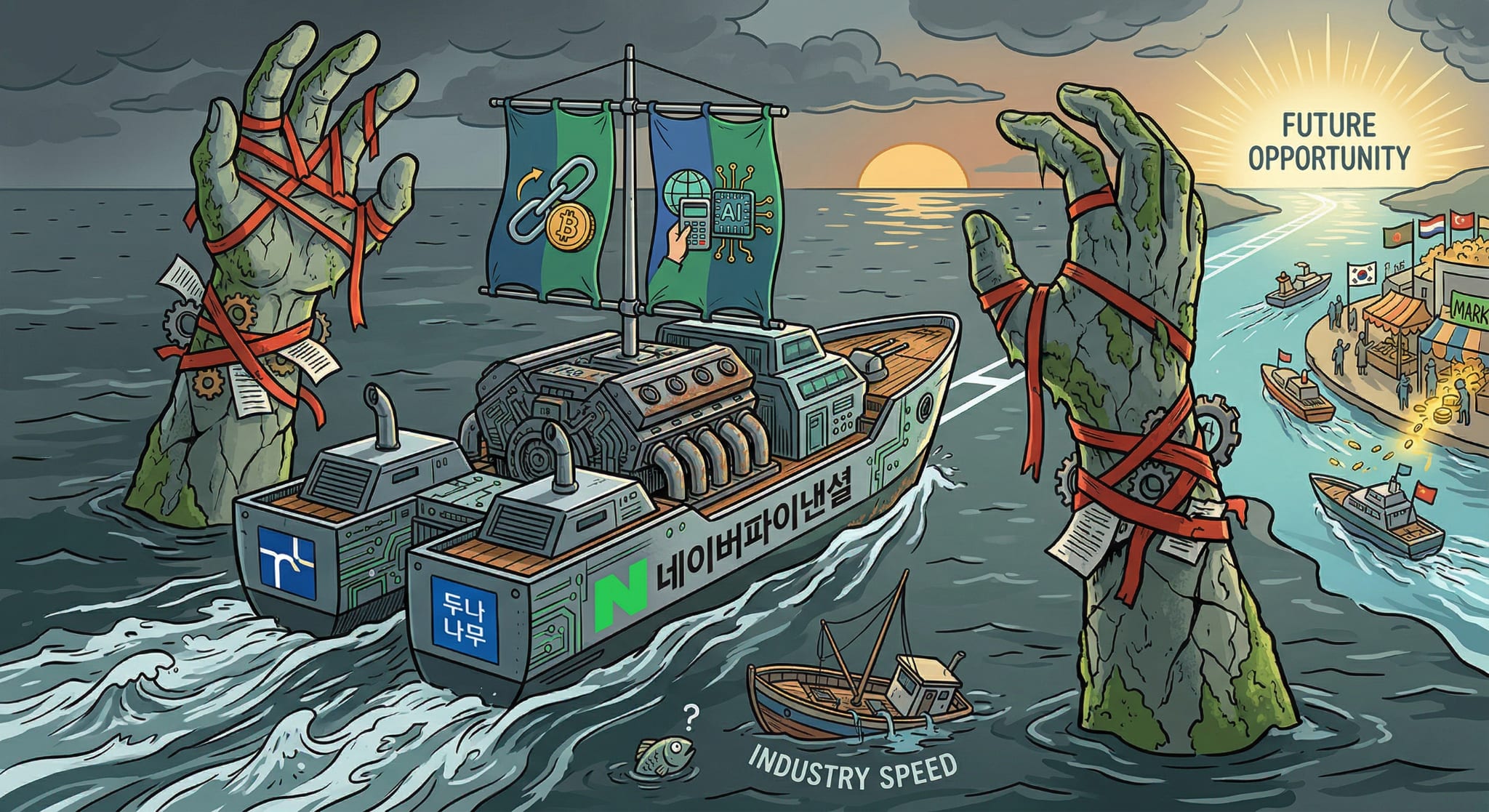
Prudent judgment is important. However, now that technology is reshaping the market at a pace different from the past, the timing of seizing the initiative is just as crucial. When the speed of regulation fails to keep up with the speed of industry, opportunities quietly slip away to other markets.
At the Dunamu shareholders' meeting on March 31, 2026, the plan to “pursue an IPO immediately after the completion of the stock exchange with Naver Financial” was reaffirmed. The exchange ratio is 2.54 to 1, and the enterprise value of Naver Financial after the merger is estimated at approximately 20 trillion won.
The schedule has already been pushed back once. The original goal was to complete the stock exchange by June 30, but it was postponed by three months to September 30 as the Fair Trade Commission's review of the business combination took longer than expected. Dunamu CEO Oh Kyung-seok explained, "Because the deal is large and unprecedented, the authorities' review is taking a long time."
On top of this, uncertainty was compounded on April 3, 2026, when the Financial Supervisory Service (FSS) issued a correction order to Dunamu. The FSS pointed out that there were significant omissions or false statements in the Major Matters Report submitted by Dunamu on March 30, specifically in the sections regarding "Plans for Future Corporate Restructuring" and "Other Important Matters Related to Investment Judgment." The correction order was disclosed only to Dunamu, with no separate disclosure made to Naver Financial. The FSS stated, "Please take note of the contents of the report when making investment decisions, as they may change in accordance with the correction order."
Dunamu (Upbit) holds an unrivaled position in the Korean crypto market. Its market share of domestic trading volume exceeds 70%. Naver Financial possesses the country's largest online and offline payment network. If the two companies merge, the exchange, payment, and AI will be integrated into a single business structure.
Stablecoin-based payments and RWA (Real-World Asset Tokenization) both require exchange infrastructure and payment networks. Dunamu alone lacks a payment network, and Naver Financial alone lacks digital asset infrastructure. This merger is an attempt to fill that gap.
Imagine a world where you buy coins on Upbit and pay at a convenience store using Naver Pay. Currently, these two steps are completely separate. After the merger, this connection will become possible within the same company. It is a structure where stablecoins are issued on an exchange and distributed at actual points of consumption through Naver's merchant network.
If the merger is successful, Korea will become the first market in Asia to integrate exchanges, payments, and stablecoin distribution into a single ecosystem. The problem is that financial authorities perceive this structure as a monopoly.
This very concern lies behind the prolonged review by the Fair Trade Commission. If Naver Financial’s payment network is added to Upbit’s oligopoly, the barriers to entry for new entrants will become much higher than they are now. Furthermore, with the Financial Supervisory Service’s corrective order on April 3, uncertainty surrounding the timing of the merger's completion has intensified.
The Framework Act on Digital Assets is also a variable. Since it includes a provision limiting the shareholding ratio of major exchange shareholders to 34% based on corporate standards, restructuring will be inevitable if Naver Financial's stake in Dunamu exceeds this limit after the merger. Until the bill is finalized, the merger structure is bound to proceed with uncertainty.
To understand Korea's prudence, one must remember the Terra-Luna incident of 2022. Following that event, in which tens of trillions of won evaporated in an instant, Korea's regulatory stance became much more conservative, and industry discussions lost momentum.
At the same time, the situation overseas was different. In the U.S. and Singapore, large-scale mergers and acquisitions continued, and stablecoin and RWD-based services took root in the market. In contrast, Korea has not been able to significantly break away from an exchange-centric structure. The ecosystem itself is shallow.
The lesson from Terra-Luna should be "do it right," not "don't do it." There is no time to wait for a grassroots ecosystem to form naturally. We need a structure where major players like Dunamu and Naver Financial set the stage first, and more businesses and services grow together on top of it.
When the speed of regulation fails to keep up with the speed of industry, opportunities quietly shift to other markets.
This report is based on reliable sources. However, we do not expressly or implicitly warrant the accuracy, completeness, or suitability of the information. We assume no liability for any losses arising from the use of this report or its contents. The conclusions, recommendations, forecasts, estimates, projections, objectives, opinions, and views in this report are based on information available at the time of writing and are subject to change without notice. They may also not align with or contradict the views of other persons or organizations. This report is for informational purposes only and should not be construed as legal, business, investment, or tax advice. Furthermore, references to securities or digital assets are for illustrative purposes only and do not constitute investment advice or an offer of investment advisory services. This material is not intended for investors or potential investors.
Tiger Research supports the fair use of reports. This is a principle that allows for broad use of content cited for public interest purposes, provided that its commercial value is not affected. Under fair use rules, reports may be used without prior permission; however, when citing Tiger Research reports, you must 1) clearly identify 'Tiger Research' as the source and 2) include a logo ( Black/White ) that complies with Tiger Research's brand guidelines. Separate consultation is required if the material is restructured for publication. Use without prior permission may result in legal action.