
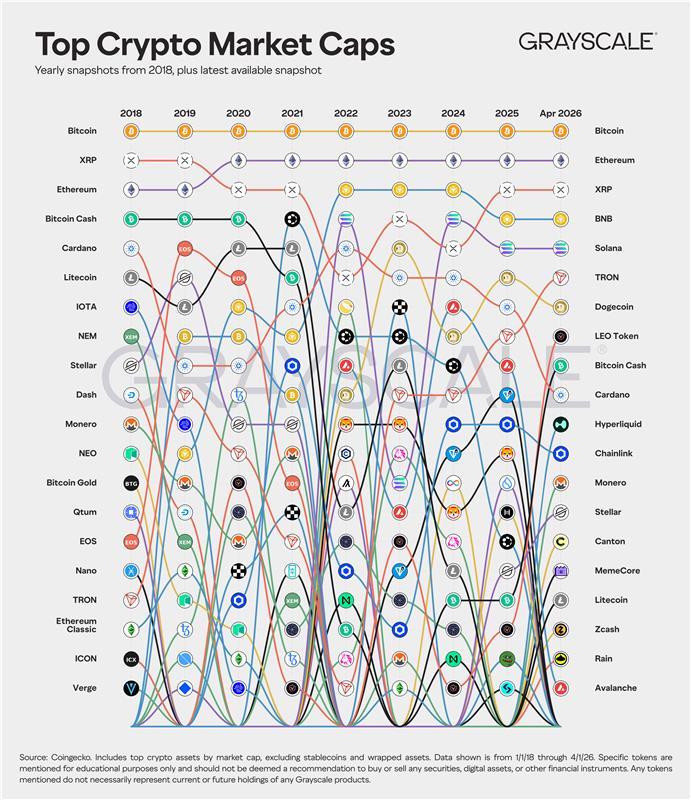
The Era Where 90% of Altcoins Disappear: A Comparison of Coin Market Cap Between 2018 and 2026 and My Thoughts on the Coins That Will Survive X Full Text 2018: $BTC $XRP $ETH $BCH $ADA $LTC $IOTA $XEM $XLM $DASH $XMR $NEO $BTG $QTUM $EOS $NANO $TRX $ETC $ICX $XVG 2026: $BTC $ETH $XRP $BNB $SOL $TRX $DOGE $LEO $BCH $ADA $HYPE $LINK $XMR $XLM $CC $M $LTC $ZEC $RAIN $AVAX (My thoughts & interpretation below) Grayscale posted a chart comparing top market cap assets. While BTC, ETH, XRP, etc., still hold the throne, many coins have been eliminated. (Especially ETC, Poppy, etc.) The newcomers for 2026 are HYPE, CC, M, and ZEC. The emergence of these newcomers demonstrates what the market currently values more highly. Although many PuffDEXs appeared after the HYPE myth, the trend ultimately shifted in a direction that concentrated liquidity and attention more on HYPE rather than expanding the overall market pie. Also, themes regarding chain/network infrastructure that can connect with institutional finance, including Canton, are being re-evaluated in the market. MemeCore has become a meme chain that maximizes liquidity and community cohesion, boasting the 26th position in market capitalization (beating Shiva Coin...). Reactions are emerging from the US, with WallStreetBets, a US KOL with 1 million followers, mentioning $M and asking, "What is MemeCore that it is pumping like this?" Zcash is closer to an asset that has become necessary again rather than a newcomer. Having passed the era where the market only wanted transparency, it has started to re-evaluate the value of privacy technology alongside regulation-friendly infrastructure. Coins that maintained their positions in 2028 and 2026: (Only 9) BTC ETH XRP BCH ADA LTC XLM XMR TRX I believe the top rankings in 2018 were driven by high expectations from the ICO era. It was an era where promises of "what to build" created market capitalization, but by 2026, we are approaching an era where the top tier will be nothing more than networks where actual funds, users, trading volume, and fees circulate. Unless the asset itself has become a category, like Bitcoin or Ethereum, most altcoins eventually become victims of sector rotation. To be honest, when a coin price drops during a project, we often see cartels banding together to abandon the existing coin and move on to a new project anonymously or with just a slightly changed team (cough cough). In coin investment, the more important question seems to be whether the project's stakeholders still want to make money on that token, rather than whether the project is still alive. If the development team, market makers, exchanges, community KOLs, and foundations all move to a new landscape, the existing token becomes a soft rug—whether voluntarily or involuntarily—even if the technology remains. I believe the key to coin survival is not the short-term hype, but the trajectory of the hype's movement. The short-term hype could start in Asia first. This is particularly because Korean and Chinese communities exhibit rapid initial growth and turnover, as well as high short-term trading volumes. However, for Hype to last, it must eventually expand into the US market (meaning it needs to be translated into a narrative that both US retailers and institutions can understand simultaneously). To be honest, as the market changes in this way, project strategies are bound to change as well. In the past, the "grammar of feeding users with airdrops" worked, but now that method alone clearly has its limitations. Ultimately, there must be a product and narrative that appeals to general Web2 users, which inevitably reduces the opportunities for pure retailers to absorb large volumes via airdrops. (This is why the question of "how will they make a living?" keeps coming up.) For a while, projects formulated strategies focused on "how to retain users acquired via airdrops." The structure involved distributing initial volume, inflating the market cap through anticipation, and maintaining that momentum for as long as possible. However, things are a bit different now. Coins destined to fail after a TGE fail even faster, and the market now places greater importance on whether actual trading volume occurs, whether fees are profitable, and whether the activity is sustainable, rather than simply the number of users. The problem here is that the volume of airdrops actually becomes a structural weakness. Airdrop volume is ultimately potential selling pressure, and from the project's perspective, the rewards distributed to increase users immediately turn into dumping pressure. In other words, the structure is such that the incentives distributed to gather users actually become a burden on price, liquidity, and sustainability. Furthermore, airdrops targeting the U.S. have frequently been excluded due to regulatory issues. However, recently, projects are all prioritizing the U.S. market, so it seems highly likely that relying solely on the "airdrop method to gather users" will face increasing limitations in the future. (= It will be difficult to "eat up" the market through trading like Arbitrum did.) There is no eternal throne, but the coins that survive are not those with superior technology, but those that have succeeded in translating into the language of global capital. When I entered the industry in '21, the mass adoption I hoped for might not be exactly as my colleagues and I imagined, but it seems to be happening in a different way. As expected, "honey pot" is a word that cannot coexist with mass adoption, and it seems that as the market becomes more efficient, it ultimately heads in the direction of a sad normalization. A long post for the first time in a while.
This article is machine translated
Show original

Telegram
Disclaimer: The content above is only the author's opinion which does not represent any position of Followin, and is not intended as, and shall not be understood or construed as, investment advice from Followin.
Like
Add to Favorites
Comments
Share
Relevant content