Editor's Note: This article argues that what truly drives oil prices is not whether the conflict has ended, but "when the tipping point will be crossed."
Amid the nearly four-week-long conflict with Iran, the oil market is undergoing a classic case of "time-based pricing." The release of strategic reserves has delayed the impact but failed to eliminate the supply gap; disruptions to tanker transport and delayed production recovery are causing inventory pressure to accumulate into the future. Once the critical mid-April mark is passed, the price mechanism will shift from "buffered volatility" to "gap-driven repricing."
More importantly, the game structure itself is changing. The conflict is no longer following an "escalation-to-de-escalation" path, but rather a test of endurance against market tipping points. Whoever can hold out until the supply-demand imbalance is priced in by the market will hold the upper hand in negotiations. This means that even if the conflict ends in the short term, oil prices are unlikely to return to their previous range. The current supply losses are reshaping the global oil balance for some time to come.
The following is the original text:
In this article, I will break down several possible scenarios. With the conflict in Iran now nearing four weeks in, how will this situation affect the oil market?
On March 9th, we published an article titled "My Latest Assessment of the Oil and Gas Market Amid the Iran Conflict," in which we stated:
The following are the impacts on oil prices under different scenarios ("Barrels lost" includes the time required to restore production capacity):
Scenario 1: Tanker shipping resumes the following day
→ The average price of Brent crude oil for the year will be between $70 and $80 (a loss of approximately 210 million barrels).
Scenario 2: Tanker shipping resumes before March 15.
→ Brent crude oil prices are expected to average around $80 per barrel for the year (resulting in a loss of approximately 290 million barrels).
Scenario 3: Tanker shipping resumes before March 22.
→ Brent crude oil prices are expected to average around $90 per barrel for the year (resulting in a loss of approximately 370 million barrels).
Scenario 4: Tanker shipping resumes before March 29.
→ Brent crude oil prices are expected to average around $90 per barrel for the year (resulting in a loss of approximately 450 million barrels).
If tanker shipping cannot return to normal by March 29, the situation facing the oil market will be unimaginable. The only way out will be a forced contraction in demand, pushing prices to extreme levels.
Shortly after the report's release, the International Energy Agency (IEA) announced a coordinated release of 400 million barrels from the global strategic petroleum reserve (SPR). This will mitigate the impact of supply losses to some extent. However, as we pointed out in our subsequent article, "IEA's Coordinated Release of SPR: A Major Gift for Bulls,"...
From a trading perspective, traders won't rush to push oil prices higher until this "buffer" is exhausted. The concentrated release of SPRs does alleviate short-term supply anxieties, but this is only a temporary solution. The market will remain tense, and as long as tanker shipping doesn't return to normal, oil prices will gradually rise.
On the other hand, if the situation de-escalates quickly—for example, with an immediate ceasefire or agreement—oil prices will fall rapidly. For instance, if a peace agreement is reached before March 15, global inventories will see a net increase of 110 million barrels (400 million barrels released - 290 million barrels lost).
This could push Brent prices back down to the mid-$70 range.
Conversely, without a peace agreement and with supply disruptions continuing until the end of March, global inventories will decrease by a net 50 million barrels, and the deficit will widen by approximately 80 million barrels for each additional week.
Therefore, the role of SPR was merely to "buy time" and did not solve the core problem. Tanker shipping must return to normal. However, it did prevent a catastrophic price surge in the short term, thus preventing a massive collapse in demand.
As we've progressed, we've entered the "March 29th scenario" set at the beginning of the month. Next, we'll assess the oil market's direction based on the latest facts.
fact
The total production shutdowns from Saudi Arabia, the UAE, Kuwait, Iraq, and Bahrain have reached 10.98 million barrels per day.
Iraq: -3.6 million barrels per day
Kuwait: -2.35 million barrels per day
UAE: -1.8 million barrels per day
Saudi Arabia: -3.05 million barrels per day
Bahrain: -180,000 barrels per day
Saudi Arabia has fully utilized its east-west oil pipeline capacity, currently exporting approximately 4 million barrels per day via the Red Sea. The UAE, also using the Habshan-Fujairah pipeline as a detour, has similarly reached its maximum capacity of approximately 1.8 million barrels per day. Tanker traffic in the Strait of Hormuz remains completely disrupted. In fact, even if the war ends tomorrow, it will take months to restore production and rebuild normal shipping operations.
Scenario deduction
I will give three possible paths:
1) The war will end this week, and transportation will resume by the end of the week.
2) The war ended in mid-April.
3) The war ended at the end of April.
It's important to note that the release of 400 million barrels of SPR, compared to our initial assessment on March 9th, has bought the market more time. The following oil price scenarios have taken this change into account.
Scenario 1: End of this week
Impact on global inventories: -50 million barrels (already factored into SPR)
Impact on Brent: Short-term pullback to a low of $80, with the annual average price remaining in the mid-to-high range of $80.
Scenario 2: Ending in mid-April
Impact on global inventories: -210 million barrels
Impact on Brent: Short-term pullback to a low of $90, with the annual average price remaining in the mid-to-high range of $90.
Scenario 3: Ending at the end of April
Impact on global inventories: -370 million barrels
Impact on Brent: Short-term surge to the $110 range, with an annual average price of $110–$120.
Key turning point: Mid-April
For the oil market, there is a clear "tipping point." The current market consensus is that the conflict will end by mid-April, and this expectation is crucial for oil price pricing.
Oil prices are a product of "marginal pricing." As long as the market believes that supply is still "barely enough," there will be no panic. This is exactly the current state of the oil market—a lack of panic.
The Trump administration's policy statements, the easing of sanctions on Iranian and Russian oil, and the release of the SPR (Special Purposes) all contributed to suppressing oil prices.
But once this critical point is crossed, all these factors will become ineffective.
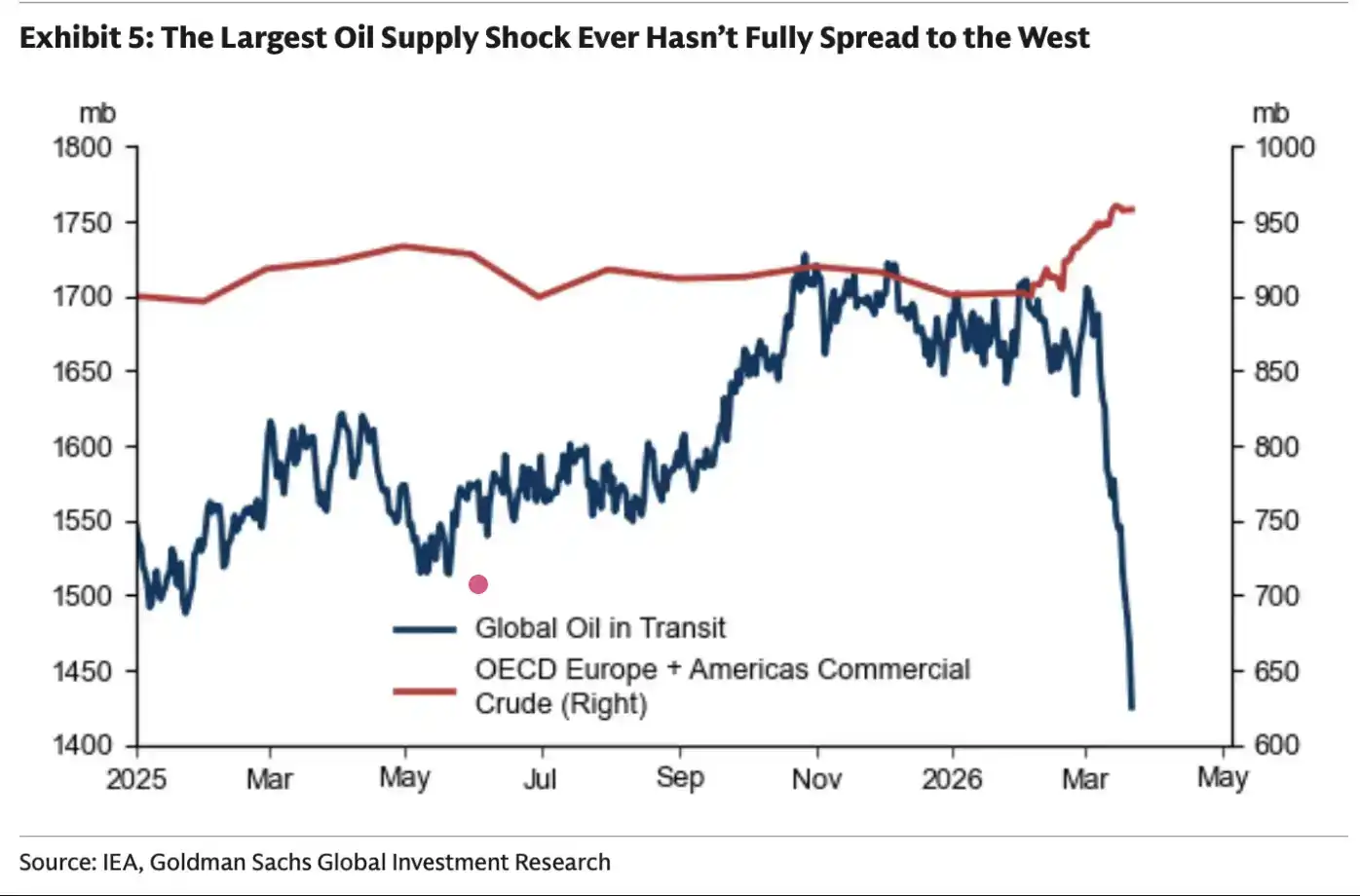
Currently, the evaporation effect of global "crude oil in transit" has not yet truly translated into onshore inventories. However, we predict that this impact will be fully apparent by mid-April.
If the conflict remains unresolved by mid-April, the International Energy Agency (IEA) will have to coordinate another release of approximately 400 million barrels of strategic petroleum reserves (SPR). Otherwise, oil prices will surge into the "demand destruction" zone (above $200).
Long-term effects
According to Energy Aspect's latest weekly report, the cumulative supply loss in the market is estimated at approximately 930 million barrels. Of this, the cumulative production loss from May to December is approximately 340 million barrels.
This assessment is clearly more aggressive than ours. Our inventory sensitivity analysis did not fully account for the reality that countries like Iraq and Kuwait may need 3 to 4 months to restore production capacity. This means that our previous estimates may have been too conservative.
For Goldman Sachs, the conclusion is straightforward: the longer the conflict lasts, the longer high oil prices will persist.
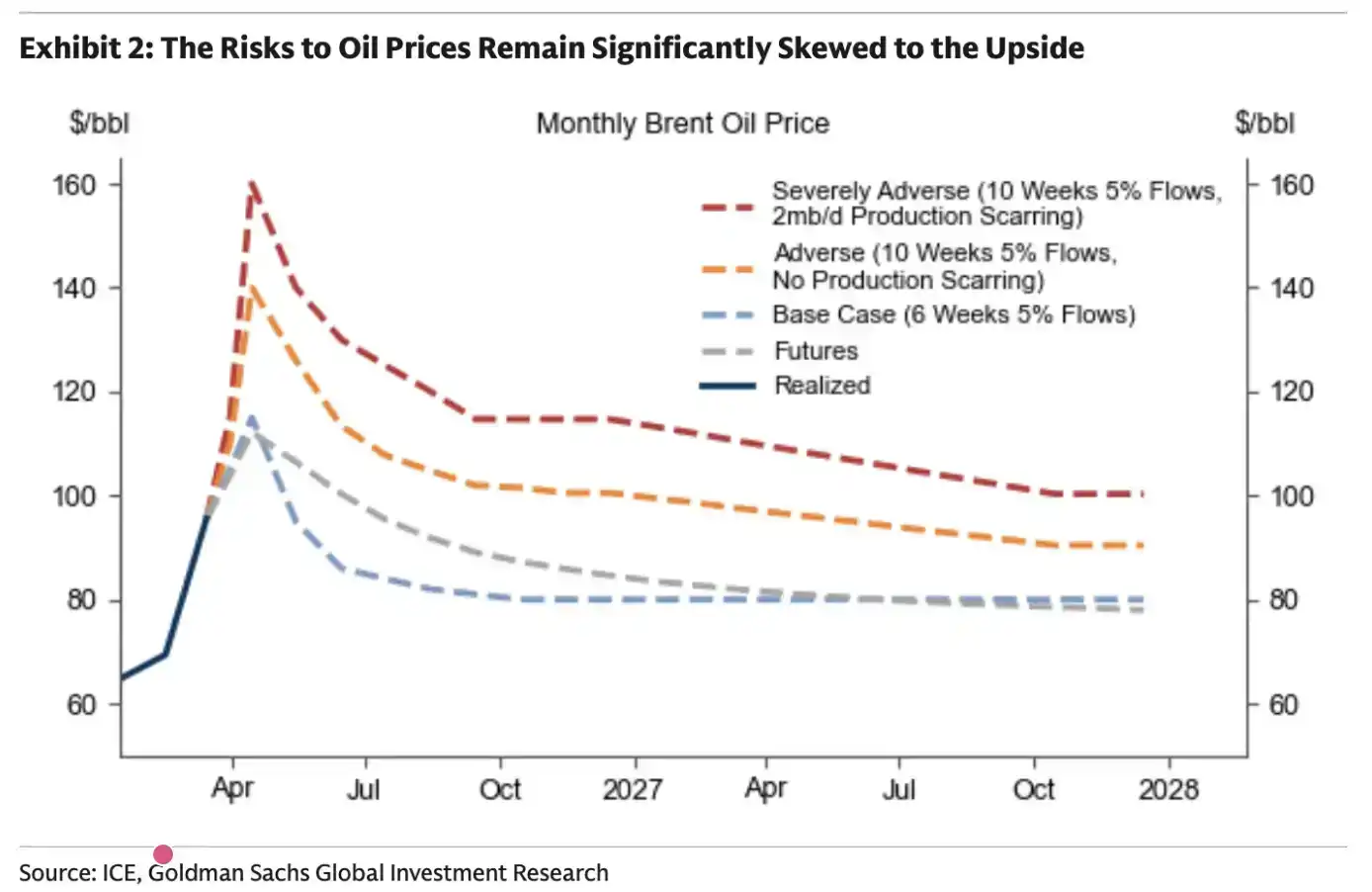
In the above scenario, Goldman Sachs also put forward a hypothesis: what would the market look like if the conflict continued for another 10 weeks? Their judgment is basically consistent with our previous deduction.
Essentially, there is a "tipping point" in the oil market. Once that line is crossed, there is no turning back.
Readers should be prepared for a structural increase in oil prices in the future. Even if the war ends this week, the supply losses already incurred will have a substantial impact on the future global oil supply and demand balance.
How long will it last?
Up until now, I have avoided making any predictions about "when this conflict will end." On the one hand, I don't want to "set a flag," and on the other hand, I really can't predict it.
But one thing is clear: this conflict is different from previous ones. In the past, the common strategy was to "escalate to de-escalate," but now there are almost no signs of that.
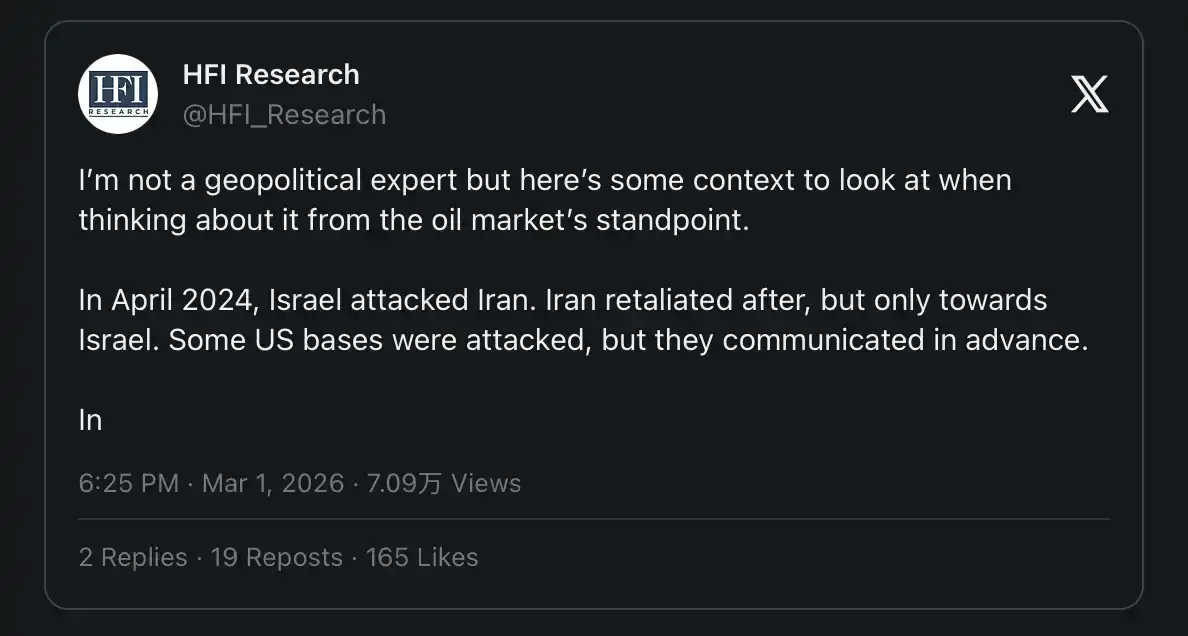
The retaliatory strikes occurred without warning; Iran's reach also appeared to extend beyond Israel to the Gulf states. It was this manner of response that made me realize from the outset—this time, things were different.
With the conflict nearing its fourth week, I am increasingly worried that with each day of delay, the probability of an agreement decreases significantly. As we analyzed in our article "Time Is Running Out," Iran is very clear about the logic of the oil market. It only needs to wait for the market to reach that "critical point" to extract the maximum concessions from the United States in negotiations. From a tactical perspective, reaching an agreement at this point offers no advantage to it. The Strait of Hormuz card has already been played, and it is unlikely to be used again in the future.
For the Gulf states, this situation of being "held hostage" will continue to occur repeatedly if the current Iranian regime is not overthrown. Even if some kind of "toll" mechanism is established, this uncertainty remains unacceptable.
Therefore, logically speaking, the initiative lies not with the United States, but with Iran. In this situation, Iran has a greater incentive to push the situation to a "critical point" in the oil market to test the United States' resilience. All it needs to do is "hold on" for another three weeks until cracks begin to appear in the market.
However, it must be emphasized that I am not a geopolitical expert and do not have complete confidence in such judgments. What I can offer is merely an assessment of the current situation based on fundamental analysis.