The US stock market may see the three most expensive IPOs in history this year—OpenAI, SpaceX, and Anthropic. These three unicorns will bring more innovative gameplay and narrative depth to the RWA narrative in the crypto world.
In 2026, the US stock market is witnessing a trillion-dollar IPO frenzy.
The combined valuation of OpenAI, SpaceX, and Anthropic—three epoch-making unicorns—is approaching $3.3 trillion, far exceeding the market capitalization of the crypto market. As of the date of writing, the total circulating market capitalization of cryptocurrencies, including stablecoins, has just rebounded to $2.45 trillion.
The listing of these three companies is expected to not only drive up the overall valuation of the technology sector, but also inject new imagination and value anchors into the RWA narrative in the crypto world.
SpaceX, OpenAI, and Anthropic are going public.
Following geopolitical volatility, US stocks are beginning to recover, while the AI and space technology sectors continue to attract substantial institutional investment, reflecting the market's peak demand for high-growth, high-barrier-to-entry assets. The upcoming IPOs of three major projects this year perfectly exemplify this trend.
SpaceX: The largest IPO in history, Musk's "final piece of the puzzle"
SpaceX is Elon Musk's Starlink project, and its IPO is unique in that it has a three-dimensional business model of "hardware + services + data"—the continuous sale of Starlink devices, revenue from network service subscriptions, and the potential tokenization of space data assets.
According to publicly available data, SpaceX has achieved global broadband coverage through its low-Earth orbit satellite network, with more than 9,500 satellites deployed. In 2025, its revenue was approximately $12.3 billion, accounting for about 70%-80% of SpaceX's total revenue. It serves more than 10 million users and is rapidly expanding into the aerospace, maritime, and defense sectors.
Regarding the IPO schedule, Musk has confirmed that the company will proceed with the listing in 2026, with the earliest launch in June, earlier than OpenAI and Anthropic.
It's worth noting that SpaceX recently raised its IPO target valuation to over $2 trillion. Looking at it from a broader perspective, when this largest IPO in human history is placed within the grand narrative of "surpassing the seven largest U.S. stocks," it transcends a simple fundraising activity. Through a highly impactful vision and meticulous capital arrangement, it is continuously strengthening market consensus and asset premium before the listing.
OpenAI: The Most Expensive Growth Machine in the AI Era
As the developer of ChatGPT, OpenAI has established an absolute leading position in the field of AGI (Artificial General Intelligence).
From a fundamental perspective, OpenAI is growing at a rate never before seen in human history: ChatGPT has surpassed 900 million weekly active users, Codex serves over 2 million developers weekly, and its annualized revenue exceeded $25 billion in February 2026. The company projects its annual revenue to exceed $280 billion by 2030 and has publicly declared its intention to become an "AI super app" platform.
Just at the end of March, OpenAI completed the largest funding round in Silicon Valley history—raising a total of $122 billion from investors including SoftBank, Amazon, Nvidia, and Andreessen Horowitz at a valuation of $852 billion. Amazon alone invested $50 billion, while also bundling a $100 billion commitment to AWS cloud services.
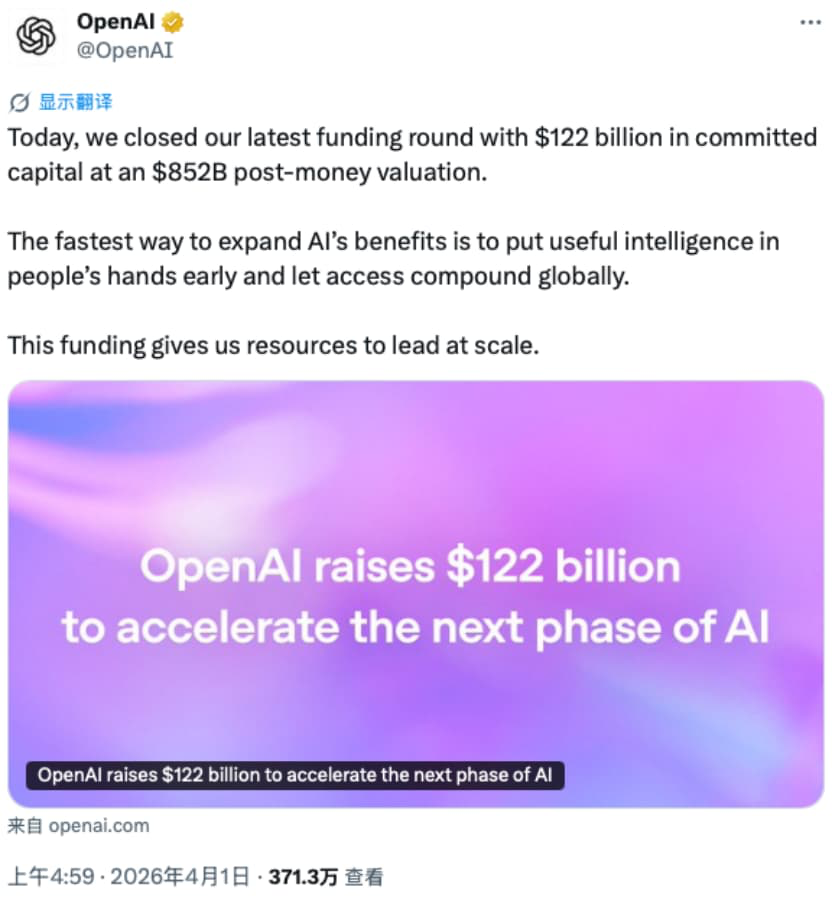
A clear signal accompanying this is that OpenAI has opened up banking channels to individual investors for the first time, a move widely interpreted as a prelude to a potential IPO in the fourth quarter.
Compared to SpaceX's scarcity and profitability as the only commercial space project, OpenAI is currently in a state of fierce competition and large-scale losses: burning through more than $14 billion annually—the cost of computing power armaments necessary for cutting-edge model training and data center expansion, and the company has also pledged to invest more than $600 billion in cloud servers over the next five years.
Faced with multi-faceted competition from Anthropic, Google, and the open-source community, this parallel state of large-scale losses and rapid business growth will continue to be scrutinized by the public market.
Anthropic: OpenAI's strongest competitor, focusing on security and enterprise AI
Compared to OpenAI's aggressive expansion, Anthropic, the developer of the Claude series of models, takes a more stable approach favored by compliance and large enterprises. Its brand positioning based on "AI safety first" has secured it the second position in the AI field.
This differentiated approach has resulted in equally impressive business growth: Anthropic's annualized revenue this year has soared from $9 billion at the end of 2025 to $30 billion, setting a record for the fastest quarterly growth for a company of this size in enterprise software history.

In fact, thanks to the advantages of Claude's models in long text processing and the security of "AI Constitutional AI" (a method of training artificial intelligence systems to align with human values), Anthropic has become the preferred choice in the enterprise AI market: currently, 8 of the Fortune 10 companies worldwide are Claude's paying customers, and enterprise customers account for more than 80% of revenue.
In its Series G funding round in February of this year, Anthropic raised $30 billion, and its valuation soared to $380 billion.
It is reported that Anthropic is considering an IPO on Nasdaq as early as October 2026, aiming to raise more than $60 billion, with an estimated valuation range of $400 billion to $500 billion.
Summary: Pre-IPO is currently in a boom period.
By 2026, RWA will be the most certain narrative in the crypto industry: the scale of on-chain tokenized US Treasury bonds has exceeded $1.28 trillion, and the entire RWA market grew by more than 200% year-on-year in 2025. The combined valuation of these three IPOs is approaching $3.3 trillion, far exceeding the current total circulating market capitalization of the crypto market—meaning the crypto world is facing an unprecedented opportunity for an RWA boom: the most popular technology equity assets are waiting to be on-chained.
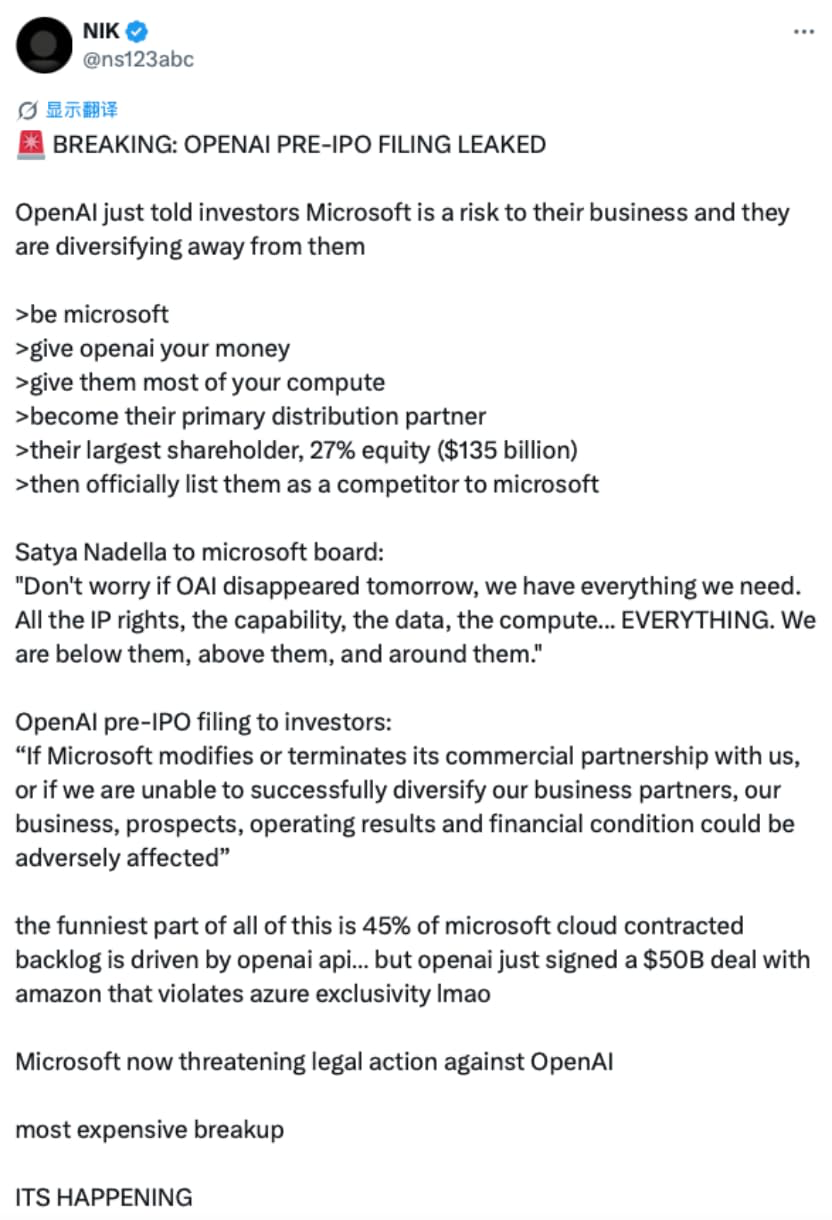
The current surge of pre-IPO products is a natural progression for RWA to expand from bonds and ETFs to high-growth technology equity. Based on our observations, on-chain participation in pre-IPO currently exhibits three main models:
• Pre-market contracts : These enable "equity-like" transactions through perpetual contracts. They offer high capital efficiency and low barriers to entry, but pricing is highly dependent on oracles, making them susceptible to manipulation and carrying significant risk exposure.
• Real Equity Tokenization : Legal ownership is established on-chain through an SPV (Special Purpose Vehicle) structure, with the underlying assets backed by real equity and a clear compliance path. This is the most legally robust of the three models, but it has high compliance thresholds and a limited tradable share, and is currently still in an early stage dominated by institutions.
• Shadow Stocks/IOUs : These are traded in advance as spot transactions before the market opens, and physical delivery takes place after the real equity assets are put on the blockchain. The process is simple and quick, but the trust endorsement of the underlying asset custody is weak, and the legal risks cannot be ignored.
These three paths each have their own trade-offs and are not yet mature. However, the underlying logic is consistent: from US Treasury bonds and real estate to technology equity, asset tokenization is an irreversible trend of financial innovation and a positive practice of financial democratization—allowing more ordinary investors to participate equally in scarce assets that were originally only available to top institutions.
In summary, this year's three hottest IPOs are not only historic moments for the US stock market, but also the strongest catalyst for the deep integration of crypto technology and RWA. We will continue to track this trend, seeking a balance between product innovation and compliance implementation, launching relevant RWA products in due course, providing investors with a more efficient and transparent way to participate, and welcoming the arrival of a new era of equity tokenization.
about Us
WEEX Labs is the research arm of the WEEX exchange, dedicated to tracking and analyzing cryptocurrency, blockchain technology, and emerging market trends, and providing professional assessments.
Adhering to the principles of objectivity, independence, and comprehensiveness, the team aims to explore cutting-edge trends and investment opportunities through rigorous research methods and advanced data analysis. The goal is to provide the industry with comprehensive, rigorous, and clear insights, and to offer all-round development and investment guidance to Web3 startups and investors.
Disclaimer
The views expressed in this article are for informational purposes only and do not constitute an endorsement of any products or services discussed, nor do they constitute any investment, financial, or trading advice. Readers should consult a qualified professional before making any financial decisions. Please note that WEEX Labs may restrict or prohibit all or part of its services from restricted regions.