Yields on 10-year Japanese government bonds (JGBs) surged to 2.49% – their highest level in nearly three decades – following the US announcement of a blockade of the Strait of Hormuz.
Compared to the end of last week, yields have increased by 5.5 basis points. Previously, the 2.44% threshold was XEM a "hard ceiling" for the market – last seen in 1998 – when the Japanese Ministry of Finance's trust fund manager stopped buying government bonds.
US crude oil prices rose to $105.63 a barrel at the start of the week, following the collapse of negotiations between the US and Iran. President Donald Trump subsequently announced that the US Navy would blockade the Strait of Hormuz to ships paying fees to Iran.
This move has heightened concerns about global energy supply, thereby driving up inflation expectations – a factor that directly puts pressure on the bond market.
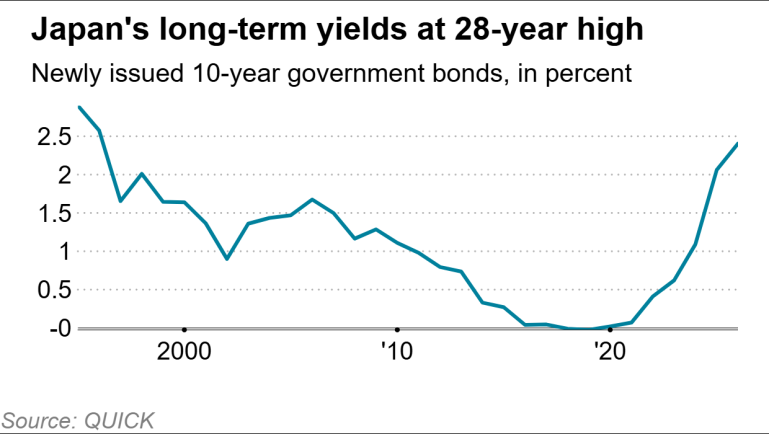
Japanese bond yields surge after nearly three decades (Graphic: Nikkei Asia)
The market is currently betting that the Bank of Japan (BOJ) will have to raise interest rates at its policy meeting on April 27-28.
Besides oil prices, the weakening yen is also contributing to exacerbating inflationary pressure. According to Tsuyoshi Ueno, an expert at the NLI Research Institute, high oil prices combined with a stronger US dollar could widen Japan's trade deficit, thereby providing further justification for the BOJ to tighten monetary policy.
In fact, long-term Japanese bond yields have been on an upward trend since 2022, when the BOJ began adjusting its policy and raising interest rates after decades of staying near 0% since 1999.
Japan's core inflation has also largely remained above the BOJ's 2% target since April 2022, with the exception of February this year – a period affected by energy subsidy programs.
According to Mr. Ueno, rising interest rates could put pressure on the Japanese economy by slowing down business and real estate investment. At the same time, financial institutions could face unrealized losses as bond prices fall. Conversely, households could benefit from higher deposit and investment yields.
However, the long-term consequences could be increased inequality: the gap between those with and without assets will widen, while younger generations will face higher mortgage costs.
Source: Nikkei Asia