A Macro-Paradigm Revolution: The Leap from "Interactive Portal" to "Sovereign Execution"
Today, in 2026, discussions about AI in the crypto market have long since moved beyond simple "investment advisory bots" or "chat interfaces," entering a more radical paradigm shift: an intent-centric interaction revolution. For a long time, human interaction with trading platforms has essentially been a manual labor of "finding buttons." Users are bogged down by cumbersome GUIs (Graphical User Interfaces) and high-frequency market noise; even with the keenest intuition, they often miss fleeting liquidity opportunities due to complex manual operations. However, with the maturation of proxy flows , trading sovereignty is shifting from the bottom up—AI is no longer a passively responding dialog box, but is evolving into a "digital employee" or "independent economic agent" with complete decision-making capabilities.
Against this backdrop, the competitive logic in the financial sector has shifted: future traffic entry points will no longer be specific websites or apps, but rather the execution endpoints of large-scale management models (LLMs). When a user says, "Try a small position when BTC breaks through the resistance level," it's no longer a trivial statement, but a complex instruction to be processed. However, a significant "action gap" exists between existing trading infrastructure and AI. Large-scale management models possess powerful cognitive capabilities but lack the "hand" to directly intervene in assets and execute logic in real-world financial scenarios. This disconnect between "perception" and "action" is the final barrier preventing AI agents from being effectively implemented in the financial field.

WEEX Labs astutely recognized this historic turning point. We believe that whoever can first establish a "standardized action component" between fragmented AI commands and highly sophisticated exchange engines will hold the foundation for the next generation of trading civilization. This is why WEEX Trader Skill... The open-source release of [the technology] is not only an iteration of technical components, but also a deep foray into the future form of "AI-native exchanges".
A Deep Dive into "Action Discontinuity": The Logical Clash Between Probabilistic Large Models and Deterministic Execution
When we try to get a large language model (LLM) with trillions of parameters to operate an extremely sophisticated, high-frequency volatile crypto exchage API, a hidden "clash of civilizations" begins. The biggest obstacle to the implementation of AI agents in financial trading is not that the models are not smart enough, but that there is a seemingly insurmountable semantic gap between their underlying probabilistic logic and the strong deterministic execution required by exchange APIs .
Traditional exchange interfaces are designed for "black and white" code logic: they require strict parameter formats, complex signature verification, and millisecond-level timing alignment. However, LLM outputs are essentially probabilistic text predictions. When AI attempts to understand a vague user intent—such as "help me maintain a 20% safety margin and close my position when the market fluctuates wildly"—it faces a double dilemma:
1. Execution Illusion: In the absence of standardized action mapping, AI is highly susceptible to producing small but fatal deviations when generating API parameters. A malformed JSON field or a leverage ratio misunderstood by the model often means liquidation risk in real trading.
2. Timeliness and Redundancy: Traditional REST APIs often contain a large number of redundant fields that are useless for AI decision-making. The inference delay caused by AI when processing this structured data is almost unacceptable in the high-frequency changing Crypto market.
The deeper problem lies in the fact that most existing APIs are "front-end oriented" or "oriented towards professional algorithm developers," rather than "agent oriented." They assume that the caller has perfect logic and pre-defined code paths, but AI agents require a middleware layer with fault tolerance and semantic alignment. This means that if we cannot build a "plug-and-play" functional module for AI, AI will forever remain a theoretical exercise in a simulation environment. This incomplete state of "having a brain but no hands" is the fundamental reason why countless AI trading projects stop at the demo stage.
Deconstructing the WEEX Trader Skill: Building a "Financial Relay Layer" on top of GitHub
Faced with the gap between AI cognition and execution, WEEX Labs did not simply patch up the existing API ruins. Instead, it reconstructed a "financial action instruction set for agents" from the underlying logic through the WEEX Trader Skill , which was released as open source on GitHub. If the large model is the "brain" of the AI agent, then the WEEX Trader Skill is its "nerve endings" and "action reflex arc" for accessing the crypto market.
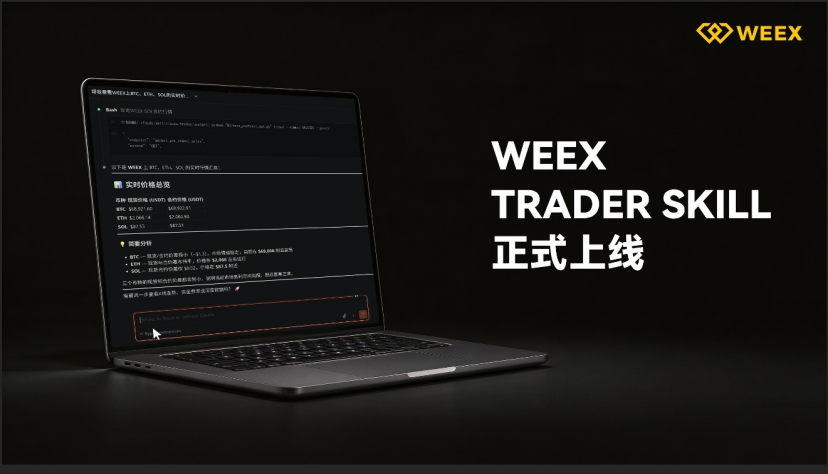
The brilliance of this Skill toolset lies in its highly precise "atomic encapsulation." By encapsulating cumbersome low-level interface calls (such as signature calculation, nonce maintenance, and order state machine tracking) into "skill modules" that AI can directly understand and trigger, WEEX has successfully transformed complex financial logic into standardized plugins within Agentic Workflow. Its core technological advantages are concentrated in three dimensions:
1. Minimalist Intent Mapping: WEEX Trader Skill provides LLM with a rigorous set of operational boundaries through a pre-defined JSON structure and function call mechanism. It no longer requires AI to learn how to construct a POST request; instead, it allows AI to precisely trigger atomic actions such as "query depth," "tiered order placement," or "one-click closing" based on natural language intent. This design directly reduces the "illusion rate" during execution to an engineering-ready level.
2. Deeply compatible with mainstream frameworks like OpenClaw: As a product of the AI-native era, this toolset achieves deep decoupling and hot-swappability with Agent frameworks such as OpenClaw. Developers no longer need to write lengthy adaptation layer code for each new strategy; they only need to attach WEEX Skill to enable AI agents to perceive market depth and respond in milliseconds, achieving a productivity leap from "cold start" to "real-world trading."
3. Status-Aware Closed-Loop Response: Traditional API calls are often fragmented, while WEEX Trader Skill provides a "feedback-driven action flow." It not only issues buy orders but also monitors order execution status, account balance changes, and position risk indicators in real time. This two-way, closed-loop feedback mechanism endows the AI agent with true "financial self-reflection capabilities," enabling it to self-correct its strategies in a dynamic market environment, much like a seasoned trader.
In our GitHub repository (weex-labs/weex-trader-skill), we've released not just code, but a set of interactive specifications for programmable exchanges . WEEX is using this standard to eliminate sunk costs for developers integrating AI with trading systems, simplifying complex engineering problems into simple logic configurations. This foundational approach signifies WEEX's evolution from a simple traffic matching platform into an indispensable liquidity infrastructure for the AI Agent era.
Permission reshaping and security sandboxes: anchoring asset sovereignty amidst the wave of AI automation.
When we partially delegate trading decision-making power to AI agents, an unavoidable question arises: how can humans retain ultimate asset sovereignty in the face of the algorithm's black box? In WEEX's design philosophy, automation should never come at the expense of security. WEEX Trader Skill integrates with the WEEX API. The prerequisite is essentially to build a physical-level "safety sandbox" between the crazy logic of AI and real-world assets.
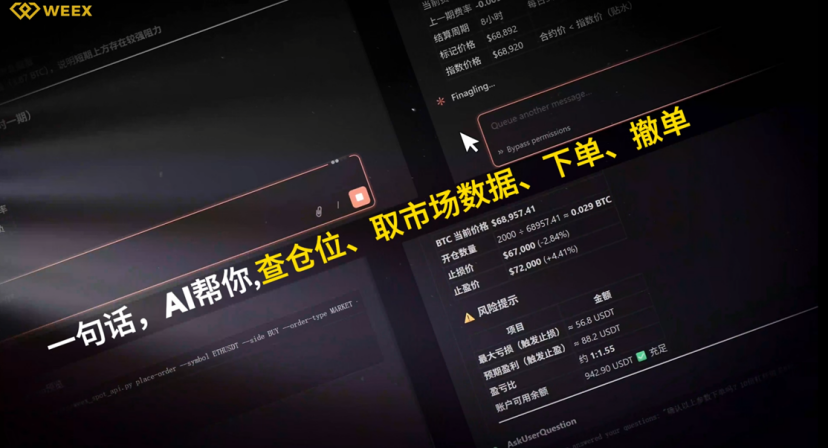
Traditional centralized hosting models are too fragile in the AI era, while fully decentralized signatures often suffer from performance bottlenecks. WEEX's proposed solution is based on the principle of least privilege and permission bit isolation. This is concretized in the GitHub guidelines as a rigorous API application paradigm:
1. Precise Permission Segmentation: WEEX guides users to surgically divide the permissions of the AI agent when generating API keys. By locking transfer permissions and isolating withdrawal paths, users can grant the AI only "read-only market data" and "spot/contract trading" permissions. This means that even if the AI agent exhibits extreme anomalies in its logical deductions, its destructive power will be strictly limited within the preset "trading sandbox," preventing it from infringing on the user's fundamental financial sovereignty.
2. Key Sovereignty Management: WEEX Trader Skill emphasizes the localized and encrypted configuration of API Keys and Secret Keys. This design logic breaks the illusion of "the platform controlling everything," returning the underlying control of security to the user. This is not merely a guide for technical integration, but also a defense line for "financial sovereignty"—while AI thinks for you, WEEX's underlying protocol guards the gate for you.
3. Abnormal Circuit Breaker Mechanism: In conjunction with the closed-loop feedback of Trader Skill, the API system acts as a "physical circuit breaker" in the automated process. When unexpected command frequency or unauthorized parameter calls are detected, the underlying security network will intercept them before the AI logic.
We define the API application process as a "digital sovereignty awarding ceremony." WEEX believes that a truly AI-friendly exchange must not only provide a smooth execution engine but also a robust and fault-tolerant security governance framework. This restraint and adherence to security red lines elevates WEEX Trader Skill beyond a mere tool, transforming it into the most trustworthy financial firewall in the AI era.
Practical Evolution Theory – The Arena of WEEX AI Trading Hackathon Season 2
If WEEX Trader Skill is the top-tier skeleton tailor-made for AI agents, then the upcoming " WEEX AI Trading Hackathon Season 2 " (WEEX AI Wars II) , officially launching in May , will be a stress test of this foundational system in the real battlefield. This is not just a prize-winning competition among developers, but also a profound experiment on the "evolution of financial species": in the extremely volatile crypto market, can AI, through a standardized toolset, demonstrate a resilience that surpasses human intuition?
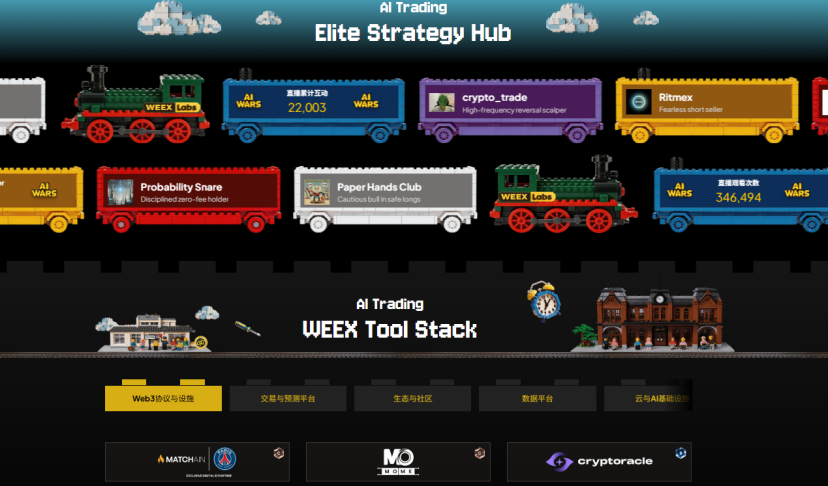
Compared to the first season, this year's hackathon has undergone a generational leap in both breadth and depth. It no longer merely assesses the profitability of algorithms, but instead focuses its core spotlight on "AI-native execution capabilities" and "Multi-Agent Systems." Empowered by WEEX Trader Skills, participants will no longer be bogged down in tedious API integrations, but can instead concentrate fully on building higher-level strategies.
1. From "Individual Combat" to "Swarm Intelligence": Developers can leverage the Skill module to build a "digital asset management team" composed of multiple agents. For example, one agent can handle real-time sentiment analysis of Twitter and news, another agent can perform multi-timeframe technical modeling of candlestick charts, and a third agent can perform millisecond-level order splitting and execution using WEEX Skill. This complex swarm decision-making is the mainstream form of future asset management.
2. "Algorithm Breakthrough" in Extreme Scenarios: The competition will simulate extreme stress environments such as black swan events and high-frequency oscillations. Participating teams must prove that their AI agents can perform automated rollback control and logic circuit breaking without relying on human intervention, utilizing the closed-loop feedback mechanism provided by Trader Skill.
3. The "Alchemy" of Real Liquidity: WEEX offers not only prizes, but also a real matching engine environment. This means that optimizing every line of code directly confronts global-level challenges.
Through this competition, WEEX is extending an invitation to developers worldwide: to leverage our open-source "skill kit" to personally cultivate the first generation of AI traders with real-world trading autonomy amidst the market turmoil of May. This is not only a tribute to technology but also a comprehensive practical rehearsal of future financial interaction paradigms.
Vision and End Goal: Building a "Programmable Mobility Foundation" for the AI Era
Looking back at the history of financial transactions, every leap in productivity has been accompanied by a complete restructuring of interaction protocols. From noisy open outcry to millisecond-level electronic matching, humanity has always been pursuing the limits of efficiency. Today, with the open-source release of WEEX Trader Skill and the launch of the second season of the AI Trading Hackathon , we are witnessing the beginning of a new era: exchanges are no longer just places to buy and sell assets, but are evolving into an AI-friendly, highly programmable liquidity platform.
In WEEX Labs' grand vision, the future trading landscape will be woven from countless AI agents running in the cloud. These agents will no longer be cold, impersonal code, but digital beings with strategic sovereignty, capable of autonomous learning and complex interactions using standardized "skills." WEEX's mission is to provide the most fertile ground for these digital beings. We deeply understand that a truly future-leading platform should not attempt to control user logic, but rather empower every developer through a "foundational" strategy—providing the most robust API system, the most atomic action components, and the most secure execution sandbox.
This is not merely a technological leap forward, but a profound strategic move towards "financial fairness." When AI Trader Skills make complex asset management strategies readily accessible, and when API access control allows ordinary developers to securely access global depth, the barriers to financial trading will be completely eliminated. This May, as global tech enthusiasts collide on the WEEX platform, we are not just predicting the future; we are bringing the era of intelligent, transparent, and borderless programmable exchanges into reality through every line of code and every AI-driven order.
WEEX's ultimate goal is to become the standard for "Liquidity as a Service (LaaS)" in the AI era. This transformation began with a commit on GitHub, blossomed in the arena in May, and will ultimately define the financial interaction civilization of the next decade.
About WEEX
Founded in 2018, WEEX is a global cryptocurrency trading platform dedicated to providing users with secure, stable, and user-friendly trading services. The platform supports both spot and futures trading and is equipped with a multi-layered risk control system and a full insurance mechanism to protect user assets. WEEX has already established an official regional brand partnership with La Liga in Hong Kong and Taiwan and continues to advance its compliance and localization efforts in multiple markets, including the Middle East, Europe, Latin America, Africa, and Southeast Asia. With the continuous expansion of its Web3 ecosystem strategy, WEEX is collaborating with global developers and user communities to drive the evolution of digital asset trading towards greater openness and transparency.
For more information , please visit: Website | Twitter | Telegram | LinkedIn