
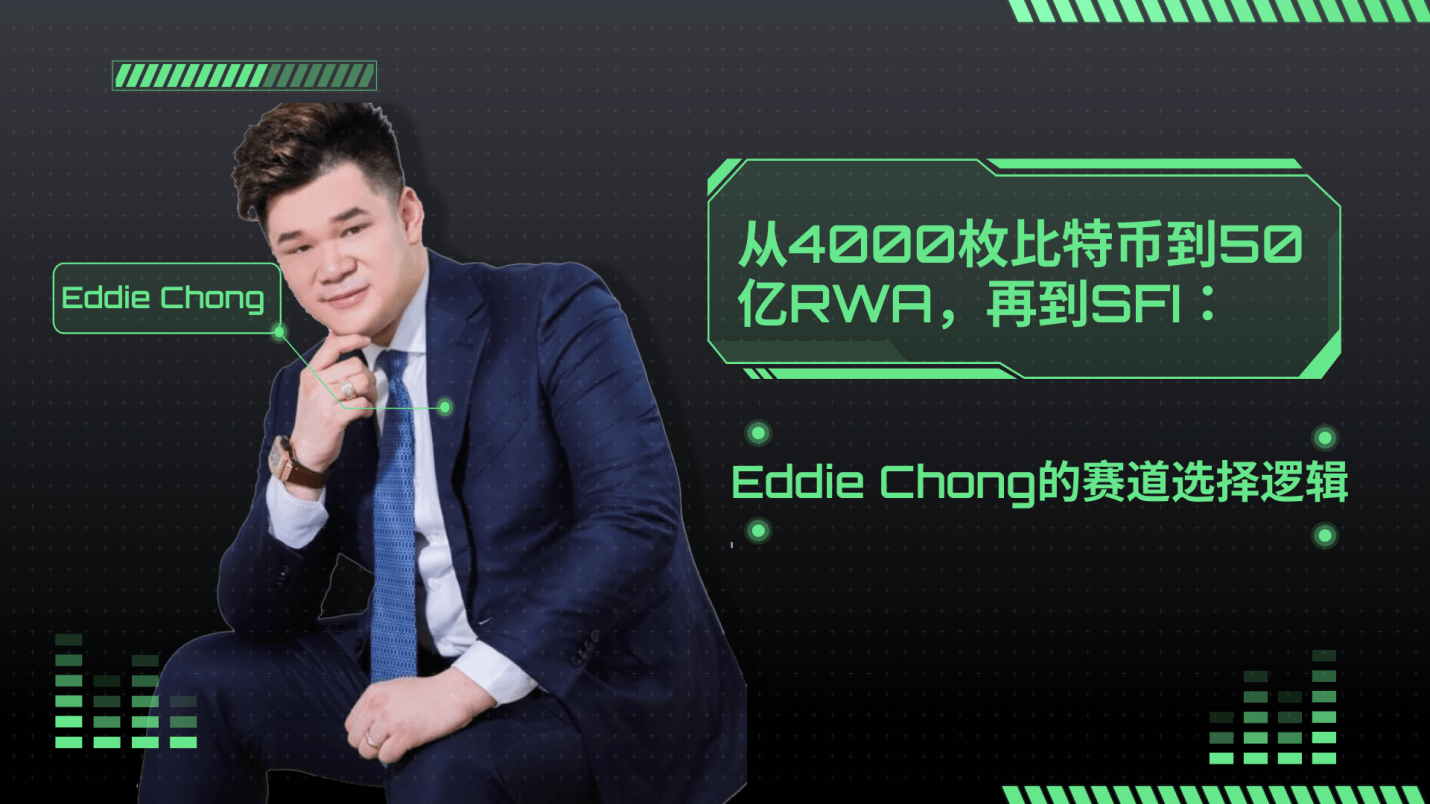
In the Web3 industry, the ability to anticipate trends and the dedication to in-depth development are the core benchmarks that distinguish short-term speculators from long-term builders. In this circle that is never short of smart people, what is most scarce are long-term thinkers who can accurately bet on industry trends before they arrive and who can patiently persevere until the results are realized.
From an early blockchain gold digger with 4,000 Bitcoins to an industry pioneer managing a $5 billion RWA empire, and now an ecosystem builder establishing stablecoin infrastructure with SFI—since entering the blockchain field in 2015, he has anchored his efforts on solving industry pain points. Every strategic choice he makes is driven by clear and unwavering logic, consistently staying ahead of market consensus. As Chairman of the SFI Ecosystem Foundation, Founder and President of X Infinity, and Executive Chairman of the HK Web3 Club, this Malaysian entrepreneur based in Singapore has businesses spanning multiple global markets, connecting over 100 Web3 and traditional enterprises, and boasting a core community influence of over 20 million people. More worthy of in-depth study than these figures are his three market-leading strategic choices—each accurately identifying pain points and successfully implementing closed-loop systems.
Starting with payment pain points, we developed a self-made public blockchain to break through performance bottlenecks.
In 2015, Eddie Chong came across Bitcoin due to the efficiency challenges of international trade payments. At that time, Bitcoin's 75-minute settlement time was a significant improvement over traditional banking processes, but he astutely saw the core problem behind it: Bitcoin's transaction processing capacity of only 7 TPS was simply insufficient to support large-scale payment scenarios in the real world, which was the first hurdle for blockchain to move towards practical application.
It was this forward-thinking judgment that propelled him to found X Infinity in 2017, resolutely launching a plan to develop his own high-performance public blockchain. After two years of refinement, the X blockchain officially launched in 2019, achieving a transaction processing speed of 100,000 TPS and a transaction confirmation time of only 0.1 milliseconds, representing a qualitative leap in performance compared to Bitcoin. In the same year, X Infinity completed its exit through an acquisition for $160 million, and this technological exploration, which started from addressing payment pain points, finally gained market recognition.
While the technology was being implemented, Eddie Chong's thinking didn't stop there. He realized that while high-performance public chains solved the problem of blockchain circulation efficiency, new industry shortcomings immediately emerged: without real assets on-chain as support, even the most efficient technology was just a castle in the air. This realization led him to turn his attention to the then little-known RWA track, allowing his track selection logic to be put into practice for the first time.
Deploying RWA against the trend during a bear market allows blockchain to carry real-world value.
From 2019 to early 2020, the crypto remained mired in a bear market, with low market sentiment. Most participants remained focused on purely technical narratives and speculation in virtual assets. However, Eddie Chong was the first to shift his investment focus to the tokenization of real-world assets. In his view, if blockchain cannot support real assets, it will never escape its speculative nature; only by combining the virtual and the real can it go further. This judgment predates RWA becoming a buzzword in the industry by a full three years, and it is also a further manifestation of his logic of choosing a track based on solving the core pain points of the industry.
In 2020, as the pandemic impacted global markets and most investors opted for a conservative wait-and-see approach, Eddie Chong launched a series of precise contrarian investments, placing significant bets on real-world assets: a $350 million investment in MICK Malacca Gold Harbour, anchoring a core Southeast Asian hub asset, now valued at $5 billion; a $4 million investment in the smart glass sector, Nextglass, now valued at $300 million, making it a leader in its niche; a $20 million investment in Delta private jets, cultivating the high-end travel market, now valued at $200 million; and a $20 million investment in the Asian streaming market, WebTvAsia, whose market capitalization is projected to exceed $500 million by 2025.
During the same period, thanks to his accurate grasp of industry trends, he has achieved a cumulative return of over $400 million in the fields of digital currency, gold, and biomedicine through legal and compliant two-way cooperation and value investment.
These investment cases collectively form X Infinity Capital's core investment model: efficiently connecting high-quality physical assets such as ports, real estate, and advanced manufacturing with the capital market through digitalization, tokenization, and structured financial instruments, forming a closed loop driven by "physical value + digital empowerment." Today, the fund manages $5 billion in assets and has invested in over 400 projects, becoming a benchmark investment platform in the RWA (Real Estate Investment and Development) sector. This $5 billion RWA portfolio is a testament to the fruitful results of its sector selection logic.
Anchoring the shortcomings in circulation, SFI completes the final piece of the RWA puzzle.
From 2023 to 2024, the RWA (Real-Time Asset Wafer) sector finally experienced a boom, becoming one of the most certain development directions in the Web3 field. However, at this time, Eddie Chong astutely discovered a new structural problem: as more and more physical assets were put on-chain, the industry lacked efficient and stable circulation tools, and a large number of RWA assets were "locked" on the chain, unable to truly enter the real economic cycle. This became a new bottleneck for the large-scale development of RWA.
In his view, RWA and stablecoins are two sides of the same coin: without RWA, stablecoins can only remain at the level of simple transactions, lacking real value support; without stablecoins, RWA assets lose an efficient medium for circulation and are difficult to implement on a large scale.
Based on this assessment, in 2024, Eddie Chong co-founded SFI (Stablecoin Financial Infrastructure), positioning it as a one-stop stablecoin ecosystem infrastructure. Its core goal is to break down all barriers between stablecoins and consumers and businesses, making stablecoins a bridge connecting on-chain RWA assets with real-world offline scenarios. This is another key strategic move he has made around addressing the pain points of the RWA sector.
Today, SFI has established active communities in over 100 countries worldwide, with over 200,000 active users. Its ecosystem network covers multiple core sectors including stablecoins, digital asset cards, public chains, and DeFi. Paired with X Infinity's X-Pay payment system—which integrates a cryptocurrency wallet and supports physical digital asset cards from VISA/MasterCard/UnionPay, connecting with 800 million merchants globally—SFI and X-Pay form a deep synergy, enabling cross-currency spending in scenarios such as utility bill payments, apparel, and transportation. This synergy effectively constructs a complete business loop from RWA asset on-chain to stablecoin circulation and offline real-world consumption, truly realizing the circulation and implementation of its $5 billion RWA ecosystem.
Deeply rooted in the industry, rather than chasing trends, our core methodology focuses on solving industry pain points.
Looking back at Eddie Chong's three key choices, a clear logic for choosing a track has been consistent throughout: from early exploration of Bitcoin in the blockchain era, to the industry layout of the $5 billion RWA empire, and then to the ecosystem building of SFI to connect stablecoin infrastructure—he has never chased market hotspots, but rather accurately identified the weakest links in the industrial chain at each stage of industry development, using this as the core basis for track selection, and personally getting involved to solve problems.
From 2015 to 2017, addressing the pain points of low efficiency and insufficient TPS performance in blockchain payments, he founded X Infinity to develop a high-performance public chain, filling a key gap in the underlying technology. This marked the first implementation of his track selection logic. From 2019 to 2020, recognizing the industry problem of a lack of real asset support on the blockchain, he established X Infinity Capital and systematically cultivated the RWA track, enabling blockchain to truly carry real-world value and applying this logic to the field of real-world assets with greater long-term value, ultimately building a $5 billion RWA empire. In 2024, recognizing the new bottleneck of RWA assets lacking efficient circulation tools, he co-founded SFI to build stablecoin infrastructure, bridging the last mile of asset circulation and completing the layout of the RWA track.
Each round of strategic deployment represents a breakthrough in overcoming the core bottlenecks of the industry in the previous stage, and each problem-solving process continuously improves its business landscape. Ultimately, a complete Web3 ecosystem loop, encompassing the underlying technology (X public chain), the asset side (RWA track), and the circulation layer (SFI + X-Pay payment system), has taken shape through its continuous and in-depth development. The construction of this loop is a comprehensive implementation of its track selection logic.
Currently, RWA remains the most certain trend in the Web3 industry, and Eddie Chong has been deeply involved in this field for five years. With over a decade of experience in the blockchain industry, he has distilled a clear logic for choosing a path: don't chase trends, focus on addressing weaknesses, and anchor long-term value by solving core industry pain points . This offers profound insights for Web3 practitioners: only by choosing a path based on solving real-world problems, rather than blindly following trends, can one gain a foothold in the industry's waves and achieve the leap from single-point exploration to ecosystem building.