Sui's DeFi infrastructure is evolving from decentralized product nodes into an interconnected financial system.
Written by: ChandlerZ, Foresight News
In the first quarter of 2026, the total value added (TVL) of the entire DeFi market fell by 16%. The collective performance of L1 tokens was even less optimistic. 1kx data shows that despite accounting for 90% of the market capitalization of the crypto market, L1 public chains actually collected only 12% of the total market fee revenue. Almost all mainstream L1 tokens recorded negative annual returns, and the market is voting with real money, questioning L1's ability to capture value as an infrastructure layer.
When the growth in on-chain activity doesn't automatically translate into an increase in the value of L1 tokens, the protocol layer, rather than the infrastructure layer, is capturing more and more economic benefits. This forces every L1 blockchain to rethink a fundamental question: what truly underpins the long-term competitiveness of a public blockchain?
In this environment, most public blockchains chose to cut spending, slow down development, and wait for the market to recover. Sui, however, took the opposite approach. Within a single quarter, Sui launched four tiers of financial infrastructure upgrades: ETF approval to open up institutional access, the launch of two stablecoins through different pathways, upgrades to margin trading infrastructure, and the initiation of a developer incentive program.
According to official data, since August 2025, Sui has processed more than $1 trillion in stablecoin transactions, with a peak of $229 billion in August 2025.
Behind this lies a clear judgment: when market cycles suppress token prices, what truly accumulates long-term competitiveness is the completeness of the underlying financial infrastructure. While most public chains are still debating whether to prioritize applications or infrastructure, Sui has provided its own answer: infrastructure first, waiting for the cycle to reverse.
ETFs break the ice, becoming the fifth crypto asset to receive US approval.
In January 2024, a Bitcoin spot ETF was approved, followed by Ethereum in the middle of the same year. In September 2025, XRP became the first approved Altcoin spot ETF, with Solana following closely in October. In February 2026, SUI became the fifth crypto asset spot ETP approved by the SEC in the United States. The top four on this list are all mature assets with market capitalization rankings in the top ten and several years of trading history.
For a public blockchain that has been online for less than three years, being included in this list signifies that traditional financial markets are beginning to view SUI as an asset class worthy of independent allocation. It's worth noting that in September 2025, the SEC approved a general listing standard, reducing the approval cycle for crypto ETFs from over 240 days to approximately 75 days. This institutional change created conditions for the rapid approval of the SUI ETF.
Within a month, three SUI ETFs were launched, covering two exchanges and three issuers. Concurrently, VanEck launched the SUI ETN (ticker symbol VESU) on the Deutsche Börse Xetra, offering fully collateralized compliant exposure to European investors.
On February 18th, Grayscale's GSUI and Canary Capital's SUIS launched simultaneously, with the former trading on NYSE Arca and the latter on Nasdaq. Both products feature built-in staking functionality, a first for previously approved BTC and ETH spot ETFs. GSUI uses 100% of its SUI holdings for on-chain staking, participating in verification through the Sui network's delegated proof-of-stake mechanism. As of late March, its net staking yield was approximately 1.32%, with a management fee of 0.35%, waived for the first three months or until assets reach $1 billion. SUIS reported a staking yield of approximately 7% and a management fee of 0.75%. The significant difference in yield between the two products stems primarily from their different staking strategies and fee structures, allowing investors to choose based on their risk and return preferences.
On February 24th, 21Shares' TSUI was launched on Nasdaq, offering pure spot SUI exposure without collateralization, with a management fee of 0.30%, waived until October 2026. Previously, 21Shares launched a 2x leveraged SUI ETF (TXXS) in December 2025, with a management fee of 1.89%, providing a derivatives channel for investors with a high risk appetite. From leverage to spot to collateralization, SUI's product line in the US ETF market has covered investors with different risk appetites and return expectations within a single quarter.
The differentiated strategies of the three products are clearly visible: Grayscale and Canary Capital have chosen collateralized ETFs to pass on on-chain returns to traditional financial investors; while 21Shares has chosen a pure spot route to provide an entry point for institutions that prefer simple exposure and lower fees.
The significance of collateralized ETFs goes beyond simply being a funding channel. In traditional ETF structures, investors purchase price exposure while the asset itself remains dormant. Collateralized SUI ETFs change this logic. Institutional funds enter through the ETF, which then stakes SUI on the network to participate in verification and enhance security, with staking rewards being returned to holders. This creates a two-way flow of value between traditional capital and the on-chain economy. This is a structural innovation that previous BTC and ETH ETFs failed to achieve; the SUI ETF is among the first products to embed on-chain economic incentives into a traditional fund structure.
Previously, institutional investors needed to access SUIs through OTC counters or by managing their own private keys, which was both difficult and complex. ETFs simplify this process to the level of a regular stock transaction.
For the Sui ecosystem, the opening of institutional access channels means that the user base and capital pool have expanded from native on-chain users to the traditional financial system. When a fund manager holding a traditional brokerage account can buy SUI exposure just like buying SPY, the potential capital pool of this public chain jumps from billions of dollars native to crypto to trillions of dollars in traditional asset management.
Stablecoin infrastructure: providing a settlement engine for DeFi.
ETFs solved the problem of who can participate, while stablecoins address the issue of what to use for trading once participants are involved. Without a mature stablecoin infrastructure, on-chain DeFi is like a system with pipes built but no water flowing; capital cannot circulate efficiently, and transactions lack stable pricing and settlement tools.
In the first quarter of 2026, two stablecoin products with drastically different paths were launched on Sui, driving the on-chain stablecoin market capitalization to continue to climb from approximately $485 million at the end of 2025.
On February 11th, Ethena's synthetic USD, suiUSDe, launched on the Sui mainnet. suiUSDe is the native version of Ethena Labs' synthetic stablecoin on Sui, maintaining its peg to the US dollar through a Delta-neutral strategy. Unlike traditional fiat-backed stablecoins, Ethena's model generates yield through long-short hedging of crypto assets, making suiUSDe naturally suitable for leveraged trading and yield strategies in DeFi scenarios.
The launch of suiUSDe was completed simultaneously with its integration with DeepBook Margin. As the first synthetic dollar to be integrated into the DeepBook margin trading system, it can be used directly for margin trading, lending, and leveraged operations from day one, without waiting for each protocol to be integrated individually. This efficiency of infrastructure-ready equals product-ready is precisely the advantage of composable architecture.
SUI Group Holdings (NASDAQ: SUIG) has injected $10 million into the suiUSDe yield treasury on Ember Protocol, bringing the initial capacity to $25 million. SUIG is a Nasdaq-listed digital asset platform holding approximately 102 million SUI tokens and focuses on driving institutional-grade applications within the Sui ecosystem. The direct involvement of a Nasdaq-listed company in deploying an on-chain yield treasury demonstrates that the type of capital Sui is attracting has shifted from retail to institutional investors. Projects within the ecosystem such as Aftermath, AlphaLend, Bluefin, Navi, Scallop, and Suilend have already announced support for suiUSDe, covering key application scenarios including lending, trading, and yield aggregation.
USDsui, launched on March 4th, took a completely different path. While suiUSDe serves native on-chain DeFi players, USDsui targets the broader market of compliant payments and institutional settlements. USDsui is issued by Bridge, a stablecoin infrastructure company acquired by Stripe in 2025, which enables businesses and networks to quickly deploy customized stablecoin products through its Open Issuance platform.
USDsui's reserves are managed by institutional partners such as BlackRock, Fidelity Investments, and Superstate, and are structured in accordance with GENIUS Act compliance requirements. A key feature of USDsui is its interoperability. Through Bridge's Open Issuance ecosystem, USDsui can be instantly swapped 1:1 with other Bridge-issued stablecoins, enabling low-friction cross-chain circulation. For global payments and DeFi applications, this means having a compliant, scalable USD-pegged asset on the Sui chain.
The strategic intent behind these two paths is clear. suiUSDe targets native DeFi users, providing the underlying asset for yield generation and leveraged trading; USDsui targets payment and compliance scenarios, providing a stable US dollar backed by institutional-grade reserves. This dual-track architecture enables Sui to attract both DeFi capital and traditional institutional funds.
In a broader market context, the global stablecoin market capitalization reached a record high of $316.4 billion in Q1 2026, with monthly trading volume exceeding $10 trillion. Even amidst a general contraction in DeFi TVL, stablecoins remain the fastest-growing category of crypto assets. The completeness of a public blockchain's stablecoin infrastructure directly determines its share of this structural growth. Sui's simultaneous launch of two stablecoins at this time is a calculated strategic move.
DeepBook Margin, a composable layer for DeFi infrastructure
ETFs bring capital in, and stablecoins provide a pricing tool for capital. However, for capital to flow efficiently on the blockchain, a unified trading infrastructure integrating matching, lending, and clearing is still needed. The launch of DeepBook Margin fills the most critical link in this chain, enabling capital on the Sui blockchain to progress from simply being able to enter and having the necessary tools to being able to trade efficiently.
DeepBook is Sui's core liquidity layer, a fully on-chain Central Limit Order Book (CLOB). As of April 15, DeepBook has processed a total transaction volume of $18.8 billion, serving over 31.4 million users, with a 24-hour transaction volume of approximately $10.5 million. 26.5 million DEEP tokens have been permanently burned from transaction fees.
Building upon this proven matching infrastructure, DeepBook Margin adds functional modules such as margin trading, a liquidation engine, and interest rate calculation, supporting leverage options from 1x to 16x. Transactions are automatically completed through flash loan, encompassing borrowing, exchange, collateralization, and repayment. Interest rates are dynamically calculated based on the utilization rate of the liquidity pool, employing a piecewise linear model. Interest rates increase moderately at low utilization rates and surge sharply when utilization exceeds a threshold (e.g., 80%), automatically balancing supply and demand through market mechanisms. The liquidation mechanism is also entirely executed on-chain. When the risk ratio of a margin account falls below the liquidation threshold, anyone can trigger the liquidation process. The liquidator receives collateral and rewards, protecting the lender's funds.
This upgrades DeepBook from a matching engine to a full-stack DeFi infrastructure platform. For developers, building products such as leveraged trading, lending, and market making no longer requires building margin management and settlement logic from scratch.
DeepBook Margin provides a shared, embeddable set of financial primitives that development teams can directly call upon, allowing them to focus on product-level innovation and differentiation. Adeniyi Abiodun, co-founder and chief product officer of Mysten Labs, stated that DeepBook Margin represents a new model for on-chain financial infrastructure, and its integration with suiUSDe makes it a definer of this category.
Several ecosystem projects have already announced deep integration with DeepBook Margin, including leveraged and derivatives trading, liquidity infrastructure, and lending markets. Abyss, Cetus, and Deeptrade will be the first to integrate margin trading functionality, and other projects can also provide users with richer trading options through shared infrastructure.
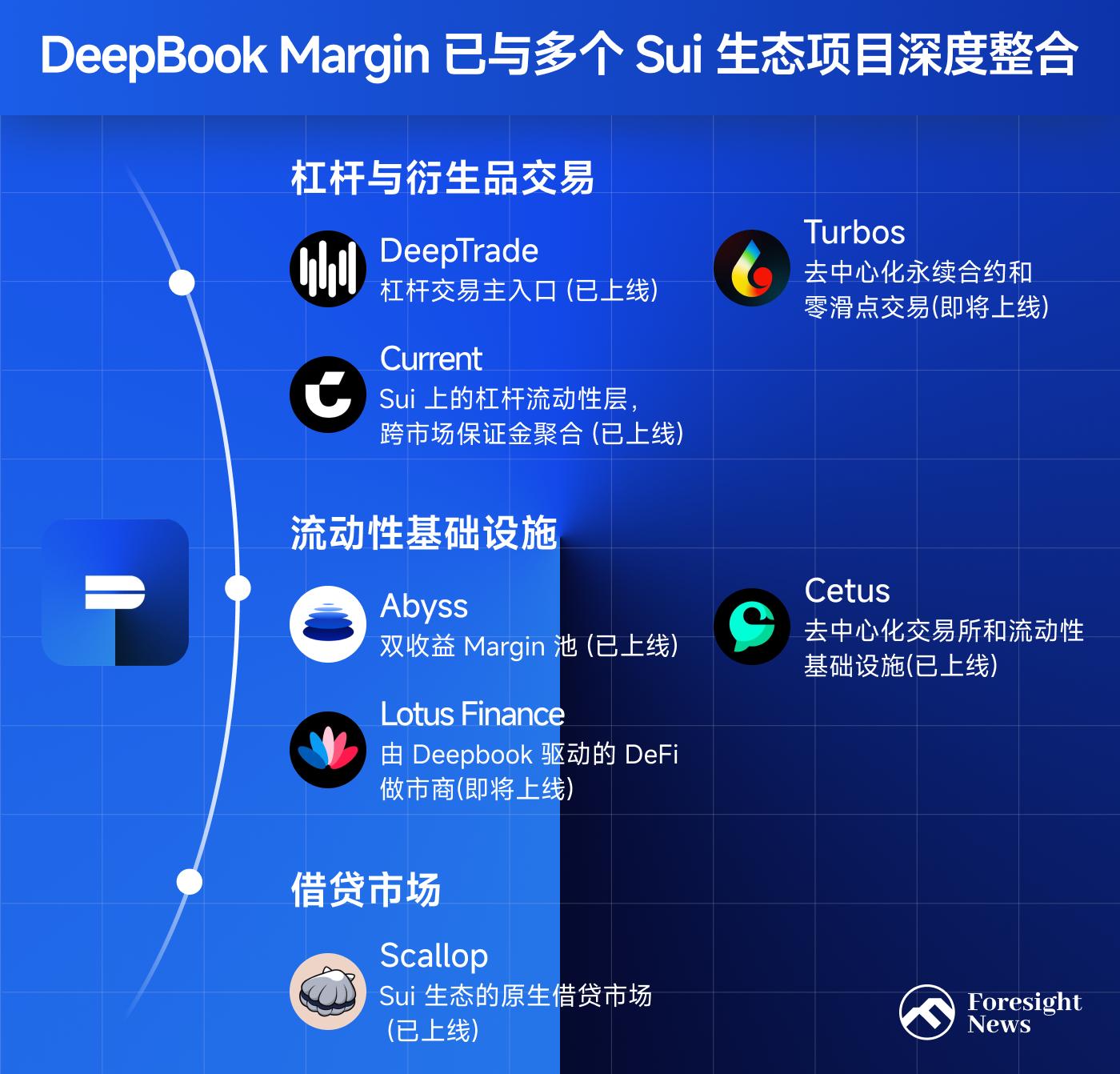
The value of this composability lies in the scale effect. As more and more protocols share the same set of margin and clearing infrastructure, liquidity is no longer isolated within individual protocols but circulates throughout the entire DeepBook network. For users, this means better price discovery and lower slippage; for developers, it means lower development barriers and faster product iteration speeds.
In the Ethereum DeFi ecosystem, each protocol builds its own margin system, resulting in highly fragmented liquidity and user funds being locked across different protocols and unable to be transferred. Sui chose a different architectural approach, sinking margin and clearing to the infrastructure layer, allowing the application layer to focus on product innovation, thus avoiding the problem of liquidity fragmentation from the underlying architecture.
This also explains why suiUSDe was able to directly integrate margin trading on its first day of launch, with stablecoins and trading infrastructure sharing the same composable platform.
Bear Market Empowers Builders
With the recent deployments of ETFs, stablecoins, and the DeepBook Margin, Sui completed a massive upgrade to its Layer 4 financial infrastructure within a single quarter. However, the value of infrastructure depends on the applications built upon it. To bridge this gap, the Sui Foundation launched DeFi Moonshots, an elite incentive program designed to drive the "infrastructure flywheel." Unlike traditional inclusive grants, Moonshots focuses on a select few pioneers with industry-leading positions, offering growth incentives of up to $500,000 and direct technical collaborations to ensure this newly laid foundation translates into tangible ecosystem outcomes.
This aggressive expansion strategy is a textbook example of counter-cyclical investing, accelerating growth when the overall market faces contraction and pressure. By prioritizing the construction of a complete financial system, from institutional settlement to permissionless innovation, Sui is poised to reap substantial rewards when the cycle reverses. Regardless of whether the market immediately rewards the token with a higher price, the first quarter results indicate that Sui's competitive advantage now depends on the completeness of its infrastructure, effectively betting that the first chain to build the foundation will lead the eventual recovery.