Original article | Odaily Odaily( @OdailyChina )
Author | Asher ( @Asher_0210 )
Over the past week, the crypto market has been dominated by one name – RAVE .
Whether on social media, in trading groups, or in various market recaps, everyone's focus, complaints, and even outlets for emotional outbursts almost all revolve around it. The reason is simple: this coin's price movement is simply too erratic. It surged from $0.22 to $28 in just over a week, a more than 100-fold increase; then, just last weekend, the price suddenly reversed, plummeting from its high to around $1 in less than 24 hours, a drop of nearly 95%, and it continues to fall.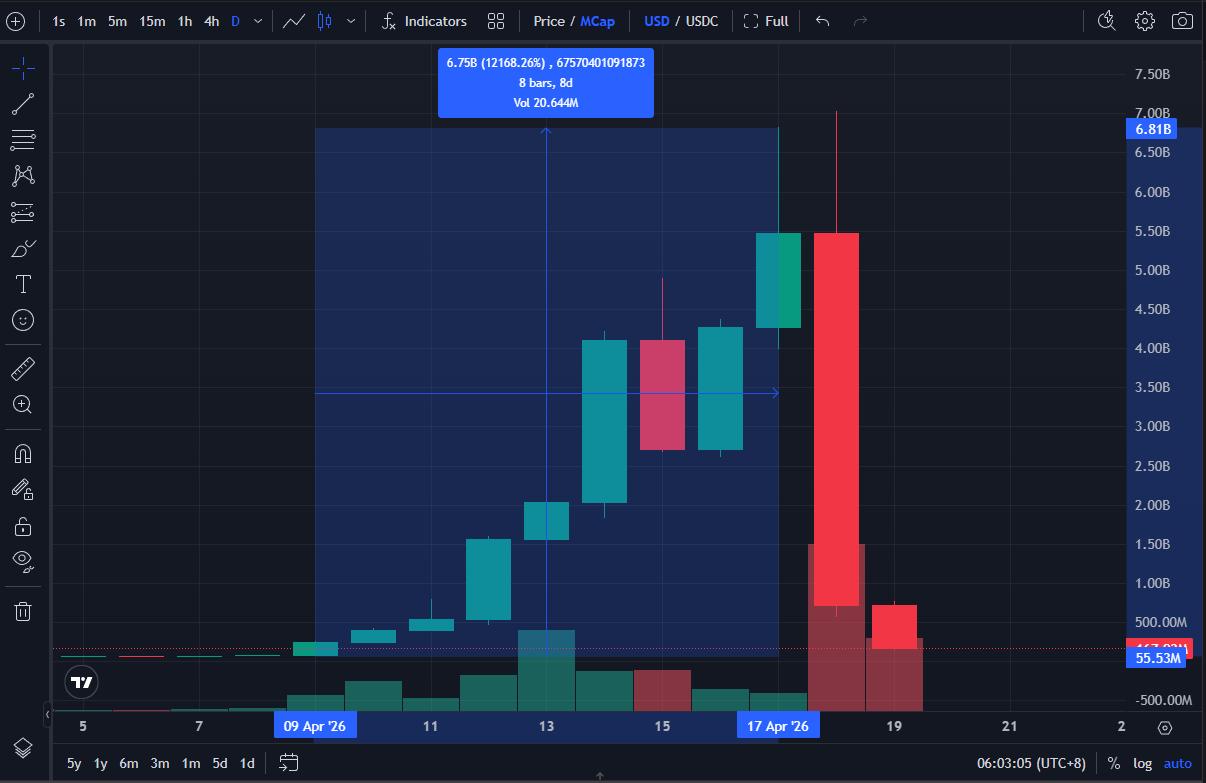
RAVE tokens have increased more than 100 times in just one week.
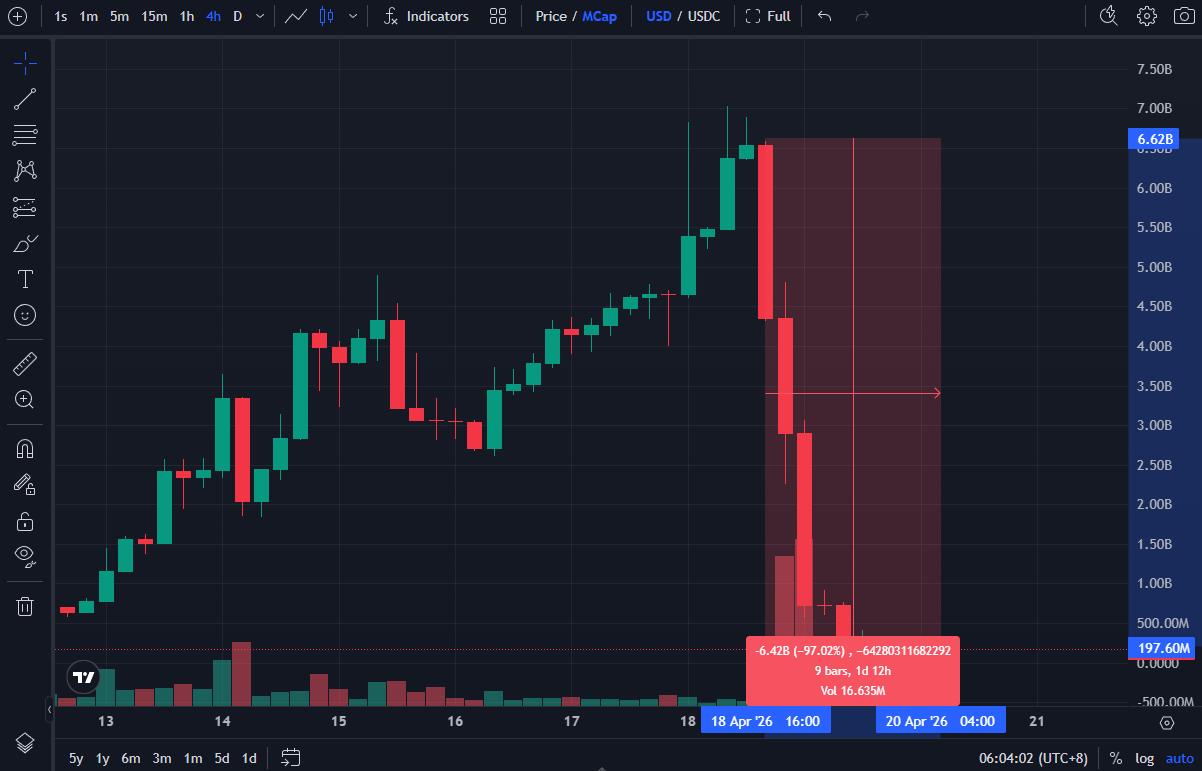
RAVE tokens plummeted nearly 95% in a single day.
The dramatic shift from a sustained surge to an instantaneous collapse is not only exaggerated but also difficult to explain as a "normal market trend." This is precisely why RAVE quickly transformed from a "monster coin" example into a focal point of discussion across the market. Odaily will provide a complete recap of RAVE's entire rise and fall.
A week-long "short squeeze rally"
In just over a week, the price of RAVE rose almost uninterruptedly, increasing a hundredfold. This rise was not gradual but accelerated, constantly exceeding expectations, making it almost impossible to find a "reasonable"short point for shorting. Thus, a familiar scenario began to unfold—the higher the price rose, the more people short it.
Reviewing community and media commentary during this week's rally, the vast majority of traders were waiting for a "crash." The more outrageous the price, the stronger the bears' confidence became. Many people, while cursing the "outrageous" prices, continued to add to short, trying to catch the inevitable turning point. But the reality is that RAVE has provided almost no decent pullback space. Every seemingly top-level fluctuation has ultimately turned into a higher-level rally. On April 18th, RAVE's hourly liquidation volume even exceeded that of BTC.
Screenshots of "I've been wiped out again" began appearing frequently in the group chat. Some chose to add to their positions and hold on, some exited with consecutive stop-loss orders, and others let their losses snowball by continuously averaging down. Market sentiment gradually shifted from "How can this even go up?" to "When will it finally stop?"
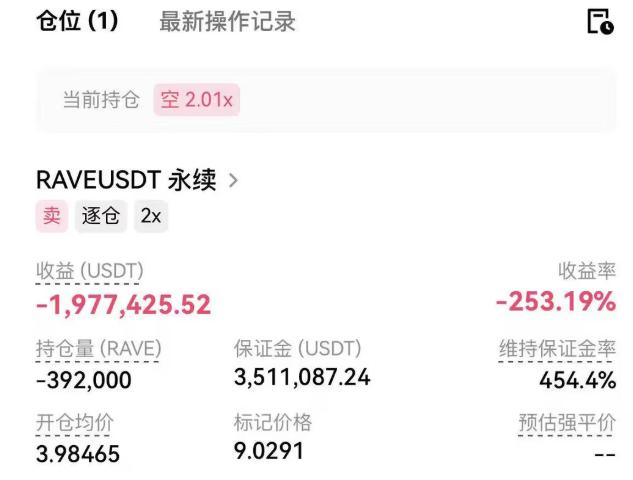
During the RAVE price surge, numerous users short, resulting in substantial losses.
Meanwhile, more subtle changes were also taking place. As prices continued to hit new highs, the focus of market discussion shifted from "where to short" to "how to catch the next rave." Some were analyzing the rhythm of each rally, some were scrutinizing the data to try and identify patterns, and others, knowing something was amiss, still couldn't resist participating. The entire market was swept deeper and deeper into this upward trend, caught in a state of both disbelief and a desire not to miss out.
While the market was still caught up in the frenzy of this ongoing short squeeze, RAVE's market capitalization once approached $7 billion . Almost everyone knew that such a trend would eventually lead to a crash, but no one was sure when or how it would happen.
Ultimately, the turning point did not come from the market itself, but from a public naming by blockchain detective ZachXBT.
Following ZachXBT's public criticism, investigations, responses, and a stock market crash occurred simultaneously.
On April 18th, a public naming of RaveDAO by blockchain detective ZachXBT under a tweet from the RaveDAO team became the turning point of the entire incident. At 3:26 PM (Beijing time) that day, he posted an article directly accusing RAVE of obvious market manipulation and naming Binance, Bitget, and Gate as the three exchanges to launch an investigation . He also set a $10,000 reward for insider information. Within hours, as more community participants joined, the reward amount quickly increased to $25,000.
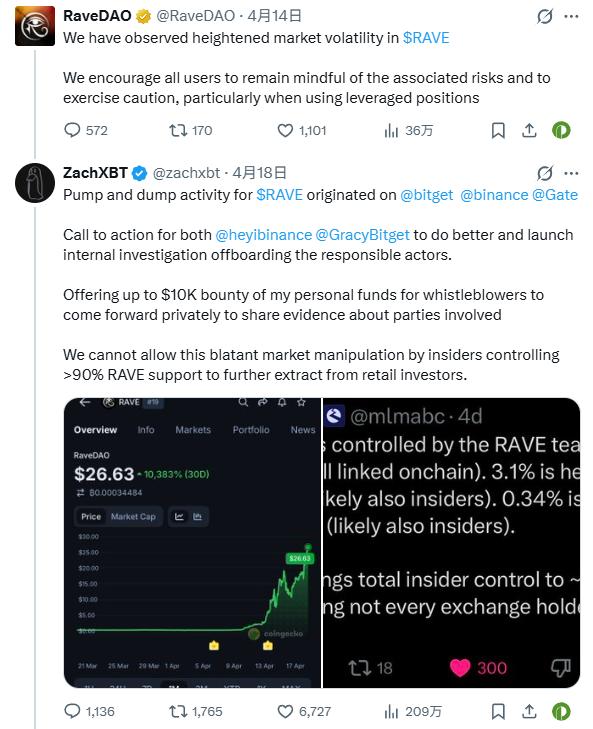
The incident quickly escalated. Bitget was the first to respond. At 19:18 (Beijing time), Bitget CEO Gracy Chen stated: "Thanks for highlighting! We've started investigating into $RAVE tokens," confirming that the platform had launched an investigation.
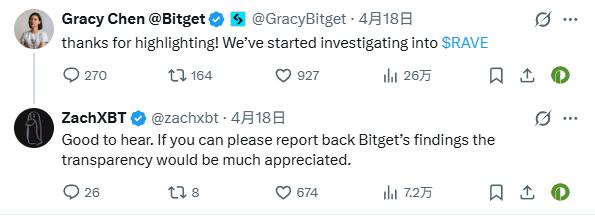
Bitget's response to ZachXBT's allegations regarding the RAVE token
Binance subsequently issued a statement. At 22:08 (Beijing time), Binance Co-CEO Richard Teng responded: "Thank you for flagging this with us, we're looking into it. We will always do our part to investigate all market misconduct."
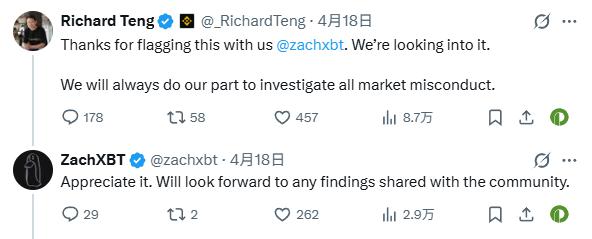
Binance's response to ZachXBT's allegations regarding the RAVE token.
At 00:19 the following day (Beijing time), Gate also issued a response. Gate's Chief Business Officer, Kevin Lee, stated: "We are already on it. User protection always comes first at Gate. We're reviewing RAVE token transactions and will act accordingly."
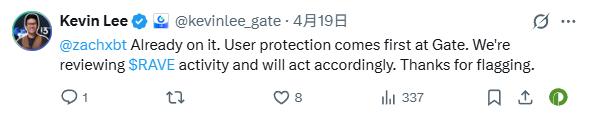
Gate's response to ZachXBT's allegations regarding the RAVE token
As these responses came one after another, RAVE's price began to plummet. From initial high-level fluctuations to a continuous price drop, the market was given almost no time to react—a collapse of trust triggered by public naming was unfolding simultaneously in the price.
From around $26 to $1, RAVE plummeted by nearly 95% in less than 24 hours. This once-monster coin, approaching a market capitalization of $7 billion, was completely wiped out overnight. Even more striking are the comparative figures later provided by ZachXBT: approximately $6 billion in market capitalization was wiped out, but the 24-hour liquidation amount was only about $52 million. This extremely asymmetrical collapse further amplified the doubts about "overvaluation and distorted pricing."
"Who is really making money?": Divided market sentiment
As RAVE collapsed rapidly amid investigations, the market did not reach a consensus; instead, a clear division emerged. Some viewed it as a classic case of "market manipulation and profiteering," while others believed it was simply part of a market game, only this time it was played out on a more extreme scale.
Some traders believe that RAVE is no longer a "normal market." "With a coin controlled by 99% of the market, you're not trading; you're participating in a script. Prices don't move as they appear; they're designed according to the liquidation order." In this narrative, trends, technical analysis, and even trading logic become meaningless—you see candlestick charts, but the manipulators only see who's going to be liquidated. "There's no room for judgment in this kind of market. You think you're betting against the market, but you're actually providing liquidity to the big players."
But another voice is equally strong. Some see this as the most typical dark humor in the crypto: " They investigate when it rises 100 times, but no one cares when it falls to zero. " "When it rises, you have to prove your innocence, but when it falls to nothing, no one takes responsibility." In their view, RAVE is not an isolated case, but rather an amplification of a long-standing problem in the market—projects that steadily decline and eventually go to zero also cause losses for many retail investors, but are rarely questioned in this way.
Some have pointed to a more macro-level structural problem. "Hasn't the crypto space already been an unregulated casino?" From market makers dominating liquidity to a closed loop of pump-and-dump schemes, the so-called "value" has long been marginalized; attention and capital are the only pricing logic. In this environment, RAVE is neither the first nor likely the last; it simply made everyone re-examine the rules in a more dramatic way.
Official response: Denies manipulation, emphasizes "long-term narrative"
Amidst the dramatic fluctuations in exchange and market sentiment, RaveDAO issued an official response immediately. Its core stance was very clear: denying involvement in price manipulation and distancing itself from the recent sharp price swings .
RaveDAO stated that the team was neither involved in nor responsible for the recent price performance of the token, and emphasized that its long-term goal is to "bring Web3 into the real world," attempting to build a culture and user entry point through offline activities. In this statement, price fluctuations are downplayed as external market behavior, while the team itself is placed in a more "builder" position.
At the same time, the project team also provided some responses to token-related issues. They stated that they will indeed sell some unlocked tokens at an appropriate time in the future for operational, recruitment, market expansion, and other development expenses, but will explore mechanisms including price or performance-triggered lock-up to achieve long-term alignment of interests with the community.
In terms of tone, the statement deliberately avoids discussing short-term market trends, shifting the narrative back to "long-term development" and "real-world implementation." From "driving the mass adoption of Web3" to "connecting the world through music and events," and pledging to donate a portion of profits to charity, RaveDAO is attempting to depict a project vision that transcends price fluctuations.
At the same time that this statement emphasizing "long-term development" and "real-world implementation" was released, RaveDAO held an offline event, "Dim Sum Rave," at the Lin Heung Restaurant in Central, Hong Kong, on the evening of April 18.
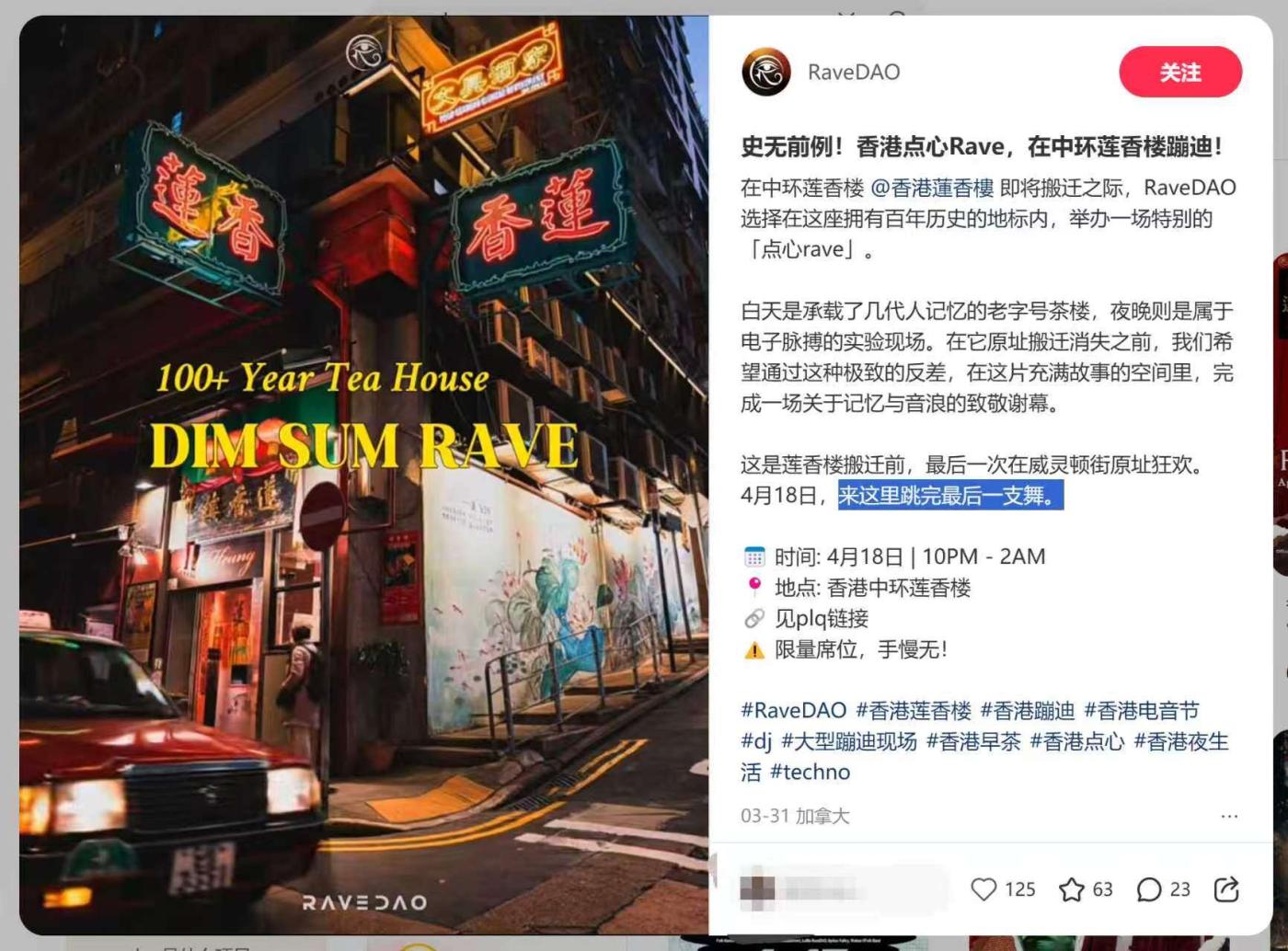
RaveDAO's Announcement of Offline Event in Hong Kong
But in the crypto world, the price of RAVE plummeted in tandem, sliding from its highs almost without pause. On one hand, offline events proceeded as scheduled, with crowds continuing their revelry to the music; on the other hand, the price experienced a near-zero drop in a short period, and market sentiment cooled rapidly. These two timelines intersected on the same night, creating a stark contrast that was hard to ignore.
This is precisely why the event description, "Come dance your last dance here on April 18th," carries an extra layer of meaning for many market participants. As for who truly danced their "last dance" that night, perhaps only the candlestick chart remains, offering conflicting answers.