Welcome to the 2,250 newly Not Boring people who have joined us since our last essay! Join 263,454 smart, curious folks by subscribing here:
Hi friends 👋 ,
Growing up, I sailed a little sailboat called a Sunfish. I was OK, not great, which is a shame, because had I been a little more competitive, I would have raced against the next town over, whose team included a young Taylor Swift.
When I turned 16, I became a beach lifeguard, which is pretty much the greatest job ever for a 16-year-old, and I held onto it for the next four summers. I wasn’t a great swimmer or a great rower, but I was a good enough runner to make up for it so they kept me around. Over those summers, I fell in love with Wes Anderson’s The Life Aquatic with Steve Zissou, which was based, red knit cap and all, on the life of Jacques Cousteau.
All of which is to say, while I spent a lot of time by the ocean, I had a tourist’s relationship with it. I enjoyed it, swam in it, sailed in it, and then went back to the real world, where classes and eventually a real economy awaited.
This, Will O’Brien argues, is how we’ve all handled the ocean until now. We come, we explore or exploit, and we get back to dry land. This, Will thinks, is no longer how we will handle the ocean. With Ulysses, The Ocean Company of which he is co-founder and President, Will plans to help build the infrastructure that would allow us to treat the ocean as a permanent fixture of the economy, and potentially even as a new home for humanity. The way our grandparents and JFK thought we would.
Since meeting Will two and a half years ago, he’s become one of my favorite people in tech to talk to about everything from Irish omnipresence to religion to aliens to vertical integration. I’ve been asking him to put his gift of gab to paper with me for a while, and now that the company has successfully raised $46M from a group of investors led by a16z American Dynamism, he finally had the time to oblige.
Note: not boring capital is not an investor in Ulysses, but I am a huge fan.
In this co-written essay, Will tells a history of the future of the ocean that I’d never heard, before making the case that the ocean is the last great frontier and one of the greatest economic opportunities available to humanity. It’s an adventure, and in the words of Steve Zissou, “Anyone who wants to tag along is more than welcome.”
So throw on the most underrated soundtrack of the 2000s…
And let’s get to it.
Today’s Not Boring is brought to you by… Framer
Launch fast. Design beautifully. Build your company's website on Framer.
Framer helps teams design, build, and launch their marketing sites lightning fast. With the ability to publish hundreds of CMS pages in a single click, operate at a global scale with seamless localization, and even host unified content across multiple domains, teams have never been able to ship faster. Companies like Miro, Bilt, and Perplexity trust Framer to achieve:
Speed without chaos: ship pages and updates faster without turning the site into a fragile set of one-off hacks.
Reduced dependency: shift routine brand and marketing work out of product engineering queues.
Production-grade foundation: Run real marketing systems (CMS, SEO, performance optimization) with governance and collaboration.
👉 Build your company's site on Framer today
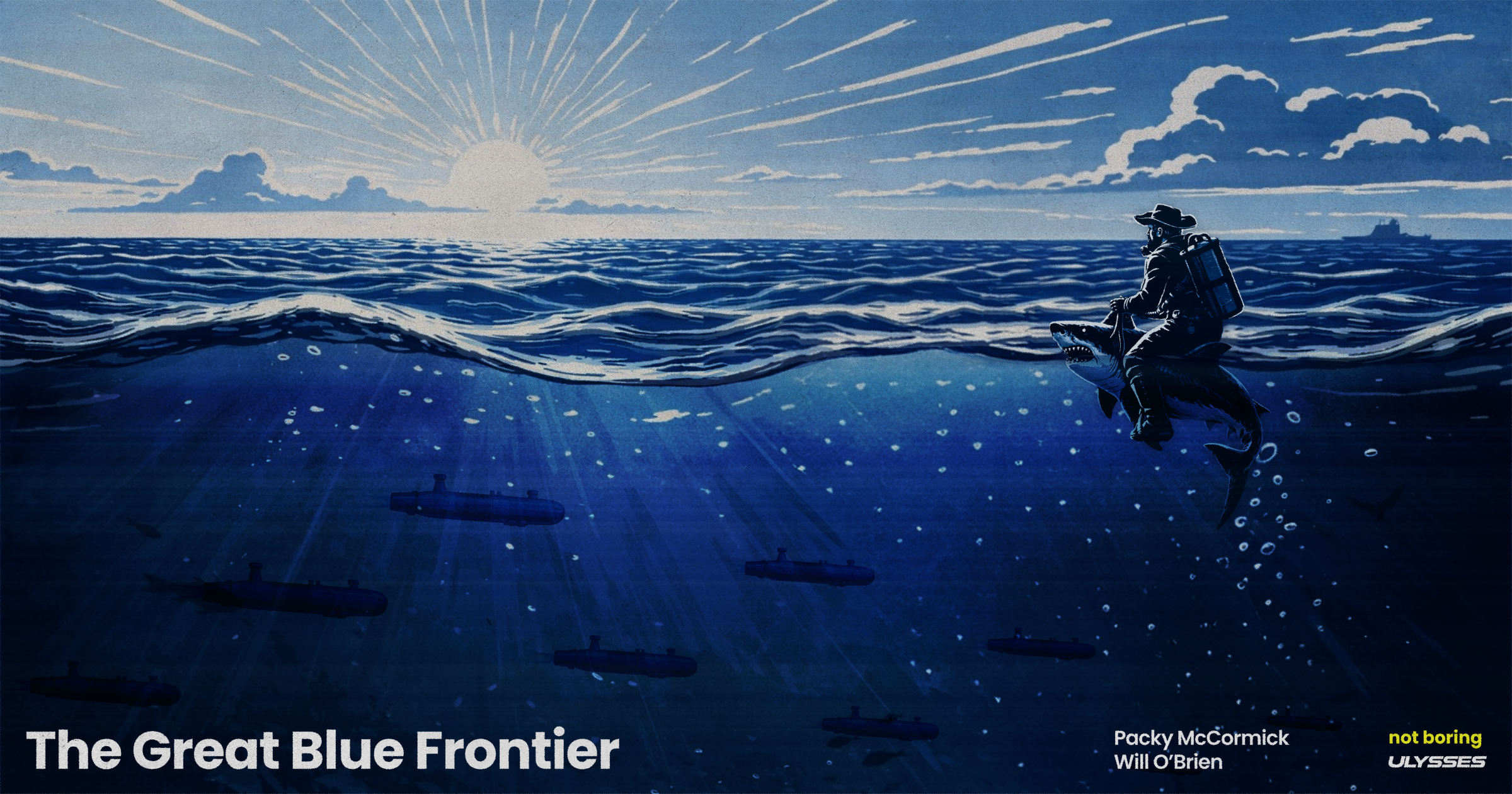
The Great Blue Frontier
With Ulysses President Will O’Brien
The Death of the Ocean Dream
At 4 AM on February 17, 1969, Berry Cannon was lowered 610 feet below the surface of the Pacific in a steel personnel transfer capsule to make repairs to the Navy’s “yellow submarine,” Sealab 3. At that depth, normal air becomes toxic to humans and the nitrogen can send you delirious, so Cannon was breathing helium instead. Helium keeps your mind clear, which was helpful for Cannon. He had been awake for twenty straight hours. Unfortunately, helium also strips heat from your body six times faster than air does. This was a problem. That particular morning, the capsule’s heater was broken.
No matter. Cannon, one of history’s greatest maritime frontiersmen, was running on amphetamines and conviction. When the capsule reached the seafloor, he dropped through the hatch into open water and began swimming through pitch darkness toward a leaking underwater habitat. This habitat, the U.S. Navy believed, would be humanity’s first permanent foothold on the ocean floor.
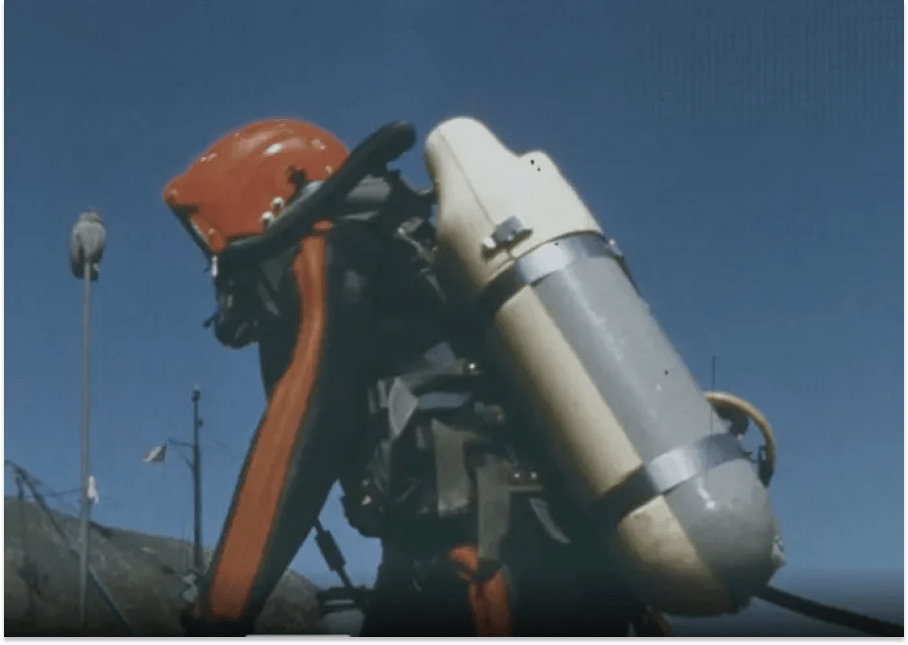
It was a routine fix as far as deep sea habitat fixes go. Except for one fact: Cannon’s rebreather’s CO₂ scrubber canister was empty of Baralyme. He didn’t know that. Nobody did. On a TV monitor topside, Captain George Bond watched Cannon swim gracefully—and then he watched Cannon’s body suddenly jackknife.
“Any time you see rapid motion in a diver,” Bond would say later, “you know he’s in trouble.”
Berry Cannon was dead. And with him died America’s plans to conquer the ocean.
Five months later, Neil Armstrong walked on the Moon, fulfilling one of JFK’s most ambitious promises. It’s been over half a century, and we all know Neil Armstrong’s name.
But nobody remembers the man who died trying to live on the seafloor. Nor do we remember the ocean dream he represented.
I grew up in County Cork, on the south coast of Ireland, and spent every summer at Garrettstown jumping off the pier or the cliffs, bodyboarding and pulling crabs out of rock pools, or heading out in the boat with my dad to catch mackerel. I loved the ocean the way you love something before you understand it. The textures, the cold, the endlessness of it. As a kid, I loved explorers too. Steve Irwin, especially. He wasn’t an ocean guy, but he had that renegade explorer energy, that willingness to just get in there and figure it out. I think I always assumed someone was figuring the ocean out, that there was a Steve Irwin of the Deep. That someone was down there, mapping it, understanding it, and protecting it.
As I got older, I realized nobody was.
So I’ve made the oceans my life’s work. In just the past few months, my office has rotated between Washington D.C., San Francisco, Los Angeles, London, Western Australia, Maine, Virginia, Florida, New Orleans, and San Diego. I would do this for free; I might even pay to do it. But as I’ve been living out my childhood dream, I’ve found that the ocean economy is something like a sunken treasure that’s been waiting on the bottom of the sea for anyone intrepid enough to go grab it.
Today, I’m going to let you in on the secret I’ve discovered down there: Earth’s largest domain and last great frontier is also its grandest economic opportunity.
The Two Frontiers
In the 1960s, America was a country dreaming at full volume. You could taste optimism in the air — and in the sea.
Most of us alive today never learned how important ocean exploration was to the future our grandparents imagined. Americans were fantasizing about ocean exploration in the same way they were about going to the Moon. They were as captivated by The Great Blue Frontier as they were by the Space Race.
At the 1964 New York World’s Fair, GM’s Futurama II ride carried more than 26 million visitors past a vision of the near future. Alongside the lunar base and the Antarctic weather station, guests saw ocean-floor oil rigs, submarine trains hauling minerals to shore, and Hotel Atlantis, a sub-oceanic resort around which vacationers explored in various personal oxygenated craft.
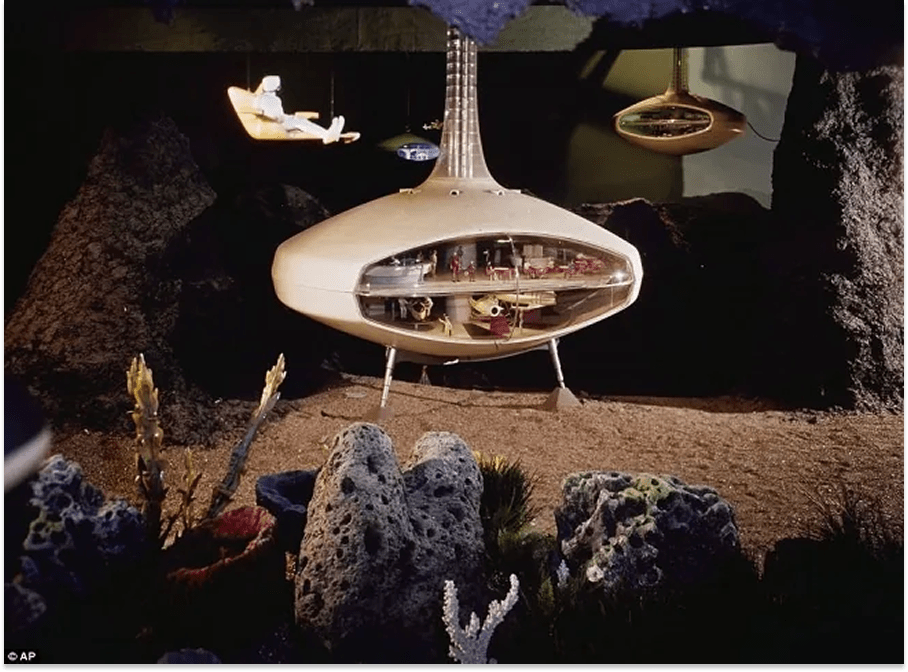
The ocean stood right beside the Moon in the American imagination, and it promised just as much: food and living space for a rapidly growing country, minerals and energy for a booming industry, and the upper hand in the Cold War.
President John F. Kennedy saw the problem clearly. “We know less of the oceans at our feet, where we came from, than we do of the sky above our heads,” he told the National Academy of Sciences in 1963.
His administration had been trying to close that gap from the start. In a March 1961 letter to Congress, he called for “a national effort in oceanography,” warning that “knowledge of the oceans is more than a matter of curiosity — our very survival may hinge upon it.” Kennedy’s FY1962 budget request nearly doubled federal oceanography spending, funded ten new research vessels, and expanded shore facilities fivefold. Two years later, he sent Congress a ten-year, $2 billion plan called Oceanography: Science for Survival, and directed the Navy to begin SEALAB — an underwater habitat program explicitly conceived as the ocean floor’s answer to the Space Race.
President Kennedy placed the ocean alongside space as the twin frontiers of American ambition and coequal national priorities, and his ambition was matched by action.
While Kennedy persuaded Americans about the ocean’s importance as a governmental priority, French naval officer, explorer, and filmmaker Jacques Cousteau charmed them in their living rooms.
Cousteau had co-invented the modern scuba regulator and was one of the most famous people in the world. He built Conshelf, a series of underwater habitats where teams of divers lived for weeks at a time on the seabed. Conshelf II, built in the Red Sea in 1963, was essentially an underwater village: a starfish-shaped structure at a depth of 33 feet with bedrooms, a kitchen, hot showers, and a television.
A parrot named Claude served as the carbon dioxide detector. If Claude fell off his perch, the air was bad. You couldn’t whistle because of the helium. Matches wouldn’t light, although the crew still managed to light cigarettes. Sparkling wine went flat under pressure. Fried food was forbidden because greasy fumes couldn’t be scrubbed from the air.
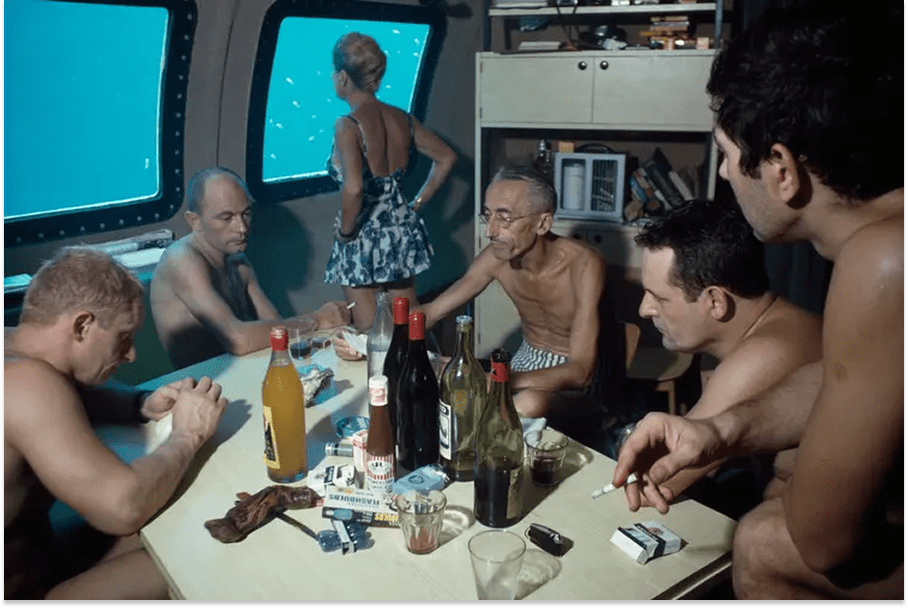
The documentary about this village, World Without Sun, won the Academy Award. The Undersea World of Jacques Cousteau ran on prime-time American television from 1966 to 1976. The ocean was mainstream culture, Academy Award-winning cinema, and prime-time television. It had become a fixture of the popular imagination.
Simultaneously, the U.S. Navy was building permanent undersea infrastructure with the same seriousness that the Army had when it built forts across the American West. Its program, SEALAB, consisted of three progressively deeper underwater habitats that were designed to prove that humans could live and work on the ocean floor for extended periods. We were going to settle the ocean. On SEALAB II, astronaut Scott Carpenter, one of the original Mercury Seven, spent 30 consecutive days underwater, becoming the only astronaut-aquanaut in history.
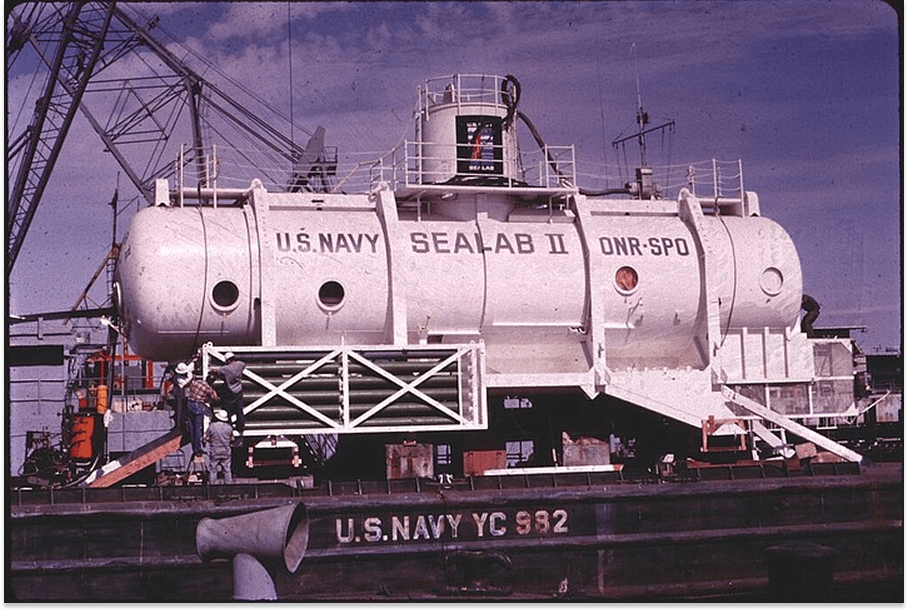
By the late 1960s, more than 60 underwater habitats dotted the world’s seabeds: Hydrolab, Helgoland, Tektite, Aquabulle, Hippocampe, dozens more.
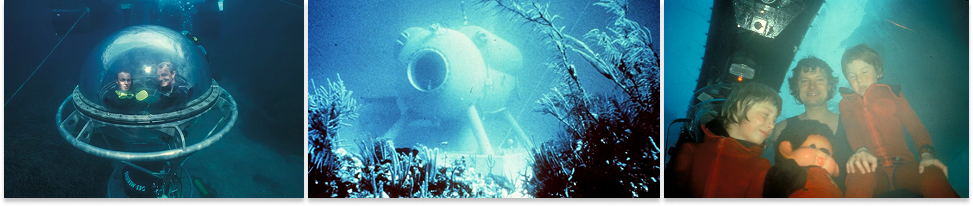
Kids wanted to be aquanauts the way they wanted to be astronauts. The ocean was a national obsession on par with the Moon.
Then, in roughly five years, it all died.
SEALAB was suspended immediately after Cannon’s death. The Navy, which could invest in the future during peacetime, was pulled into the Vietnam War. Even Jacques Cousteau, the man who had done more than anyone alive to prove humans could live underwater, the man who had unmatched cultural authority on anything to do with the ocean, pivoted from exploration to activism. He founded the Cousteau Society in 1973 to protect and preserve the oceans instead of exploring and settling them.
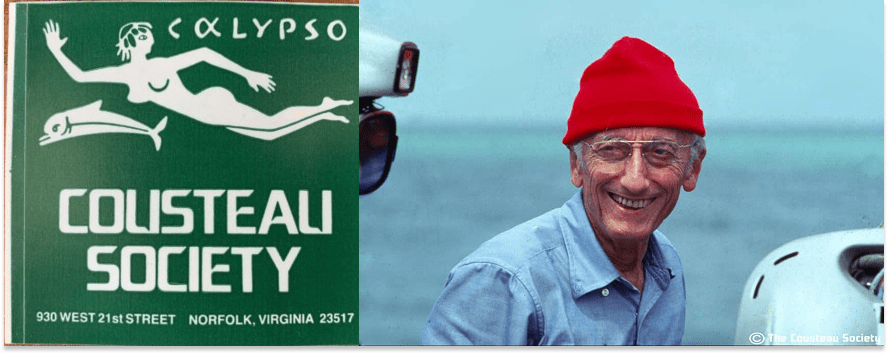
By the 1992 Rio Earth Summit, he was dubbed “Captain Planet.” America, in some sense, always followed Cousteau’s lead on the ocean. When he explored, we wanted to explore. When he said “protect,” oceanic policy and funding priorities fell in line. The regulations that followed, including the Marine Mammal Protection Act, UNCLOS, the IWC whaling moratorium, and the High Seas Treaty, were individually important protections, responding to real ecological crises that demanded our attention. But their cumulative effect, compounded by Cousteau’s cultural reframing, led to a collective shift in how we considered the ocean as a domain to build in. Within a generation, any proposal for persistent ocean activity faced a default presumption of harm.
In the 1960s, America set its sights on two frontiers. By the 2010s, we had all but stagnated on those hopes. We landed on the Moon, went back a few times, and then decided to keep our eyes on the ground. We gave up on settling the ocean altogether.
But we are going back to the Moon, this time to settle it. Just this month, the Artemis II astronauts orbited the Moon for the first time since 1972 in an important step towards settlement. NASA Administrator Jared Isaacman has laid out a plan to begin building a permanent base in 2028, a mission made possible by progress in the commercial space sector over the past two decades. We are going to be an interplanetary species! The Moon should be a state, experts are saying.
It’s time that we settle the ocean too.
This forgotten frontier is no less economically or geopolitically important than space; in fact, it is both larger and more urgently strategic. Through our forgetfulness, the ocean has become a wild and lawless domain whose potential to benefit humanity lies dormant, one which is being abused by those who care nothing for protection or preservation.
What Happens to a Frontier Forgotten
In 2015, a wooden fishing boat washed ashore on the coast of Japan carrying the skeletal remains of its crew. Then another arrived. And another. Over the next several years, hundreds of these “ghost boats” drifted onto Japanese beaches, small wooden vessels with many carrying only bones and tattered North Korean flags.
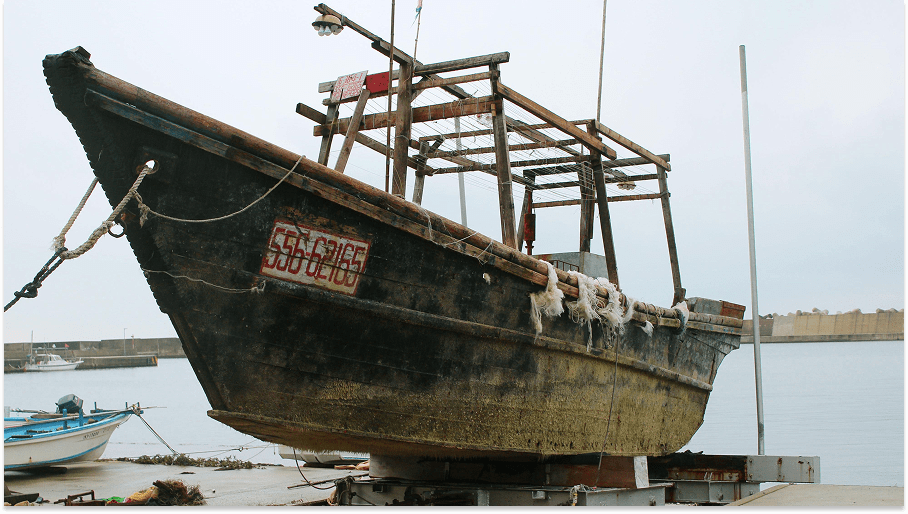
Investigators eventually pieced together the story, which turned out to be more tragic than supernatural. 900 Chinese distant-water fishing vessels had moved into North Korean waters in violation of UN sanctions (sanctions that China itself had signed and ignored), strip-fishing the stocks and pushing local fishermen further and further offshore in boats not built to take on the open ocean. Those fishermen starved at sea, and their boats drifted east until Japan’s coastline caught them. Nobody stopped the Chinese fleet, and nobody rescued the fishermen, because there was nobody out there to stop or rescue.
A 2024 study in Nature found that three out of four industrial fishing vessels are invisible to public tracking, which is wild in a modern society that tracks everything.
Consider the pandemonium that broke out when MH370 went missing, because planes, unlike fishing vessels, don’t just go missing. Last weekend, I spoke with a man who was in a terrible car accident on a Canadian highway in 1994; his right leg and hip were crushed, but he lived because a helicopter arrived to whisk him to the hospital within five minutes. In the air and on land, we track our people and our critical assets with stunning accuracy.
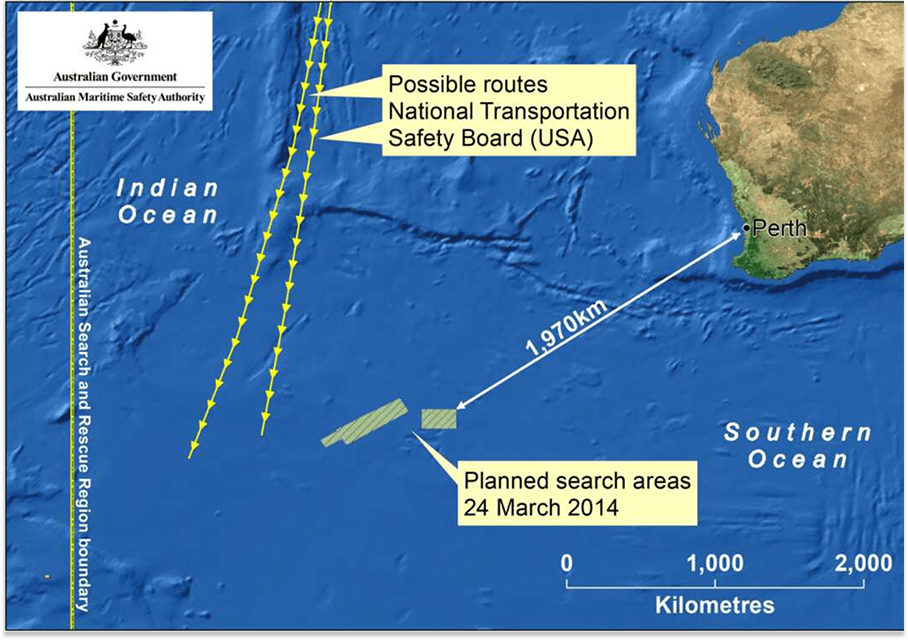
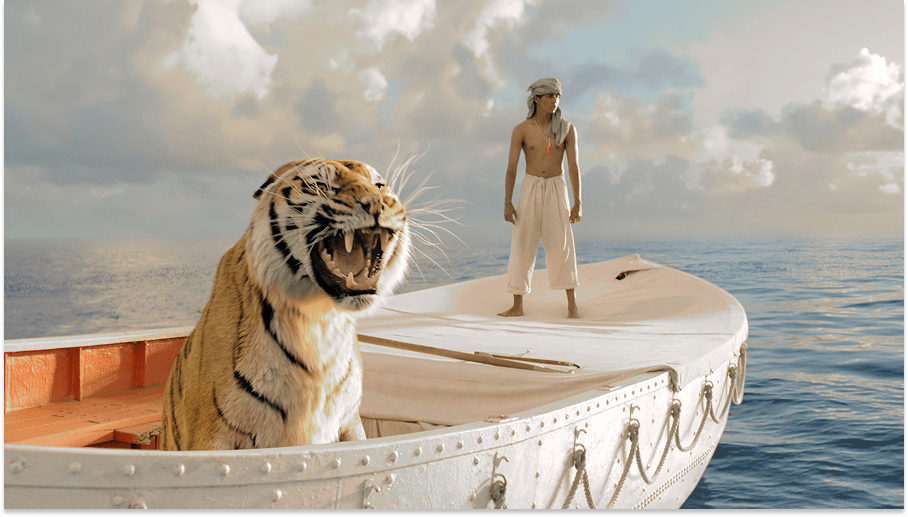
But the ocean doesn’t operate like that, in large part because we don’t have the infrastructure to make monitoring possible. So we’ve kind of given up. Two-thirds of the ocean falls outside any country’s jurisdiction, and there is no police force or coast guard with global reach. There is a reason that so many ocean movies involve protagonists lost at sea, hoping that someone chances upon them.
As a result, we often find boats doing bad things, too late. Fleets of hundreds of Chinese vessels have been caught operating illegally off the coast of Ecuador, right at the edge of the Galápagos Marine Reserve, one of the most ecologically sensitive places on Earth. In 2017, Ecuador intercepted a single vessel, the Fu Yuan Lu Leng 999, which was carrying 6,000 sharks, many of them endangered species, fished from Galápagos waters. Workers on distant-water fishing vessels are held for years, passports confiscated, in conditions that meet every definition of slavery.
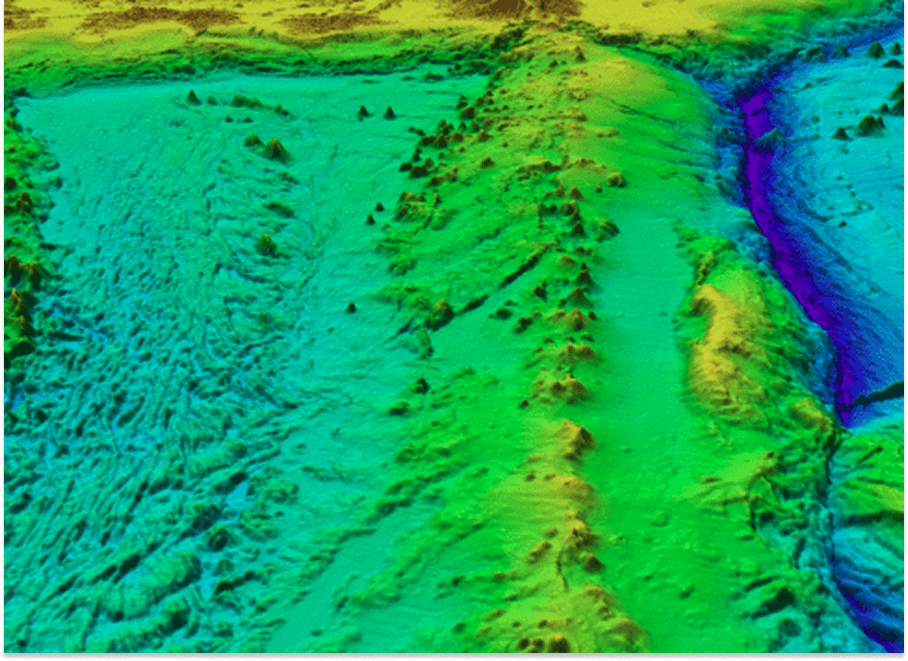
There is no way of knowing how many illegal vessels go undetected, because so much of the ocean remains unmonitored, and we have less of a clue the further beneath the surface we go. While humanity has mapped 100% of the surface of Mars, a planet with no known life 140 million miles and seven months (if you time it just right) away, we have mapped only 27% of the ocean floor with modern sonar, and much of that is coarse, low resolution.
“If you just look at the size of the ocean,” Bob Lazar (yes, that Bob Lazar) recently told Jesse Michels, “you can hide an entire civilization down there. Especially if they’re immune to the effect of the ocean. You just gotta be deep. We’ll never find ‘em.”
While we can neither confirm nor deny the existence of subsea civilizations (except for maybe Atlantis), the fact is there is certainly enough space and little enough visibility to get away with it. The ocean is unfathomably large, and we haven’t even begun to fathom what’s happening all those fathoms below.
This, as President Kennedy warned in 1963, is more than a matter of curiosity. Our survival, or at least our flourishing, may hinge upon it.
Sixty-three years later, we have failed to heed his words, and to capitalize on the opportunity. The ocean covers 70% of our planet, carries 99% of our internet traffic and 80% of our trade. It contains more critical minerals than all known land reserves. And we still know critically little about any of it.
A full 91% of ocean species remain unknown to science. When researchers sequence DNA from deep-sea sediments, they can’t match it to any known organism by species or taxonomic group. The largest library of biological information on earth is functionally unread. Chances are, that library contains a well-stocked pharmacy.
Marine organisms have already given us Ziconotide (a painkiller 1,000x more potent than morphine, from cone snail venom) and Trabectedin (a cancer drug, from a sea squirt). The alien-looking jellyfish Aequorea victoria provided researchers with the green fluorescent protein (GFP) that won them the 2008 Nobel Prize in Chemistry, which now “enables scientists to track, amongst other things, how cancer tumours form new blood vessels, how Alzheimer’s disease kills brain neurons and how HIV infected cells produce new viruses.”

Presumably, there is more where that came from inside the other 91% of sea creatures we have yet to discover. If AI for bio is data-limited, we have a library full of it in the ocean.
There is much for a knowledge-loving people to discover down below, so… let’s just go find out what else is down there. Let’s send people and instruments and start intervening.
Alas, there is nothing to intervene with, because we never built anything that could intervene, and little more to listen with, because we let our ears rot.
Back in the 1950s, back when the nation had aquatic ambitions and a Cold War foe against which to sharpen them, the US Navy built a classified network of undersea hydrophone arrays called the Sound Surveillance System, or SOSUS. By exploiting the deep sound channel, or SOFAR channel, SOSUS could track Soviet submarines across enormous swaths of the Pacific and Atlantic Oceans. Individual listening stations could pick up a submarine across entire ocean basins thousands of miles away.
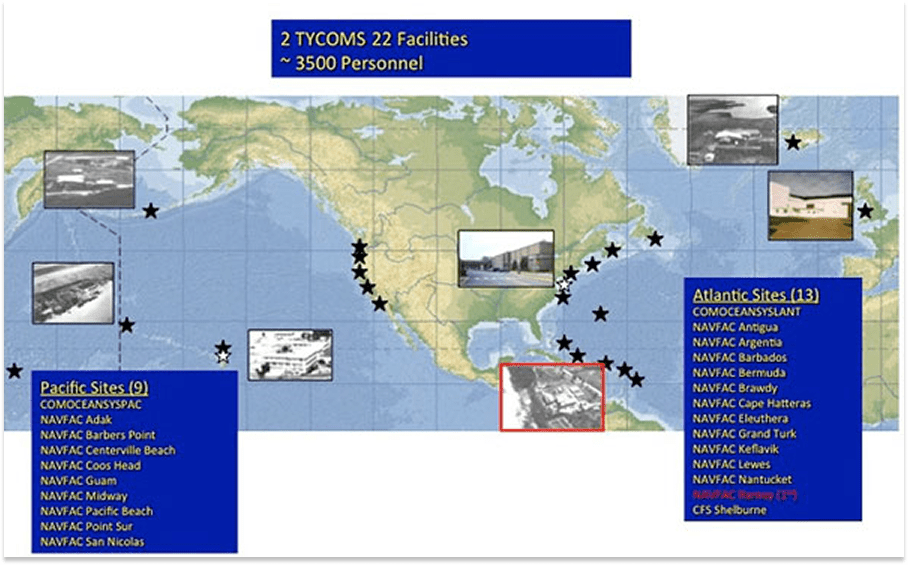
Turns out, SOSUS could track whales, too. When it was partially declassified in the 1990s, marine biologists realized the Navy had been accidentally collecting the richest dataset on ocean biology ever assembled. They’d captured volcanic eruptions, seismic events, whalesong, species migrations, and, in 1997, the “Bloop,” a mysterious sound that has still not been fully explained…
But the Cold War ended in the ‘90s, and by then, our ocean dreams were already long dead. The US government declassified SOSUS, celebrated its scientific contributions, then cut its funding. Some assets were folded into another program, IUSS, a bunch of the hydrophone arrays were put into standby status, and stations at places like Bermuda, Adak, and Keflavik were shut down.
Today, our greatest effort at ocean observation is a network of 4,000 robotic floats called Argo, the 27-year-old “crown jewel of ocean observing systems.” Each of the 4,000 floats monitors an area larger than Portugal, surfacing once every ten days to transmit a single temperature reading. They are deployed like this…
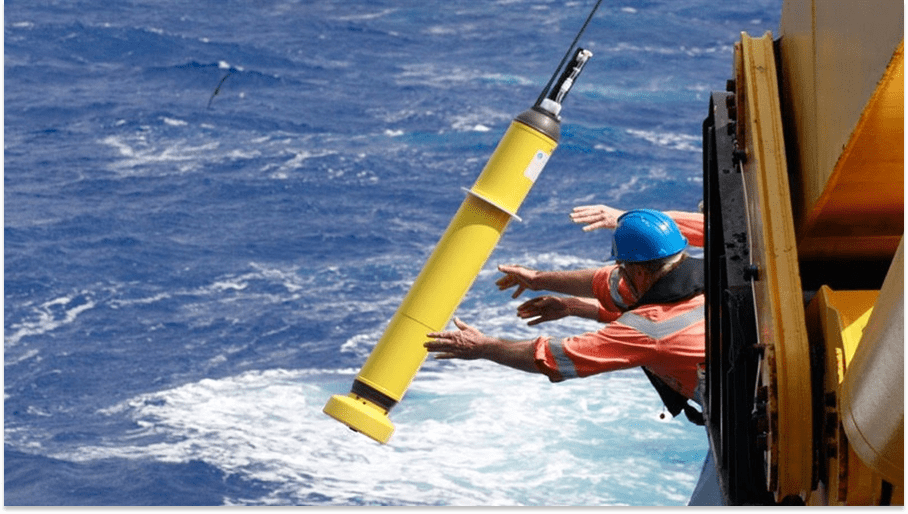
Or, like this...
The entire program is tax payer-funded. And despite running on just six cents per American per year, those 4,000 floats now generate more subsurface ocean data every month than the entire rest of the observing network combined. Argo is great, but that is much more an indictment of the state of our ocean awareness than a celebration of the system.
Plus, Argo can only observe, just like SOSUS could only listen. If a float detects a chemical anomaly, a biological collapse, or a dangerous trend, there is nothing and no one for miles around to respond, in much the same way a thermometer can tell you that you have a temperature but can’t do a damn thing about it.
The question is, in a time of technological wonder, why the ocean remains dark.
The Ocean is Pre-Industrial
Frontiers are tamed when there’s money to be made from taming them and the technology to tame them is viable.
President Thomas Jefferson sent Lewis and Clark west to wrest the fur trade from the Canadians and establish commercial routes. The Forty-Niners went to find gold. These were risky and potentially highly profitable expeditions, and when they paid off, America built the railroad to connect the West with civilization.
The railroad meant that normal people, not just bold or desperate explorers, could establish their homes, families, and businesses in the West, and it made new industries possible: ranching, mining, commercial agriculture, towns, and cities. The railroad industrialized the Western Front.
Something similar happened in space, a domain accessible only to national governments and a handful of intrepid telecommunications pioneers in search of vast riches before SpaceX collapsed launch costs. Before SpaceX, the biggest satellite constellations were measured in dozens. Today, SpaceX has more than 10,000 Starlinks in orbit; people make fun of Jeff Bezos for flying “only” a couple hundred satellites.
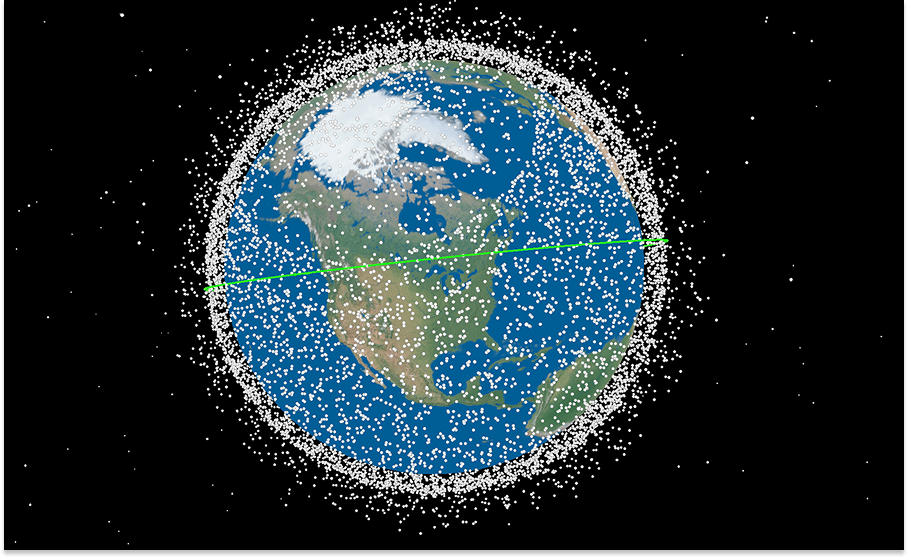
Reusable rockets are the space railroad, and on them fly hundreds of businesses seeking to get to space and stay. SpaceX industrialized space, and the effects of that industrialization are just beginning to be felt.
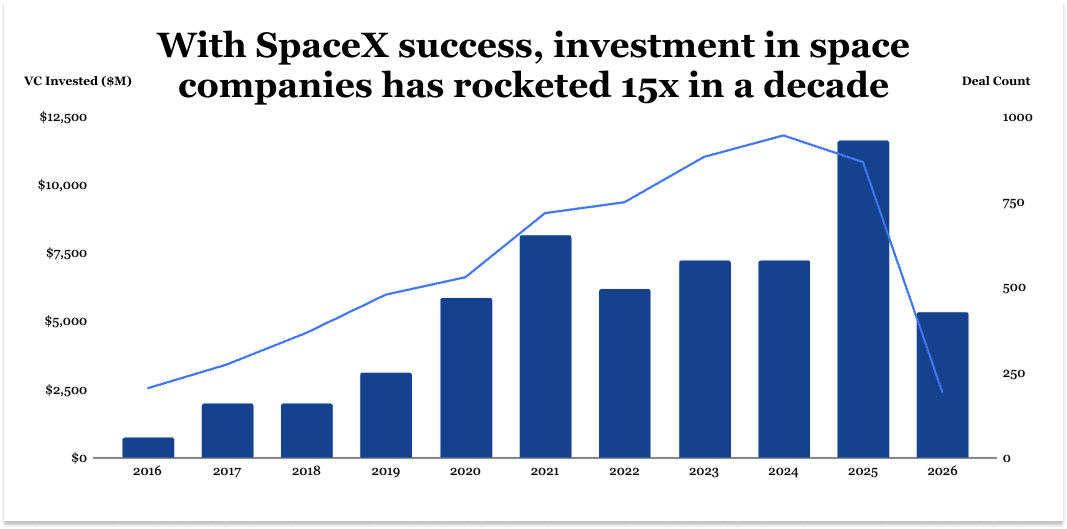
For all of the exploration and trade we’ve done out there, the ocean has never had this moment. We’ve fished it, laid cables across its floor, drilled rigs into it, plopped wind turbines in it, raced around the globe on it, and shipped goods across it, but nobody has ever cracked the economics of operating within it, broadly and persistently, as a domain. The ocean still runs on an 1800s-era expedition model that puts expensive humans on expensive ships for expensive campaigns, then brings them back to dry land.
There’s a word for a frontier that hasn’t had this moment yet. The ocean is pre-industrial.
To industrialize a frontier means to transform it from a place with industries in it, exploring and opportunistically extracting, to a place built to support industries persistently and economically, at scale.
An industrialized frontier is a platform, not a series of projects. Each new piece of infrastructure makes the next one cheaper and unlocks activities that weren’t possible before. An industrialized frontier compounds.
The railroad industrialized the West and SpaceX is doing the same for space. Nobody has industrialized the ocean yet.
If we want to gain dominion over Earth’s oceans and steward them properly, we need to make it a place where industry can thrive.
Creating more industry in the ocean would decrease crime, increase our understanding of our home planet, accelerate scientific discovery, grow existing maritime industries and enable new ones altogether, unlock resources that are literally sitting on the floor, and, counterintuitively, incentivize our stewardship of it.
A Note On Industry and the Environment
Industrialization has dirty connotations. As you read the word, you might be picturing smokestacks, or worse, the soot-darkened faces of pre-pubescent factory workers.
I’d argue that the industrialization of new frontiers has been one of the most powerful engines of human progress. So I want to tell you how I think about industrializing the ocean while protecting it, because a desire to protect it, to restore it, is where I began this journey.
When we started Ulysses, we set out to help restore the oceans by using underwater robots to replant seagrass more efficiently. Seagrass meadows cover less than 0.2% of the ocean floor but store up to 18% of the ocean’s carbon, support roughly a fifth of the world’s fisheries, and have been declining at about 7% a year since the 1990s. This means we’ve lost roughly a third of all seagrass globally in the past few decades. Restoring these meadows is an important part of bringing back the vitality of the oceans.
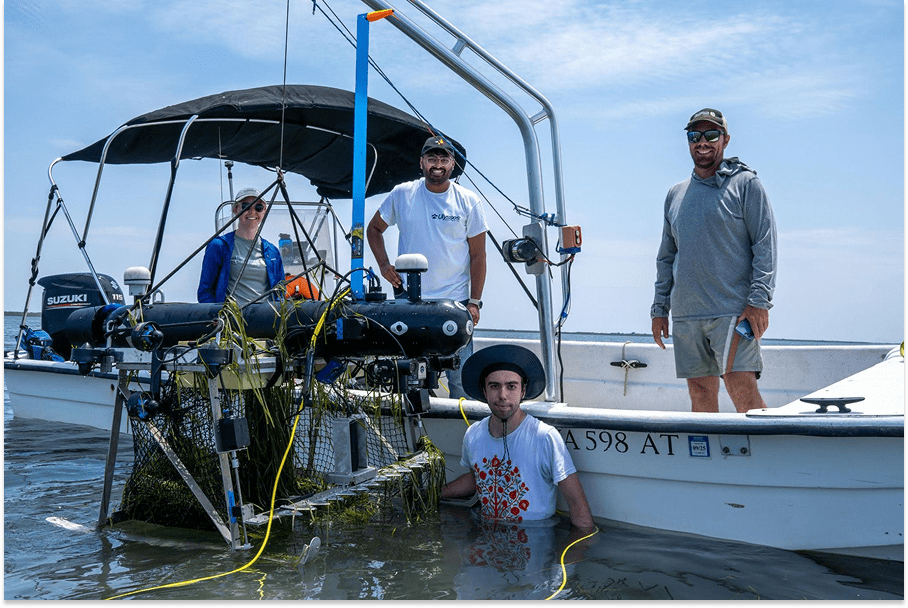
That work is underway in Florida, Virginia, Western Australia, and in the Great Barrier Reef. As we waded into the ocean, however, we realized a few things.
First, we realized that the infrastructure we’d need to do restoration well didn’t exist. We’d have to vertically integrate and build most of it ourselves. Soon, we realized that the infrastructure we had to build was exactly what everyone else working in the ocean needed too. We’ll talk about that below.
Second, there are big differences between 19th-century industrialization and modern oceanic industrialization, the biggest of which is the difference between combustion and electric machines. Unlike those factories, or even modern oceanfaring vessels, our vehicles won’t emit smoke or smog. They run on electrons and don’t emit exhaust or greenhouse gases during operation. We will discuss this, too.
Third, we realized that when we expanded our economic ambitions, we also increased our environmental ones. I’ve just shown you what a pre-industrial ocean looks like. There is slavery, overfishing, the extinction of entire species, and ignorance of endless pots of gold. A pre-industrial ocean doesn’t mean an untouched ocean; it just means that the pirates are the ones doing the touching. Commerce brings law and order, if only selfishly, but that law and order has positive externalities. You are far less likely to be murdered in a Western Saloon today than you would have been in 1826. We believe that by industrializing the ocean, we are incentivizing its protection and restoration.
The ocean is too precious to leave to the pirates.
How to Industrialize a Frontier
So if we want to industrialize the ocean, how do we do it? There seem to be four stages that frontiers go through on the path to industrialization.
Discovery → Expedition → Access Breakthrough → Industrialization
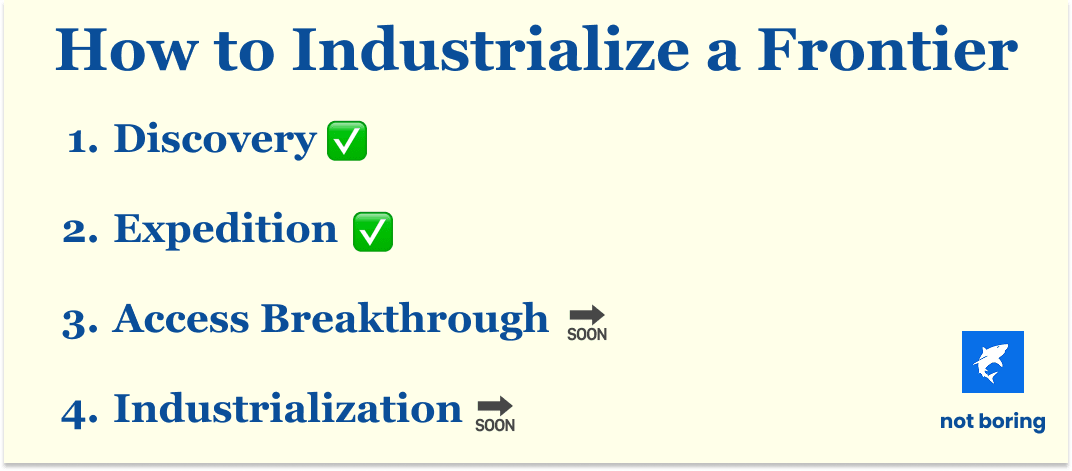
Discovery proves the frontier is real and reachable. Expedition explores it, maps it, and finds the resources worth pursuing, but it does so episodically and expensively (or illegally). The fruits of expedition incentivize the development of the access breakthrough: a technology that dramatically collapses the cost of reaching and operating at the frontier, making entirely new categories of economic activity viable for the first time. That triggers industrialization: the frontier integrates into the broader economy, and industries emerge that couldn’t have existed at the old cost structure.
The American West went through all four stages. The early explorers proved it was there. For sixty years, wagon trains, fur traders, and the Oregon Trail explored it episodically. Then, in 1869, the Transcontinental Railroad met at Promontory Summit, Utah, collapsing the cost of access, and what followed was the industrialization of half a continent. The Homestead Act alone distributed 270 million acres, an area larger than France, Germany, Italy, and Spain combined. Western mines produced the copper that wired America’s cities, the gold and silver that backed its currency, and the timber and beef that fed its industrial workforce. Over the century that followed, the frontier compounded into trillions of dollars of real economic value and provided the physical substrate of the American century.
Space has followed the same arc. Sputnik proved it was reachable. Apollo and the Shuttle explored it at $1.5 billion per launch. Then SpaceX spotted that rocket materials cost about 2% of the selling price, vertically integrated them, built reusable boosters, and cut costs 20x. The space economy has tripled over the past two decades, reaching $613 billion in 2024, and is projected to hit $1.8 trillion by 2035.
Both of these examples are gross oversimplifications, but what I want to establish is that there is economic activity on the frontier even before industrialization. Risk-seekers are captivated by the promise of the untamed. But true market creation occurs when early economic activity incentivizes and funds access infrastructure, and access infrastructure facilitates normal business creation. Industrialization moves frontiers from limited, risky, low-volume, potentially high ROI trades to higher volume, safer, lower-individual-ROI but higher-overall-output activities.
Today, the ocean’s pre-industrial economy is already enormous. We spend $2.6 trillion a year across shipping, offshore oil, fishing, subsea cables, and coastal ports. That is an order of magnitude larger than the space economy was when SpaceX was founded.
But the economics of the ocean severely limit where we can operate, and therefore the size of the ocean economy.
We ship across the surface because the surface is the cheapest layer to traverse, and the only one where our GPS and WiFi work. We drill oil from expensive fixed platforms because oil is valuable enough to pay for the helicopters and the two-week crew rotations. We fish from the top of the water column because that is where our tools reach, and as a result, we decimate the stock.
In short, we are limited to the easiest-to-access parts of the ocean, unless an extremely valuable and fairly predictable commodity can justify deeper exploration, just as the fur trade did during America’s westward expansion.
To the extent that we can decrease the cost of access, we can increase the size of the ocean economy. We need the ocean’s railroad. It is surprising that, if $150 billion of activity was enough to trigger a railroad for space, $2.6 trillion of pre-industrial economic activity didn’t trigger one for the ocean long ago.
Why have we not built the ocean’s railroad?
The Ocean Fights Back
Two factors must be simultaneously present for industrialization to occur: suitable technology and urgent demand.
Humans have had boats for a very long time. As early as 3000 BC, the Austronesian people migrated throughout the islands of the Indo-Pacific using sailboats like this one.
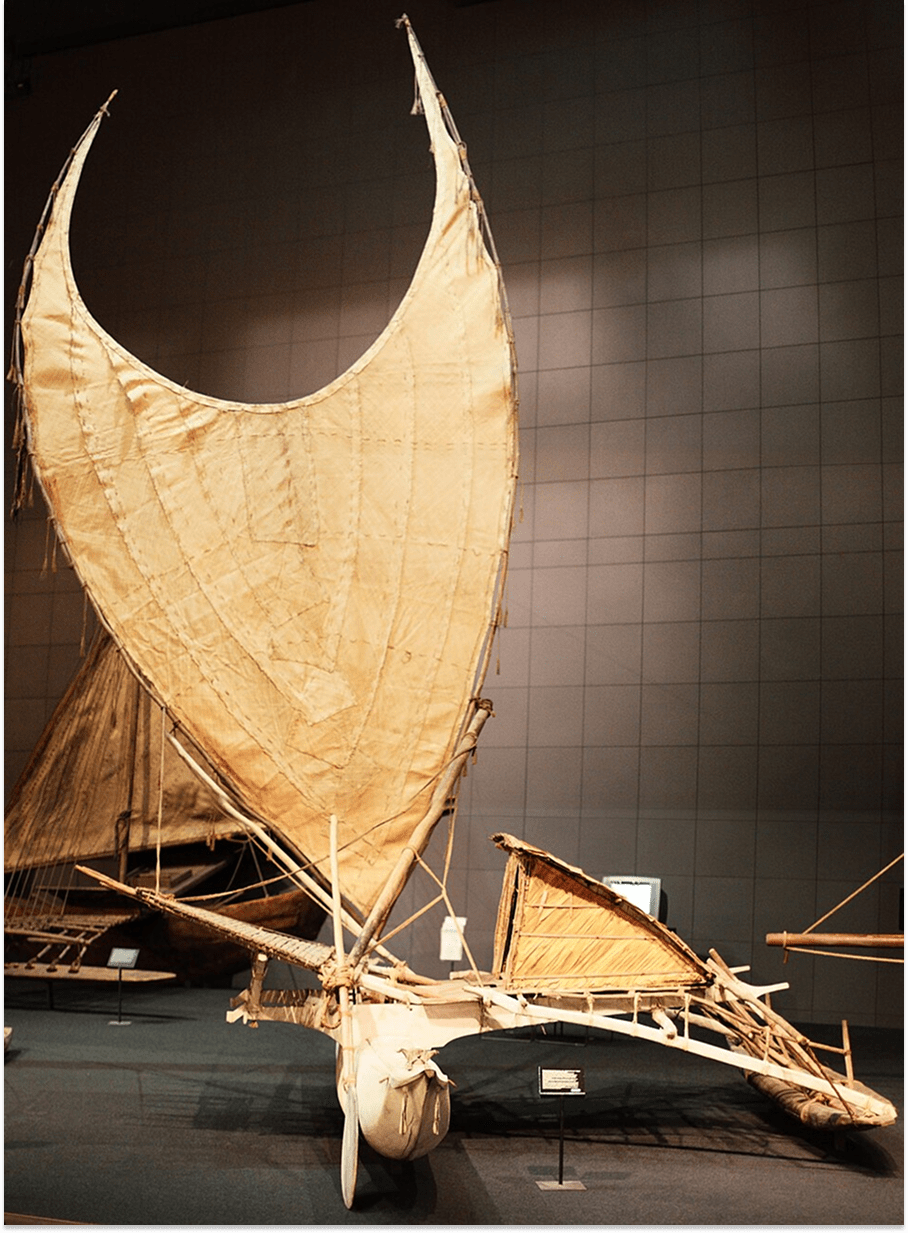
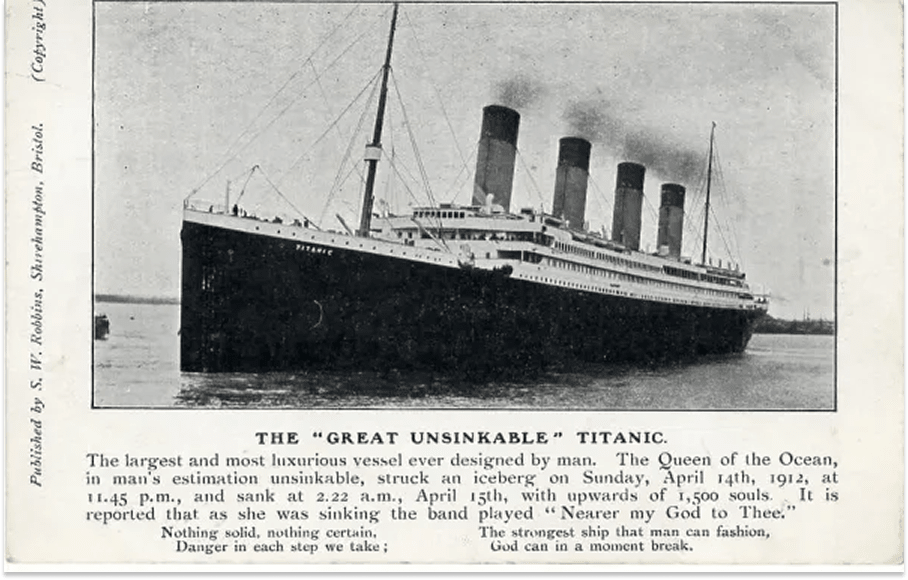
But the ocean has never made traversing its surface easy. During the Age of Sail, an estimated 3-5% of merchant fleet ships were lost per year. Rather than being retired, most wooden ships ended their careers by being wrecked, foundering, or being lost at sea. Over time, we got better at making sturdier boats. But even still, the 1990s’ most popular movie was about the sinking of the “Great Unsinkable” Titanic.
Stewart Brand recently published Maintenance with Stripe Press. He chose to open the book with the story of the 1968 Golden Globe Race, the first solo, non-stop circumnavigation of the earth by sailboat. The race’s sponsor, The Sunday Times, charged no entry fee and laid down almost no rules. Sailors simply had to leave from a British port, travel around the globe, and come back to it without stopping.
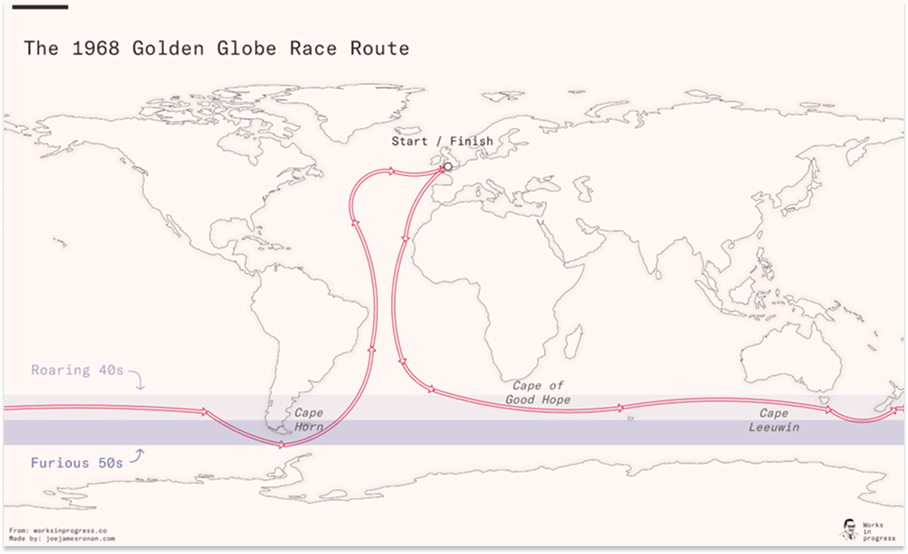
Nine sailors entered the race, and historians mainly focus on three of them.
Donald Crowhurst, a brilliant inventor with arguably the most technologically advanced boat in the race, never made it past the Atlantic. His electronics failed, his hull leaked, and the isolation broke him. He falsified his logbook, drifted in circles, and eventually stepped off the back of his trimaran into the sea. His body was never found.
Bernard Moitessier, the most gifted sailor in the fleet, abandoned the race despite being far in the lead. Months alone in the Southern Ocean convinced him he’d rather keep sailing to Tahiti than return to civilization.
Robin Knox-Johnston spent 312 days at sea, and most of them were spent not sailing but repairing. Where the others designed their sailboats for technological superiority or speed, Knox-Johnston designed his to be fixed:
To prepare SUHAILI for a ten-month passage, most of it in the world’s roughest waters, he packed into his small boat all the ‘materials and tools’ he could imagine he might need – specialized wrenches for every exotic nut on the boat; ditto for screwdrivers; a sailmaker’s bag full of needles, sewing palms, and twine; a bosun’s bag with every kind of shackle, thimble, and marlinspike for managing all his steel wire rope; a spare bilge pump and extra rubber pipe; 12 yards of canvas; caulking chisels and cotton; plenty of oil, glue, and Stockholm tar; spare parts for everything mechanical; and medical supplies for repairing himself.
It was the right move, because he spent most of his 312 days on the water fixing. And yet… “I realized I was thoroughly enjoying myself,” he said later. Still, the enjoyment was the enjoyment of a man who understands that the ocean is in a permanent state of war with anything humans put in it.
Knox-Johnston won the race, “and the prize of £5,000 – which he gifted to Donald Crowhurst’s bereaved wife and young children.”
Typically, the story is told as a story of different flavors of the human spirit, and it is certainly about that. But Brand chooses to tell it as a story about maintenance. The universe tends towards entropy, but it does so particularly quickly on the open sea. There is no environment on earth that so persistently attacks those who dare challenge it.
Which is to say that the ocean is the hardest frontier on Earth. It fights you every day that you’re in it. The ocean doesn’t necessarily want to fight you. It is simply a matter of the ocean’s constitution.
Saltwater is one of the most corrosive environments on earth, eating through steel, degrading composites, and attacking every electronic component it reaches. Since water flows happily through cracks, it ultimately reaches almost everything. The North Sea, one of the most developed ocean regions on Earth, is so punishing that corrosion alone accounts for roughly 60% of maintenance costs on production platforms, and lifetime operating spend routinely exceeds the original construction cost. Offshore wind has struggled to meet expectations because maintenance costs 2-3x more than onshore wind, components break down more frequently, and turbine performance degrades by an average of 4.5% per year. The global cost of marine corrosion runs to $50 to $80 billion a year, and that’s just for the structures we’ve bothered to build.
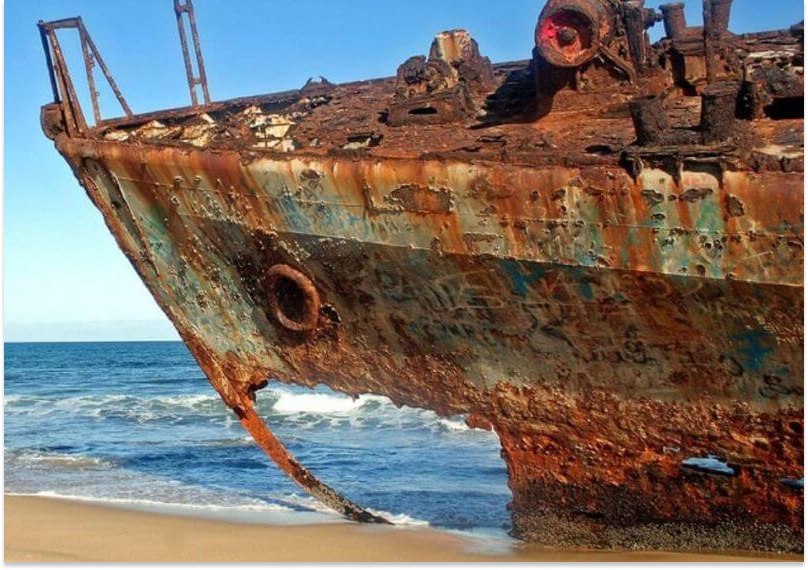
Then there’s biofouling (think barnacles): the moment you put something in the water, organisms begin to colonize it. Within weeks, without active maintenance, a clean sensor is blind, and a clean hull is dragging tons of extra weight. The offshore oil industry spends billions per year fighting exactly this. Everyone who chooses to operate on the ocean must become a Robin Knox-Johnston.
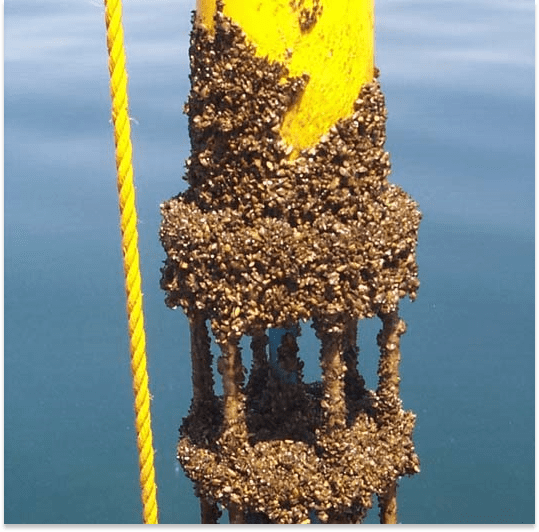
Below the surface, the battle only intensifies. Pressure increases by one atmosphere every ten meters of depth. At the average seafloor, you’re looking at 370 atmospheres. Everything on a subsea vessel must be engineered for forces that have no analog on land or in space, and which vary continuously with depth. Space is extreme, but the vacuum is a single, well-understood engineering problem. In the ocean, every meter deeper you go changes the engineering envelope.
We have thus far described fair weather conditions, but the ocean is a stormy place. Storms routinely destroy purpose-built infrastructure: Hurricanes Katrina and Rita alone destroyed 113 offshore platforms and ruptured 457 pipelines.
In each one of these cases, unless you are right there with your vessel, you’re unlikely to even know when things go wrong, because the ocean is a communications desert. GPS doesn’t work underwater at all. Radio and optical signals penetrate about 20 meters before the water absorbs them. Acoustic signals can travel further, kilometers in some cases, but at painfully low bandwidth, about a million times slower than surface 5G. To get around these constraints, you can tether a vehicle to a surface ship with a cable, but that limits your range and requires an expensive crewed vessel overhead, at which point, you’re still stuck in the expedition model.
The ocean is a domain that degrades everything you put in it, crushes anything you send deep, destroys what you bolt to the surface, and isolates whatever survives.
This is before we even address the immense scale of the ocean. So even if you solve every engineering problem, you still face the question of how to cover a domain that dwarfs anything we’ve ever tried to operate in while fighting corrosion, biofouling, pressure, storms, and the comms desert. None of these is impossible to overcome, but every one of them is a tax. A tax currently paid in steel thickness, redundant systems, $20,000/day ship time, mobilisation windows, insurance premiums, and in the engineers you have to send offshore to fix what can’t be fixed from shore.
And on top of that, the industry that grew up around this domain never got what aerospace and automotive got: scale, software, modern supply chains. Maritime is still largely a cottage business of bespoke parts and hand-built systems. So you pay the tax twice: once to the physics, and again to the pre-modern industry that evolved to serve the physics.
We call it the Ocean Tax: the compounding cost the sea, and the industry that grew around it, extracts from anyone who tries to do anything in it. Every existing ocean company is, at heart, a machine for paying the Ocean Tax.
So the natural question is, how do we get around it?
What It Would Take to Industrialize the Ocean
The good news about the ocean being such a challenging environment is that every problem that the ocean throws at you doubles as a design requirement. If we solve for the challenges, we know what kind of system to build.
The ocean is vast. Instead of a few expensive, exquisite vessels, you need a lot of cheap ones.
This is the same trend that we’ve seen in space, going from a few billion-dollar communications satellites to thousands of small, cheap ones. The latter means that the network can cover more area more reliably than single satellites can, and inevitable damage to a single satellite doesn’t knock it out. It is resilient. We are seeing the same trend in defense, with the move towards high-volume, attritable drones instead of a few exquisite platforms.
Like space, it is hard to comprehend just how much room there is to cover in the ocean. The 361 million square surface kilometer number hides just how big it is, because it also goes deep. Industrialization requires coverage of the X, Y, and Z axes. The ocean is more than two miles deep, on average, and its deepest trenches are so deep that Mount Everest could be dropped into the Challenger Deep with 2km of clearance above it. Its total volume is something like 1.3 billion cubic kilometers, which is so large that I’m not even sure what to tell you, other than to say that the number of vehicles we put in it each year stands absolutely no chance.
Today, the entire global autonomous underwater vehicle (AUV) market produces roughly 1,000 vehicles per year, and the incumbents’ AUVs cost on average $500k to $5 million each. For scale, a thousand units across the entire ocean is equivalent to just 27 vehicles across the entire United States. Imagine trying to patrol the entirety of the United States with just 27 vehicles. And that is just the surface comparison! These vehicles are precious, and are treated as such, which is no way to build an economy.
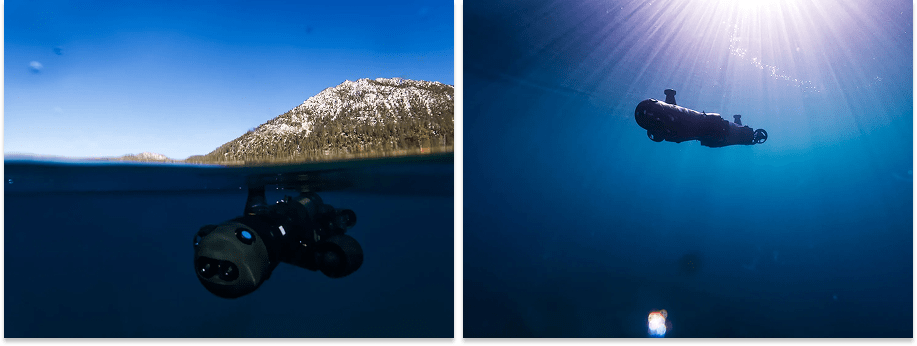
We think the answer to making ocean infrastructure possible is manufacturing at radically lower costs. At Ulysses, we build AUVs for as little as $50,000 per unit, a 10x to 100x reduction over the most commonly sold incumbent models. At that price, we and our customers can think in terms of fleets rather than individual vehicles, and fleets, we believe, are the unit of infrastructure the ocean demands.
The ocean demands you operate at the surface and subsea as a single integrated system.
How do you design a vessel meant to operate on the surface and in the deep ocean, when the two are almost entirely separate domains, with radically different physics? Well, you don’t.
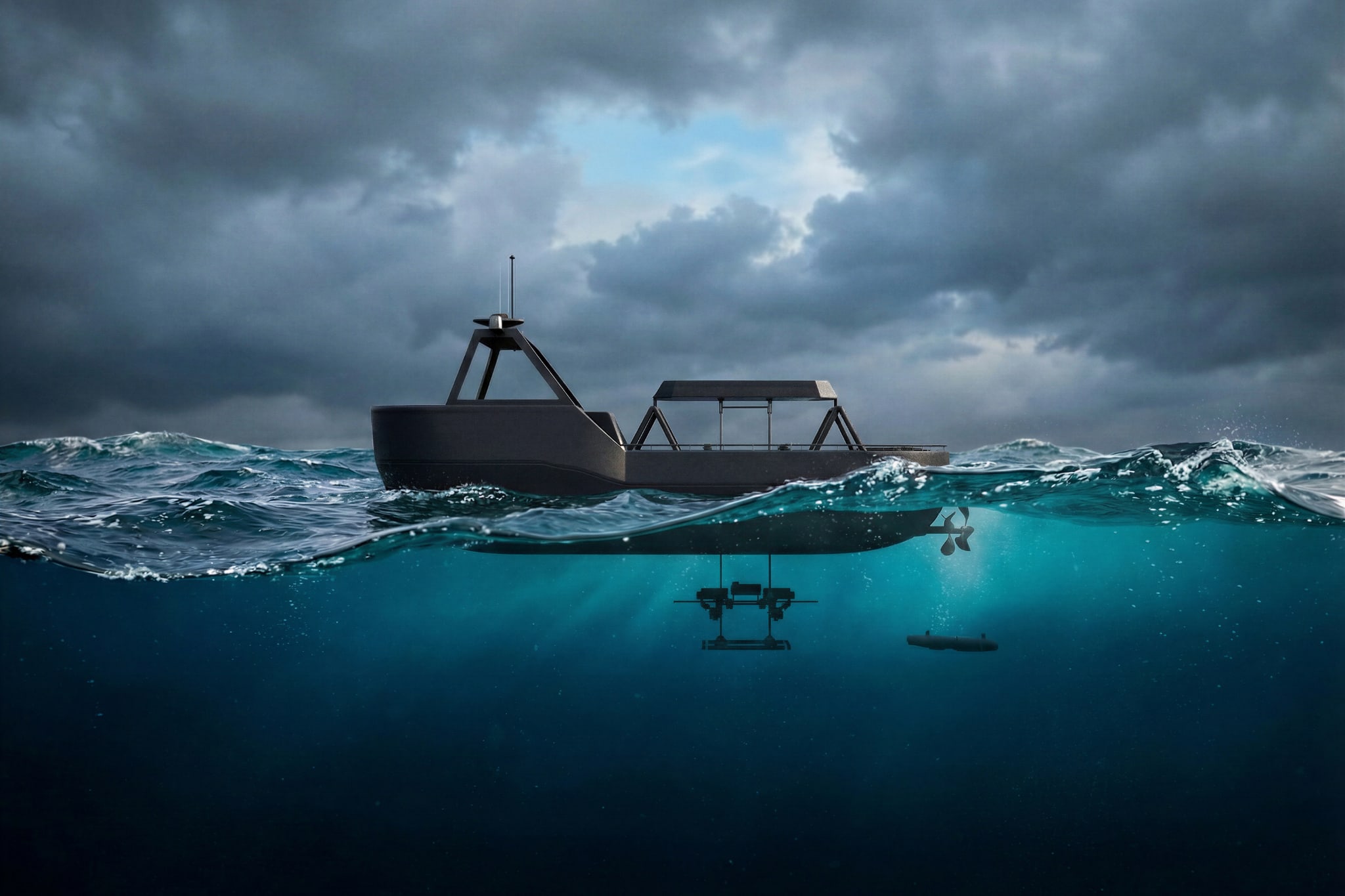
You design a system that handles both, consisting of separate vehicles optimized for each. The surface is where GPS and Starlink work, and doesn’t face the same pressure challenges as lower down, so that’s where communications, fuel, power, and logistics live. But most of the work is below the surface, where the undersea cables, seafloor, and marine ecosystems lie. You need vehicles that can go where the work is, and you need surface platforms that can deploy, recover, recharge, and connect them to the rest of the world.
A fully autonomous system is a much cheaper system, because the cheapest AUV in the world is still expensive if it’s hand launched and recovered, and requires a crewed ship to operate it. There’s a joke in the maritime industry that “unmanned” systems are only unmanned in the sense that the people aren’t on or in them, but right beside them while they operate. As long as humans have to babysit autonomous vehicles, they’re not really autonomous, and it will be impossible to achieve scale.
We’ve designed the system at Ulysses with those requirements in mind. Our underwater vehicle Mako goes deep and does the work. Our autonomous surface craft and mothership, Leviathan, equipped with our autonomous launch, recovery, and recharge platform, Kraken, remains on the surface and serves as the fleet’s connective tissue: deploying Makos, recovering them, recharging their batteries, and relaying their data to onshore operators via satellite. Leviathan is a working asset in its own right, a node in a domain awareness network that can carry its own sensors and serve its own missions. Together, linked by Kraken, they form a single integrated system that can persist at sea without retreating to port.
The underwater environment demands autonomy.
Because of the underwater communications desert we described earlier, you cannot supervise an underwater vehicle in real time the way you would a drone in the air. The bandwidth simply isn’t there, and the latency would make remote control dangerous and unreliable.
AUVs need to think for themselves. Because we’re talking about large fleets of small, inexpensive vehicles, there is no room in either the cost structure or the vehicle itself for a human pilot. Each AUV needs to navigate without GPS, make decisions based on what they see, avoid obstacles, adapt to changing conditions, and execute complex missions with only periodic check-ins.
This is as much a compute problem as it is a software one. At Ulysses, we pack over 100 times more onboard compute than anyone else in our underwater form factor, data-center-class GPUs running inside an AUV. Since we can’t talk to our vehicles, they need to be smart enough not to need us.
Industrializing the ocean demands both observation and action.
Most ocean technology stops at sensors, which are valuable in their own right. However, sensors are not by themselves industrial infrastructure. To industrialize a domain, you have to be able to act on what you observe.
Consider a vehicle that can only observe. It would swim around, notice that a pipeline was in need of repairs, ascend to the surface, and send a message back to a team of humans, who would then schedule and weather permitting, get on an expensive vessel, travel out to the site of the damage, and send a human or ROV (remote operated vehicle) below to make the necessary repairs. That process costs an unnecessary amount of time and money. Conversely, a platform that can both observe and act would be able to both inspect and repair the pipeline, quickly and cheaply. More persistent monitoring would also mean that each individual repair is likely to be simpler.
Here, modern robotics is key. The fleet of machines we send into the ocean must be able to manipulate, intervene, and repair, which means that they need arms, tools, and the dexterity to do meaningful work at depth. If they can, you’ve turned a sensor network into an industrial presence. This is the hardest part of the stack to get right, but given our heritage in sea grass planting, it’s the part that we started with.
The ocean demands a fully integrated system.
You may have noticed, reading this section, that each requirement builds on the others. If you want low costs, for example, vehicles need to be autonomous and they need to be able to act. As soon as you introduce humans back into the equation, coverage and persistence drop while costs rise. If you want vehicles that are truly autonomous, persistent, and can act at depth, you n