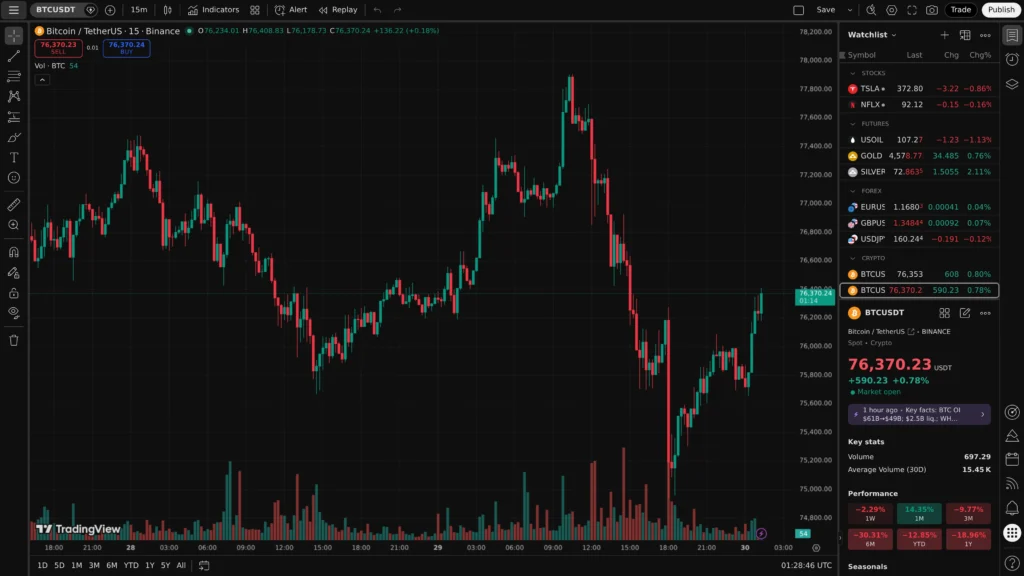
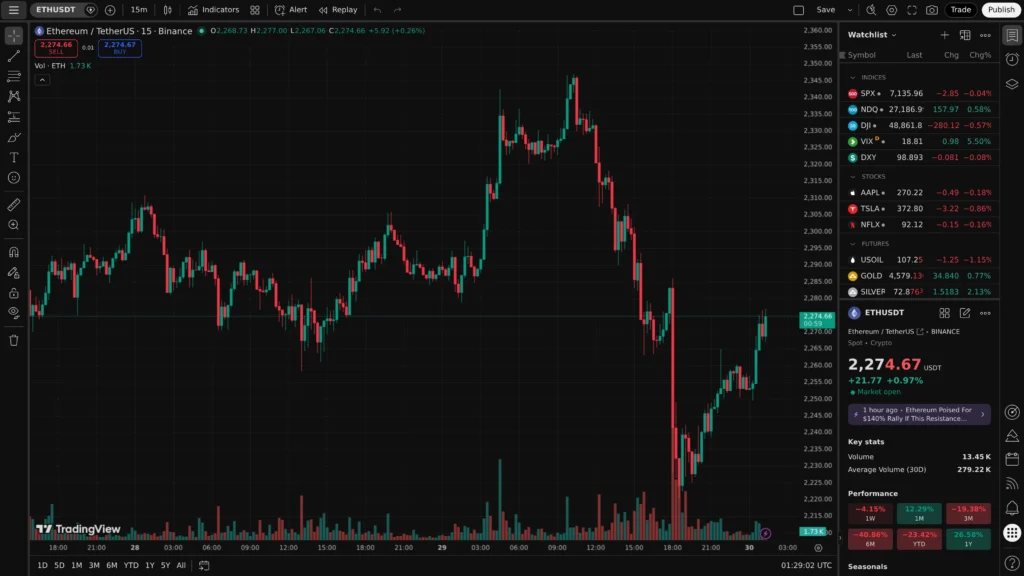
Bitcoin experienced a volatile trading pattern after the FOMC meeting, reaching a high of $77,904.93 in the past 24 hours before falling back to test a low of $74,937.52. This morning (30th), it was trading at approximately $76,275.80, a slight increase of 0.03% in 24 hours. Ethereum saw even more dramatic fluctuations, reaching a high of $2,346.95 in the past 24 hours before dropping to $2,220.36. It is currently trading at approximately $2,271.11, down 0.49% in 24 hours.
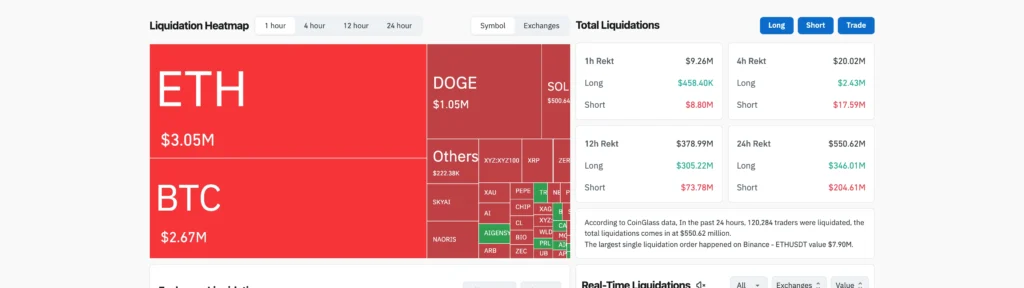
Over 120,000 people experienced margin calls within 24 hours, with long positions accounting for approximately 62.8%.
According to liquidation data scraped from CoinGlass, 120,284 traders were liquidated in the past 24 hours, with a total liquidation amount of $550.62 million. Of these, $346.01 million were long positions and $204.61 million were short positions, with long positions accounting for approximately 62.8%, indicating that this market volatility primarily punished those who bought at higher prices.
Looking at the bigger picture, $378.99 million in positions were liquidated in the past 12 hours, with long positions accounting for $305.22 million; in the past 4 hours, $20.02 million were liquidated, while short positions accounted for $17.59 million, reflecting a short-term rebound after the sharp drop. The largest single liquidation occurred on Binance ETHUSDT, amounting to $7.9 million.
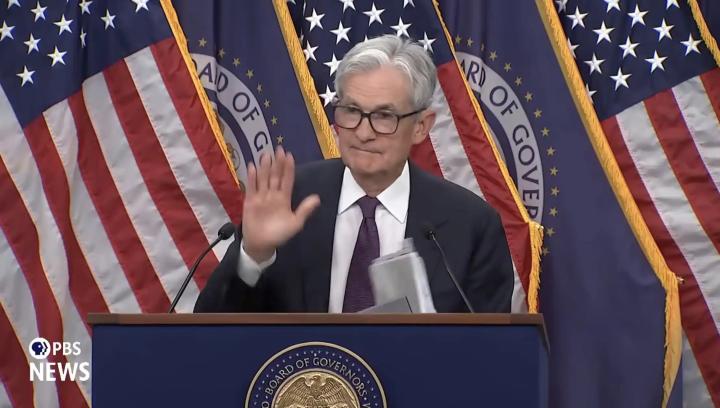
The FOMC kept interest rates unchanged, with oil prices and Iranian risks suppressing expectations of a rate cut.
The main driver of this volatility remains the Federal Reserve. On April 29, the US Federal Reserve announced that it would maintain the benchmark interest rate in the range of 3.5% to 3.75%. The market had already expected no rate cut, but the conflict in the Middle East and rising energy prices have made "how much more rate cuts this year" a greater uncertainty.
U.S. stocks closed in a cautious manner: the S&P 500 fell 2.85 points to 7,135.95, the Dow Jones dropped 280.12 points to 48,861.81, while the Nasdaq rose slightly by 9.44 points to 24,673.24. AP noted that the nearly 6% surge in Brent crude oil also pushed up U.S. Treasury yields, reducing market bets on a Federal Reserve rate cut this year.
ETF funding has cooled, and BTC still faces pressure from its April 23 high.
Another source of pressure comes from ETF liquidity. According to SoSoValue data, on April 28, US spot Bitcoin ETFs saw a net outflow of $89.68 million, with BlackRock IBIT experiencing an outflow of approximately $112 million; Ethereum spot ETFs also saw an outflow of $21.8 million. This reduced institutional buying support in the market before and after the FOMC meeting.
Price data shows that BTC's 14-day high remains at $79,321.16, reached at 00:01 on April 23, and was not reached today; ETH's 14-day high is $2,451.21, reached at 01:00 on April 18. In other words, today's market movement is more like a consolidation and correction after the FOMC meeting, rather than a renewed breakout of previous highs.
SOL and XRP traded in a narrow range, with the main focus remaining on whether BTC can hold above 75,000.
Other major cryptocurrencies also failed to establish a clear direction. SOL is currently trading at approximately $83.83, down 0.05% in the last 24 hours, with a range between $81.40 and $85.56; XRP is currently trading at approximately $1.3787, up 0.01% in the last 24 hours, with a range between $1.3458 and $1.4067.
The highest price for SOL in the last 14 days was $90.32 at 01:01 on April 18th, while the highest price for XRP in the last 14 days was $1.50 at 23:00 on April 17th. Both are currently consolidating below their previous highs. If BTC cannot regain its footing above the $77,900 to $79,300 resistance zone, the short-term rebound of Altcoin could easily be hampered by liquidity constraints.
The fear index has dropped to 29, but the market has not yet switched from risk aversion to chasing prices.
Alternative.me's Fear & Greed Index is currently at 29, still within the Fear range. This number aligns with the price action: BTC hasn't continued its sharp decline, but the market hasn't yet shifted back to aggressive buying.
There are three key points to watch next: First, whether BTC can hold the 24-hour low near $74,900; second, whether ETF funds will resume inflows after the FOMC meeting; and third, whether oil prices and Middle East risks will continue to push up inflation expectations. If these three factors do not improve, the rebound near $76,000 may just be a technical respite after a leverage cleansing.
 Related reports