U.S. President Donald Trump said on Tuesday he would briefly pause an operation to help escort ships through the Strait of Hormuz, citing "great progress" toward a comprehensive agreement with Iran.
Hours earlier, U.S. Secretary of State Marco Rubio had outlined the effort that began on Monday to escort stranded tankers out of the Gulf. The strait has been virtually shut since the conflict began, blocking some 20% of world oil supplies and igniting a global energy crisis.
"We have mutually agreed that, while the Blockade will remain in full force and effect, Project Freedom ... will be paused for a short period of time to see whether or not the Agreement can be finalized and signed," Trump wrote on social media.
There was no immediate reaction from Tehran, where it was early on Wednesday morning.
Shortly after Trump's post, U.S. crude oil futures fell $2.30 and broke below $100 per barrel, a much-watched threshold since the conflict sent energy prices soaring two months ago.
The White House did not immediately reply to a request for comment on what progress had been made, or how long the pause would last.
Rubio and other senior administration officials said earlier on Tuesday that Iran could not be allowed to control traffic through the strait.
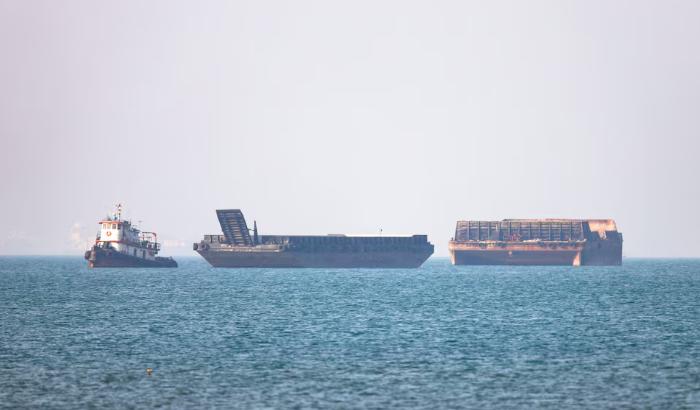
Iran has effectively sealed off the strait by threatening to deploy mines, drones, missiles and fast-attack craft. The United States has countered by blockading Iranian ports and mounting escorted transits for commercial vessels.
The U.S. military said on Monday it had destroyed several Iranian small boats, as well as cruise missiles and drones.
RUBIO SAYS MAIN OPERATION IS OVER
Rubio told reporters at the White House that the United States had achieved its objectives in its military campaign, which was launched on February 28 alongside Israel.
"Operation Epic Fury is concluded," Rubio said. "We're not cheering for an additional situation to occur."
One of Trump's central objectives in launching military strikes against Iran was to ensure Tehran does not develop a nuclear weapon, something Tehran has denied seeking. However, Iran has not handed over more than 900 pounds of highly enriched uranium.
While Rubio was speaking, Britain's Maritime Trade Operations agency reported that a cargo vessel had been struck by a projectile in the strait. Further details of the incident were not immediately available.
U.S. Defense Secretary Pete Hegseth said earlier on Tuesday that the U.S. had successfully secured a path through the waterway and that hundreds of commercial ships were lining up to pass through. The four-week-old truce with Iran was not over, he added.
"Right now the ceasefire certainly holds, but we're going to be watching very, very closely," he said.
General Dan Caine, chairman of the U.S. Joint Chiefs of Staff, said Iranian attacks against U.S. forces fell "below the threshold of restarting major combat operations at this point".
Asked what Iran would need to do to violate the ceasefire, Trump said: "They know what not to do."
'RIGHT TO RESPOND'
Shortly after Hegseth spoke, the UAE's defence ministry said its air defences were again dealing with missile and drone attacks coming from Iran, though Iran's joint military command denied carrying out attacks.
The UAE's foreign ministry said the attacks were a serious escalation and posed a direct threat to the country's security, adding that the Gulf Arab state reserved its "full and legitimate right" to respond.
Iran's foreign ministry rejected Abu Dhabi's statements, saying its armed forces’ actions have been solely aimed at repelling American aggression.
The U.S. military said on Monday that two U.S. merchant ships made it through the strait, without saying when, while shipping company Maersk (MAERSKb.CO), opens new tab said the Alliance Fairfax, a U.S.-flagged ship, exited the Gulf under U.S. military escort on Monday.
Iran denied any crossings had taken place.
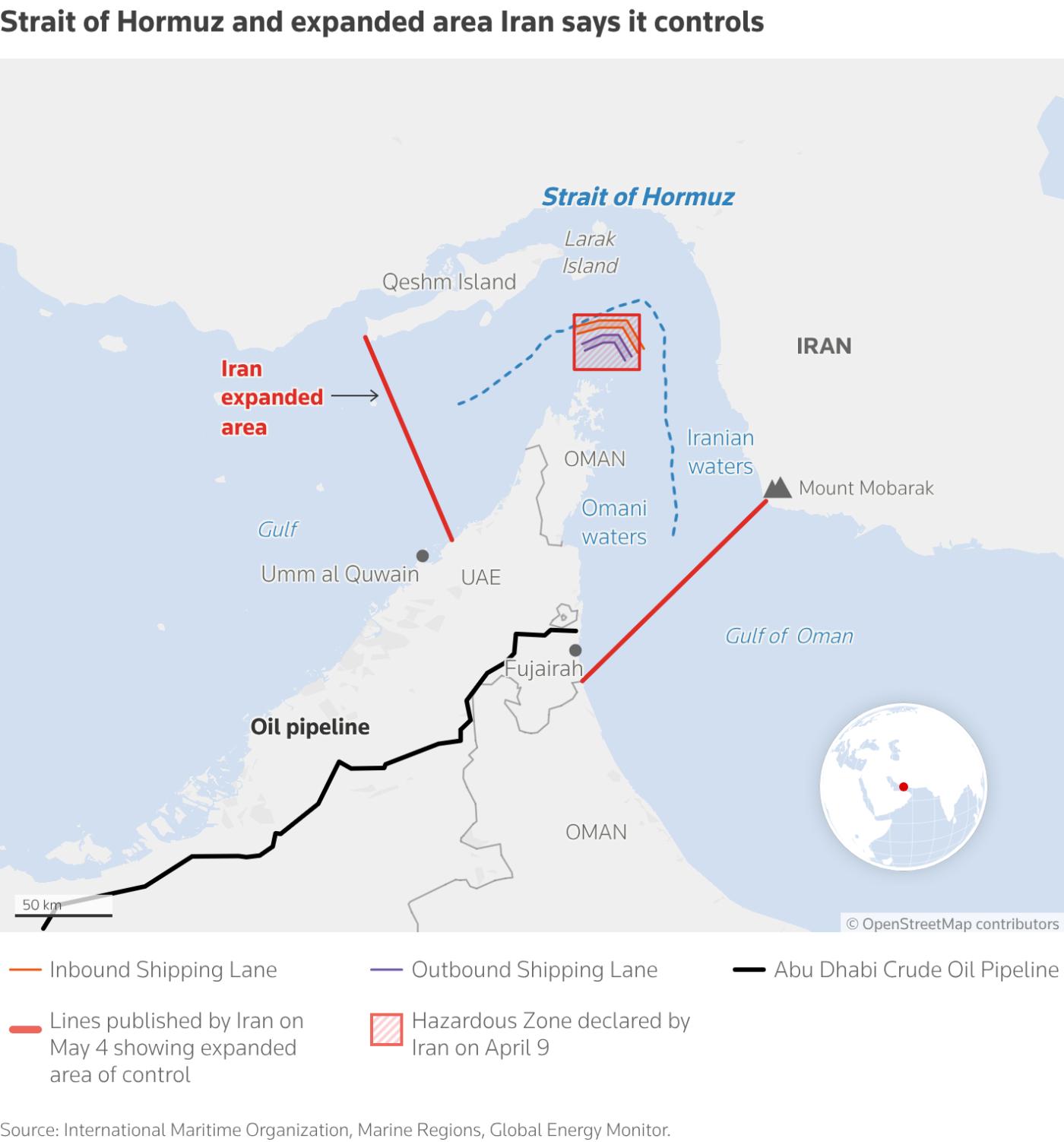
A map showing the inbound and outbound shipping lanes in the Strait of Hormuz, in addition to the the maritime boundary between Oman and Iran.
A map showing the inbound and outbound shipping lanes in the Strait of Hormuz, in addition to the the maritime boundary between Oman and Iran.
PAKISTAN'S MEDIATION EFFORTS CONTINUE
The war has killed thousands as it has spread beyond Iran to Lebanon and the Gulf, and roiled the global economy. The head of the International Monetary Fund said on Tuesday that even if the conflict ended immediately, it would take three to four months to deal with the consequences.
Rubio said 10 civilian sailors were among those who had died in the conflict, adding that crew on vessels stranded in the waterway were "starving" and "isolated."
Trump told reporters in the Oval Office that Iran's military had been reduced to firing "peashooters" and Tehran wanted peace, despite public sabre-rattling.