On May 6th, Beijing time, OpenAI made two progress.
First, GPT-5.5 Instant has become the new default model for ChatGPT, and will be gradually rolled out to all ChatGPT users, including free users. Compared to its predecessor, GPT-5.3 Instant, the new version improves factual reliability and adds stronger context management capabilities; Plus and Pro users can more effectively access past conversations, files, and relevant information from connected Gmail accounts in the web version.
From that day forward, ChatGPT’s default experience had, for the first time, the minimum usable form of “long-term memory”.
Secondly, OpenAI launched its self-service advertising platform, announcing it as a key step towards achieving its goals of $2.5 billion in advertising revenue by 2026 and $100 billion by 2030. Asad Awan, head of advertising and monetization at the company, confirmed at a media briefing that the self-service Ads Manager is now in beta for advertisers of all sizes across the US. The previous minimum spend of $50,000 has been removed, and CPC (cost-per-click) billing has been enabled. Conversion tracking pixels and the Conversions API are also being launched. Third-party measurement and CPA billing are in the works, but partners and timelines have not yet been finalized.
Behind this appears to be a carefully designed business logic, a business model familiar from the internet age: the stronger the free model, the larger the free user base, the richer the dialogue data, the more advertising inventory, the more precise the unit advertising, and the higher the unit advertising price.
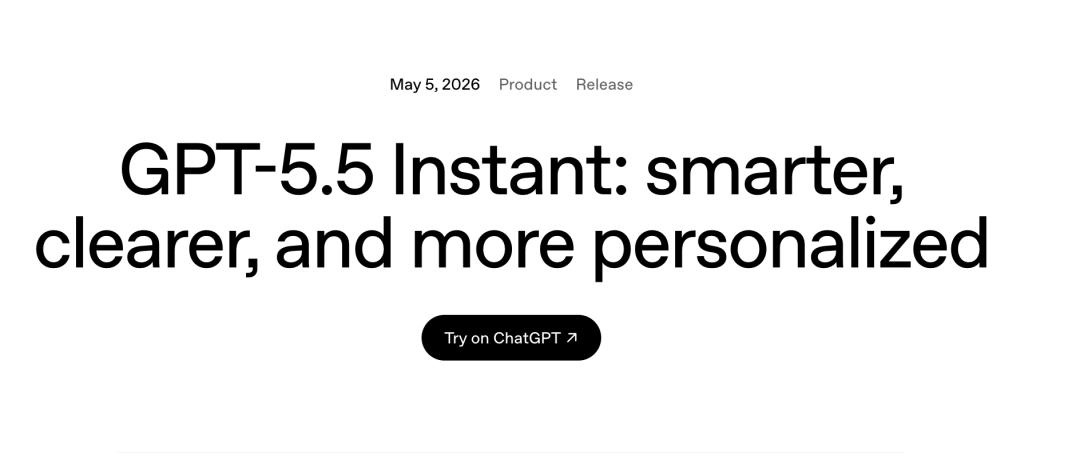
Figure: GPT-5.5 Instant became the default model for ChatGPT on the same day, with a 52.5% decrease in illusion rate compared to the previous generation, and added "context management" capabilities.
01 One free product, two business models
OpenAI is actually running two businesses simultaneously, with different target customers, pricing logic, and revenue structures.
The first business model targets "intelligent providers" for developers and enterprises. The GPT-5.5 flagship version's API input is priced at $5 per million tokens, and output at $30 per million tokens. Payers include developers building upper-layer applications, companies creating agent systems, and SaaS companies embedding model capabilities into their own products. The logic behind this business line is selling intelligence based on usage volume; the profit model is direct, the chain is short, and the customer unit price is high. The stronger the model, the higher the value per usage, and the greater the pricing power.
The second business is the consumer-facing (C-end) business targeting 900 million weekly active users. ChatGPT has over 900 million weekly active users, but over 95% of them are free users. The core function of the free version of GPT-5.5 Instant is to maximize daily active users, conversation frequency, dwell time, and long-term retention.
Currently, this approach seems closer to the advertising strategies of the internet age, delivering two things to the advertising business: reach scale and high-density behavioral data for each user. In terms of business model, this line of business is more similar to Google Search or Meta Stream.
The May 6th launch marked a significant step forward in the industrialization of this business line. During the pilot phase, advertisers could only pay per impression (CPM); the advertising platform officially launched on February 9th with an initial CPM of $60, which had dropped to $25 by mid-to-late April.
The price decline itself reflects both an increase in advertising inventory and a shift in the bargaining relationship between advertisers and platforms towards a "pay-per-performance" model.
The introduction of CPC marks this shift. CPC stands for Cost Per Click, meaning advertisers no longer pay only for ad impressions, but for actual user clicks. Combined with the Conversions API and conversion pixels, this means OpenAI can now tell advertisers: "You pay for every valid click, and I can tell you the results of every subsequent purchase, registration, and lead generation."
This is a complete performance advertising infrastructure, benchmarked against mature product forms in the Internet era, such as Google Ads and Meta Ads.
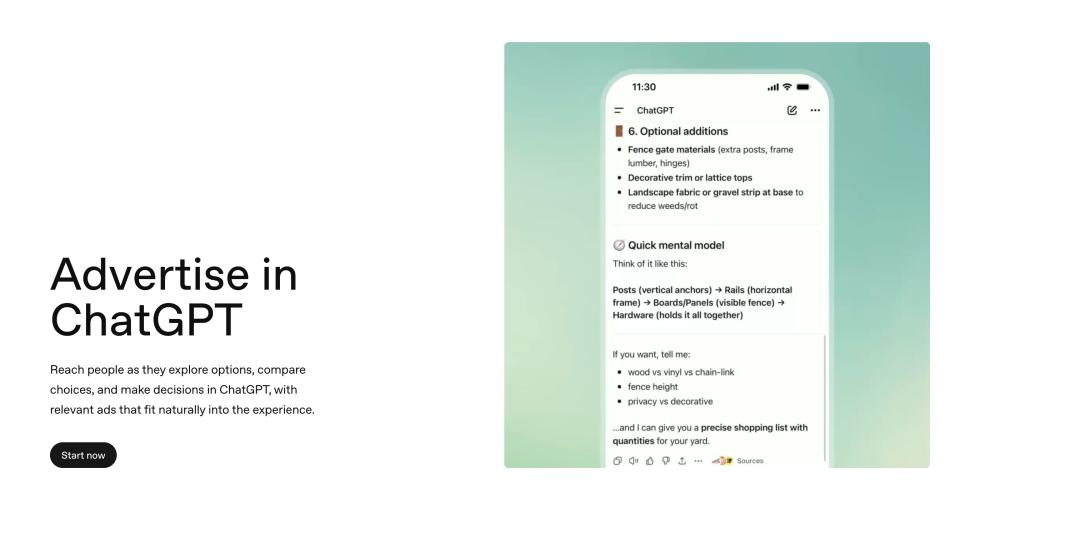
Image: OpenAI officially announces that its advertising platform is open for beta testing to advertisers of all sizes across the US, and officially launches CPC billing.
Another key executive in charge of advertising is Dave Dugan, former Vice President of Global Clients and Agencies at Meta. The partners announced on May 6th included four major advertising holding groups: Dentsu, Omnicom, Publicis, and WPP, as well as ad technology companies such as Adobe, Criteo, Kargo, Pacvue, and StackAdapt. This list itself seems more like a declaration of benchmarking.
On May 1, OpenAI updated its US privacy policy, disclosing its advertising data flow more explicitly for the first time. On one hand, OpenAI may receive conversion data such as purchases and registrations from advertisers; on the other hand, it may also share some data used for ad measurement and placement with its marketing partners.
In other words, this privacy policy update provides a legal and compliance basis for establishing a data loop for the advertising system: "user clicks on an ad—conversion is completed off-site—conversion results are fed back to the platform—further optimization of ad placement." Just five days later, on May 6th, OpenAI opened up more comprehensive ad buying tools to advertisers; the timing of this move is not accidental.
02 “Memory” is also an infrastructure
In addition, GPT-5.5 Instant introduces "context management," which more effectively accesses relevant information from past conversations, saved memories, files, and connected applications, reducing the need for users to repeatedly provide information. OpenAI also mentions on the GPT-5.5 Instant release page that all ChatGPT models will incorporate memory sources. This means that when a response is personalized, users can see which contextual sources the model used, such as saved memories or past chats; and if a message is outdated or irrelevant, users can delete or correct it.
This capability is intended to ensure continuity of responses, but in the context of advertising, it also means that ChatGPT can more accurately determine user intent based on the current conversation, recent chats, long-term memory, and other available context.
OpenAI's advertising help documentation explains it quite directly: If a user enables ad personalization, ads will be personalized based on the context used in the user's chat and ChatGPT responses; if memory is enabled, ChatGPT may also use memories and recent chats to select ads. Users can manage memory and ad personalization in the settings.
In contrast, Google search ads provide single, explicit, and point-like data signals: a user types "running shoes" at a specific moment, and the system displays a Nike ad. The signal window is short, the context is thin, and the user's intent is clear. The bottleneck of this mechanism is also clear: it only works the moment a user actively expresses a need, and it is powerless against potential intents that have not yet manifested in a search behavior.
ChatGPT's conversational signals are continuous, implicit, and surface-like. For example, a complete purchase decision may span several weeks and dozens of rounds of conversation: first complaining about knee pain after a long run, then asking if you need to change your shoes, then asking which cushioning technology is more suitable, then discussing the price range, and finally making a purchase at some point.
This signal discrepancy is further amplified in the new advertising system. On ChatGPT's advertising platform, advertisers use natural language to describe potentially relevant conversational scenarios for a product, and the platform's inference engine makes the final matching decision.
The ideal closed loop is now relatively complete: user dialogue generates memories, memories drive personalized experiences, personalized experiences improve retention and dialogue frequency, higher-frequency dialogue generates more refined profiles, more refined profiles support higher ad CPC, higher ad revenue feeds back into model training, and the model becomes stronger and more reliable. Each loop amplifies the effect. The better the free version of GPT-5.5 Instant performs, the larger the loop amplifies.
However, there is usually a huge gap between ideal design and reality.
03 The real cost is trust.
Over the past 20 years, the cost of "free" internet products has been known, such as social networks and short video platforms, which involve giving up attention and time. These costs have been psychologically accepted by users, partly because the product form itself is public and instrumental, and the boundaries of tools always exist.
ChatGPT may be giving up something else: trust.
When users confide their anxieties, refine their purchasing decisions, organize their workflows, draft personal emails, or discuss career challenges with ChatGPT, the interaction feels more like a one-on-one consultation. The model's use of the second person, its ability to remember user-mentioned details, and its coherent "understanding" across different conversations all contribute to a personalized relationship. Users don't trust tools; they trust entities that feel like they "understand" them.
OpenAI is clearly aware of this. Their advertising principles repeatedly emphasize that ads do not affect the answers provided by ChatGPT, conversation content is kept confidential from advertisers, user data is not sold to advertisers, users can turn off personalization and clear data used for advertising, and there are never ads in paid tiers (Plus, Pro, Business, Enterprise). They also promise that users under 18 will not see ads, and ads will not appear near sensitive areas such as health, mental health, or politics. Ad placement decisions are made entirely within OpenAI's own system; advertising technology partners are only responsible for budgeting, bidding, and creative content. Conversation data remains with OpenAI, and advertisers only receive aggregated performance metrics.
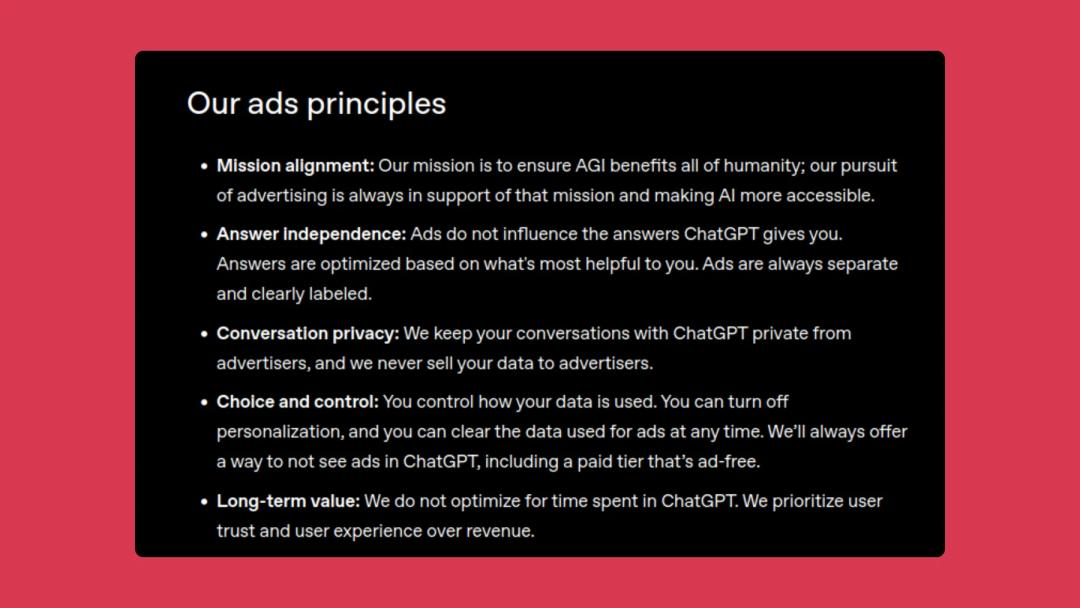
Image: OpenAI elaborated on its advertising principles when announcing its advertising test on ChatGPT.
However, there are still several unresolved issues beyond the guardrail.
First, the safeguards prevent "advertisers from obtaining conversation content," not "conversation content from being used for targeting." OpenAI's own disclosed ad matching mechanism explicitly includes the user's current conversation topic, past chats, and past ad interactions. In other words, the conversation content doesn't leave OpenAI's servers, but OpenAI itself uses it to decide what ads to show to the user.
This is a privacy design for "internal use," which is more respectful to users than "selling to advertisers," but it also means that every word a user says to ChatGPT may come back to them in the form of an advertisement at another time.
Second, the "separation of advertising and answers" is a visual commitment, not a cognitive one. OpenAI uses sponsored tags in its advertising products to clearly label ads and separate them from the main text. However, users' level of trust in ChatGPT is not equivalent to their level of trust in search engines: even if search engine ads are not labeled, users can mostly identify them based on experience; but for someone positioned as a consultant, the cost of identification must be borne solely by the user, especially when that consultant is also aware of your health anxieties, career difficulties, and spending habits.
Third, the rules for separating memory and advertising remain opaque. OpenAI states that "users can turn off personalization and clear data used for advertising," but operational details such as how memory data enters the targeting system, whether clearing takes effect simultaneously, and whether the remembered content can be partially deleted rather than completely are not disclosed. Users should receive clearer, more granular information when making decisions about whether to rely on these services.
When an AI simultaneously remembers a user's health anxieties, spending habits, career dilemmas, and family relationships, can the user still clearly distinguish which of its product recommendations are suggestions and which are paid content?
$2.5 billion is OpenAI's target for its advertising business in 2026, and $100 billion is its vision for 2030. Whether these two figures can be achieved depends technically on the quality of the models and the scale of reach; commercially, it depends on a more fundamental product question: Is there a new kind of intimate relationship between AI and humans? How far can this "intimate relationship" be transformed into a business model, and at what point will it encounter user aversion and resistance?
One thing the previous generation of free products on the internet taught users was that free was never truly free. The cost of this generation is more insidious; it can occur even before users realize what they've given up.
This article is from the WeChat official account "Tencent Technology" , author: Worth Paying Attention to, and is published with authorization from 36Kr.