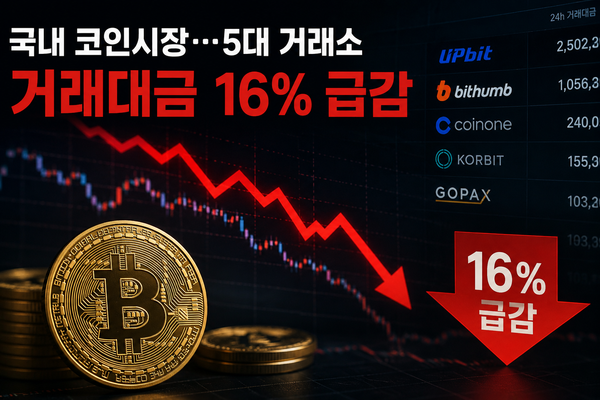
Trading enthusiasm in the domestic virtual asset market is cooling rapidly. Weekly trading volume at the top five domestic KRW-denominated exchanges fell by approximately 16% compared to the previous week, dropping to its lowest level in a month. With Bitcoin continuing to trade sideways near its peak and altcoin volatility also slowing, demand for short-term trading appears to be shrinking sharply.
According to industry sources on the 8th, the trading volume of Korea's top five exchanges—Upbit, Bithumb, Coinone, Korbit, and Gopax—over the past week was tallied at approximately 16.9 trillion won. This represents a decrease of more than 15% compared to the previous week. This is the first time since early April that the weekly trading volume of domestic exchanges has fallen to this level.
The market attributes the recent excessive stabilization of virtual asset prices to this as the primary cause. While Bitcoin maintains a relatively high price level driven by the inflow of global institutional funds and demand for spot ETFs, analysts suggest that demand for short-term trading, centered on domestic retail investors, is noticeably declining as sharp fluctuations have diminished.
The slump in the altcoin market is particularly pronounced. As the volatility of meme coins and small-to-medium-sized altcoins, which previously drove trading volume on domestic exchanges, has decreased, investor turnover has also dropped significantly. It is assessed that the recent delay in expectations for U.S. interest rate cuts and global macroeconomic uncertainty are also weakening risk asset preference.
Changes in exchange market share are also noteworthy. Upbit maintained its dominant position with a share of over 60%, but its share declined slightly. On the other hand, Bithumb expanded its market share and narrowed the gap somewhat by leveraging aggressive marketing and new listing strategies. Coinone, Korbit, and Gopax also saw a slight rebound, but it was insufficient to reverse the overall downward trend in market trading.
Some in the industry interpret the recent decline in trading volume not merely as a temporary adjustment, but as a signal of structural changes in the domestic virtual asset market. Analysts suggest that as it has become difficult for the market to grow solely through high volatility and speculative trading as in the past, there is a growing likelihood that capital flows will shift toward real-world markets such as stablecoins, Real-World Asset Tokenizations (RWA), and Security Token Offerings (STO) in the future.
In fact, tokenized U.S. Treasury bonds, gold-backed digital assets, and the expansion of stablecoin payment infrastructure have recently emerged as new growth drivers in the global market. In contrast, the domestic market remains centered on spot trading, so if the decline in trading volume persists, pressure on exchanges' profitability is expected to intensify.
"A market insider analyzed, 'The domestic exchange model centered on simple trading is approaching its limits,' adding, 'In the future, the competitiveness of exchanges will be determined by the inflow of institutional funds and real-world-backed digital assets.'"