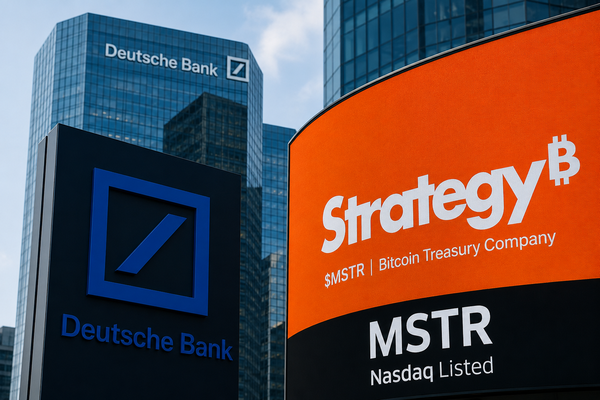
Deutsche Bank, one of Germany's largest financial institutions, has further increased its stake in MSTR, a Bitcoin financial strategy firm. This follows a continuing trend in the traditional financial sector of expanding indirect exposure to Bitcoin through publicly listed companies rather than holding it directly.
According to recently released data, Deutsche Bank purchased an additional 53,215 shares of Strategy. As a result, its total holdings increased to 784,919 shares, with a valuation of approximately $140.1 million.
Strategy is a leading listed company that has incorporated Bitcoin as a core financial asset. As its stock price shows a high correlation with the price of Bitcoin, it is being utilized by institutional investors as a 'Bitcoin proxy stock'.
This acquisition goes beyond simple investment in individual stocks and demonstrates a shift in the traditional financial sector's approach to digital assets. Instead of direct holdings, which entail significant regulatory, accounting, and custody burdens, banks and asset management firms are opting to gain exposure to the Bitcoin market through listed stocks, ETFs, and stakes in related infrastructure companies.
In particular, with the recent confirmation that Deutsche Bank, following UBS, has expanded its stake in Strategy, the trend of major European financial institutions incorporating digital assets is becoming more pronounced. This suggests that Bitcoin is establishing itself as an alternative and strategic financial asset within institutional portfolios, moving beyond being merely a speculative asset.
However, as strategy stocks are highly sensitive to Bitcoin price fluctuations, increased institutional buying does not necessarily mean they are a stable investment vehicle. Stock price volatility could increase further depending on Bitcoin prices, interest rate environments, and companies' additional buying strategies.
Deutsche Bank's recent additional purchase is interpreted as a signal that the global financial sector is incorporating Bitcoin into the institutional framework in a manageable manner, rather than turning a blind eye to it. This effectively expands the next investment option for institutions beyond Bitcoin spot ETFs to include "listed companies holding Bitcoin."