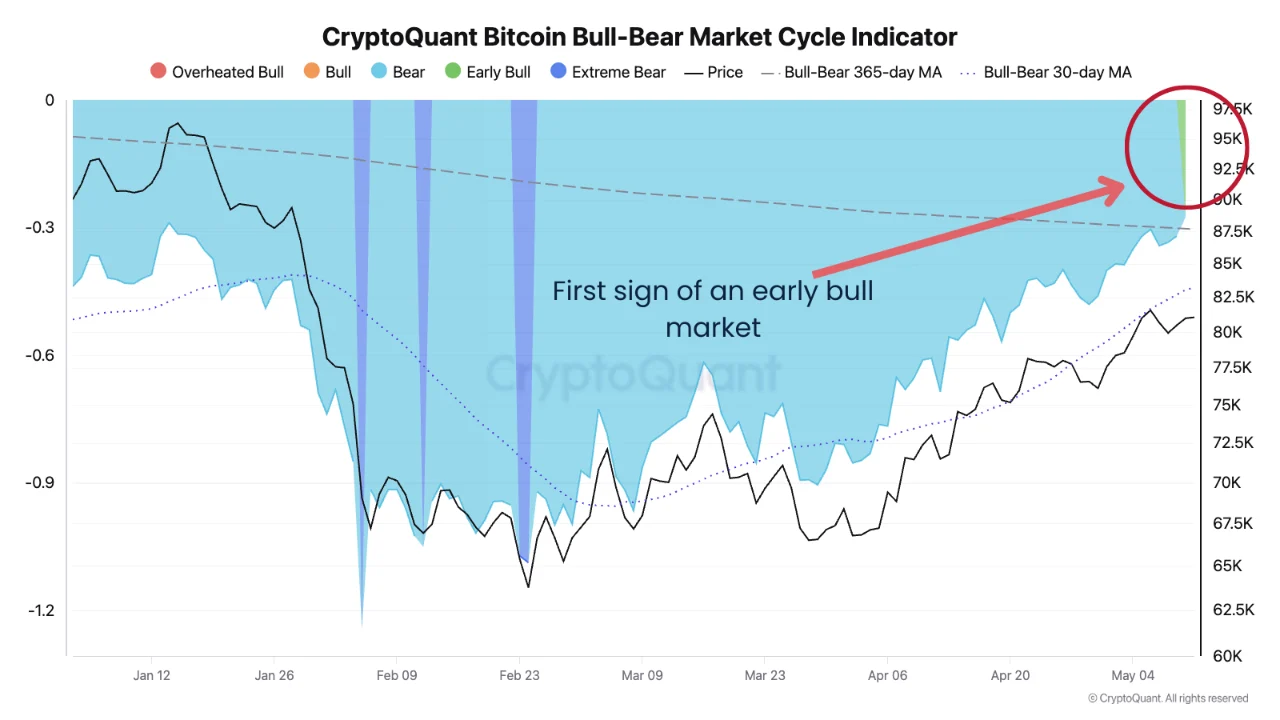
Bitcoin is holding above $80,000, but on-chain indicators suggest the upward momentum may be weakening.
BTC 's SOPR (Surface Price Per Share) remained above 1 for nine consecutive days in May, suggesting that many coins being moved on-chain are taking profits. At the same time, some historical signals and exchange reserve data suggest a risk of correction if selling pressure weakens.
- Bitcoin's adjusted SOPR above 1 reflects profit-taking by holders.
- The CSH Score indicator, at 41, has fallen into a zone previously associated with sharp declines.
- The monthly increase in BTC reserves on exchanges indicates that more coins are flowing into the exchanges than are being withdrawn.
Bitcoin remains above $80,000 thanks to selling pressure.
Bitcoin continues to trade above the psychological $80,000 mark as stronger buying pressure from holders absorbs profit-taking selling. However, if this absorption dries up, the price could enter a correction phase.
The fact that the adjusted SOPR is above 1 indicates that, on Medium, coins moved on-chain are being sold for profit. This is often a sign that the market still has strength, but it also indicates that profit-taking pressure exists.
The CSH score of 41 has appeared during bear market rallies.
The CSH Score is currently at 41, and this is the third time in Bitcoin's history that this indicator has entered a zone previously associated with a rebound in a bear market. In all three previous instances, BTC subsequently experienced a sharp correction.
This indicator functions as a trend oscillator , running on a scale of 0 to 100. Zones below 30 are generally XEM consolidation, while levels above 60 indicate an overstretched market. The 41 level isn't yet in overheated territory, but it's well above the neutral threshold and warrants close monitoring.
The accompanying observation is that this data set is small, so a single indicator cannot be used to draw conclusions about the trend. However, if history repeats itself, taking profits or staying out of the market might be a more prudent option in the short term.
BTC inflows into exchanges are increasing, even though institutions still say they are buying.
Monthly exchange reserve data shows that when the 30-day period turns positive, the amount of BTC entering exchanges exceeds the amount withdrawn during the same period. This is often XEM as a signal that supply may be ready for selling activity.
While some institutional investors and funds may still announce they are buying more BTC, on-chain data paints a more cautious picture. When exchange reserves increase while the price continues to rise, the upward momentum usually relies more on weak selling pressure rather than a genuine surge in buying demand.
What investors need to watch next.
Two key signals to watch are the ability of the area above $80,000 to hold firm and the flow of BTC into exchanges. If the amount of coins flowing onto exchanges continues to increase while buying pressure weakens, the risk of a correction will become clearer.
Conversely, if profit-taking pressure eases and inventories on the exchange cool down, the upward trend could be extended. At present, the data is leaning towards a more cautious stance rather than confirming a sustainable uptrend.
Summary
Bitcoin is still holding above the $80,000 mark, but SOPR, CSH Score, and exchange reserves all indicate that the upward momentum is facing short-term warning signs.