With the rapid development of AI and internet infrastructure, an increasingly obvious problem is emerging:
The global digital world is almost entirely built on open source software (OSS), but the developers who actually maintain these core infrastructures have long lacked sustainable economic incentives and a trust system.
Tea Protocol is trying to solve this problem.
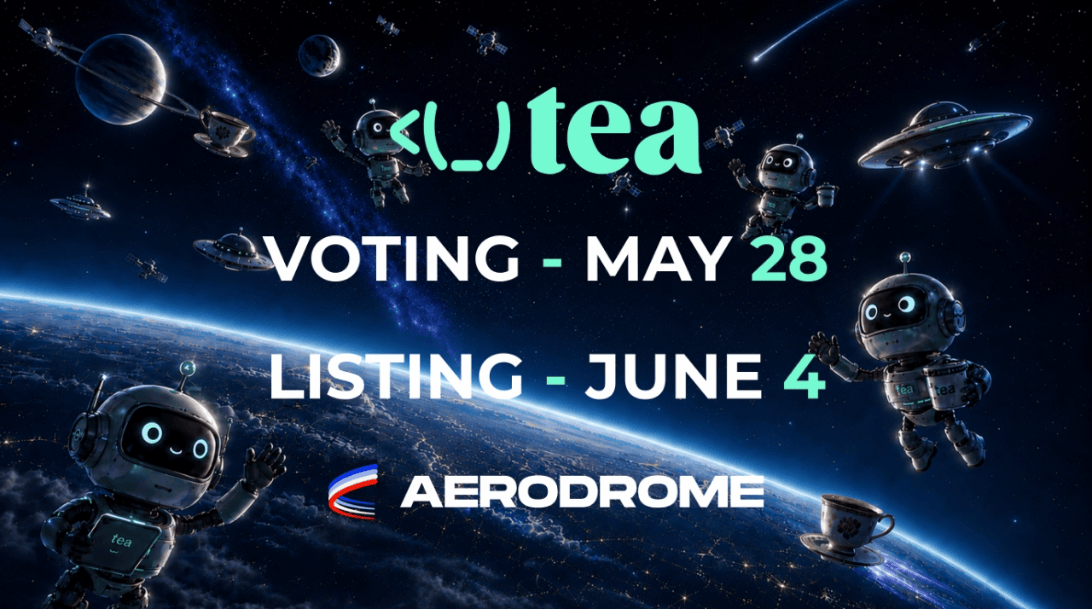
Recently, the official Tea platform confirmed that its native token, $TEA, will officially complete its TGE (Transactions Execution) on June 4th and be listed on Aerodrome, the core liquidity platform of the Base ecosystem. Meanwhile, the Aerodrome ecosystem voting will begin on May 28th.
The official term for this phase is: "The Tea Party Begins June 4".
In addition to Aerodrome, tea also stated that more information on centralized exchanges (CEXs) listings will be released in the coming weeks.
As "code" becomes abundant, "trust" becomes a scarce resource.
Tea presented a core argument in its official PR:
Today's internet is not lacking in code; what is truly scarce is "trust."
With the accelerating development of AI, automation, and global software collaboration, an increasing number of critical systems rely on open-source software to run. From AI frameworks and developer toolchains to cloud infrastructure and software supply chains, OSS has become the most core underlying structure of the digital world.
However, the current OSS world has several long-standing core problems:
● Developer contributions are difficult to quantify
● Critical infrastructure has long been maintained by a small number of people.
● The open-source ecosystem lacks long-term economic incentives
● Insufficient trust mechanisms in the software supply chain
● Truly important foundational projects often lack resource support.
What tea hopes to build is a "trust layer" around OSS.
tea is more than just a Web3 project
Unlike many traditional Web3 projects, tea is not just about DeFi or financial transactions.
Tea is more like an economic agreement for the global open-source software ecosystem.
The project aims to enable OSS developers, maintainers, and core infrastructure projects to truly share the value they create through on-chain mechanisms, a contribution system, and decentralized incentives.
Currently, tea supports the following:
● Homebrew
● npm
● PyPI
● RubyGems
● Crates
● APT
● pkgx
It is part of several mainstream global open-source software ecosystems.
Max Howell, co-founder of tea, is also the founder of Homebrew. For many macOS developers, Homebrew is arguably one of the most essential package management tools.
In a sense, tea is regarded by many developers as:
"Homebrew's extension into the Web3 world."
Proof of Contribution: Making "Contribution" a New Measuring Method of Value
One of the core mechanisms of tea is "Proof of Contribution".
Unlike traditional blockchains that rely on computing power, capital, or staking rights, TEA focuses more on developers' genuine contributions to the open-source ecosystem.
The agreement will be adopted:
● Dependency graph
● Software usage
● Project Ecosystem Impact
● Community contribution behavior
The OSS project is continuously evaluated from multiple dimensions, and a dynamic contribution ranking system is formed.
In short:
If an open-source library is relied upon by a large number of projects worldwide, its contribution and potential rewards within the tea network will be higher.
This means that the underlying OSS infrastructure, which has been neglected for a long time, may have a truly sustainable economic model for the first time in the future.
In the AI era, the importance of OSS is being amplified once again.
The emergence of tea also aligns with a key trend in the current AI era.
As the AI industry expands rapidly, the world's reliance on open-source software and the developer ecosystem continues to deepen.
Whether it is:
● Large model frameworks
● AI agent infrastructure
● cloud-native systems
● developer tooling
● Software supply chain
Almost all next-generation technology systems are built on OSS.
What tea hopes to build is not just a token project, but a long-term open-source economic network.
The project aims to establish a new value distribution system and collaborative trust mechanism for global developers through Web3 incentive mechanisms.
$TEA is about to launch, and the ecosystem is entering a critical stage.
With the Aerodrome voting starting on May 28 and the TGE approaching on June 4, tea is gradually entering a critical stage of its ecosystem development.
As the Web3 industry gradually shifts from short-term financial narratives to real-world infrastructure development, the importance of the open-source software ecosystem is continuously increasing. tea is attempting to establish a new network of value collaboration, contribution incentives, and trust within the global OSS ecosystem, and to drive the developer economy towards a more long-term and sustainable direction.