Original article by Odaily Odaily(@OdailyChina)
Author|Wenser (@wenser 2010) 
Last September, the battle between Hyperliquid's native stablecoin USDH became a focal point in the industry; now, this once highly anticipated stablecoin has suddenly faced its "exit moment".
Last night, Coinbase announced it will become the official treasury deployer of USDC on Hyperliquid, while Native Markets, the issuer of Hyperliquid's native stablecoin USDH, granted Coinbase the right to purchase USDH branded assets. The USDH market will subsequently be gradually closed, during which time users can still exchange USDH for USDC or fiat currency without transaction fees.
As a result, the once-famous USDH became an asset acquired by Coinbase, while USDC was officially established as Hyperliquid's official stablecoin and pricing asset. Odaily will briefly analyze the inside story and subsequent impact of this event in this article.
USDH exits, USDC rises: The economic implications behind $5 billion
This epic battle for the Hyperliquid ecosystem stablecoin ultimately ended with a win-win situation for Coinbase & Circle, Hyperliquid, and USDH issuer Native Markets.
Coinbase uses this to further deepen its integration with the Hyperliquid ecosystem; Hyperliquid, in turn, reaps the lion's share of the USDC stablecoin reserve revenue within the ecosystem; and Native Markets, as the ultimate winner of USDH, gains its reward by "selling USDH brand assets".
Coinbase & Circle: Partnering with Hyperliquid's on-chain economy and continuing to increase investment in HYPE
Currently, the USDC value on Hyperliquid is approximately $5.164 billion, representing a 2-fold increase year-on-year.
As an official partner and revenue sharer of USDC, Coinbase's move is undoubtedly aimed at forging a deeper connection with the Hyperliquid ecosystem.
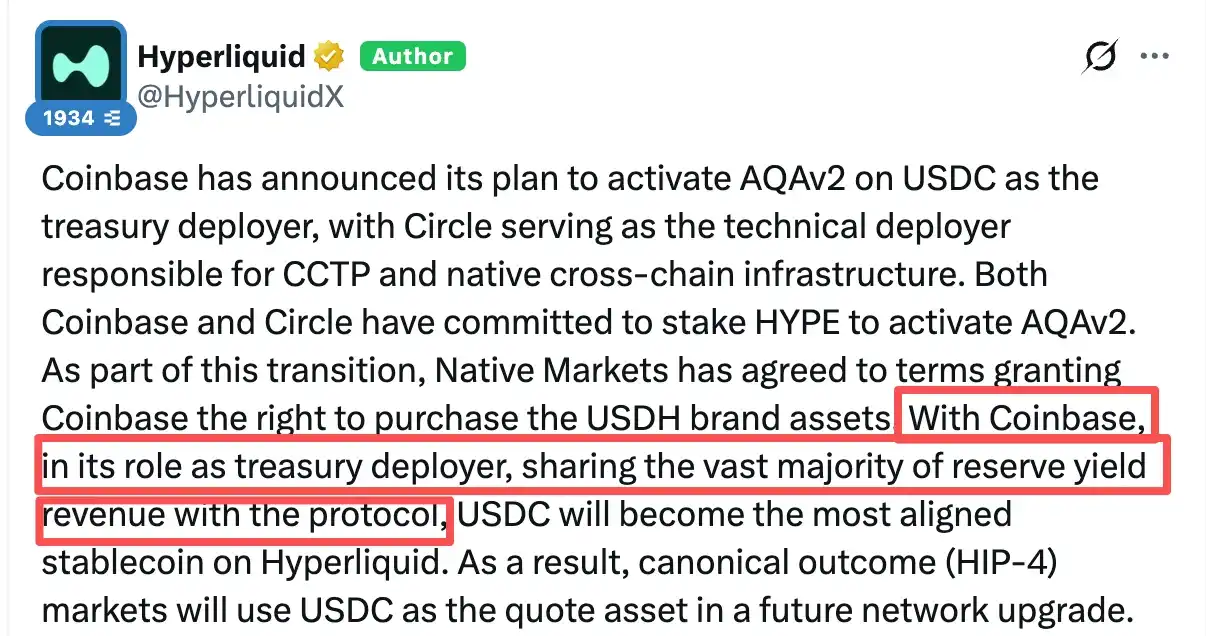
In addition, according to Hyperliquid's official announcement, Coinbase (the fund deployer) and Circle (responsible for the technical deployment of CCTP and native cross-chain infrastructure) have both committed to staking HYPE to activate AQAv2 (Aligned Quote Asset v2).
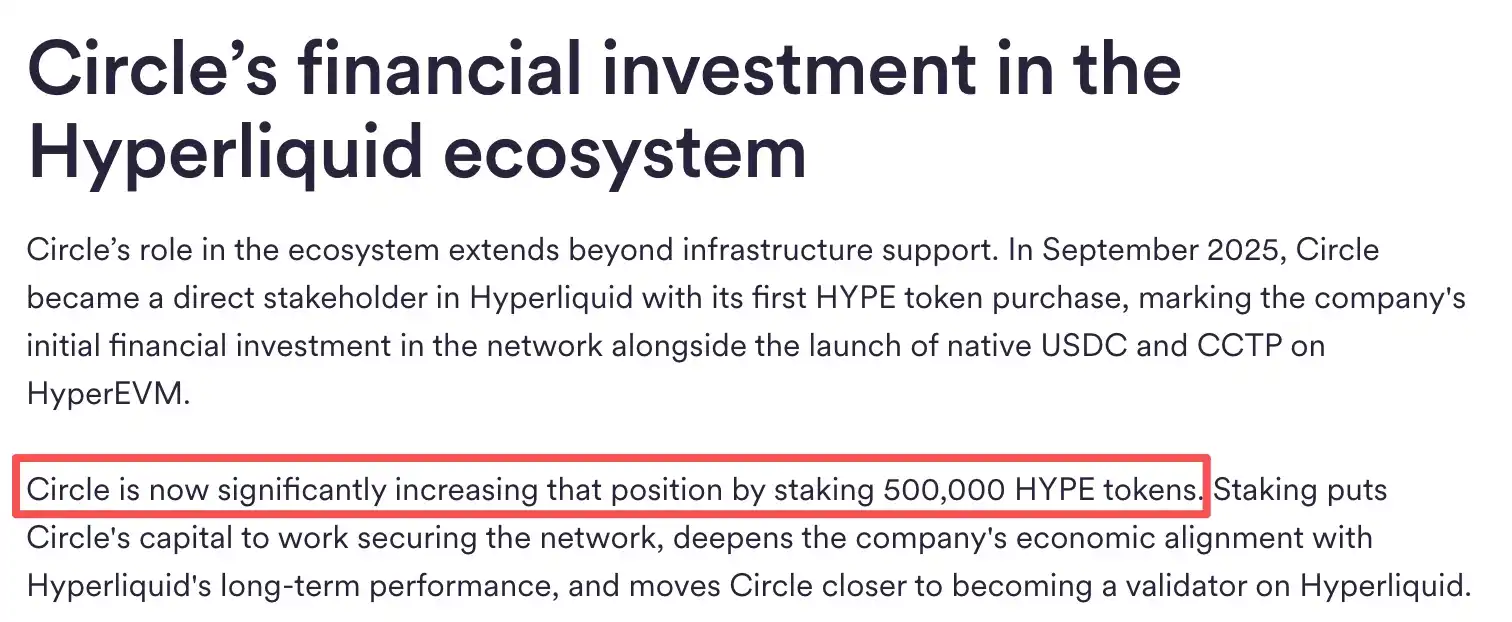
It's worth mentioning that Circle bought HYPE tokens last September, and its HYPE token staking has now increased to around 500,000 tokens.
Hyperliquid: Reaps the lion's share of USDC reserve gains and enjoys the benefits of being a Coinbase ally.
As for the biggest winner of this collaboration, it is undoubtedly Hyperliquid, which serves as the foundation of the ecosystem.
According to the official announcement, Coinbase will now share the vast majority of reserve revenue with the Hyperliquid protocol. While the specific revenue sharing ratio has not yet been announced, based on the previous USDH revenue sharing mechanism, Hyperliquid would effectively receive approximately 90% of the reserve revenue.
According to calculations by Hyperliquid community members, with a scale of $4.7 billion and a yield of 3.8%, this income corresponds to approximately $160 million; in other words, it corresponds to a daily buyback of $440,000 in HYPE tokens.
Furthermore, with the passage of the CLARITY Act by the U.S. Senate Banking Committee, the deep integration of Hyperliquid and Coinbase also means that HYPE and Hyperliquid have gained some support from U.S. regulators.
Native Markets: USDH's historical mission is complete.
As the issuer of Hyperliquid's native stablecoin USDH, Native Markets appears to be the biggest loser in this "acquisition incident," but judging from its official statement, its outcome can be considered a "successful retreat."
On the one hand, USDH provides an example and template for Coinbase and the Hyperliquid protocol to share USDC revenue; on the other hand, Coinbase has essentially acquired the brand assets related to USDH directly. The USDH stablecoin issued by the Native Markets team can be considered to have been "acquired by Coinbase," thereby giving the team a certain economic return.
Native Markets subsequently stated that it would remain independent and seek development in other areas.
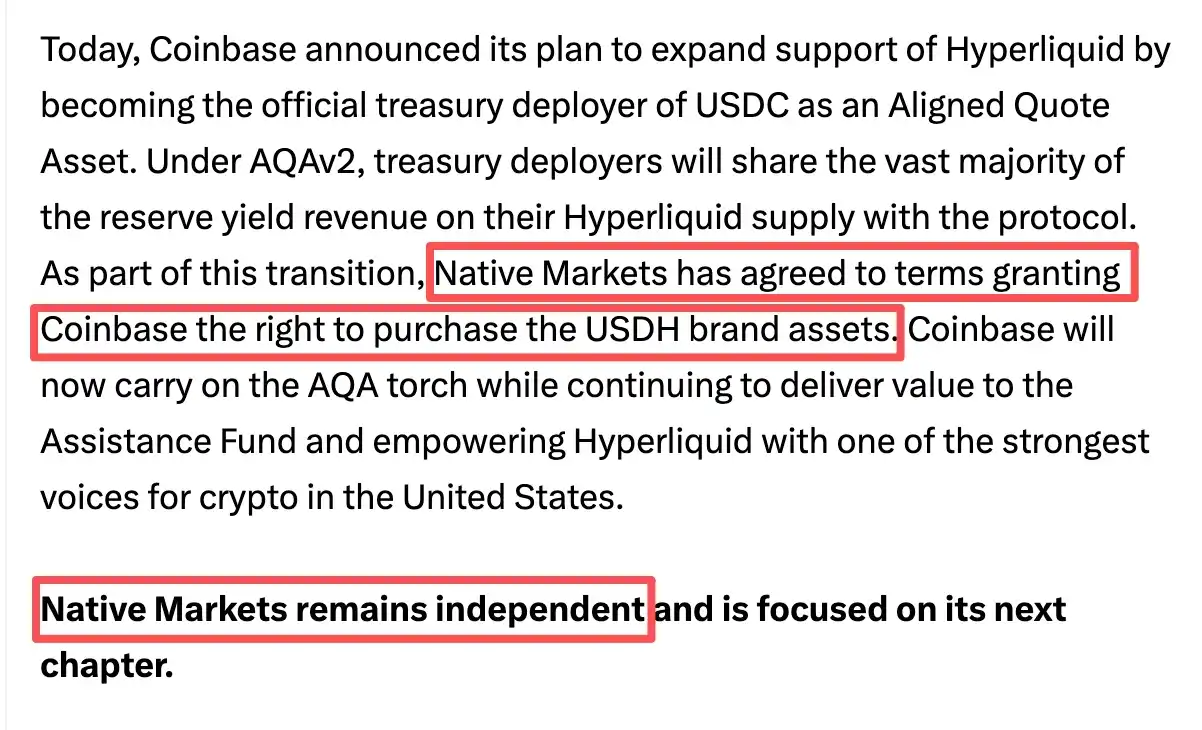
After USDH exits the market, in a win-win-win situation, only USDH users will suffer losses.
Of course, Native Markets' exit was not universally praised; Hyperliquid community users also expressed reservations about its claim of "going to the negotiating table."
Some believe that the exit of USDH signifies a complete regression in the era of decentralization.
Some have pointed out that the USDH stablecoin issuer vote should have gone to Paxos, as they were at least considering the interests of users and stablecoin growth, while those who voted for Native Markets were merely acting out of loyalty and internal interests. Ultimately, users gained nothing. These arguments have garnered considerable support.
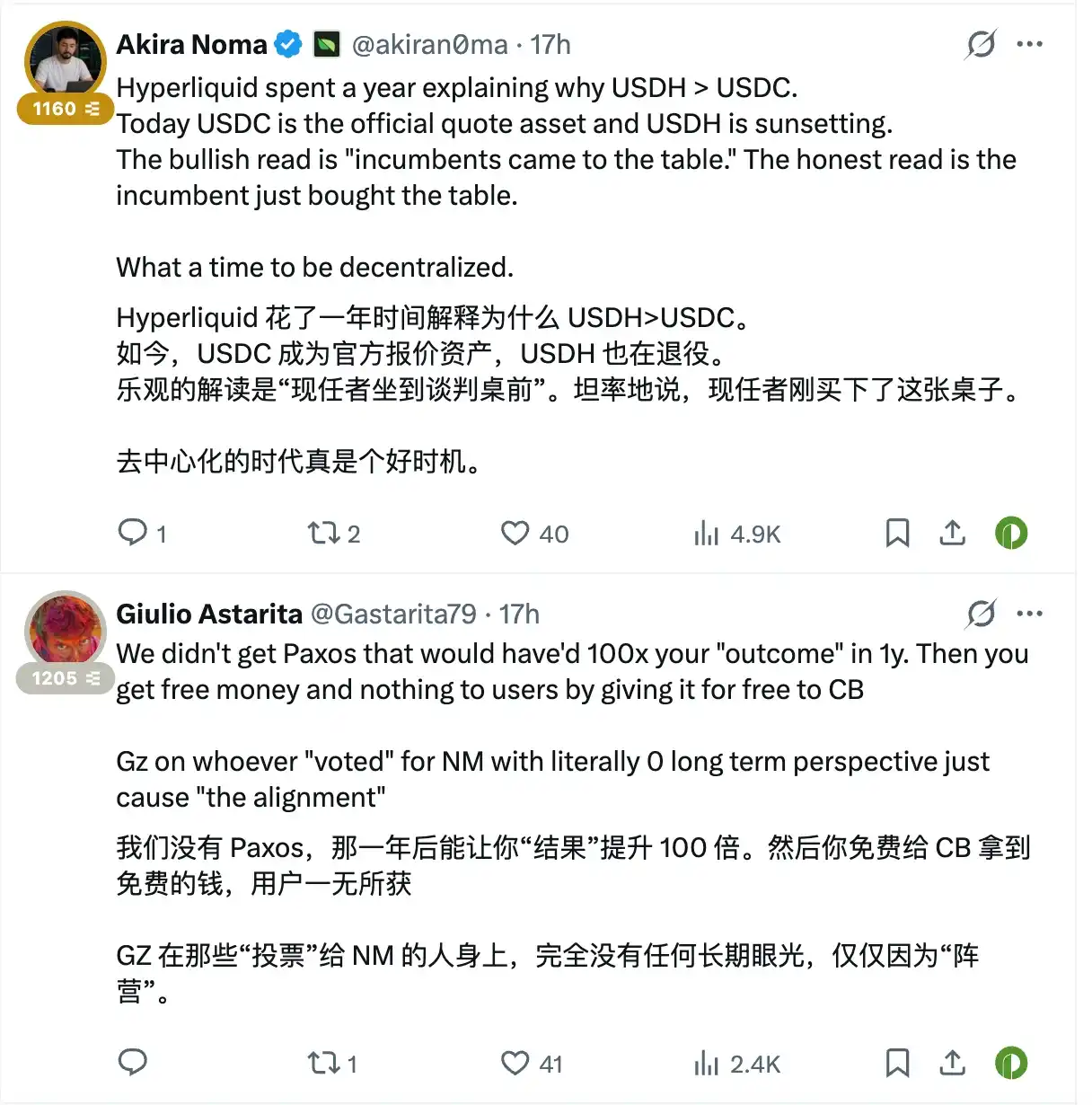
Thus, the drama of "CEO pursuing love" and "rebellion against the tycoon" from a year ago finally came to an end.
However, looking back at the scene of Hyperliquid "shaking hands and making peace" with Coinbase and Circle now, it is ultimately a bit sad and ironic.
It turns out that everything was just about the distribution of benefits, not about the slogans of "for the community" and "for Hyperliquid" that were once shouted.
Recommended reading
Hyperliquid's stablecoin USDH becomes a hot commodity in the industry, with industry giants launching a chaotic battle for distribution rights.
USDH voting in progress: "Preordained script," "CEO pursuing love," and "retreating gracefully" unfold in turn.