Author: 798.eth
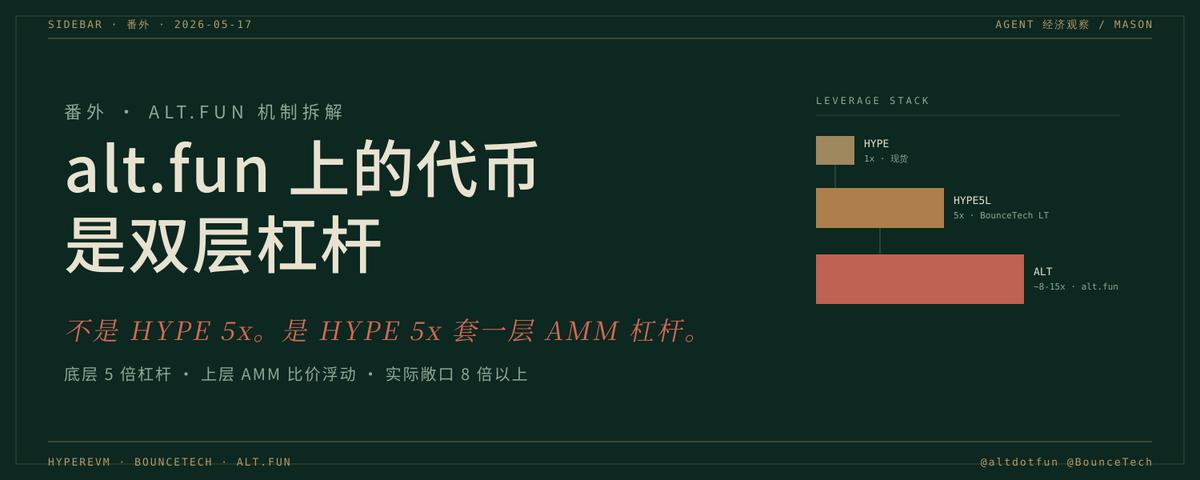
The alt tokens on alt.fun are not HYPE 5x leverage. They are HYPE 5x leverage with an additional layer of AMM leverage on top of that.
This isn't something you can see intuitively. Just look at the mechanism and you'll understand. Here's the current data for easy comparison.
HYPE spot price: 42.84 USDC.
HYPE5L (LT, a 5x long leveraged token issued by BounceTech) currently has a NAV of 0.870 USDC, a 13% decrease from its issue price of 1 USDC.
In the HyperSwap V2 pool of alt.fun's flagship token ALT, there are 18.58 million ALT and 129,400 HYPE5L. 1 ALT equals 0.00697 HYPE5L. The USDC price is 0.00606. The price of ALT in USDC is the product of the two tokens.
Note: After graduation, there will be no USDC in the pool; the paired asset will be HYPE5L LT. This is the starting point for all understanding.
The USDC price of ALT = the exchange rate of ALT to HYPE5L in the pool multiplied by the current NAV of HYPE5L.
The first factor is called AMM (Alternating Multiplier) price comparison. The less ALT and the more HYPE5L in the pool, the higher the price comparison, meaning ALT is more expensive. Conversely, it's cheaper. This factor is determined by the strength of buy and sell orders and is unrelated to the price of HYPE.
The second factor is called LT Net Asset Value. If HYPE rises by 1%, HYPE5L Net Asset Value rises by approximately 5%, and vice versa. This factor is determined by BounceTech's actual perp positions on Hyperliquid and is unrelated to alt.fun's trading activities.
The two factors are independent of each other. Multiplying them together gives the final USDC price of ALT.
Why does this constitute a double lever?
HYPE rose 1%.
The second tier (LT) was increased by 5%. HYPE5L net asset value increased by 5%.
The first layer (AMM) amplifies this effect. As HYPE5L rises, HYPE5L holders realize they are profiting, and some will buy more alt tokens on alt.fun (leveraged exposure plus alt story exposure). This purchase increases HYPE5L and decreases ALT in the pool, raising the AMM price ratio. The same 1% increase in HYPE is amplified again at the AMM layer.
Ultimately, the USDC price of ALT will likely increase by between 8% and 15%, depending on the depth of the AMM pool and the strength of buying pressure. However, it will always be greater than 5%.
The same logic applies when prices fall, but in reverse. HYPE drops 1%, HYPE5L drops 5%, and ALT holders find their losses amplified. Some start selling ALT to exchange for HYPE5L in an attempt to redeem. This selling pressure pushes down the AMM price ratio, and the USDC price of ALT is likely to fall by 8% to 15%.
There's also an asymmetric effect during price drops. The alt.fun docs themselves point out that large sell orders can revert due to the non-atomic path (the path where alt first converts to HYPE5L and then redeems to USDC; large orders can't withstand the LT redemption on the BounceTech side). This means that when the pool is thin, retail investors can't stop their losses. The first wave of sellers sells at a high price, the next sells at a low price, and those after that are stuck in the contracts and can't get out.
ALT, HBULL, HYPE Life, BALD, and HLC—these five HYPE5L-backed alt tokens are now graduated. Every transaction they make on HyperSwap V2 affects the AMM price comparison. Simultaneously, the HYPE price influences the HYPE5L net asset value. These two layers are overlapping.
HYPE5L is a leveraged LT (Limited Time) product issued by BounceTech. Theoretically, it offers 5x exposure, but in practice, frequent rebalancing triggers result in volatility loss. In volatile markets, the actual exposure is less than 5x, while in trending markets it is more than 5x.
So when you open the alt.fun UI and see an alt token labeled "HYPE 5x Long," the USDC price displayed on the UI is actually the result of the HYPE price being amplified 5x by BounceTech and then amplified again by HyperSwap V2 AMM. You think you're buying 5x exposure to HYPE, but you're actually buying 8 to 15x floating exposure.
When prices rise, this floating exposure allows you to earn more than 5 times your initial investment; when prices fall, it allows you to lose more than 5 times your initial investment. That's the whole meaning of double leverage.
Comparing it with pump.fun will make it clearer.
The token pairing asset on pump.fun is SOL. SOL is a 1x exposure spot token. If SOL drops by 10%, the USDC price of the pump.fun token drops by 10%, plus the selling pressure from the AMM, resulting in a drop of approximately 15% to 25%. The AMM acts as an amplifier, but does not have underlying leverage.
The token pairing asset on alt.fun is HYPE5L. HYPE5L is already a derivative with 5x leverage. If HYPE drops 10%, HYPE5L drops 50%, and the USDC price of alt token drops 50%, plus the selling pressure from the AMM, the total drop is approximately 60% to 80%. The AMM acts as an amplifier, and the underlying asset already has 5x leverage.
Both use launchpads and AMM pairings, but alt.fun's overall risk profile is drastically different simply because it changed the quote asset. This difference is not explicitly highlighted in alt.fun's UI.
The last sentence is for retail investors.
You click on alt.fun and see a token labeled "HYPE 5x Long," and intuitively assume it's a 5x leveraged exposure to HYPE. That intuition is wrong.
The underlying leverage is 5x. The AMM layer adds another 1 to 2x floating exposure. In a trending market, you'll outperform 5x significantly. In a range-bound market, volatility loss will wipe you out. During a crash, large sell orders become unsellable; those who exit first sell at higher prices, while those who exit later are stuck with their contracts.
This is not HYPE 5x long. It is a second-order product of HYPE 5x long with an AMM leverage layer.
This is not investment advice; I just want to think things through.