In just two months, CBRS yielded over 300% from subscription to spot trading. Are Anthropic and Polymarket, which are following suit, worth participating in?
Article author and source: MSX
The pre-IPO sector is entering the second half of its journey: realizing profits and verifying the closed loop.
Last week, MSX's first Pre-IPO project, Cerebras (CBRS), completed the only closed-loop verification in the industry to date: a complete closed loop from Pre-IPO subscription, IPO listing to spot trading. Based on the initial subscription price of 100.35 USDT and the high point on the first day of listing, the overall return rate of participating users once exceeded 300%.
New targets followed immediately.
On May 16, 2026, MSX Pre-IPO Phase 2 (https://msx.com/ipo?tab=2) officially opened for subscription, with Anthropic and Polymarket as the targets. The subscription price for Anthropic was 855 USDT, corresponding to a valuation of $950 billion; the subscription price for Polymarket was 152 USDT, corresponding to a valuation of $15 billion.
This is not an ordinary asset listing. For users who participated in the first Pre-IPO, CBRS.M, a successful example that went from subscription to listing and trading in just over two months, provides a clearer benchmark for subsequent Pre-IPO projects.
In particular, Anthropic and Polymarket, two new targets, have experienced valuation leaps of 10 times or even higher in the past year. They respectively represent the most watched productivity entry point in the AI era and the event pricing infrastructure in the prediction market. Are they worth participating in?
I. Pre-IPO: Completion of the first "full-process closed-loop" verification
In recent times, pre-IPO assets have become a new asset class that is visibly competing for between on-chain US stocks and crypto trading platforms.
From SpaceX, OpenAI, and Anthropic to Cerebras and Polymarket, leading unlisted companies have long been core targets for various platforms to cover. The AI, aerospace, defense technology, and prediction markets they represent are areas of greatest interest to global capital and represent high-quality assets that ordinary investors have long found difficult to access directly.
This is not hard to understand.
In traditional financial markets, the early-stage shares of leading unlisted technology companies like Anthropic and SpaceX are often snapped up by primary market funds and large institutions. Even if ordinary investors understand the trend, it is difficult to obtain the corresponding entry point. They can only participate when the company goes public or during the IPO stage. However, by this stage, the company's valuation has usually been adjusted upwards multiple times, and the investment dividend has been greatly reduced.
Therefore, in the past two months, starting with MSX's launch of its Pre-IPO product in early March, almost all mainstream trading platforms have begun to cover popular unlisted companies with their products. Although the implementation logic of these products is not exactly the same, they are all essentially aimed at meeting users' demand for "entry points to high-quality early-stage assets".
However, as more and more platforms enter the Pre-IPO stage, the focus of competition has also begun to change.
The first half was about who could cover popular names faster, but the second half is about who can provide a clearer and more complete product chain. Although users can complete the subscription with a relatively low threshold, can the target really be smoothly connected to spot trading after listing? In particular, are the exit and settlement paths clear, and does the platform have real cases to verify this?
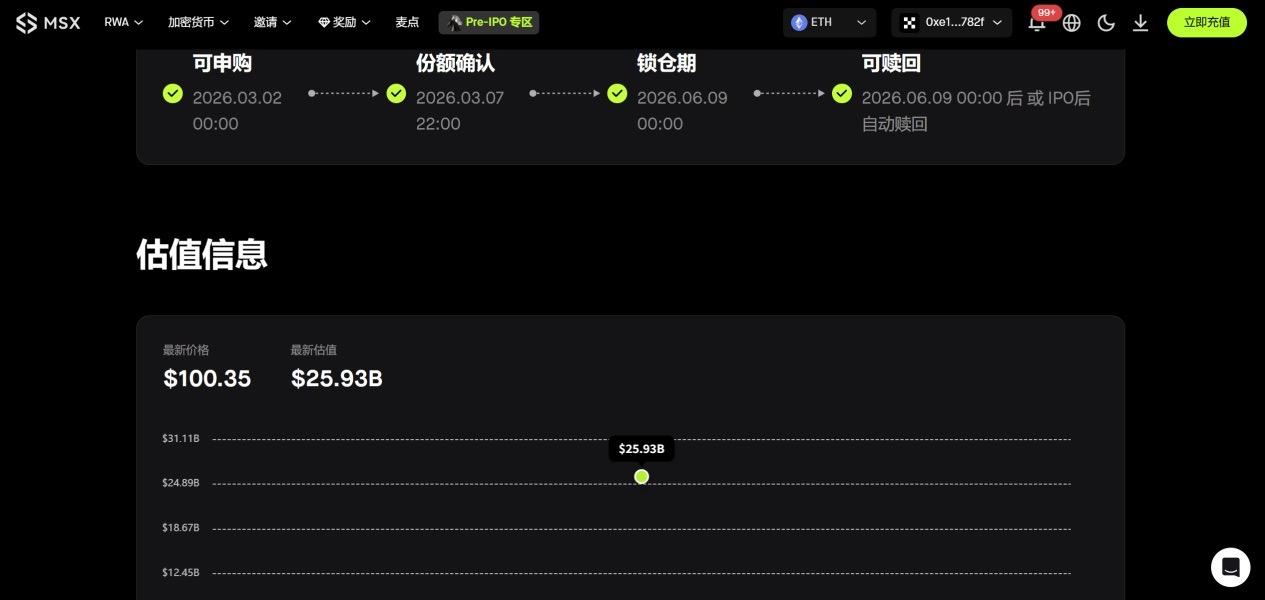
Until last week, the emergence of CBRS.M provided a concrete and referable sample at this juncture.
After the MSX Metcoin first pre-IPO offering began on March 2, participating users subscribed to CBRS pre-IPO shares at a price of 100.35U. Simultaneously with Cerebras' listing on Nasdaq, the MSX platform also launched spot trading of CBRS.M on the same day. This provided pre-IPO users with a path for subsequent trading and exit. Based on the high point of the first day of listing, the overall return for participating users once exceeded 300%.
This means that MSX Pre-IPO Phase 1 is not just validating the ability to select a single project, but rather a complete product mechanism covering subscription, holding, listing, spot trading, and stablecoin settlement, all of which are integrated into an executable chain.
More importantly, this sample only existed for a short period of time: from the first round of subscriptions to Cerebras' listing, it was only a little over two months. The Alpha effect was quickly amplified by the market. It was precisely because of this sample that the launch of Anthropic and Polymarket was not just "two more hot stocks," but more like the beginning of the continuous realization of pre-IPO dividends.
II. Anthropic and Polymarket: Two Rising Stars with Soaring Valuations
The most noteworthy aspect of MSX's Pre-IPO Phase 2 (https://msx.com/ipo?tab=2) is that Anthropic and Polymarket represent two highly representative asset classes.
Anthropic corresponds to the productivity gateway in the AI era, while Polymarket corresponds to the prediction market and event pricing infrastructure. These are currently the hottest sectors in the "Internet" and "Web3" industries, respectively.
In particular, both companies have experienced significant valuation leaps in the past year, which is the most interesting aspect of placing them in the same pre-IPO period.
1. Anthropic: From $61.5 billion to nearly $1 trillion in 15 months
First up is the well-known Anthropic.
Beyond the imaginative AI business models brought by Claude Code, Anthropic's popularity in the capital market over the past year has largely stemmed from its extremely rapid valuation leap; if you only look at the numbers, it's a very steep curve:
- In March 2025, Anthropic announced the completion of a $3.5 billion funding round, valuing the company at $61.5 billion post-money.
- In September 2025, its valuation rose to $183 billion;
- In February 2026, it completed another $30 billion financing round, reaching a valuation of $380 billion;
- According to the latest reports from Bloomberg and other media outlets, it is currently undergoing a new round of financing exceeding $900 billion.
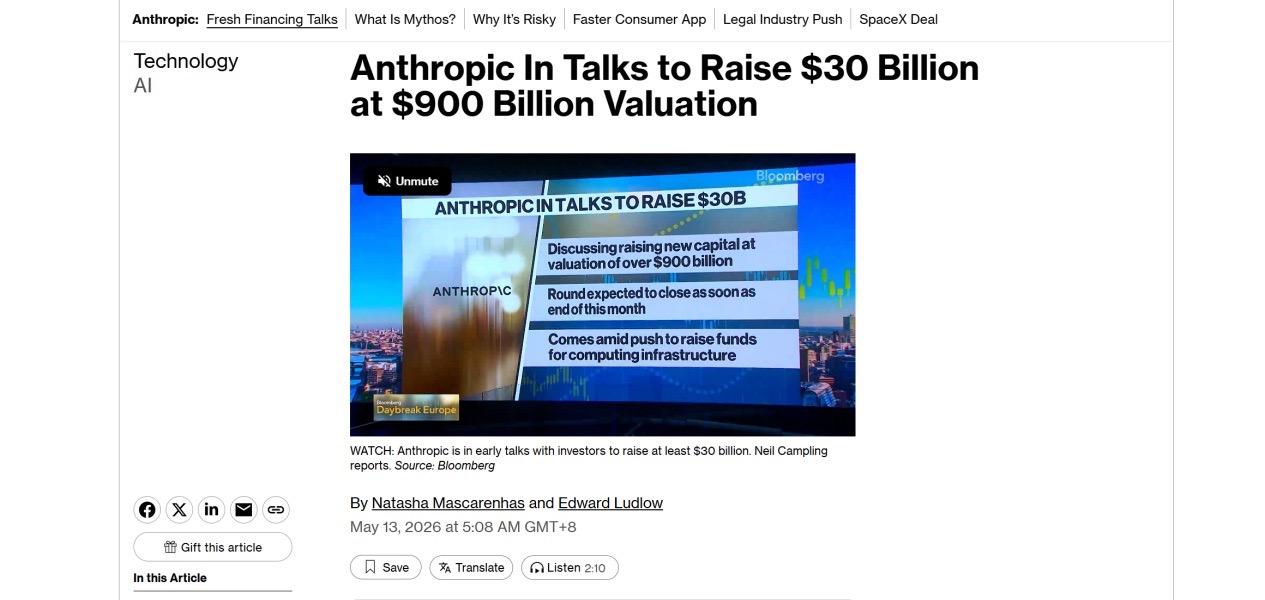
In other words, in 14 months, Anthropic's valuation went from $61.5 billion to nearly $1 trillion, a valuation increase of about 15 times. Even in the most aggressive AI cycle in the primary market, this curve is an extreme example.
Behind this is not just the enthusiasm of capital chasing AI, but a change in the pricing logic of the AI industry. As we all know, the market initially focused on model capabilities, then on computing power reserves, engineering efficiency, and commercialization speed, and the next stage's more core variable is whether the model can truly enter enterprise workflows and become part of the productivity infrastructure.
For example, Claude's biggest advantage is that it is no longer just a chat tool, but is entering the fields of code processing, enterprise collaboration, and intelligent agent execution. In particular, the growth of products such as Claude Code has extended Anthropic's potential from general AI applications to developer productivity and enterprise software infrastructure.
In other words, Anthropic's valuation potential doesn't just stem from the fact that "Claude is very useful," but from its potential to become a key productivity gateway in the AI-native era. This is also one of the core reasons for choosing Anthropic in this Pre-IPO round: it occupies the most central position in the AI application layer, while possessing strong product appeal, strong user growth, strong enterprise scenario penetration, and strong capital attention.
Of course, Anthropic is a typical high-certainty, high-attention, and high-valuation stock. The key is not just to look at the current valuation, but to see if it is still on the main line of long-term capital narrative and industrial expansion . Especially at the point where it is only one step away from a trillion-dollar valuation, whether it goes to IPO, M&A, or continues to remain in private equity, Anthropic's current valuation level may become an important reference anchor for the market to look back on repeatedly.
2. Polymarket: Prediction markets are evolving from crypto applications to information pricing layers.
Compared to Anthropic, Polymarket's story leans more towards crypto natives, but its potential extends beyond the crypto industry.
Polymarket's core application scenario is to allow users to express their judgments on the outcomes of real-world events through market prices. For example, political elections, macroeconomic policies, sporting events, geopolitical conflicts, technology product launches, and regulatory outcomes can all be converted into tradable probabilities.
This differs from stocks, bonds, and commodities in traditional financial markets. In the past, the market understood real-world events primarily through media reports or polls/research reports. However, this information is often lagging, biased, or noisy. The unique aspect of the prediction market is that it allows different participants to directly translate their judgments into prices, forming a real-time, changing probability signal.
It's worth noting that, like Anthropic, it also experienced a rapid leap in valuation:
- In 2024, Polymarket completed a $70 million funding round;
- In June 2025, it completed a $200 million funding round, valuing the company at over $1 billion.
- In October 2025, ICE, the parent company of the NYSE, will invest up to $2 billion, corresponding to a valuation of approximately $8 billion.
- In April 2026, Reuters, citing The Information, reported that Polymarket was in talks for a $400 million funding round, valuing the company at approximately $15 billion.
In other words, in less than a year, Polymarket's valuation jumped from the $1 billion level to the $15 billion level. Compared to traditional crypto applications, this is no longer just a story of transaction volume or user growth, but a process of repricing the prediction market as a new type of information infrastructure.
This is why Polymarket has received continuous attention over the past few years. It is both a native Crypto application and naturally connected to real-world events. As the market continues to expand, Polymarket has the opportunity to evolve from a crypto application into a pricing infrastructure for real-world events.
Therefore, although Anthropic and Polymarket are in different industries, they have become some of the most representative leading assets in their respective fields, and have experienced extremely rapid valuation leaps in the past year. This is the underlying logic behind MSX Pre-IPO Phase II listing the two side by side.
Third, Pre-IPO is not just about having an entrance, but also an exit.
Returning to the Cerebras case, it is worth mentioning again before the launch of the second phase, not because every pre-IPO project can replicate the short-term gains of CBRS.M, but because it verifies the most fundamental question of pre-IPO products: whether a closed loop from subscription to exit can be completed.
After all, the low-threshold entry point provided by Pre-IPO is very helpful for users, but whether they can guarantee the completion of the exit loop from subscription to withdrawal is more crucial.
The complete chain of CBRS.M proves that MSX Pre-IPO is not simply about providing a "concept share," but rather about establishing a feasible product mechanism around subscription, holding, listing, spot trading, and stablecoin settlement. Users can choose to continue holding the asset after it is listed, or they can exit through the spot market.
This is also the key difference between Pre-IPO products and simple synthetic assets or price speculation. It provides users with a clear and actionable path when the underlying asset is listed, converted, or redeemed. For example, MSX Maitong Pre-IPO Phase II continues with a relatively clear exit arrangement—according to the product rules, in addition to participating in the subscription, users can pay attention to two key milestones:
- Firstly, if the target company subsequently completes an IPO, it will enter the automatic redemption/conversion process after the IPO in accordance with the platform's rules;
- Secondly, if the target has not yet been IPO'd, users can also apply for redemption after 00:00 on August 20, 2026, according to the platform rules (the specific implementation method is subject to the rules on the MSX platform page).
The significance of this design lies in the fact that it does not just give users a "buy story", but incorporates the subsequent exit path into the product structure from the very beginning of the subscription. For assets like Pre-IPO, which naturally have a longer cycle and higher information uncertainty, clear redemption and conversion rules are an important part of users' judgment of the platform's credibility.
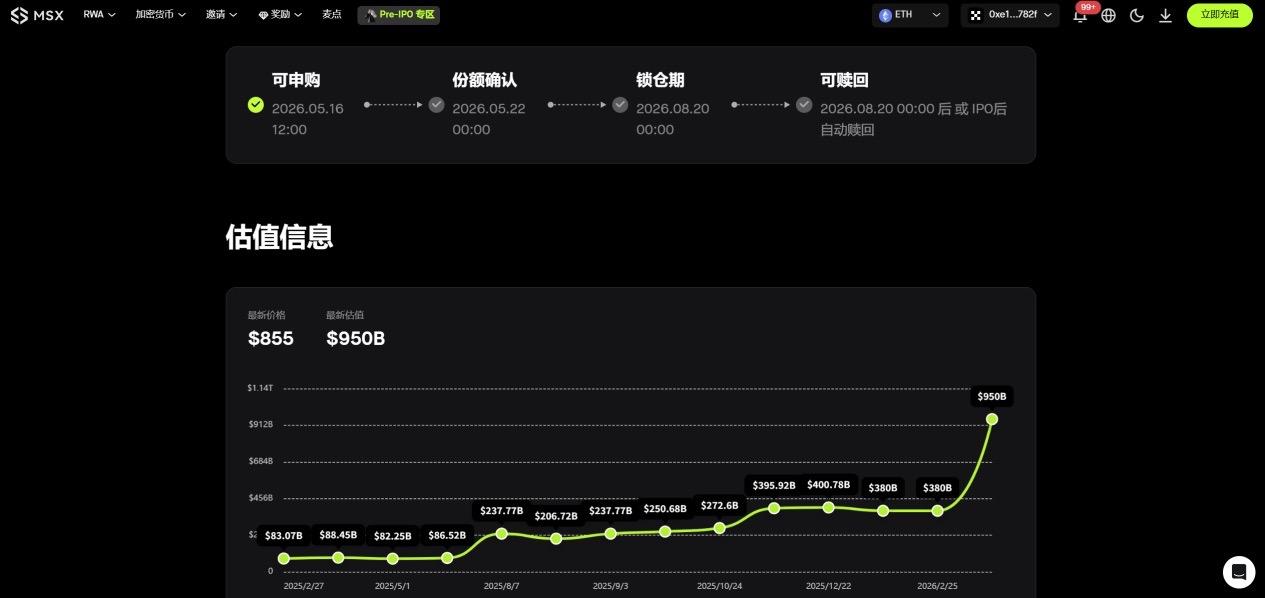
From this perspective, the Alpha effect of CBRS.M is not an isolated event, but an external validation of the pre-IPO product capabilities of the entire industry. Therefore, Anthropic and Polymarket in Maitong's second pre-IPO phase aim to further expand the boundaries of this asset on this basis: from AI chip infrastructure to AI application entry points and prediction market infrastructure.
Objectively speaking, when high-quality assets, clear exit paths, and stablecoin trading experiences are combined, Pre-IPO has the potential to become an important incremental entry point for the on-chain US stock market ecosystem. After all, it can not only meet users' needs to participate in early-stage high-quality assets, but also enrich the asset tiers of the RWA trading platform.
More notably, MSX Pre-IPO Phase 2 not only launched two highly anticipated stocks, Anthropic and Polymarket, but also offered attractive prices and valuations.
Based on the current market offerings of similar pre-IPO assets, Anthropic and Polymarket have become popular unlisted assets that multiple platforms are vying to cover. However, there are significant differences in the pricing, trading methods, and underlying structures among different platforms. Some platforms offer spot trading, while others provide price exposure in the form of synthetic assets or perpetual contracts. When users actually participate, they see not only "whether this asset exists" but also "at what price to participate."
In this regard, MSX's second phase of offerings included Anthropic at a subscription price of 855 USD, corresponding to a platform valuation of $950 billion for this phase; and Polymarket at a subscription price of 152 USD, corresponding to a platform valuation of $15 billion for this phase. Compared to the pricing and valuation benchmarks of some similar platforms in the market, MSX's subscription prices for both assets are in a relatively lower range , still providing users with relatively more attractive entry prices and a clear product structure. For pre-IPO assets, which are inherently highly volatile, highly watched, and highly valued, the entry price itself directly affects the subsequent risk-reward ratio.
Overall, Cerebras has enabled the first truly meaningful validation of on-chain pre-IPO.
It proves not only the selection of a single target, but also the feasibility of the entire product mechanism. From subscription, holding, listing, spot trading to final stablecoin settlement, this chain was successfully implemented for the first time in the scenario of a top-tier tech stock IPO. It also allows everyone to intuitively feel for the first time that once early-stage high-quality asset entry points like Cerebras are on-chain, their yield elasticity and potential are no less than any native on-chain asset.
However, what truly determines the long-term value of Pre-IPO is never the short-term performance of a particular project, but rather the platform's ability to continuously identify high-quality targets that are representative of the times and transform them into product entry points for ordinary users to participate in.
This is harder to replicate than 300%, and more noteworthy than any single profit figure.
The arrival of Anthropic and Polymarket represents MSX's second pre-IPO offering, and its ability to withstand scrutiny has been nearly perfect.
The answer is left to the market.