Original article by Odaily Odaily(@OdailyChina)
Author|Golem (@web3_golem)
Last week, a new meme issuance platform called alt.fun in the Hyperliquid ecosystem attracted a large number of meme users. Within just one week of its launch, its flagship token, ALT, reached a market capitalization of $8.8 million, but the price has since fallen back, with the market capitalization remaining around $6.7 million.
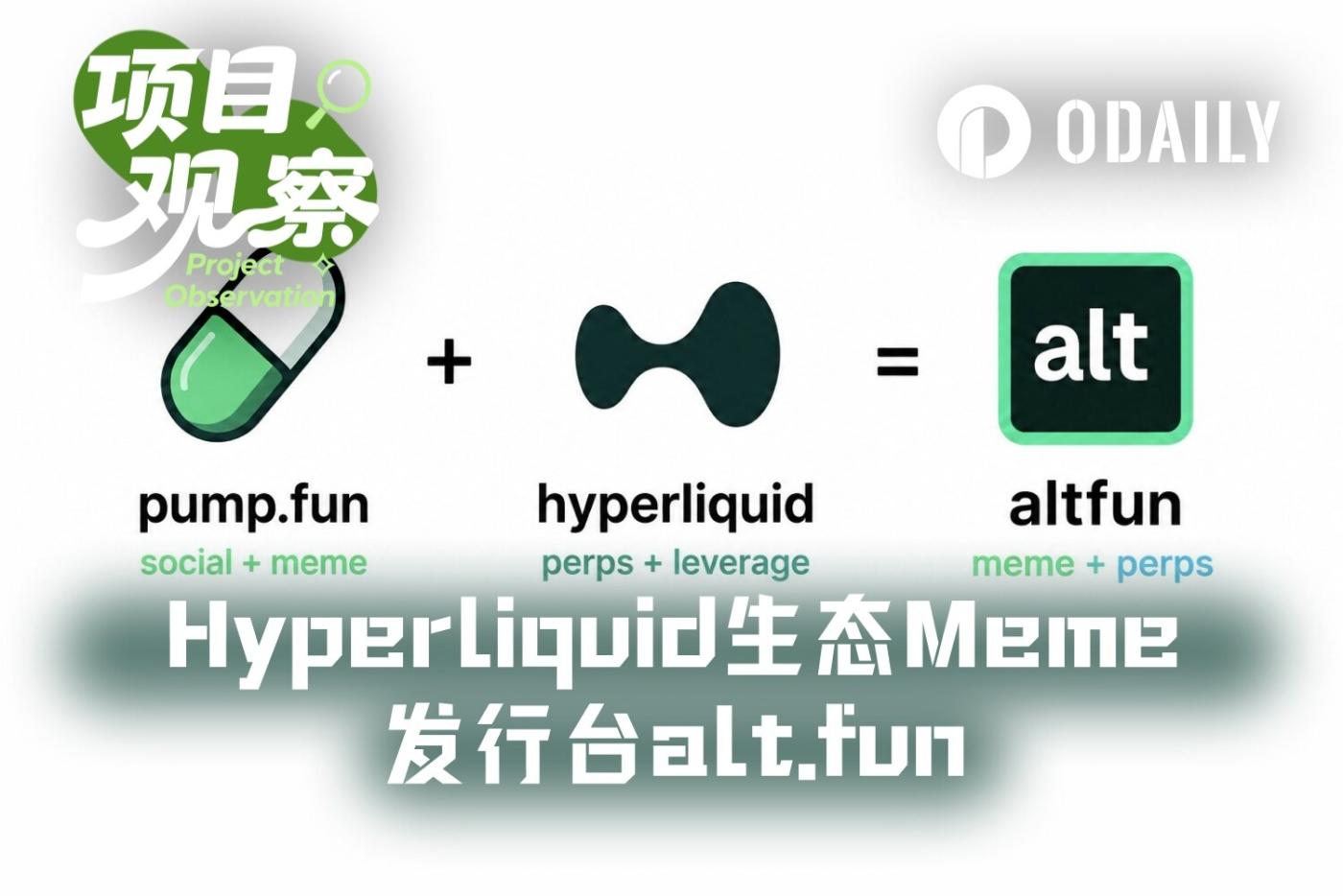
The novelty of alt.fun can be understood as a combination of Pump.fun and HyperLiquid, where users can experience the dual thrill of playing memes and opening contracts at the same time.
Introduction to the alt.fun platform mechanism
Specifically, each Meme token issued on alt.fun has a corresponding contract position matched on Hyperliquid.
Similar to Pump.fun, any user can issue Meme tokens on HyperEVM with a single click through the alt.fun platform. The token price is still affected by the bonding curve. The total supply of Meme tokens created is $1 billion. Once 75% of the tokens have been sold, the tokens successfully "graduate" and are migrated to the HyperSwap V2 liquidity pool.
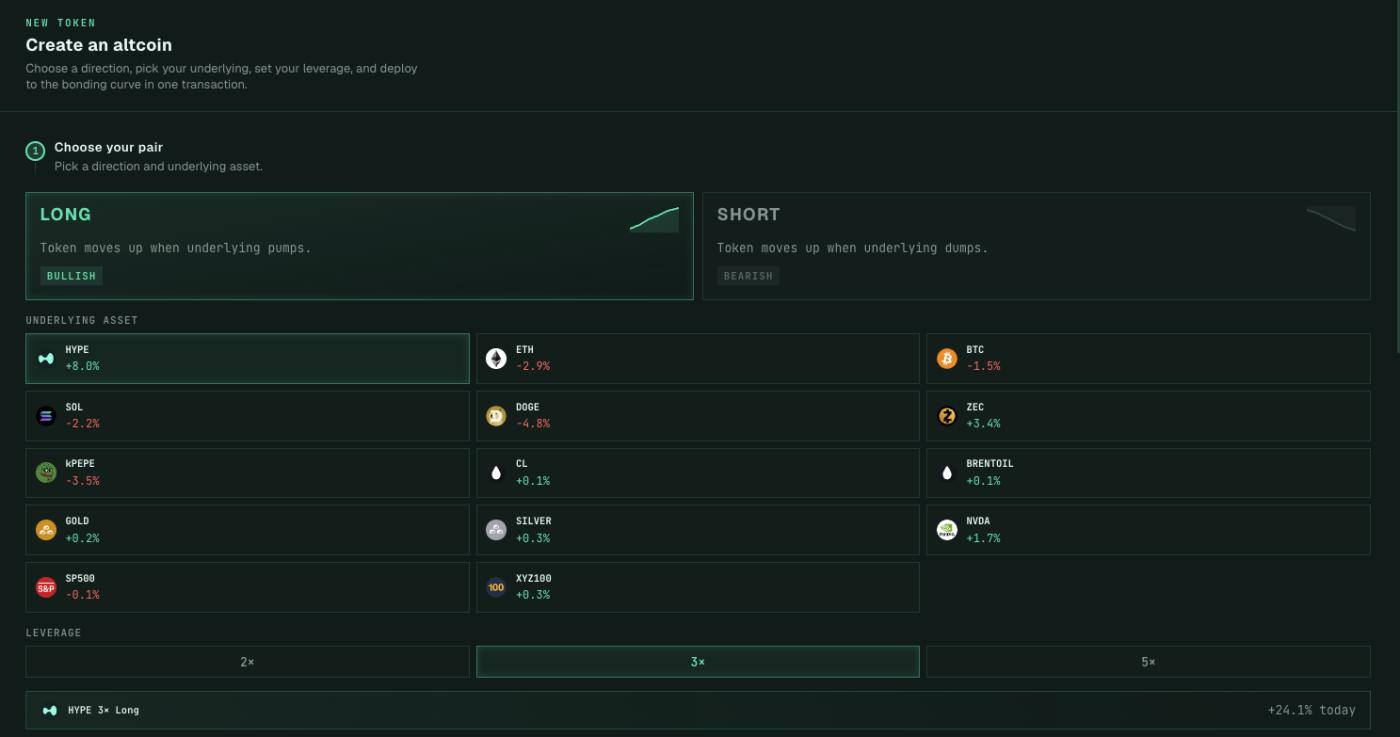
The difference between alt.fun and Pump.fun is that when creating a token on alt.fun, users need to choose an underlying asset and short/ long with a limited leverage ratio (2/3/5x). At the same time as token creation, the platform mints a corresponding number of leveraged tokens (LT) on BounceTech (Odaily note: a permissionless leveraged token platform on Hyperliquid) and sends them to the user. These leveraged tokens correspond to the perpetual contract position established on Hyperliquid. For example, if a user chooses to create a token based on a 3x long in HYPE, what they receive is essentially a leveraged token tracking the returns of a 3x long in HYPE.
As shown in the image below, users can currently choose 14 underlying assets when creating tokens on alt.fun. Similarly, when a player buys Meme tokens on the platform, the platform will also mint corresponding leveraged tokens on BounceTech. If a player sells, this process will be reversed, the leveraged tokens will be redeemed, and the user will receive the corresponding USDC.
This model , which packages leveraged tokens as underlying assets and then sells them , is similar to the securitization of specific risk exposures in traditional finance, such as futures, options, and other derivatives, like 3x short of Nasdaq ETFs or 5x short of crude oil products. The alt.fun platform acts as an asset management company in this process, managing the long-term positions behind the leveraged tokens for users.
The price of these financial products is primarily driven by net asset value. However, since the price of tokens issued on the alt.fun platform is also affected by the bonding curve mechanism of Meme coins, the graduation mode and price-driving methods of Meme coins on this platform are not singular.
Dual Graduation Model and Price-Driven Approach
This means that the price of tokens on the alt.fun platform is influenced by two factors: market sentiment and the performance of the underlying assets. So now you might understand what alt.fun's slogan, "Your token pumps even when nobody's buying," means.
If a user creates a token based on a 3x long in HYPE and invests an initial amount of $20 (the platform's minimum purchase amount), and HYPE subsequently rises by 10%, then even if no one buys the token, the user's holding value will increase by 30% to $26.
Based on a dual-driven price mechanism, the alt.fun platform's token graduation mode is not limited to one method. Specifically, its token graduation condition requires a market capitalization of $9,000. This essentially calculates the value of leveraged tokens. Besides graduating by purchasing tokens, tokens can also graduate successfully if their market capitalization reaches $9,000 due to the rise in the underlying assets. Therefore, whether a token can reach the graduation threshold is often the result of a combination of two price mechanisms.
Ideally, a rise in the underlying asset would drive up the leveraged token's price, and combined with positive sentiment in the meme market, the token might experience a dramatic upward spiral. However, if the underlying asset falls, the leveraged token's value would continuously shrink, potentially triggering a panic sell-off and causing the token's price to collapse instantly.
Therefore, while alt.fun's mechanism can effectively leverage its power, this only works in trending markets and requires users to accurately time the trend . If the underlying asset experiences volatility, users will also suffer from leverage decay losses. This is because when the underlying asset price fluctuates, the platform needs to "rebalance" to manage positions to avoid liquidation. This means that even if the underlying asset falls and then rises back, the leveraged tokens will be depreciated due to forced liquidation during the decline.
Even if a sudden price spike occurs, the platform may not be able to react in time, causing the value of leveraged tokens to drop to zero.
Meme or not Meme
The alt.fun platform currently has 41 graduated tokens, with only two having a market capitalization exceeding one million: ALT (based on a 5x long in HYPE) and STONKS (based on a 5x long in the S&P 500). It has approximately 1,000 users. Although alt.fun is still in its early stages, we can already see its current development bottlenecks.
First, the platform has too few underlying assets. Based on the current 14 underlying assets, there can only be a maximum of 84 different combinations of leveraged tokens. alt.fun already offers leveraged tokens that short/ long the underlying assets at the same leverage ratio. For example, the highest leveraged ALT token is based on a 5x long in HYPE, while another token with a market capitalization of ATH is also based on a 5x long in HYPE. The two are identical except for their token names and creation dates. Given this, why wouldn't investors buy the lower-valued ATH?
While alt.fun may support more underlying assets in the future, its core problem is its inability to build consensus within the Meme coin community .
The reason why investors choose to buy leveraged tokens on the alt.fun platform instead of opening leverage on Hyperliquid themselves is essentially to obtain greater price leverage. Furthermore, because the platform rebalances and manages users' positions in the backend, individual users can act as "hands-off managers" without worrying about individual liquidation risks.
However, this is also the problem. Investors buy an alt.fun token based on their expectations for the future price of its underlying asset, rather than on narratives, market dynamics, or attention. These "meaningless things" are precisely the core value that supports a meme. A meme's rise or market recognition is often not due to any actual value support or financial design, but more importantly, its community dissemination attributes.
As a meme enthusiast, I find it difficult to develop the same passion for a leveraged token as I do for a particular meme's community culture. If one truly has faith in the underlying assets of a leveraged token, it's better to issue one's own leveraged token rather than buying an existing one and incurring unnecessary premiums.
Therefore, while alt.fun's mechanism may seem novel, I see it as merely a mechanical innovation. If alt.fun focuses on developing into a DeFi platform, it might have a chance in the future; however, if it chooses to force its way into the meme issuance platform arena, it's destined to be short-lived.