Author: Claude, TechFlow TechFlow
TechFlow Dive: Bitcoin fell below $77,000 on Monday, returning to its May 1st opening level, erasing half a month's gains within 48 hours. A confluence of triggering factors: US April PPI surged 6% year-on-year, hitting a three-year high; Bitcoin spot ETFs saw net outflows exceeding $1 billion in a single week, ending six consecutive weeks of inflows; and the crypto market experienced $657 million in liquidations within 24 hours. While retail investors panicked and fled, Strategy& bucked the trend, investing $2 billion to add nearly 25,000 BTC, while Goldman Sachs liquidated all its XRP and Solana ETF holdings in Q1, cut 70% of its Ethereum exposure, and retained only a $700 million Bitcoin ETF. Institutional choices are becoming increasingly clear: either stay away from crypto, or stick only with Bitcoin.
Bitcoin fell as low as $76,551 in early Asian trading on Monday, its lowest level since May 1. According to a Bloomberg report on May 18, widespread risk aversion triggered by the Middle East situation prompted traders to drastically reduce their positions, resulting in nearly $500 million in liquidations in the crypto market within 15 minutes.
What does this price mean? On May 1st, Bitcoin opened at approximately $76,306. It then climbed above $82,000 over the next two weeks before falling for four consecutive trading days, erasing all of the month's gains. For traders who chased the rally mid-month, their profits turned into losses within 48 hours—a process that was almost too fast to react to.
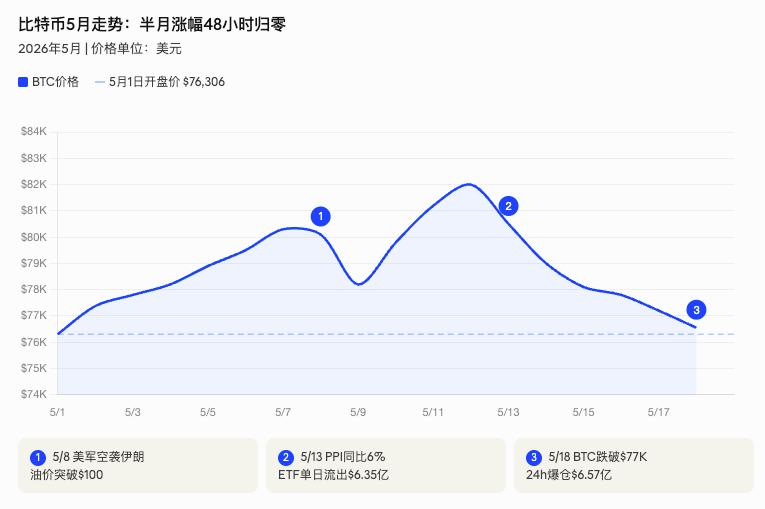
PPI rose 6% year-on-year, a three-year high, raising the probability of an interest rate hike to 39%.
The trigger for this round of sell-off was the release of the US Producer Price Index (PPI) for April on May 13. According to data from the US Bureau of Labor Statistics, the PPI rose 1.4% month-on-month, the largest monthly increase since March 2022; it surged 6% year-on-year, the highest level since December 2022, far exceeding the market expectation of 4.9%.
Energy prices are the main driver. Gasoline prices surged 15.6% month-on-month in April, while diesel prices rose 12.6%, indicating that the impact of the Iran war on the energy complex is being transmitted downstream along the supply chain. Even excluding food and energy, the core PPI still rose 1% month-on-month and 5.2% year-on-year, showing that price pressures are no longer limited to oil pumps.
Carl Weinberg, chief economist at High Frequency Economics, warned after the PPI report was released that the data would trigger alarms from both the Federal Reserve and financial markets. The CME FedWatch tool shows that the market has priced in a 25 basis point rate hike this year to about 39%, essentially ruling out a rate cut throughout the year.
Just one day before the PPI data was released, the April CPI rose to 3.8% year-on-year, the highest level since May 2023. According to CNN, several economists raised their May CPI forecasts after the PPI data release, predicting it would exceed 4%. The transmission of wholesale prices to the consumer end is accelerating.
Six weeks of ETF inflows ended, with a net outflow of over $1 billion in a single week.
Macroeconomic pressures quickly translated into institutional funding. According to SoSoValue data, in the week ending May 15, US Bitcoin spot ETFs recorded a net outflow of approximately $1 billion, ending six consecutive weeks of net inflows. A CoinShares report on May 18 showed that digital asset investment products as a whole experienced a net outflow of $1.07 billion, the third largest weekly outflow in 2026.
James Butterfill, head of research at CoinShares, said the shift "may reflect geopolitical risk aversion triggered by developments related to Iran."
The previous six weeks saw a total net inflow of approximately $3.4 billion, averaging about $568 million per week, with April alone seeing an inflow of $1.97 billion, the strongest monthly performance in 2026. This accumulation was reversed this week. On May 13, a single-day net outflow of $635 million occurred, marking the largest single-day drop of the week; on May 15, none of the 11 Bitcoin ETFs recorded positive inflows, with a further outflow of $290 million.
Ethereum spot ETFs also experienced their fifth consecutive day of decline, with a net outflow of $255 million for the week. As of the weekend, Bitcoin ETFs still saw a cumulative net inflow of $58.34 billion, with total assets under management of approximately $104.29 billion.
$657 million in margin calls, 89% of which were long positions.
While ETF funds fled, the derivatives market experienced a brutal shakeout of long positions. According to Coinglass data, the total liquidation amount in the crypto market reached $657 million in 24 hours, with long positions accounting for approximately 89%. Bitcoin.com reported that $584 million came from long positions, and the Fear & Greed Index plummeted from a neutral 50 a few days ago to 29, entering the fear zone.
The cascading effect of leveraged liquidations accelerated the decline. Bitcoin triggered a massive number of stop-loss and forced liquidations after breaking through key support, creating a spiral of "liquidation → sell-off → further liquidation." LMAX crypto strategist Joel Kruger described this process as "forced liquidation and position washing," pushing Bitcoin below key technical support levels.
Bitcoin is currently hovering between $76,000 and $76,800, with the 50-day moving average at around $76,716 providing short-term support and the 200-day moving average at around $83,513 providing resistance above.
Strategy added 20,000 BTC against the trend; Saylor doesn't rely on the same sentiment report.
While retail investors were facing margin calls and ETFs were bleeding money, Strategy (formerly MicroStrategy) took the opposite approach during the same period.
According to Strategy's 8-K filing with the SEC on May 18, the company purchased 24,869 bitcoins for approximately $2.01 billion between May 11 and 17, at an average price of $80,985. This transaction brought Strategy's total holdings to 843,738 BTC, with a total cost of approximately $63.87 billion and an average price of approximately $75,700. This round of purchases was primarily financed through the sale of STRC preferred stock.
Strategy also disclosed that its "BTC yield" (a metric that measures the growth of Bitcoin holdings relative to the number of diluted shares) has reached 12.6% since the beginning of 2026.
This isn't the first time Saylor has increased his holdings during market panic. Throughout 2026, Strategy maintained a buying pace of almost weekly or bi-weekly, regardless of market conditions. From January to May, the company increased its BTC holdings from approximately 560,000 to over 840,000, averaging nearly 60,000 new BTC per month. In the same week that everyone was focused on PPI and ETF outflow data, he spent another $2 billion buying.
Goldman Sachs liquidated its XRP and Solana ETF holdings in Q1, leaving only Bitcoin.
If Strategy's operations represent the stance of "Bitcoin extremists," then Goldman Sachs' Q1 13F holdings report presents a more representative institutional choice.
According to Goldman Sachs' latest Q1 2026 13F report, the bank completely liquidated all its XRP and Solana ETF holdings in the first quarter. At the end of the previous quarter, Goldman Sachs held approximately $154 million in XRP-related ETFs (issued by Bitwise, Franklin Templeton, Grayscale, and 21Shares, among others) and over $100 million in Solana-related ETFs. Both positions are now zero.
Ethereum ETF exposure was reduced by about 70%, from previous levels to about $114 million. Bitcoin ETF positions remained largely unchanged at about $700 million to $720 million, with only a slight reduction of about 10%.
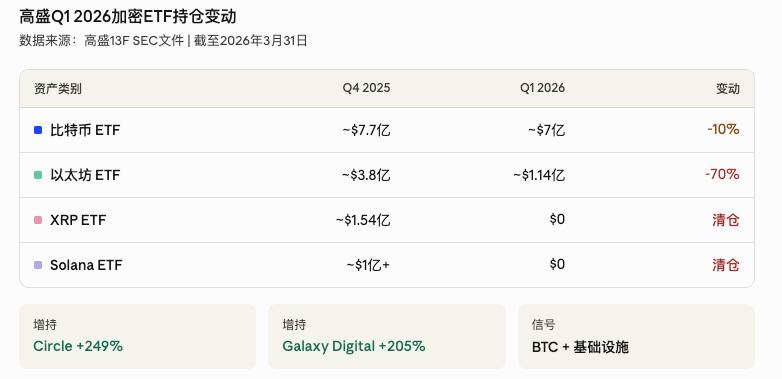
Meanwhile, Goldman Sachs increased its holdings in crypto infrastructure stocks: Circle increased by 249%, Galaxy Digital by 205%, and Coinbase also saw an increase. This series of actions sends a clear signal: Goldman Sachs is not exiting crypto, but rather narrowing its bets—shifting from a "wide net" approach back to a "BTC-only" strategy.
According to CCN, Harvard University's endowment fund also reduced its Bitcoin ETF holdings by 43% during the same period and completely exited the Ethereum ETF. Institutions are simultaneously consolidating their cryptocurrency exposure across different instruments.