Author: David, TechFlow TechFlow
Another person from OpenAI has been assembled.
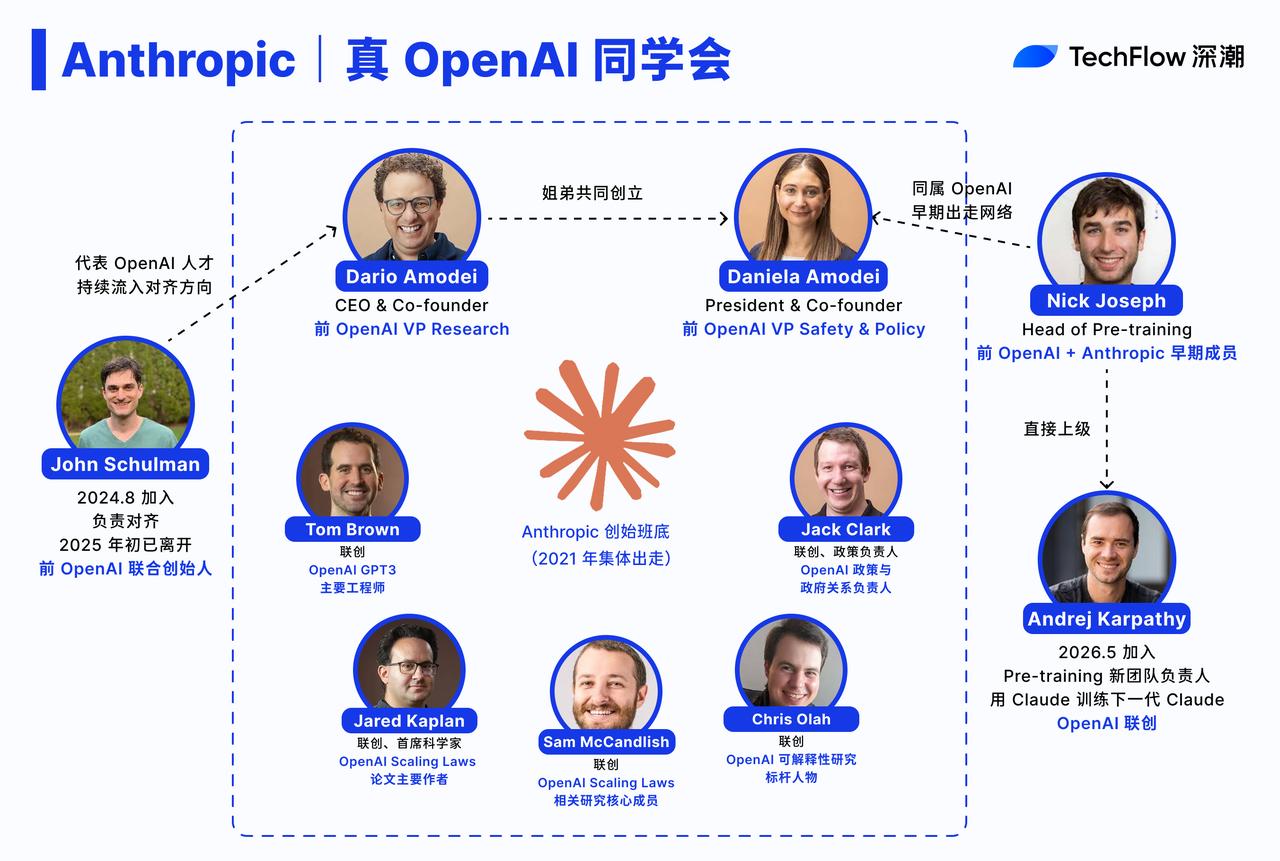
On May 19, Andrej Karpathy, former co-founder of OpenAI, former AI director at Tesla, and renowned Vibe Coding expert, officially announced his joining Anthropic.
Karpathy joined OpenAI when it was founded in 2015, later went to Tesla as AI Director, and in 2024 started his own AI education company, Eureka Labs.
Simply put, he was someone who was already financially independent, owned his own company, and no longer needed to work for anyone else. But he still changed jobs.
Even more unusual is that this top-tier figure doesn't report directly to Anthropic founder Dario Amodei. Anthropic's official statement is that he will report to Nick Joseph, the company's head of pre-training.
In a traditional tech company, this position and situation would likely correspond to a director-level role. His direct report to Nick Joseph, who himself came from OpenAI...
So the situation is this: an OpenAI co-founder becomes a subordinate at a rival company, and his boss is also a former OpenAI employee. Meanwhile, the rival company Anthropic's founder, Dario Amodei, also came from OpenAI, having previously served as OpenAI's VP of Research.
That's really interesting.
I glanced through Anthropic's internal roster, from founders Dario and Daniela Amodei, to John Schulman, who jumped ship from OpenAI in 2024 to head alignment research, then Nick Joseph, and now Karpathy who just joined...
This company has become like an OpenAI alumni reunion held at a rival company. If the US were to adopt the "non-compete agreements" popular among major Chinese companies, this reunion would probably have to be held in court today.
The co-founder worked for a former colleague so that Claude could train himself.
Karpathy's specific task upon joining is to build a new team. According to Anthropic's official statement, this is called "using Claude itself to accelerate pre-training research."
Translate it into plain language, and let the AI train itself.
Generally speaking, pre-training is the most expensive and computationally intensive stage for large models, and it determines the core capabilities of a model. In the past, this was entirely done by humans: researchers designed training programs, engineers ran large-scale training tasks, and the effectiveness could not be determined until several months later.
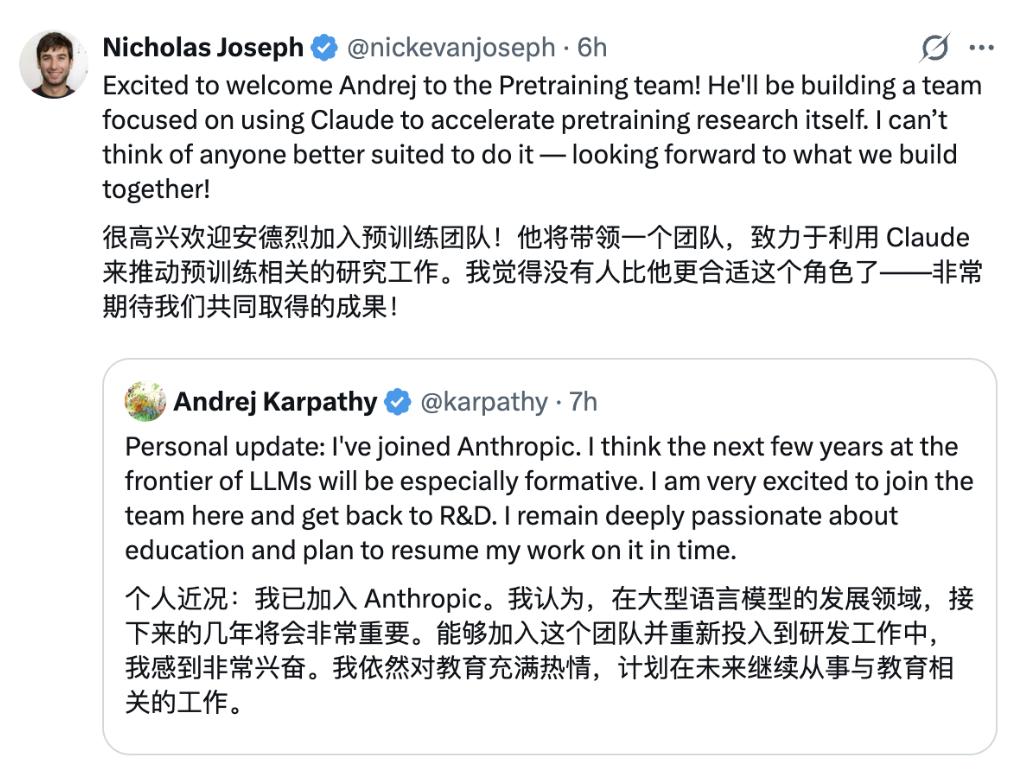
The team Karpathy is leading now is integrating Claude itself into the training process for the next generation of Claude. In other words, some of the research and development work for the next generation of Claude will be done by the current generation of Claude itself.
If this can actually work, the iteration speed of AI will no longer be linear. Jack Clark, co-founder of Anthropic, mentioned this direction in early May, saying that he was "increasingly inclined to believe" that AI is accelerating AI research and development.
Let's go back to Karpathy. Why would someone who has plenty of money, fame, and a job, and who even has an education startup running, be willing to become a subordinate of a former colleague?
The only plausible explanation is that he believes AI self-training is particularly important in the next few years, so important that it's worth putting aside everything else for him, as it's a perfect match in terms of both interest and ability.
If computing power isn't enough, experts will step in.
There are actually business reasons behind letting AI train itself.
In early May, Dario Amodei admitted at the company’s developer conference that Anthropic’s revenue and usage increased 80 times year-on-year in the first quarter of this year, but the company had only planned for 10 times.
The growth came eight times faster than expected, and the company was completely unprepared for that much computing power. The direct consequence was that several paid versions of Claude Pro, Max, and Code experienced varying degrees of bandwidth throttling, leading to widespread complaints from paid users.
The reason is simple: there simply aren't enough GPUs. This company has been buying computing power almost like crazy over the past few months.
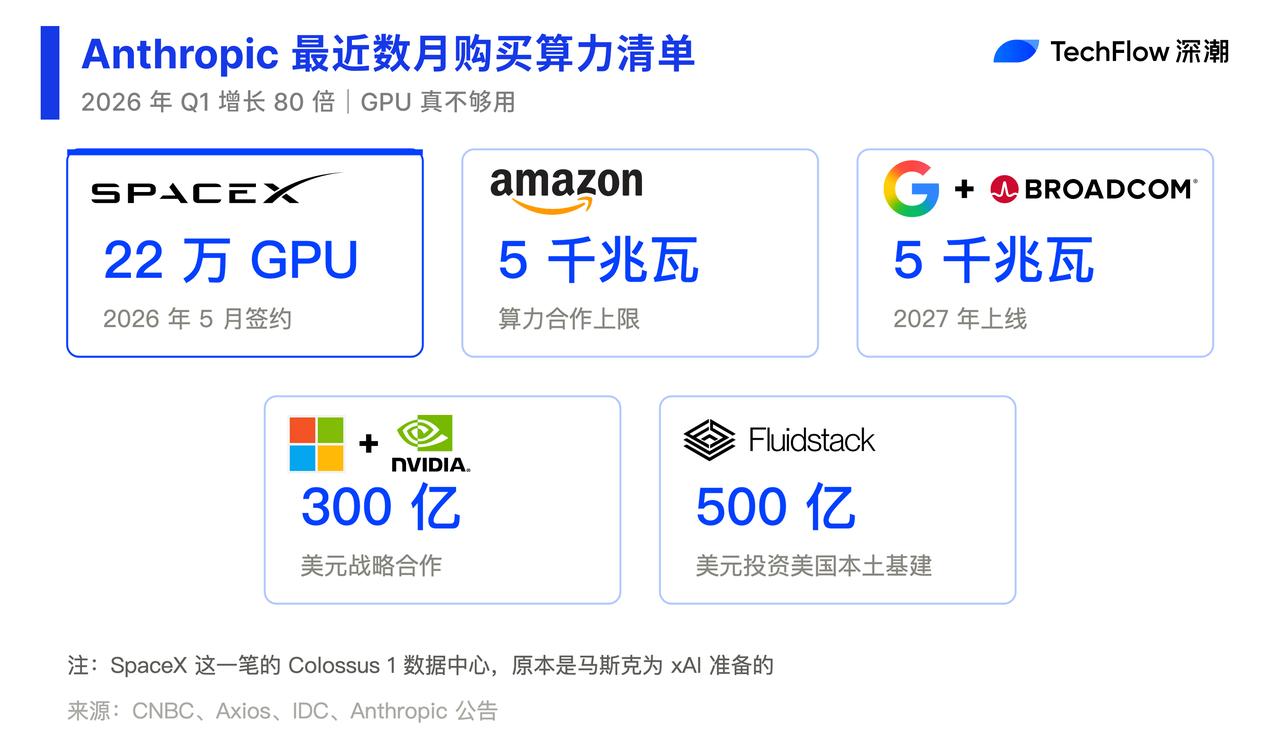
The most dramatic move was the contract signed with Musk's SpaceX on May 6th. According to CNBC, Anthropic secured the entire capacity of SpaceX's Colossus 1 data center. Colossus 1, located in Memphis, Tennessee, houses over 220,000 Nvidia GPUs and has a power capacity exceeding 300 megawatts, enough to power 300,000 homes.
The irony is that Colossus 1 was originally intended as computing power for Musk's own xAI. And just this February, Musk was on X calling Anthropic "misanthropic." The only reason the two could sit down and discuss business is because Musk is still embroiled in a lawsuit with OpenAI.
The enemy of my enemy is the computing power provider, which makes perfect sense.
In addition to the SpaceX deal, Anthropic also signed a computing power cooperation agreement with Amazon for up to 5 gigawatts, another 5 gigawatt agreement with Google and Broadcom, a $30 billion deal with Microsoft and NVIDIA, and an additional $50 billion investment with Fluidstack in US infrastructure.
This sounds like a lot of money was spent. But an IDC report in May pointed out that compared to OpenAI, Anthropic's current dedicated computing power that can actually be used for training is still much smaller.
OpenAI's approach is clear: stack computing power, stack data centers, stack parameters. Anthropic definitely can't keep up with this path.
So Anthropic had no choice but to let the AI train itself. Using a GPU more intelligently is equivalent to buying an extra GPU. Therefore, bringing in the expert Karpathy was an attempt to use his intellect to save on the cost of an unavailable GPU.
Of the 11 founders of OpenAI, only 2 remain.
If Karpathy is equivalent to a data center, then OpenAI has lost more than just one person.
And this whole thing didn't start with him.
Anthropic was founded from the ground up by a group of people who came from OpenAI. In 2021, OpenAI lost seven core employees at once, including the VP of Research, VP of Security Policy, principal engineer of GPT-3, two authors of the scaling laws paper, a leading figure in interpretability research, and the director in charge of policy. They collectively registered a company called Anthropic.
This is why the company is jokingly referred to as the "OpenAI Alumni Association".
More people joined later. In 2024 it was OpenAI co-founder John Schulman and former alignment director Jan Leike, and this year it's Karpathy and his boss Nick Joseph, along with a group of lesser-known but equally crucial researchers.
This group of people didn't split up and start their own businesses. They all went to the same company. More importantly, they had no intention of going back.
Public reports indicate that the core reason this group left OpenAI in 2021 was their disagreement with the company's rapid commercialization and lagging security research. Five years later, OpenAI secured billions of dollars in investment from Microsoft, turned ChatGPT into a consumer product, and this May, even added an advertising management backend to it. Any company in the United States can now directly advertise on ChatGPT.
Those who left five years ago because the company was commercializing too quickly have even less reason to turn back today.
Zooming out further, of OpenAI's original 11 co-founders, only two remain with the company: CEO Sam Altman and President Greg Brockman. The other nine have all left in various ways.
In 2024, almost the entire top management of OpenAI left. CTO Mira Murati, Chief Scientist Ilya Sutskever, Head of Alignment Research Jan Leike, and co-founder John Schulman all announced their departures that year. In 2025, another 12 executives left, plus 7 core researchers who were poached by Meta in the summer.
Some of these people started their own AI-related companies, while others joined competitors like Anthropic. However, almost none of them left to pursue other careers, and almost none of them chose to return to OpenAI.
Anthropic appears to be the biggest beneficiary of this migration. But the root cause of this exodus may lie with OpenAI. Karpathy wasn't the first to arrive, and it probably won't be the last.