The article mainly focuses on Changxin Memory's performance and the fundamental changes in the current storage industry. The core argument is that the storage industry is undergoing a structural rather than cyclical shift in business models driven by the demand for AI inference.
Author and Source: Research Report Diary
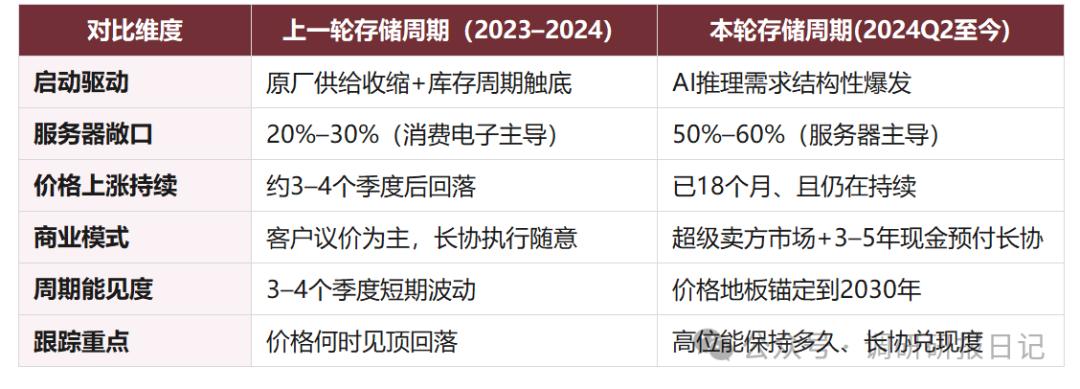
The benchmark for storage cycles is being overturned by reality—this round is not just a simple price increase, but a fundamental shift in business models. Changxin Memory's first-quarter net profit surged to 33 billion yuan, with revenue reaching 50.8 billion yuan. It projects a net profit of 66-75 billion yuan for the first half of 2026—wiping out two-thirds of the market's initial expectation of approximately 100 billion yuan for the entire year in just six months. Behind this is a structural explosion in AI inference demand: the server's share of total storage demand has jumped from 20%-30% to 50%-60%; and the 3-5 year cash prepayment long-term agreements signed between original equipment manufacturers (OEMs) and North American CSPs have anchored the price floor to 2030. Historically, storage prices rise for 3-4 quarters before falling back; this round has seen continuous increases for 18 months—visibility has never been so clear.
① Changxin's half-year net profit reached 75 billion yuan - the profitability of memory chip manufacturers is being thoroughly reassessed.
Changxin Memory reported first-quarter revenue of 50.8 billion yuan and net profit of 33 billion yuan. It projects first-half 2026 revenue to reach 110-120 billion yuan and net profit to reach 66-75 billion yuan. The market initially expected Changxin's full-year net profit to be around 100 billion yuan; the first half alone has already captured two-thirds of that expectation. This isn't simply a matter of capacity ramp-up; rather, it reflects the strongest upward cycle in DRAM prices in history, driven by AI inference demand—a structural leap in profitability, not a sudden spike. The profitability of original equipment manufacturers (OEMs) is being reassessed by the market.
② Server exposure jumps to 60%—AI inference turns storage into a core bottleneck
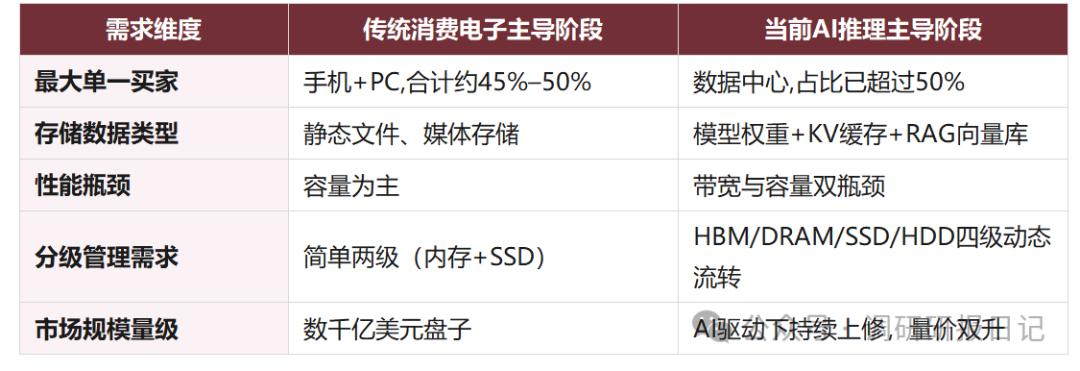
In the past few years, storage demand has been dominated by consumer electronics, with mobile phones and PCs accounting for about 45%-50% combined, while server exposure was only 20%-30%. The current landscape has fundamentally changed—server exposure has jumped to 50%-60%, almost doubling. This is driven by the dual demands of AI inference on storage capacity and bandwidth: model weights must reside permanently in HBM, dynamically expanding KV caches require a tiered flow across the entire HBM/DRAM/SSD/HDD chain, and external knowledge bases (RAG vector databases) directly drive a significant increase in demand for mechanical hard drives starting in the second quarter. This year, the storage market size is expected to reach several hundred billion US dollars—storage has become the most critical bottleneck in AI inference.
③ Long-term contracts lock in prices until 2030 – Business model shifts to a super seller's market
In the past, the storage market was a typical buyer's market, where customers could often choose not to honor long-term agreements. This round of business model changes dramatically: Original equipment manufacturers (OEMs) are no longer signing flexible LTAs (Limited Time Agreements) like before, but rather long-term agreements with strong legal binding force, requiring upfront cash payments from customers for 3-5 years. Prices are set at the level of the first and second quarters of this year as a floor price, with room for upward fluctuation. This means that profits for at least the next three years are structurally locked in, and the price fluctuation cycle is artificially lengthened—a business model never before seen in the history of the storage industry.
④ Prices have risen for more than 18 months – storage cycle visibility has been extended to an unprecedented level.
Historically, storage prices typically enter a downward trend after rising for 3-4 quarters. This current cycle, which began in Q2 2024, has seen continuous increases for 18 months and remains in an upward trend throughout this year, with prices expected to remain high next year. This cycle is not a typical inventory cycle driven by supply contraction, but rather a supercycle driven by a structural surge in AI demand—even if the second derivative of prices slows, the absolute value will not fall. The focus of future monitoring is no longer "how much higher can prices rise," but rather "how long can these high levels be maintained?" Visibility has never been clearer.
I. Storage Cycle Review and Comparison: Fundamental Differences Between This Round and the Previous Round
II. Shift in Demand Structure: From Consumer Electronics-Driven to AI Inference-Driven
III. Industry Analogy
Analogy: Similar to the "supercycle" in global shipping from 2020 to 2022—not simply fluctuations in freight rates, but a historic shift in supply and demand structures, business models (long-term contracts), and pricing power. Once the business model fundamentally changes, the frequency and magnitude of price fluctuations will be reshaped. Storage is repeating this logic: shifting from a buyer's market where customers can negotiate prices at any time to a super seller's market where original equipment manufacturers (OEMs) lock in prices with 3-5 year cash prepayment long-term contracts.