The overall open interest in the crypto market has been more than halved from its all-time high of $210 billion before the liquidation on October 10 last year.
Written by: CoinGecko
Compiled by: Chopper, Foresight News
The perpetual contract exchange industry is undergoing a structural transformation. Since BitMEX pioneered the perpetual contract trading model in 2016, centralized perpetual contract exchanges have consistently been the core liquidity hubs of the crypto market, with a total trading volume of $85.3 trillion in 2025.
With rapid product iteration and a significant increase in on-chain transaction activity, decentralized perpetual contract exchanges have grown from niche protocols into highly competitive market players. CoinGecko released its 2026 Crypto Perpetual Contract Trading Market Report, and the following is a summary of its key takeaways:
- From January 2025 to April 2026, MEXC and BingX led the industry in the number of new perpetual contracts launched, with 879 and 565 respectively.
- The average monthly trading volume of the top 11 centralized perpetual exchanges will decrease to $4.7 trillion in 2026 and reach $7.1 trillion in 2025.
- The top 12 decentralized perpetual exchanges saw their average monthly trading volume rise to $611.57 billion in 2026, and $531.65 billion in 2025.
- Driven by Hyperliquid, the trading volume of decentralized perpetual contracts saw significant growth in 2025, reaching a peak of 13% of the trading volume of centralized contracts.
- In 2025, the open interest share of decentralized perpetual exchanges continued to rise, currently accounting for 13.5%, with Hyperliquid ranking first.
The pace of new contract launches is diverging, with smaller platforms being more aggressive.
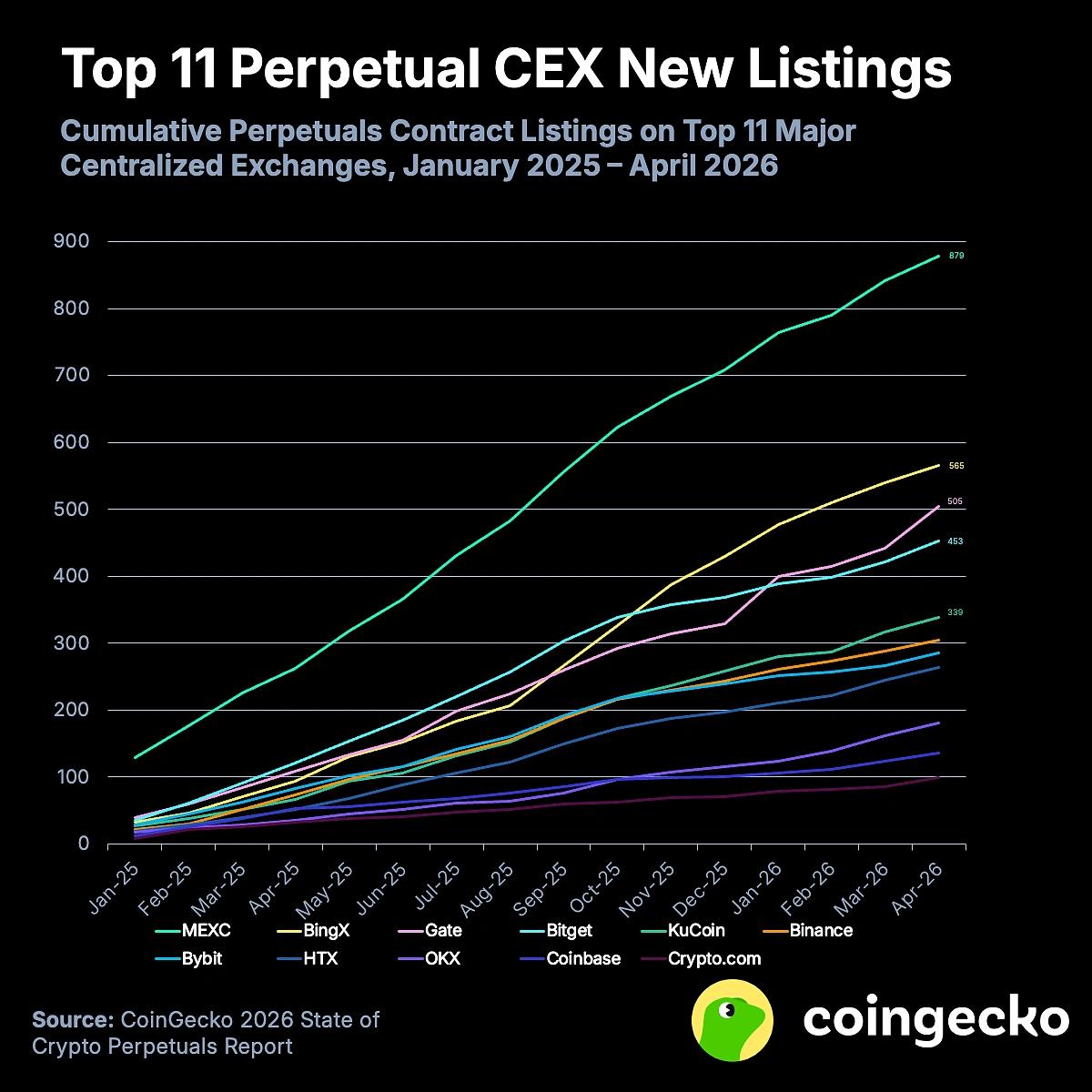
Since January 2025, MEXC and BingX have ranked first and second in the industry in terms of the number of new perpetual contracts, with 879 and 565 new contracts respectively. The average monthly number of new contracts is 55 and 35 respectively. Both platforms mainly focus on long-tail cryptocurrency contracts.
Among the top 11 exchanges, 6 have fewer than 20 new contracts launched per month, indicating a conservative investment strategy. Crypto.com has the fewest new contracts launched, with only 2 in December 2025 and a peak of only 13 in April 2026.
Major exchanges generally prioritize listing perpetual contracts, with fewer new spot currency pairs. In the past 16 months, Binance added 305 perpetual trading pairs, but only 125 spot trading pairs, with most new contracts concentrated on meme coins and AI-related tokens.
Major new investors on MEXC, BingX, and Gate are also aggressively expanding their presence in the spot currency markets. Demand for leveraged trading in niche cryptocurrencies is lower, and the target audience has a higher risk tolerance threshold.
Due to compliance requirements, the listing process for perpetual contracts is longer than that for spot trading, and the trading activity for specific cryptocurrencies is relatively limited. Since January 2025, CoinGecko has recorded a total of 7,803 new tokens, but the top 11 centralized exchanges have only opened perpetual contracts for 1,030 cryptocurrencies.
Centralized contract trading volume shrank year-on-year
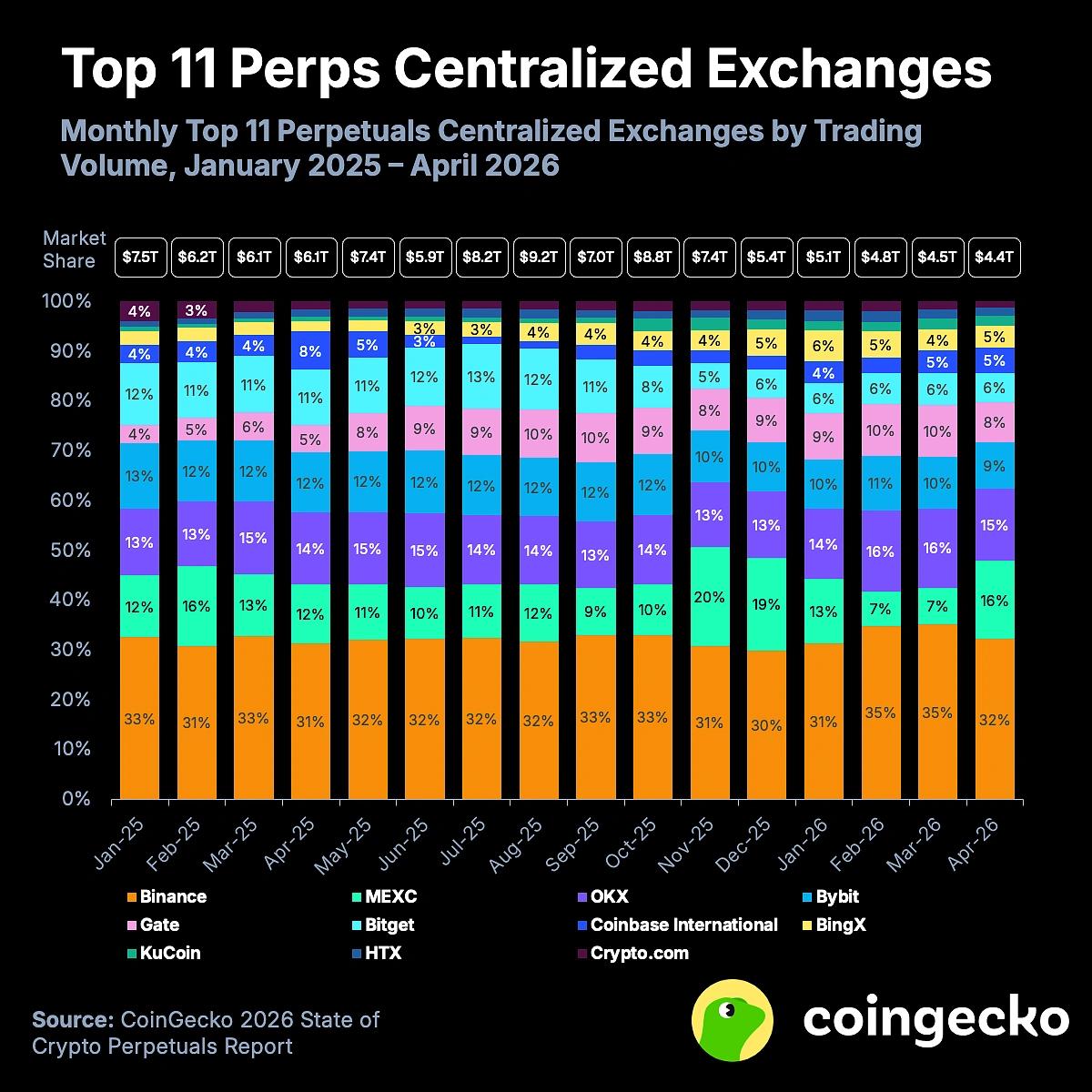
The top 11 centralized perpetual exchanges had an average monthly trading volume of $4.69 trillion in the first four months of 2026, a 34% decrease from $7.11 trillion in 2025.
BingX bucked the trend this year, increasing its market share from 3% in 2025 to 5%, currently ranking seventh in the industry. Bitget's trading volume declined, with average monthly trading volume falling from $740.62 billion to $287.08 billion, but it still holds sixth place with a 6% share.
Binance and OKX solidified their leading positions, with their market share slightly increasing. In the first four months of 2026, they accounted for 33% and 15% of the market share, respectively.
The scale of decentralized contracts is steadily increasing, and emerging platforms are rapidly breaking through.
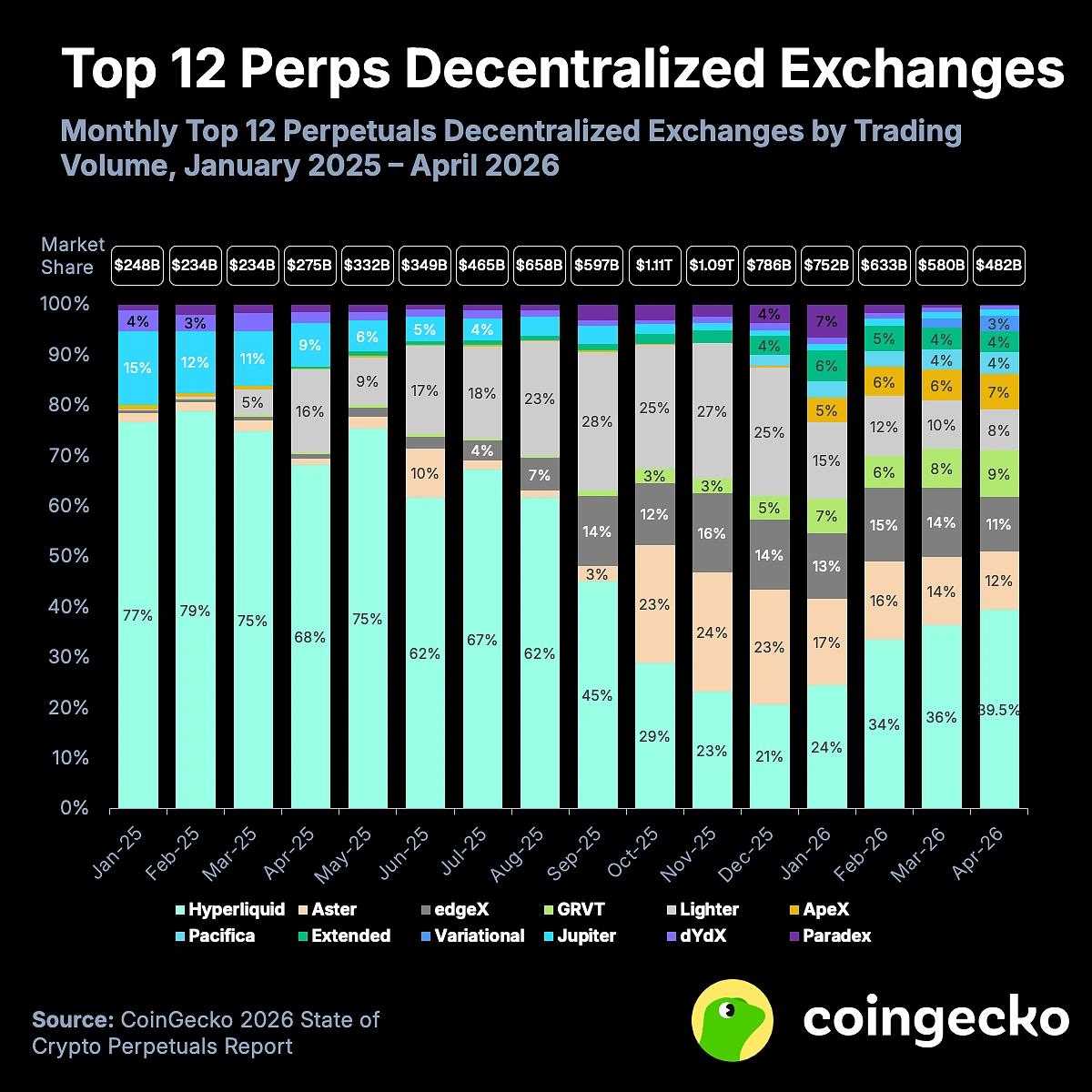
In January 2026, the transaction volume of decentralized contracts reached $751.59 billion, and then declined month by month. The transaction volume in April was $481.84 billion, which is still far higher than the level of less than $300 billion in the same period of 2025.
In 2025, the total transaction volume of decentralized perpetual contracts reached $6.38 trillion, a several-fold increase compared to $1.5 trillion in 2024. Even with overall market pressure, the industry's transaction volume in 2026 is expected to remain at the same level or even surpass that of last year.
New decentralized contract platforms such as Pacifica, Extended, and Variational continue to expand their market share. All three platforms have launched points programs, and airdrops are highly likely to follow. In April, their market shares were 4%, 4%, and 3% respectively, surpassing established platforms such as Jupiter and dYdX in size.
The proportion of decentralized contracts surged and then fell back, with leading projects showing significant scale.
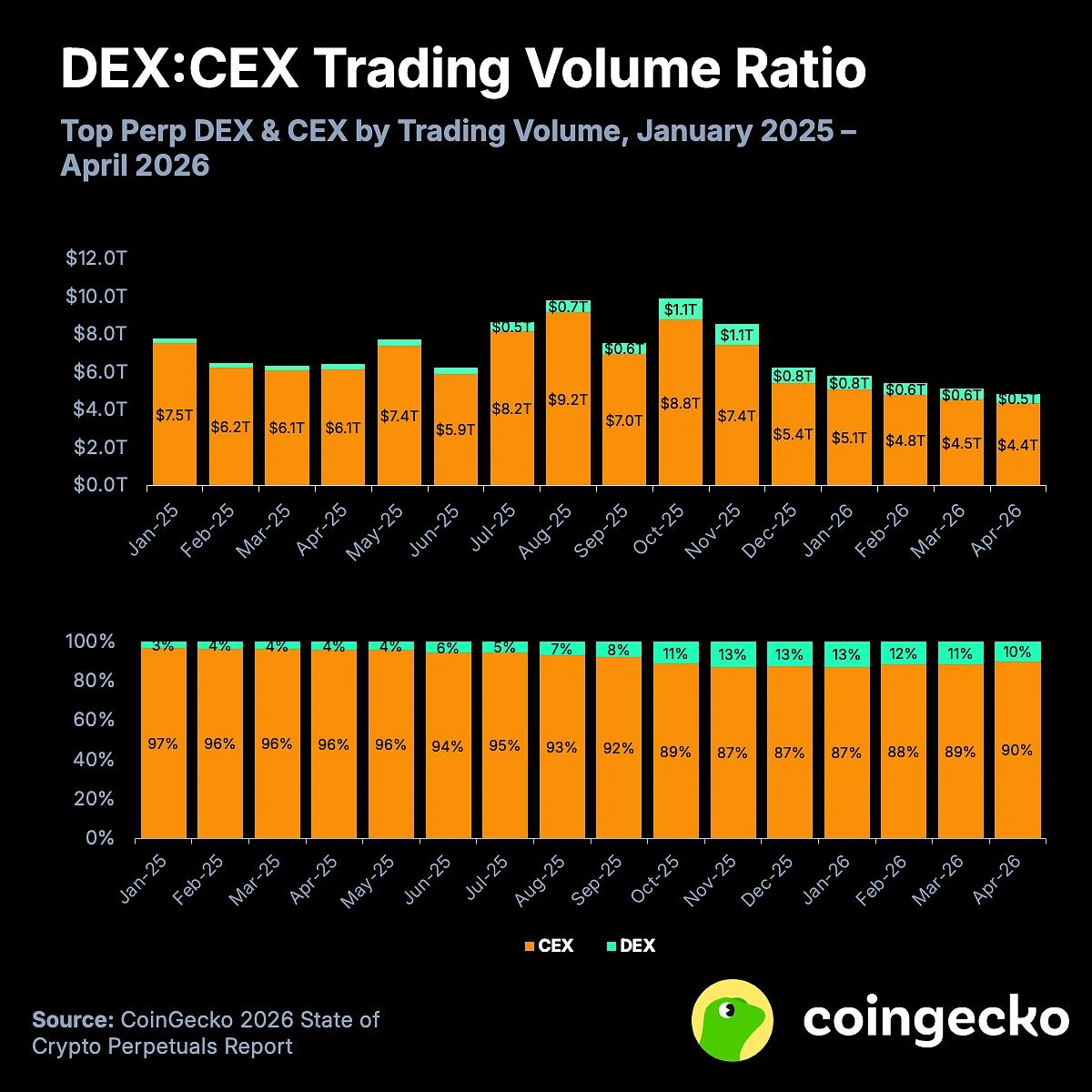
The ratio of decentralized to centralized perpetual contract trading volume continued to climb in 2025, starting at only 3% and peaking at 13% by the end of the year. In 2026, the ratio declined somewhat, dropping to 10% in April, with centralized exchanges regaining more than 90% of the market dominance, marking the first time this pattern had been restored since October 2025.
Hyperliquid accounted for the majority of decentralized contract trading volume, with a trading volume of $190.28 billion in April, accounting for 3.9% of the total contract volume in the industry, ranking ninth, slightly lower than BingX's $196.81 billion, and ahead of KuCoin's $83.71 billion.
The growth rate of decentralized contracts has slowed down temporarily, but newcomers like Pacifica are attracting funds by leveraging the expectation of points airdrops, and their market share has room to rebound in the future.
Overall open interest shrank, while the proportion of decentralized contract open interest increased significantly.
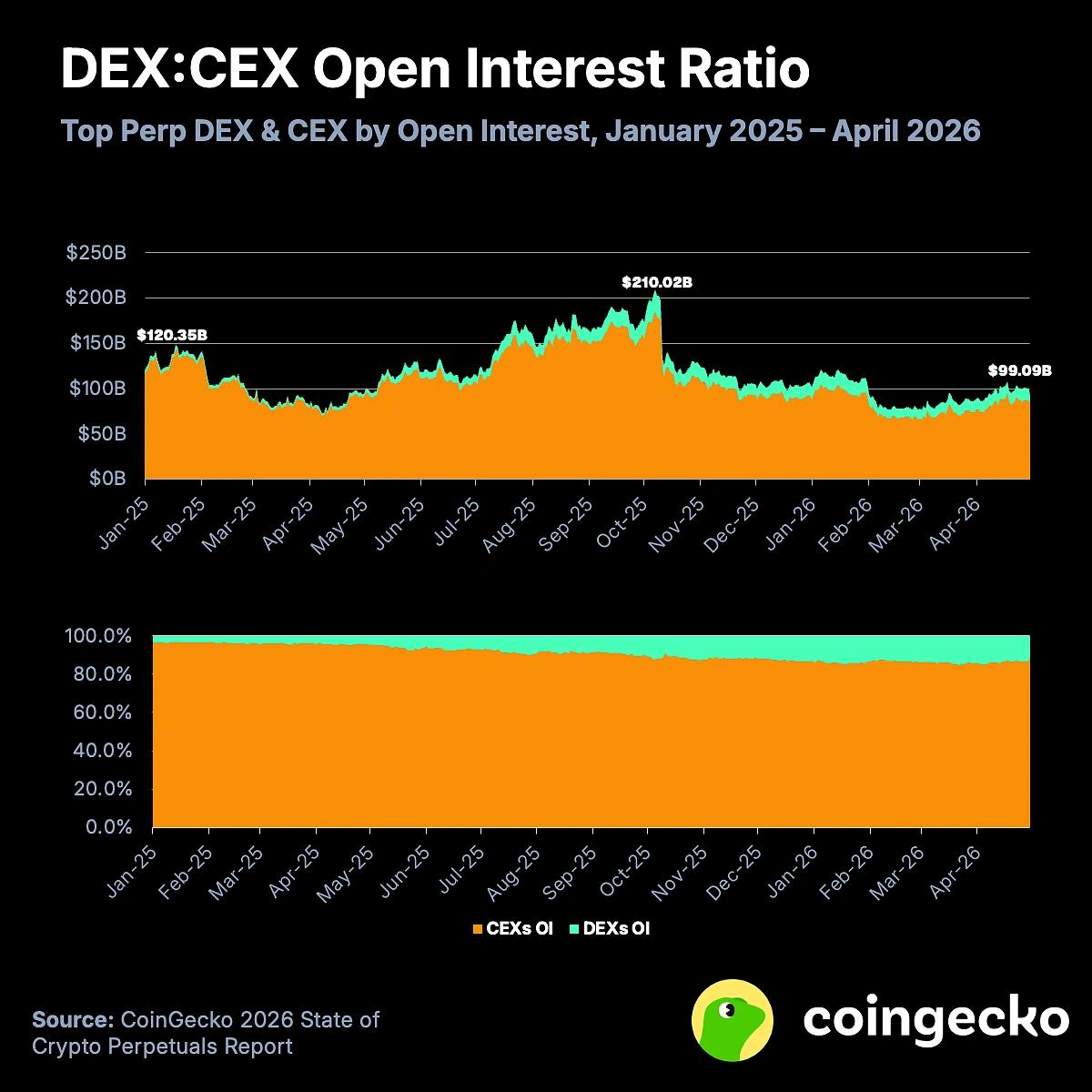
The overall open interest in the crypto market fell from $120.35 billion at the beginning of 2025 to $99.09 billion at the end of April 2026, more than halved from the historical high of $210.02 billion before the liquidation on October 7, 2025.
Centralized exchanges still hold the vast majority of open positions, but their share declined from 96.4% at the beginning of 2025 to 86.5% at the end of April 2026. Since October 2025, decentralized contracts have consistently maintained a share of over 10% in open interest.
Furthermore, the implementation of Real-World Assets (RWA) services has driven the development of decentralized contracts, allowing crypto users to participate in traditional financial market trading through these platforms without having to liquidate their holdings. However, centralized exchanges have also followed suit, launching perpetual contracts for real-world assets, further intensifying competition in the sector.