Ethereum is showing leverage increasing faster than spot demand, while institutional flows and macro liquidation continue to put pressure on price volatility.
Derivative, spot, and ETF indicators are all diverging in direction, making ETH 's recovery unlikely to be sustainable. Current data suggests the market still has buying pressure, but not enough to fully absorb the selling pressure, and Longing positions are becoming increasingly prevalent.
- Positive funding rates indicate a bullish stance has returned, but this does not necessarily mean a sustainable uptrend.
- Spot CVD improved, but ETH remains blocked below resistance zones and passive selling pressure remains strong.
- The spot Ethereum ETF is seeing outflows, further weakening the market's absorption capacity.
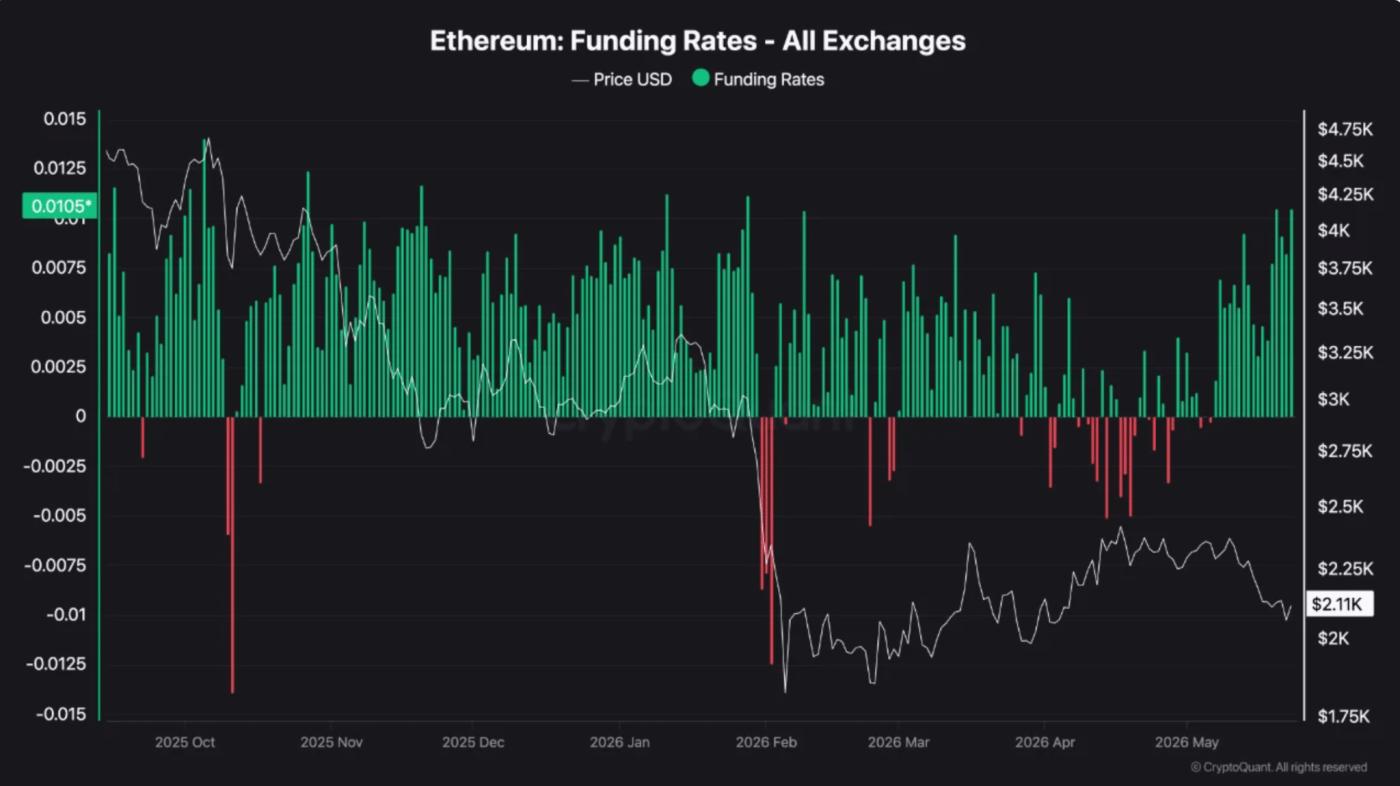
Ethereum Derivative are leaning towards a buy, but the price base Unconfirmed.
ETH 's funding rates have turned positive around 0.0105% as the price traded near $2,114. Previously, on April 17th, ETH was around $2,420 but funding remained negative at approximately -0.0040%.
This divergence suggests that sentiment in the Derivative market has improved faster than the pace of price recovery. At previous levels, such as the $4,1200 USD region in October 2025 and nearly $3,000 USD in January 2026, a similar scenario occurred before prices subsequently fell more sharply.
However, positive funding doesn't automatically mean an immediate reduction in risk. The problem is that leverage is returning faster than the strength of spot buying.
Spot buying pressure has improved, but ETH remains blocked below resistance.
Ethereum's spot CVD has improved steadily on Binance and Coinbase, while ETH remains stuck below the $2,150–$2,200 range. This suggests buying interest, but not enough to break through the upper resistance zone.
In this context, passive selling pressure continues to absorb market buy orders, rendering the breakout ineffective. Open interest remains high, and Longing positions in the perpetual market continue to increase, making the price structure more sensitive to short-term fluctuations.
Actual volatility has narrowed, which is often a sign that the market is accumulating pressure. If selling pressure weakens, ETH 's volatility range could widen more rapidly.
ETF inflows and macroeconomic liquidation are tightening the ETH market.
Pressure is coming not only from the Derivative market but also from the external liquidation environment. Treasury bond yields have risen to around 4.56%, and a stronger US dollar is further weakening risk appetite.
The Ethereum spot ETF recorded approximately $215 million in Capital in a week, while daily selling exceeded $28 million on several occasions. This weakened the ability of institutional investors to absorb the inflow at a time when ETH needed new support.
Outflows from Cold Storage have also slowed, with occasional inflows occurring during price rallies. However, with macroeconomic liquidation continuing to tighten, leveraged positions could become the biggest source of volatility risk in the short term.
Summary
Ethereum still has buying pressure in both spot and Derivative, but rapidly increasing leverage, ETF Capital , and weaker macroeconomic liquidation are making the recovery unlikely to be sustainable.