Author: TechFlow TechFlow
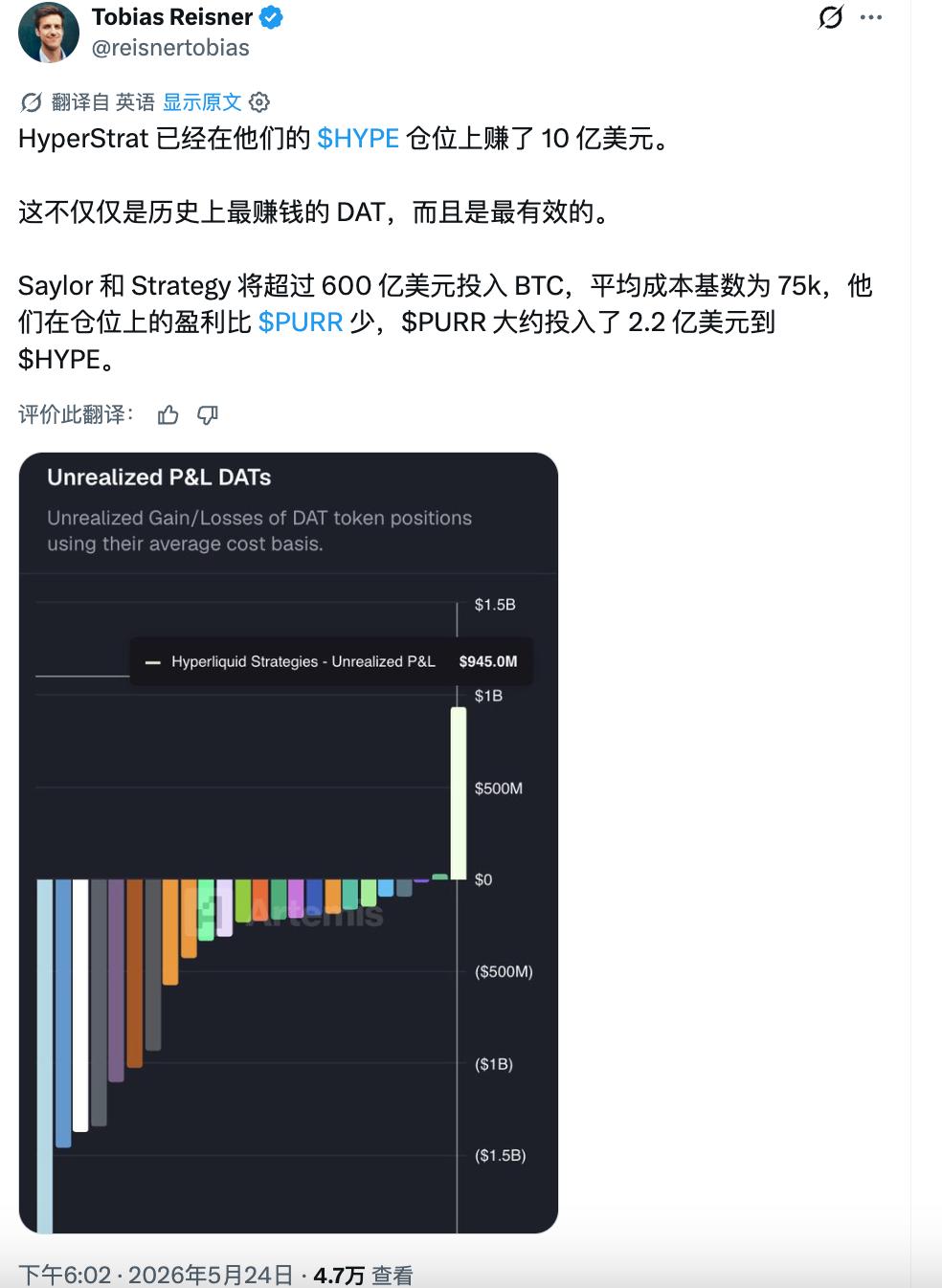
On May 24, a tweet about Hyperliquid Strategies (NASDAQ: PURR) sparked considerable discussion on the English-language CT forum:
This company bought HYPE for approximately $220 million and currently has a floating profit of nearly $1 billion, even surpassing the profitability of Michael Saylor's Strategy (formerly MicroStrategy) on BTC.
This topic is gradually spreading to the Chinese-speaking world. HYPE recently hit an all-time high of over $62, with a year-to-date increase of over 150%, making it one of the best-performing mainstream crypto assets this year.
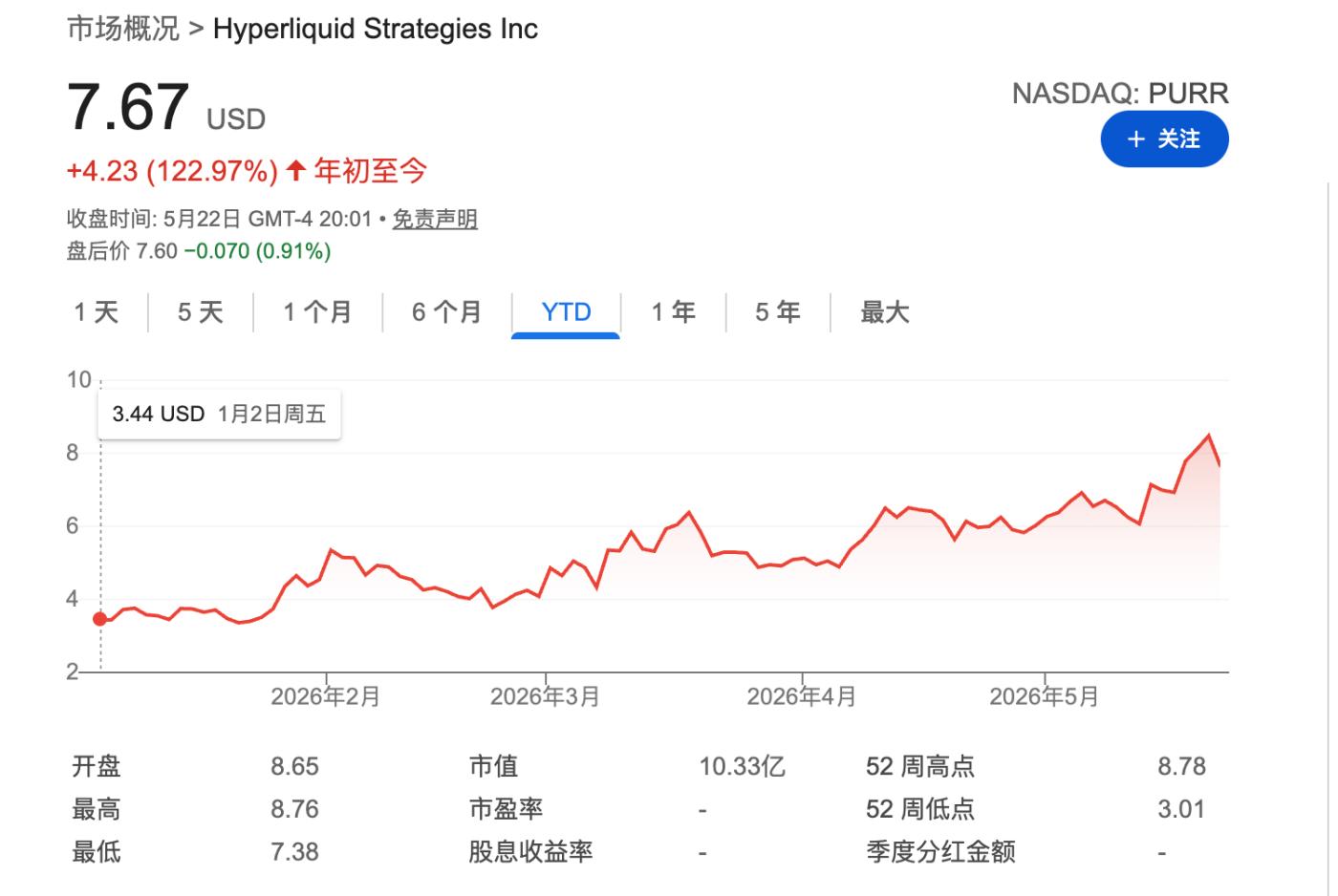
As the only publicly traded HYPE stock currently represented, PURR has risen by more than 100% since the beginning of the year, naturally making it a target of FOMO (Fear of Missing Out) in US stock market research.
But before jumping on the bandwagon, there are a few questions that need to be clarified:
1. What exactly is this company?
2. What's the difference between this and buying HYPE directly?
3. Does the claim that "capital efficiency surpasses micro-strategies" stand up to scrutiny?
$PURR, pure DAT
In conclusion: PURR is not a company with actual business operations; it's essentially a stock-packaging product.
Its business model can be summarized in one sentence: buy HYPE, pledge HYPE, and hold HYPE. As of April 2026, publicly available information shows that the company held approximately 20 million HYPE tokens, along with approximately $113 million in cash and zero debt.
This means that the entire value of the stock depends on one thing: the price of HYPE.
Since there's no business to analyze, there are only two dimensions left when looking at these kinds of companies: the underlying assets themselves, and who is operating the shell company.
The latter determines capital operation capabilities, such as when to issue new shares to buy currency, when to repurchase shares to support the price, and how to manage the premium or discount relationship between stock price and net assets... It also determines whether institutional funds are willing to enter through this tool.
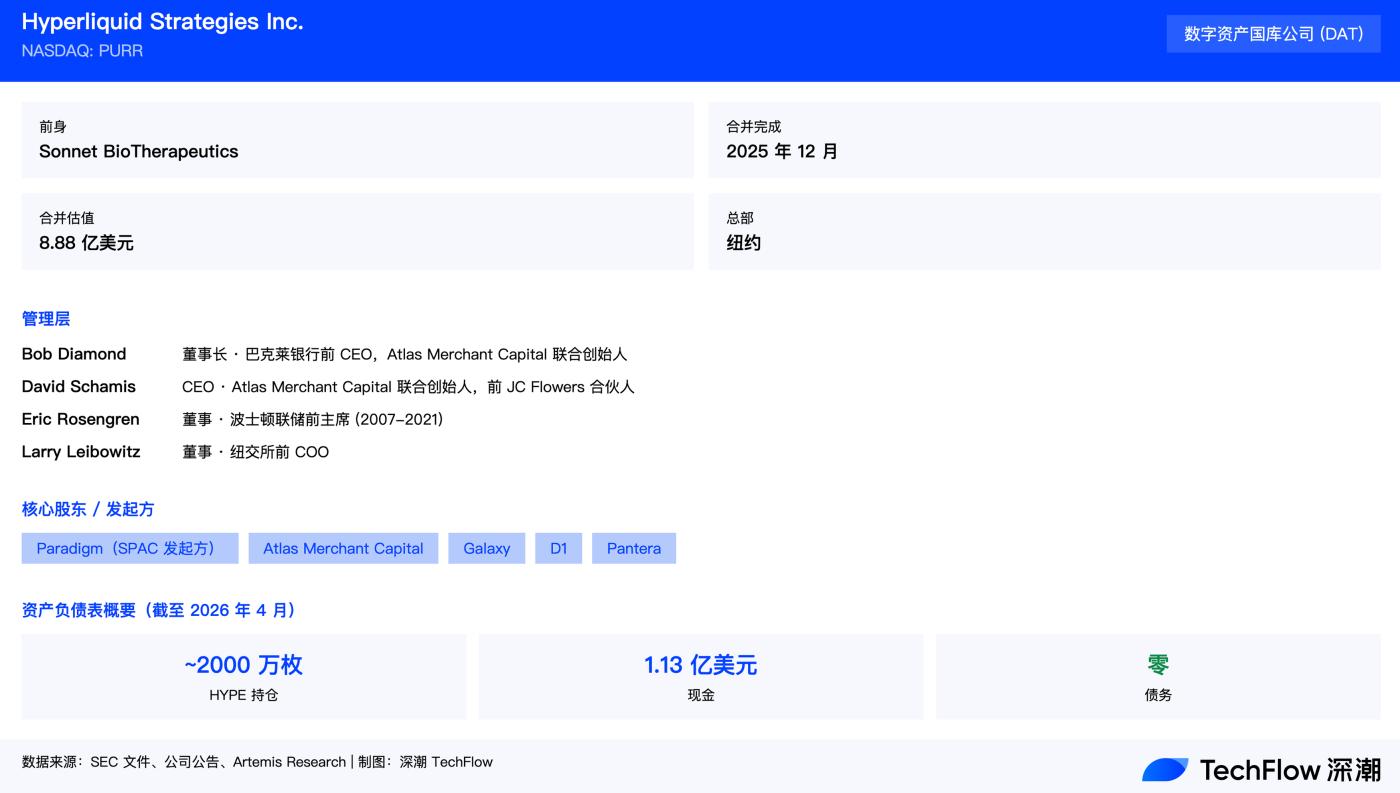
Historically, PURR was formerly known as Sonnet BioTherapeutics, a small Nasdaq-listed biotechnology company. In July 2025, it announced a merger with Rorschach I, which was completed in December of the same year, valuing the company at $888 million. It was then renamed Hyperliquid Strategies and its ticker symbol changed to PURR.
It is worth noting that the deal was initiated by Paradigm and Atlas Merchant Capital.
Paradigm is one of the top venture capital firms in the crypto industry, having invested in projects such as Uniswap, Blur, and Friend.tech. It has a deep presence in the Hyperliquid ecosystem and directly participated in the formation of the SPAC.
Atlas Merchant Capital is a New York and London-based financial services investment firm. Its two founders hold key positions at PURR: Chairman Bob Diamond is the former CEO of Barclays, and CEO David Schamis is a former partner at JC Flowers.
The board also included former Boston Federal Reserve President Eric Rosengren and former NYSE COO Larry Leibowitz. Other participants included Galaxy, D1, and Pantera, all leading institutions in the crypto and macro sectors.
Most of DAT's management comes from the crypto world, while PURR is almost entirely composed of traditional finance veterans.
HYPE is strong, PURR is soaring.
The direct reason why PURR has gained attention in the Chinese-speaking community is the strength of HYPE itself.
HYPE rose steadily from around $25 at the beginning of the year, breaking through $62 in May to set a new all-time high, with a year-to-date increase of over 150%. Against the backdrop of BTC consolidating and ETH and SOL performing lacklusterly this year, HYPE has been one of the most outstanding mainstream crypto assets.
Our previous article has dissected Hyperliquid's fundamental closed loop: perp DEX has about 70% market share, weekly fee revenue exceeds ten million US dollars, and 97% of protocol fees are used to buy back and destroy HYPE. This flywheel is still accelerating.
(See also: Market Observation: From HYPE to ZEC, grasp the 4 narratives behind the recent knock-off craze )
As HYPE rises, PURR naturally follows suit.
As the only HYPE-backed stock currently listed on the US stock market, PURR has risen by more than 100% year-to-date, from the $3 range to a recent high of $8.79.
For investors who only have US stock accounts and no direct access to the crypto market, PURR is almost the only option to gain exposure to HYPE. However, what has transformed PURR from a "niche asset" into a "social media hot topic" is the series of institutional signals that have been implemented since May.
Goldman Sachs disclosed in its Q1 13F filing that it purchased approximately 650,000 shares of PURR. While the amount was relatively small (about $3.3 million), the name Goldman Sachs itself carries endorsement. Around the same time, 21Shares and Bitwise's HYPE futures ETFs were listed on Nasdaq and NYSE respectively, and Cantor Fitzgerald raised its target price for PURR from $6 to $8.
These events, occurring within the window of HYPE reaching new highs, brought PURR into the spotlight for more people.
Then there's the tweet mentioned at the beginning of the article: PURR used $220 million of principal to buy HYPE, and currently has a floating profit of nearly $1 billion. In the short term, its capital efficiency is definitely higher than that of MicroStrategy.
A surge in price will inevitably attract a lot of attention. However, caution is advised if you intend to trade this stock.
Is DAT the most capital-efficient?
Strategy (formerly MicroStrategy) invested over $60 billion in BTC, with an average cost of approximately $75,000; PURR only used about $220 million to buy HYPE, yet its unrealized gains were close to or even exceeded those of the former. Does this mean PURR's "capital efficiency" is far higher than MicroStrategy's?
The comparison is numerically correct, but logically misleading.
PURR's early HYPE holdings had an average cost of around $7, and the current price is $62, representing a nearly ninefold increase. Strategy's BTC holdings had an average cost of around $75,000, and BTC is currently around that price level, showing almost no increase.
Therefore, the higher unrealized profit of PURR is not due to any smarter operations by the company; it's simply because the underlying assets have experienced vastly different price increases. Anyone who, at the same time, directly buys HYPE futures with the same amount of money would achieve the same rate of return without incurring the risk of equity dilution.
In other words, this is a victory of "choosing the right coin". If we push back the time when PURR was founded by six months and entered the market when HYPE was $40, this "capital efficiency" story would not hold true at all.
For US stock investors who are only now paying attention to PURR, a more practical question is: if you buy PURR now, is the price you pay a premium or a discount relative to the value of the company's HYPE holdings?
This involves DAT's most core valuation metric—mNAV (adjusted net asset value per share).
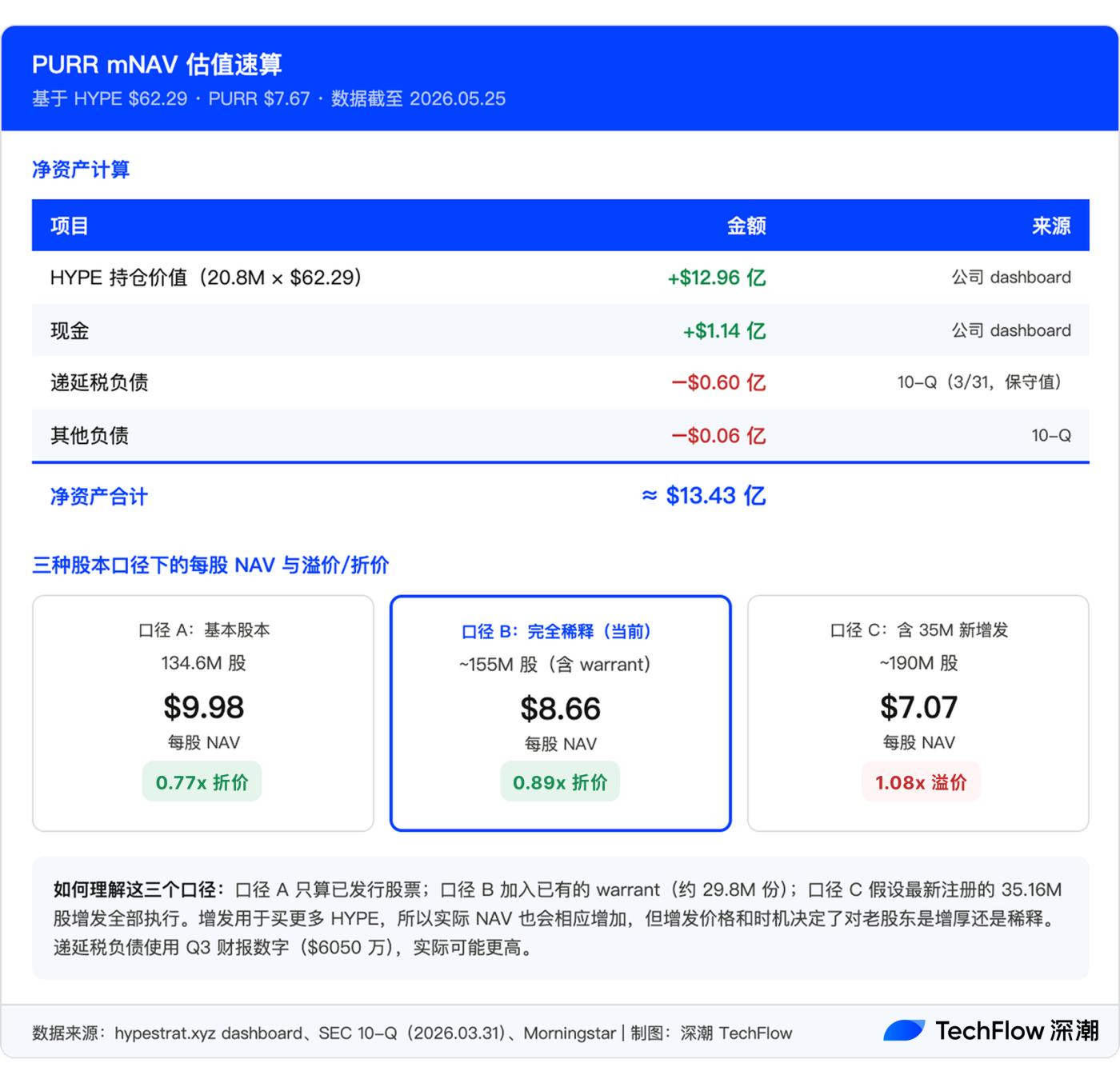
We pulled data from PURR's official dashboard and SEC filings and did a quick calculation of mNAV (adjusted net asset value per share).
The company currently holds 20.8 million HYPE tokens (worth approximately $1.296 billion at current prices), plus $114 million in cash, and after deducting deferred tax liabilities and other liabilities, its net assets are approximately $1.34 billion.
Looking only at the 134.6 million shares already issued, the NAV per share is approximately $9.98, while the current share price is $7.67, representing a discount of about 23%. If the existing 29.8 million warrants are included, the total shares diluted to approximately 155 million would have a NAV per share of approximately $8.66, representing a discount of about 11%. However, the company just registered an additional 35.16 million shares. If all of these are exercised, the denominator expands to approximately 190 million shares, reducing the NAV per share to $7.07, resulting in a slight premium of 1.08 times the share price.
Therefore, whether PURR is "cheap" or "expensive" depends on how much you expect future dilution.
Issuing new shares isn't necessarily a bad thing. If management issues shares at a high premium and uses the raised funds to buy more HYPE stocks, the cash holdings per share will actually increase. However, if the market sentiment cools down and the share price falls below NAV, then issuing new shares dilutes existing shareholders.
This company has only been established for six months and has not yet experienced a complete downturn cycle. There is currently no historical record to refer to regarding how the management would operate in extreme environments.
It's also important to note that the deferred tax liability used in the above calculations is $60.5 million as of the Q3 financial report cutoff date (March 31). However, HYPE has increased significantly since the end of March, and the tax liability corresponding to unrealized value-added has likely increased further. The actual NAV may be lower than we calculated.
What's the difference between buying PURR and buying HYPE directly?
This is the most practical question. Since the entire value of PURR comes from HYPE, why don't I skip the intermediate layer and buy HYPE directly?
The answer is simple: for some investors, it's not possible to buy directly. US retirement accounts (IRAs, 401k), traditional brokerage accounts, and funds from some institutions with strict compliance requirements cannot directly hold crypto assets.
Furthermore, the Hyperliquid platform frontend explicitly restricts its use to U.S. residents.
Therefore, PURR provides a Nasdaq-listed stock package, allowing these funds to gain HYPE exposure through standard stock trading. Essentially, Paradigm is selling this compliance channel through this shell.
If you fall into this category of investors, PURR is indeed almost the only option at present. Although 21Shares and Bitwise's HYPE spot ETFs were launched in mid-May, these products have only been online for a very short time, and their liquidity and tracking error remain to be seen.
However, if you have the ability to directly buy HYPE, then the stock packaging layer of PURR becomes a pure friction cost with negative effects; it cannot be called a superposition of HYPE's beta returns.
This cost is reflected in several aspects:
First, there's the risk of dilution. If you directly hold HYPE stock, your share won't be diluted by others. However, if you hold PURR stock, the company can issue new shares at any time to buy more HYPE.
Second, the benefit transmission is incomplete. Directly holding HYPE allows you to stake it yourself to earn staking rewards, and future airdrops and ecosystem incentives are also credited directly to your account. Holding through PURR, however, requires staking rewards to be deposited into the company's account first, and only after deducting operating expenses and taxes is it indirectly reflected in the net asset value per share.
Third, there's the friction between trading hours and pricing. HYPE trades 24/7, while PURR is only available during US stock market trading hours. If HYPE experiences significant fluctuations over the weekend or after hours, PURR holders can only react when the market opens.
Fourth, counterparty risk. SEC filings disclose that all of PURR's HYPE holdings are held by a single custodian. With PURR, the safety of your assets depends on the custodian's ability to fulfill its obligations and the company's operational continuity.
In my opinion, PURR is more of a "channel product" than an "investment product." Its value lies in opening up a channel from traditional financial accounts to HYPE, nothing more. If you don't need this channel, then every additional risk brought by the intermediary layer is unnecessary.
Therefore, for Chinese-speaking crypto and US stock investors, the conclusion is quite straightforward:
The judgment you need to make is whether you are optimistic about HYPE, not whether you are optimistic about the shell of PURR.