Anthropic was expelled from the United States and then found refuge in Rome; the story sounds like something out of the Middle Ages.
Article author and source: 0x9999in1, ME News
TL;DR
- Pope Leo XIV and Anthropic co-founder Christopher Aura jointly released the first AI encyclical, announcing a formal collaboration between the Vatican and Anthropic, focusing on AI ethics and the future of humanity.
- This is the most symbolic international political breakthrough since Anthropic was completely blocked by the Trump administration.
- The Vatican's choice of Anthropic over OpenAI or Google sends a clear signal of its alignment with a "safety first" approach.
- Anthropic's European revenue surged nearly tenfold in the past year, with its political maneuvering and business expansion deeply intertwined.
- Peter Thiel's accelerationist camp was met with a cold reception in Rome, and the Vatican's stance on technological ethics became increasingly clear.
- This collaboration is essentially a two-way "moral arbitrage"—Anthropic needs legitimacy, and the Vatican needs technological influence.
- Dario Amodei is about to embark on a visit to Rome and London, and plans to deploy a data center in Southern Europe have surfaced.
An exiled company walks into the world's oldest center of power.
May 2026.
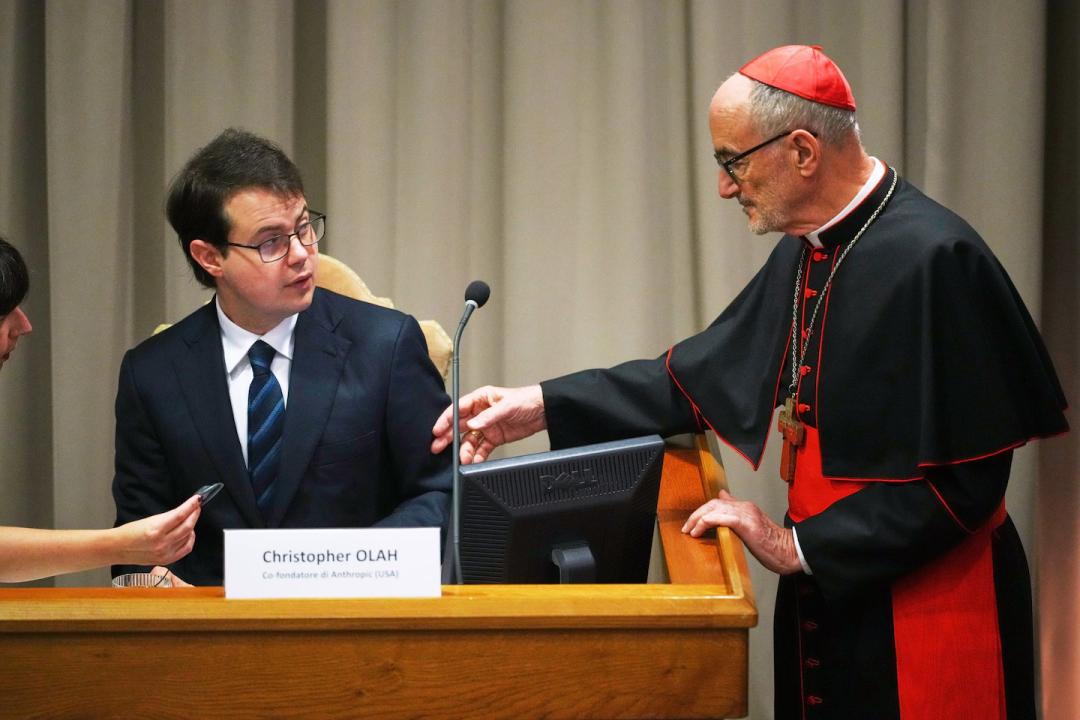
St. Peter's Square in the Vatican. Pope Leo XIV, dressed in a white vestment, stands beside a young man in a plaid shirt—Christopher Ola, co-founder of Anthropic and a pioneer in the study of neural network interpretability.
The image itself is a declaration.
An AI company designated as a "security risk" by the US government has its core scientists standing at the heart of the Catholic world, alongside the spiritual leader of 1.3 billion believers, issuing the first papal encyclical on artificial intelligence in human history.
This is not a charity event. It is not an academic conference. It is not a typical PR stunt by a tech company.
This is a political positioning accurate to the millimeter.
Let's rewind: Three months ago, Anthropic was a company facing a complete crackdown in its domestic market. In February, the Trump administration signed an executive order requiring all federal agencies to cease using Anthropic technology. The Department of Defense, for the first time ever, placed a domestic technology company on its security risk list. The reason? Anthropic refused to remove safety red lines regarding lethal autonomous weapons from its AI system.
In other words—because this company said "no".
We will not build killing machines. We will not help the military bypass ethical reviews. We will not create general-purpose intelligent weapons without safeguards.
What was the cost? Within hours of the Pentagon's ban being issued, OpenAI won the contract.
Therefore, when Aura stood next to the Pope, the subtext of this scene couldn't be clearer:
You don't want me? No problem. Someone else does. And this "person" is in charge of the world's largest moral authority.
Why the Vatican? And now?
Let me answer the first question first.
The Vatican is not a cutting-edge technology institution. It has no data centers, no GPU clusters, and may not even have a proper IT department. But it has one thing that no tech company can buy with money—moral legitimacy.
In the global struggle over AI governance, the question of "who calls the shots" remains unresolved. The US government wants to have the final say, but Trump's "removing the barriers" policy has raised global concerns. The EU wants to have the final say, but the AI Act is being implemented slowly and the EU lacks the technological capability. China wants to have the final say, but its geopolitical trust deficit is too large.
What about the Vatican? It doesn't manufacture chips, train models, or participate in commercial competition. But it possesses undisputed spiritual authority over 1.3 billion Catholics worldwide and enormous soft power over the Global South—Africa, Latin America, and Southeast Asia.
More importantly, it was Leo XIV's own stance.
The new pope, who will assume the presidency in 2025, has repeatedly expressed his concern about the risks of AI since taking office. He is not the kind of politician who speaks vaguely about "technology for good"—he has named and criticized "unrestrained technological accelerationism" and cited specific research papers on AI safety. His predecessor, Francis, had already begun to address the issue of AI ethics in his later years, while Leo XIV has directly elevated it to a priority in Papal diplomacy.
We'll see when the time is right.
What will the global AI landscape look like in the first half of 2026? In the US, security advocates are being suppressed while accelerators are gaining significant power. OpenAI has secured a military contract, achieving unprecedented depth in its collaboration with the Department of Defense. Google DeepMind's security team continues to suffer from staff losses. Meta has simply announced it will abandon all external security audits.
The prevailing trend in Silicon Valley is that "speed" has overshadowed "stability".
Against this backdrop, the Vatican's decision to forge a formal partnership with Anthropic—the only company to have paid a substantial price for adhering to security red lines—was not a spur-of-the-moment decision. It was a well-considered choice of allies.
Thiel's cold reception and Aura's red carpet appearance
There is one detail worth savoring repeatedly.
Just weeks ago, Peter Thiel—co-founder of PayPal, head of Palantir, and a key technology advisor to Trump—flew to Rome to try to sell the vision of Silicon Valley Accelerationism to the Vatican.
What was the result?
A lukewarm response. No public events, no joint statements, no papal audience. Thiel took a bunch of PowerPoint presentations on "technology unleashing human potential" to the Vatican, then quietly flew back to the United States.
Compare the treatment Aura received: joint encyclical release, global live broadcast, formal cooperation framework, and personal endorsement from the Pope.
Putting these two images together, the signal is clearer than any diplomatic rhetoric—
The Vatican is not just choosing partners. It's choosing sides.
Which side should we choose? We should choose the side that "AI should have boundaries." We should choose the side that "not all technological advancements are worth pursuing." We should choose the side that "human dignity cannot be overwritten by algorithms."
You could call it conservatism. You could call it technophobia. But when the world’s most ethically minded institution makes this choice, the ripple effects far exceed those of any government white paper.
Two-way arbitrage: What did Anthropic gain, and what did the Vatican gain?
Let's be honest.
This is not a purely idealistic alliance. Both sides have their own agendas, and both are very shrewd in their calculations.
What did Anthropic get?
First, moral legitimacy.
What does being blacklisted by your own government mean for a company? It means that in every business negotiation in the global market, you'll be asked the same question: "Do you have some kind of problem?"
When the US government calls you a security risk—even for absurd reasons—that label is poison in the international market.
But what if the Pope were to step forward and say: I trust this company, and I'm going to work with them?
This is more than just an endorsement. It's the highest level of moral whitewashing—no, it should be called moral vindication. Because the reason Anthropic was banned was precisely because it upheld moral principles, the Vatican's recognition is logically self-consistent.
Second, a political passport to the European market.
Anthropic's revenue in Europe has surged nearly tenfold in the past year. This is an astonishing figure, but product strength alone is not enough to continue growing. Europe is the most regulated AI market in the world, and the AI Act has just entered the implementation phase, with countries screening for "trustworthy AI suppliers."
With the Vatican's endorsement, Anthropic is no longer just an American tech company in the deeply Catholic markets of Southern Europe—Italy, Spain, and France. It has become a "Vatican-certified" benchmark for AI ethics.
This is a real boost to securing government contracts, data center approvals, and public acceptance.
Third, the gateway to the southern part of the world.
Policymakers in Africa, Latin America, and the Philippines are naturally wary of Silicon Valley giants but naturally inclined to be close to the Vatican. For Anthropic to open up these markets, a partnership with the Vatican is the best introduction.
What did the Vatican gain?
First, the power to influence technological discourse.
The Vatican can publish a hundred documents on AI ethics, but without establishing substantive cooperation with any cutting-edge AI companies, these documents are merely empty words.
What does partnering with Anthropic mean? It means the Vatican's ethical framework can be embedded in the design of real-world AI systems. It means that when the Pope says "AI should respect human dignity," a multi-billion dollar company is responding to that demand with actual technological architecture.
This is a leap from "shouting slogans" to "doing real work".
Second, geopolitical independence.
A key challenge facing Leo XIV is maintaining the Vatican's neutrality and independence in the US-China technological rivalry. If it fully embraces the mainstream US tech camp (OpenAI, Google, Meta), the Vatican will be seen as a vassal of US technological hegemony.
But Anthropic is different. It has been separated from the US government. It is an "American company, but does not represent the position of the US government." By cooperating with it, the Vatican can access cutting-edge technology without incurring the cost of political subservience.
Third, the attention of the younger generation.
Frankly speaking, the Catholic Church worldwide is facing a serious problem of losing young believers. AI ethics happens to be an issue of great concern to young people—especially those with higher education. The Vatican's proactive approach to this issue represents a future-oriented strategy for managing the faithful.
The weight of an encyclical
Let’s talk about the encyclical itself.
What is the status of encyclicals in the Catholic system? They are official teaching documents issued by the Pope with supreme authority, second only to the canonical charters. Historically, only a handful of encyclicals are truly significant—the 1891 encyclical *New Things* initiated the Catholic tradition of social instruction, and the 1967 encyclical *National Development* influenced the policy framework for global development aid.
Now, AI is receiving the same treatment.
This means that within the Catholic theological and ethical framework, the issue of AI has been elevated to a critical level, on par with labor rights, income inequality, and war and peace. More than 200,000 Catholic churches, over 5,000 Catholic universities, and countless affiliated hospitals and charities worldwide will be required to take the guidance of this document seriously.
Scientists from Anthropic participated in drafting this document.
What does this mean? It means that a paradigm of technological-ethical integration is taking shape: instead of tech companies creating things first and then ethicists chasing after them to criticize; the ethical framework and technological design are advancing in tandem, bound together from the very beginning.
You can question the actual effectiveness of this model. But at least on a symbolic level, it breaks the industry's inertia of "technology first, ethics second".
The European Offensive: From Morality to Business
Morality is morality, and business is business.
Anthropic's hiring of former British Prime Minister's chief of staff Liam Booth Smith to lead its European expansion speaks volumes – the company needs not a sales director, but a political strategist who can navigate between Downing Street and the Élysée Palace.
Dario Amodei's itinerary has been revealed: after Rome, he will fly to London to meet with British Prime Minister Keir Starmer. Topics will include a cooperation framework with the UK AI Security Institute, data center location selection, and potential investment from the sovereign AI fund.
The Southern European data center plan is particularly noteworthy. The Italian government has been actively promoting digital infrastructure development in recent years, and if Anthropic can establish a data center in Italy, it will not only signify a compliance advantage with EU data sovereignty regulations, but also the establishment of a forward base throughout the Mediterranean region.
The timeline of all this coincides precisely with the announcement of cooperation from the Vatican.
Coincidence? Of course not.
This is a complete set of strategies: first, moral endorsement; then, political cooperation; and finally, the implementation of commercial projects. Each step paves the way for the next, with a logical chain as clear as a textbook case.
Is the last bastion of the security faction or a new beginning?
Take a step back and see the bigger picture.
The AI industry in 2026 is in a strange state of division.
On one side is the US-led acceleration camp: deregulation, full opening of military applications, cuts to security research budgets, and the all-purpose shield of "if we don't do it, China will."
On the other side is a loose but growing global security alliance: the EU's AI Act, the UK's AI Security Institute, Canada's AISI, Japan's AI Security Network... and now the Vatican.
Anthropic is trying to position itself as the technological core of this alliance.
This is a bold bet. It's betting that, in the long run, security is not an obstacle to AI development, but rather a prerequisite for its social acceptance. When public fear and distrust of AI eventually translates into political pressure—and it's betting that day will come—those companies that have taken security seriously from the beginning will gain the greatest market entry advantage.
Was this bet right?
Frankly, no one can give a definitive answer right now. If the accelerationists are right, if AGI really does arrive in the next two or three years, if "fast" really is the only strategy... then Anthropic's choice may indeed be a form of self-marginalization.
But what if the "slow" camp is right? What if the social integration of AI takes a decade or more? What if public backlash really does occur?
The seeds that Anthropic planted in the Vatican today may well become his greatest strategic asset in the future.
An uncomfortable problem
Finally, I must raise a question that is not very pleasant.
Is there any risk involved when a commercial company becomes deeply intertwined with a religious authority?
have.
The risk lies in the fact that once moral authority is infiltrated by commercial interests, its credibility will be compromised. If the Anthropic makes a controversial decision on a specific issue in the future—such as providing services to an authoritarian government or compromising on security standards—the Vatican's endorsement will become a liability.
Conversely, if the Vatican's ethical guidance becomes too detached from technological reality and turns into empty moralizing, Anthropic may gradually reduce the relationship to a mere public relations tool.
This tension is real, and it is the most noteworthy variable in this collaboration that deserves long-term observation.
But at least today, at this particular historical moment—a company exiled for upholding its principles and an institution established on moral authority have achieved a precise mutual need—this in itself carries more weight than most AI governance initiatives.
Conclusion
Returning to that scene in Vatican Square.
Aura was wearing a plaid shirt, and the Pope was wearing a white robe. One was a scientist researching the interpretability of neural networks, and the other was an old man who claimed to represent God.
Is it absurd? Perhaps.
But in an era where all old orders are crumbling—national governance is failing, international institutions are stagnating, and corporate self-regulation has become a joke—perhaps this seemingly absurd combination is precisely what is needed to pry open even a little bit of real change.
Anthropic was expelled from the United States and then found refuge in Rome.
This story sounds like it's from the Middle Ages.
But this is 2026.
References:
- Executive Order on Federal AI Procurement Standards, The White House, February 2026.
- "Pentagon Designates Anthropic as Security Concern, Awards Contract to OpenAI," The Washington Post , February 2026.
- Pope Leo XIV, Encyclical on Artificial Intelligence and Human Dignity , Vatican Press, May 2026.
- "Anthropic Hires Former UK PM Chief of Staff for European Expansion," Financial Times , March 2026.
- "Peter Thiel's Rome Visit Fails to Win Vatican Backing for AI Acceleration," Politico Europe , April 2026.
- European Commission, "AI Act Implementation: First Compliance Reports," Brussels, Q1 2026.
- "Anthropic European Revenue Growth Surges Tenfold," Bloomberg , April 2026.
- "Dario Amodei Plans Rome and London Diplomatic Tour," Reuters , May 2026.