Just 15 minutes after Axios reported that US and Iranian negotiators had reached a draft ceasefire agreement, Wall Street added approximately $350 billion in market Capital . Conversely, Bitcoin (BTC) fell more than 3% on the day.
The proposal to extend the ceasefire by another 60 days still awaits final approval from President Donald Trump and senior Iranian leaders, so the momentum could be reversed if there are any last-minute political obstacles from either side.
Wall Street surged on draft ceasefire agreement.
According to a report from Axios, US negotiators led by Steve Witkoff and Iranian leader Abbas Araghchi have agreed to extend the current ceasefire for another 60 days through a Mnemonics of cooperation.
This agreement would pave the way for nuclear negotiations, gradually ease the US maritime blockade depending on the extent to which trade is re-established, and require Iran to remove all mines in the Strait of Hormuz within 30 days.
Immediately after the announcement, the stock market reacted instantly, pushing share prices to new record highs in just minutes.
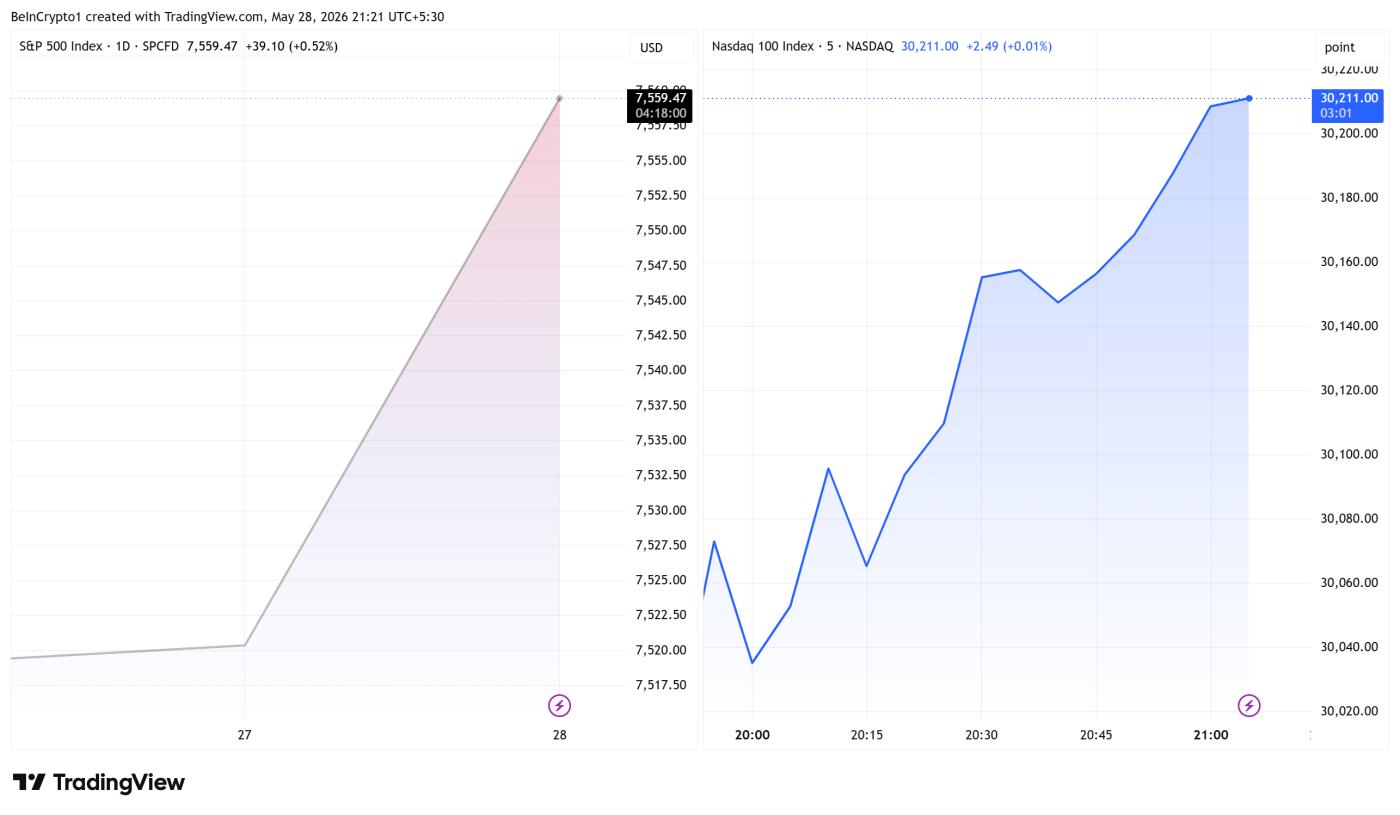 Performance of the S&P 500 and NASDAQ. Source: TradingView
"$350 billion was added to the US stock market in just 15 minutes after Axios reported that a US-Iran deal had been reached and was only awaiting final approval from Trump," the Bull Theory expert emphasized .
The agreement also requires Iran to commit to not developing nuclear weapons and to prioritize the elimination of its highly enriched uranium stockpile within the first 60 days.
In return, Washington would XEM easing sanctions and releasing frozen funds from Iran . The draft also adds mechanisms for providing humanitarian aid and transporting goods into Iran.
However, Axios's proposed ceasefire has not yet been officially signed; sources say Trump has been informed but needs "a few days to consider."
"We are still awaiting final approval for this agreement," Kobeissi Letter commented .
Reportedly, Mojtaba Khamenei – the son of Iran's supreme leader – has also not agreed to the deal.
IRAN–US DEAL REPORTEDLY BLOCKED AT TOP LEVELSA source cited by i24NEWS claims that while an agreement was reached between Iranian negotiator Araghchi and the US team led by Witkoff, it has not been approved by Iran's senior leadership.According to the report, Mojtaba…
— *Walter Bloomberg (@DeItaone) May 28, 2026
Bitcoin plummets while stocks surge.
Despite rising stock prices, Bitcoin continued to fall below the $73,000 mark , trading around $72,890 at the time of writing, a drop of nearly 5% in the last 24 hours.
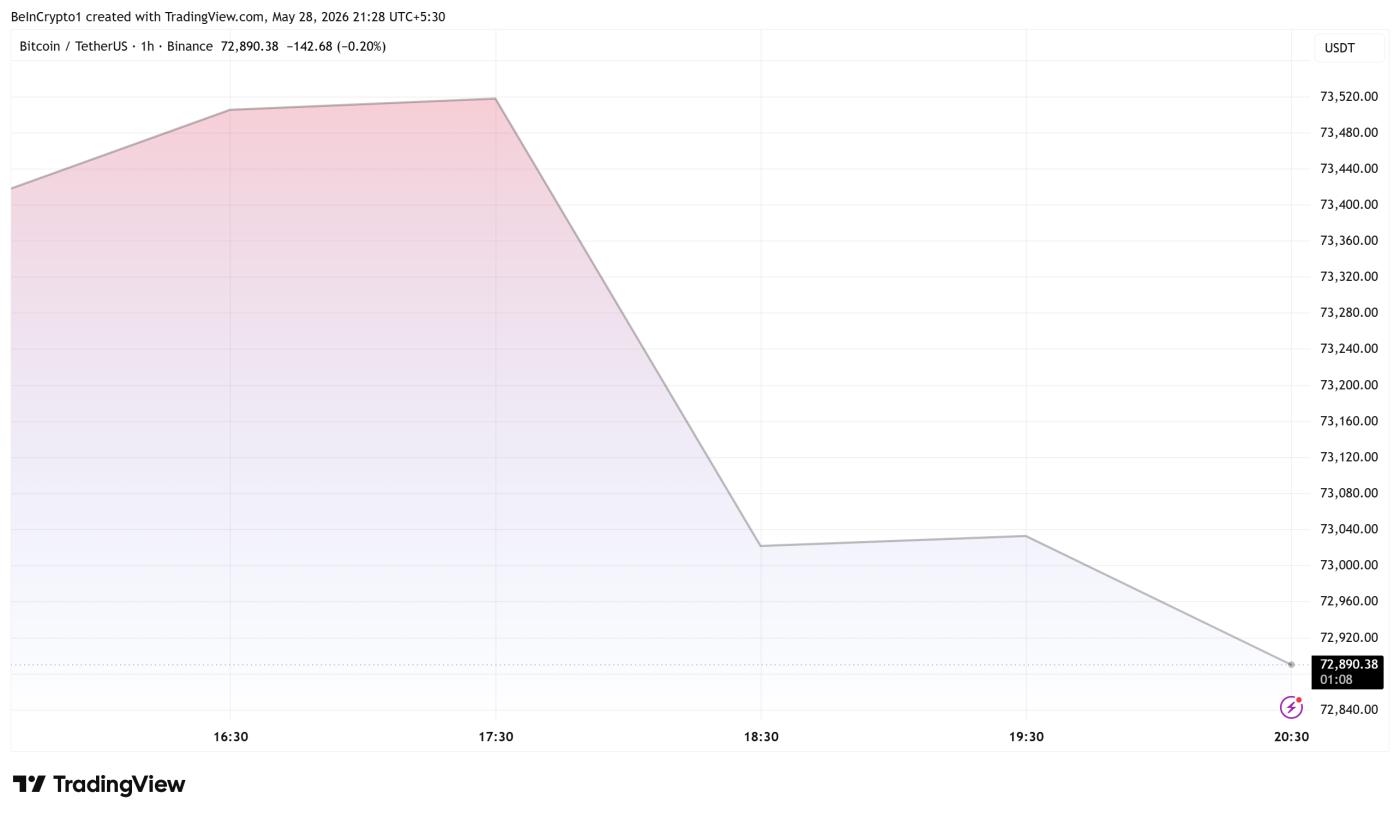 Bitcoin price movement. Source: TradingView
Bitcoin's decline occurred precisely at a time when positive news was helping stocks reach new highs.
The sanctions and maritime blockade remain in effect.
Finance Minister Scott Bessent said that sanctions and maritime blockades would remain in place until a formal agreement was signed.
The @USTreasury continues our Economic Fury campaign against the Iranian regime.Their troops are not getting paid, the police are not reporting for work, and Kharg Island is shut down. The Iranian economy and currency are in free fall.Iran's Persian Gulf Strait Authority…
— Treasury Secretary Scott Bessent (@SecScottBessent) May 28, 2026
He also warned that any party engaging in charging fees through the Strait of Hormuz would be dealt with, specifically naming Oman.
"In particular, Oman should know that the U.S. Treasury Department will take strong measures against any individual or organization – directly or indirectly – involved in or cooperating with the collection of fees in the strait," he added .
Follow us on X for the latest news updates.
According to him, the US Treasury Department also intervened to block Iranian airlines from accessing refueling points and landing slots.
The divergence between the stock market and BTC became even more apparent after Mark Cuban's comments on Bitcoin's hedging potential . The billionaire stated this month that he sold most of his BTC holdings in the range of $120,000 to $88,000 because Bitcoin no longer served its previous Vai as a hedge against risk.
“According to that theory, BTC should be constantly reaching new highs. But currently, it's acting as a risky asset instead of a hedge as expected,” Mark Cuban explained .
Cuban's argument echoes the long-running debate about whether Bitcoin is truly an inflation hedge , especially as this debate is expected to intensify in 2026 when the price of gold rises to around $5,000 while BTC depreciates.
Adam Back, CEO of Blockstream, argues that the price of BTC has still risen 25% from its previous Dip during the period of escalating tensions in Iran.
The next developments may depend on whether Trump signs the (related) decision and how quickly Tehran lifts restrictions on maritime shipping.