A representative from the State Securities Commission affirmed that investors who do not transfer assets after 6 months will not be penalized; however, when transactions occur, they must be conducted through licensed service providers in Vietnam.

Mr. To Tran Hoa - Deputy Head of the Standing Committee, Cryptocurrency Trading Market Management Board, State Securities Commission (SSC) (Photo: VGP).
Chia at the 2026 "New Products and Market Development Orientation" conference, themed "Cryptocurrencies and the Future of the Digital Asset Market," held this morning (June 5th), Mr. To Tran Hoa, Deputy Head of the Standing Committee of the Cryptocurrency Trading Market Management Board, State Securities Commission (SSC), updated some of the latest legal information for the cryptocurrency market in Vietnam to date.
The series of texts were produced within a short period of time.
Mr. Hoa stated that in a very short period from September 2025 to the present, we have issued a series of legal documents, including 2 laws, 1 resolution, and 3 circulars on the cryptocurrency trading market.
Regarding the first document issued and effective on September 9, 2025, that is Resolution No. 05, the resolution on piloting the cryptocurrency market in Vietnam.
The second document is Law No. 71, the Law on Digital Technology Industry, which for the first time introduces the concepts of digital assets, cryptographic assets, and virtual assets into law. The regulations acknowledge these as assets under the Civil Code and, for the first time, establish mechanisms to protect investors' assets, recognizing them as assets of the people.
Thirdly, there is Investment Law No. 43, which allows businesses to register conditional business lines when participating in the pilot market for cryptocurrency assets in Vietnam.
And recently, the Ministry of Finance also issued three circulars. These include one circular on accounting and auditing for organizations participating in the market; and two circulars on taxation and tax guidance. One circular provides guidance on the tax regime and taxable subjects, and another provides guidance on tax rates and methods of tax collection for organizations participating in the market.
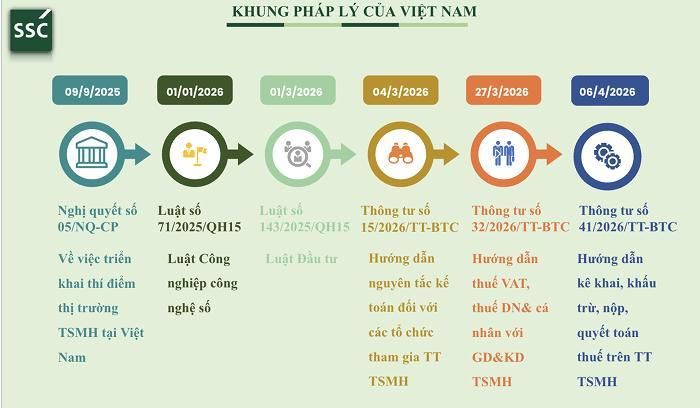
Legal framework for the cryptocurrency market in Vietnam. (Source: SSC).
Only foreign investors are allowed to trade domestically issued crypto assets.
Regarding the issuance issue, Mr. To Tran Hoa stated that according to Resolution No. 05, the underlying asset for issuance must be a real asset that has been audited and valued, excluding securities and fiat currency.
He also stated that the Securities Commission's guideline is that for underlying assets where rights or ownership transfers arise, the opinion of the relevant specialized ministry must be sought based on the type of asset.
For example, regarding goods, items like silver, copper, and other assets require approval from the Ministry of Industry and Trade; or real estate requires approval from the Ministry of Transport. However, if the asset does not give rise to ownership rights, then these obligations do not arise.
Regarding the issuing organization, it must be a Vietnamese enterprise, either a limited liability company or a joint-stock company as stipulated in the Enterprise Law. He assessed this as an open regulation, aimed at facilitating the raising of Capital abroad and the raising of Capital from abroad into Vietnam.
Regarding the group of participants in buying and trading these types of assets, only foreign investors are involved. "As for domestic investors, for the time being, we are not allowing them to participate in the issuance activities," he Chia .
Notably, all activities following the issuance and trading must be conducted at the cryptocurrency service providers, known as VASPs.
Investors who do not transfer their crypto assets will not be penalized.
In the regulations on trading activities, there is a provision that has attracted much attention: "After a period of 6 months from the date the first service provider is licensed, all trading activities of domestic investors must be conducted at licensed VASPs."
In response to a question about whether investors are penalized if they do not transfer their assets, a representative from the Securities Commission confirmed that they are not. Investors can absolutely deposit their assets in their personal wallets.
"But if a transaction occurs, it must be conducted through Vietnam's VASPs. That's the regulation," Mr. Hoa Chia .
He also emphasized that, regarding investor groups, foreign investors are naturally allowed to open accounts and participate in trading in the Vietnamese market, while for domestic investors, only those who already own cryptocurrency assets are allowed to participate.
Regarding listings, he stated that all listing and trading activities must be conducted in Vietnamese Dong.
"For example, cryptocurrency transactions include trading Bitcoin with VND or Ethereum with VND. And for crypto assets like stablecoins, although they are Peg to foreign currencies like USDT and USDC , we treat them similarly to Bitcoin and Ethereum, listing them in Vietnamese Dong and conducting these transactions," he said.
Regarding service providers, he stated that the Securities Commission also grants them considerable authority, allowing them to freely choose which crypto assets to trade and list. However, exchanges must also establish procedures and criteria for listing and must disclose information to investors.
VASPs are allowed to select the crypto assets to list. They are permitted to provide core services: proprietary trading, trading and custody, and ultimately, issuer services. They also have the right to collect service fees related to their business activities.
Organizations providing cryptocurrency services will need to have approximately 10 procedures in place, which will be XEM and approved before any information is released. Any changes to these procedures must also be reported to the regulatory authority and permission obtained before public disclosure.