According to the Financial Times, citing sources familiar with the matter, OpenAI is preparing for the largest overhaul of ChatGPT since its launch in 2022, with the new version to be rolled out gradually in the coming weeks.
The core of this redesign is to integrate Codex, OpenAI's fastest-growing programming tool, into ChatGPT, while also connecting to applications from external partners . This will transform this chat dialog box with nearly a billion users into a "super application" that can write code, manage schedules, and control software.
"The era of AI being used only for chatting is over." This is how a senior OpenAI employee summarized the transformation.
Within OpenAI, executives have reached a consensus that the future of AI lies not in simple dialogue and answering questions, but more in becoming intelligent agents that run errands and do tasks for users.
ChatGPT's role is being redefined: it's gradually transforming from a chat tool into a massive traffic portal. What truly drives its valuation and potential for paid subscriptions are the programming tools and enterprise-level services hidden behind it.
Thibaut Sottiaux, the executive in charge of OpenAI's "All Core Products and Platforms" division, described the product's final form: "You can connect to it via your phone, desktop, or web browser. You can talk to it when you're in your car." OpenAI's intention is clear: to make this intelligent agent ubiquitous and truly perform tasks for users in life and work, thereby incentivizing them to pay.
However, it remains to be seen who will dominate the AI application landscape in the next stage. Players such as Anthropic, Google, and xAI, which has been incorporated into the SpaceX system, are also continuously increasing their investment in model capabilities, application access, computing resources, and ecosystem integration.
01
Codex Reshapes ChatGPT: Programming Tools Take Over the Super Entry Point
Regarding OpenAI's strategy of integrating the entire Codex into ChatGPT, Alex Embiricos, the company's product manager, explained that the company has now entered the second phase. "With an agent that can help you do anything on a computer, the next goal is to push that capability to everyone."
To help Codex break out of the niche of programmers, OpenAI has launched six plugins for specific roles, covering areas such as creative production, sales, and public stock investment.
For ordinary users, the most noticeable changes will occur in the interface over the next few weeks.
In the initial stages of the redesign, ChatGPT's website and mobile app were crammed with numerous prompts and function entry points, guiding users to click on programming tools, image generation, or use applications built by external partners such as Canva and Booking.com.
In the short term, users will see an option to manually choose whether Codex or ChatGPT responds to their needs.
Embrycos described several everyday automation scenarios that non-technical users could immediately get started with:
After connecting to email or Slack, users only need to dictate, and Codex can automatically draft the content, match the recipient, and send it with one click after the user confirms.
After connecting to the calendar via the plugin, users can verbally inquire about upcoming events or retrieve meeting backgrounds at any time;
Users can even set up a routine that runs automatically every morning at 8 a.m., which will push daily meeting summaries and the most urgent to-do items in their inbox at set times.
But Sotio's vision goes beyond that. He believes this transition period won't last long. In the long run, the model will automatically determine whether a task should run locally on the user's device or in the cloud, so users won't have to worry about which tool is doing the work behind the scenes.
Over time, those guiding prompts and function entry points will be gradually removed. OpenAI is betting that its models will be able to automatically understand the user's intent when using the application or website.
Regarding this design direction, some netizens commented that it sounds like the beginning of a transition to AGI, and the direction is correct. Abandoning prompts may mean that users will have a better voice interaction interface, able to directly speak to activate the underlying intelligent agent.
02
The underlying driving force comes from model upgrades.
This shift in user experience is rooted in ways that are invisible to the average user. To get the public used to the "job assignment" model, ChatGPT's underlying production tools needed a complete overhaul, and that tool was Codex.
The most fundamental driving force behind this is the model upgrade. GPT-5.5, released in April of this year, significantly outperforms its predecessor in handling long-term, multi-step tasks, eliminating the need for frequent human guidance. This gives Codex real confidence in "executing independently after receiving clear instructions." In the words of Basis co-founder Mitch Trojanowski, "With GPT-5.5, Codex's advantages are too great to be ignored."
As the model's capabilities improved, developers' trust in it also increased. A tacit understanding gradually formed within the industry: when there was a clear solution in hand, people were more willing to entrust the work to Codex to see it through to the end.
Notion engineer Varun Rao mentioned a detail: when he and his colleagues were developing tools, Codex would silently fix a vulnerability in the code each time, and only when they ran it on another AI agent did they discover that the problem had existed for several weeks.
Trust is established, but people still need to be able to use it. The launch of the Codex desktop application in February of this year came just in time for this.
Previously, Claude Code could only be used through a plain text command-line terminal, which was very difficult for non-technical users. The desktop application brings a graphical interface, making it easy for ordinary users to get started, and even tech enthusiasts who want to run multiple intelligent agents at the same time find it convenient.
Max Schoening, product manager at Notion, particularly enjoys the experience of starting a task on a computer and then checking the progress on his phone via the Codex mobile app.
The data best confirms this fervor.
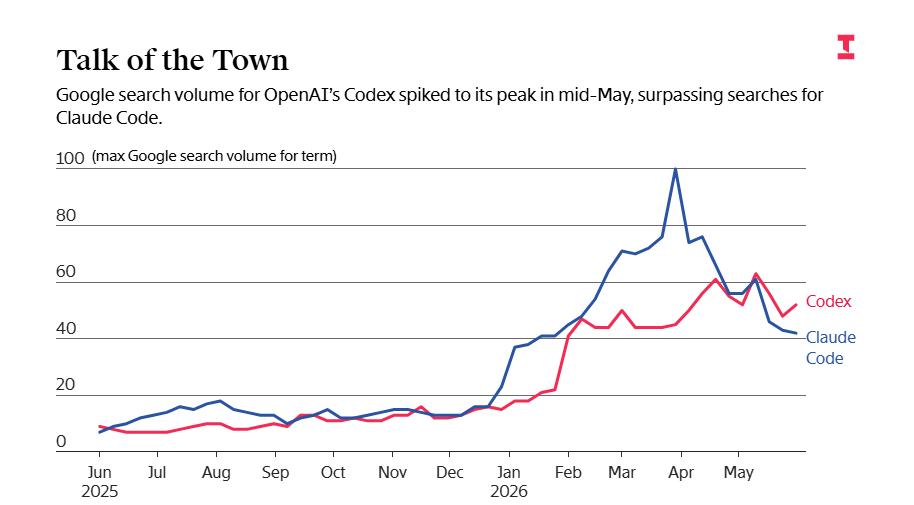
In mid-May, Google searches for OpenAI's Codex surged to an all-time high, surpassing Claude Code.
Since the launch of its desktop application, Codex's user base has grown sixfold in less than two months, with its weekly active users surpassing 5 million by the end of May.
OpenAI CEO Sam Altman revealed at a recent plenary session that Codex’s overall usage is growing at a rate of 5% per day.
Meanwhile, co-founder and president Greg Brockman also told employees last month that Codex’s revenue from enterprise customers grew by 50% week-over-week.
03
A "rapid fusion" forced upon them by Anthropic
OpenAI's major strategic shift was largely "forced" upon it by its competitor, Anthropic.
The seeds of conflict between the two companies were sown in the fall of 2024 when internal metrics showed that Anthropic's models had surpassed OpenAI in programming capabilities.
In February 2025, with the official release of the preview version of the programming tool Claude Code by Anthropic, OpenAI suddenly realized that in this crucial area, it had been overtaken by a much smaller competitor.
For OpenAI, falling behind in programming capabilities is a fundamental disaster. The company's long-held core belief is that AI for programming will accelerate its core research into superintelligence. Falling behind in programming means being outmaneuvered on the race to AGI.
Jenny Shaw, a former OpenAI researcher and now a partner at Leonis Capital, points out, "About a year ago, OpenAI's strategy was to go all out, while Anthropic's was to prioritize making money. Now, the two paths are converging because both companies are aiming for an IPO, and investors are more concerned with how to make money than with realizing their dreams."
To regain lost ground, OpenAI quickly assembled a dedicated Codex development team, personally led by executive Thibaud Sottiaux. This team enjoys a very high degree of autonomy internally, and even unprecedentedly open-sourced the code behind Codex to obtain direct feedback from users for improvement.
The success of the Codex team even prompted OpenAI to adjust its organizational structure. In January of this year, OpenAI underwent an emergency restructuring, bringing product teams closer together with researchers working on the underlying models.
In May, the organizational restructuring reached its climax, with OpenAI directly merging the ChatGPT, Codex, and API teams to form a unified core product and platform department, overseen by Sotio.
In this massive restructuring that heavily restructured resources, some consumer-facing projects became casualties. For example, the ChatGPT shopping checkout feature, which was under development, was shelved, and Sora, a video generation product launched less than a year ago, was shut down altogether. OpenAI's strategic shift is very clear: shelving consumer businesses that are difficult to monetize and concentrating resources on enterprise clients who are willing to pay.
04
With IPO imminent: Using "productivity" to get the accounts straight.
All the technology integration, organizational restructuring, and product choices ultimately boil down to one thing: before going public, revenue data must be made more solid.
Currently, approximately 2 million enterprises using OpenAI products contribute about 40% of its revenue, and the company expects this proportion to rise to 50% by the end of this year. In this process, Codex will demonstrate phenomenal monetization efficiency, as the majority of Codex users are paid subscribers.
However, the fierce competition still makes OpenAI feel the urgency. Relying on the massive revenue generated by Claude Code and Claude Cowork among developers and enterprises, Anthropic's annualized revenue soared to $47 billion in May. In contrast, although some media outlets have reported that OpenAI's annualized revenue has now exceeded $30 billion since announcing $25 billion in March, the gap remains significant.
This is why OpenAI was so eager to push Codex to ChatGPT's more than 900 million consumer users. On this massive base, even a slight increase in the average willingness to pay per user would translate into a huge influx of cash before the IPO.
The choice of technology route is also closely linked to the revenue logic.
In January 2025, OpenAI launched an AI agent called Operator, attempting to enable AI to perform everyday tasks like booking tickets and shopping in a browser, much like humans do. However, executives quickly realized that having AI mimic human clicks on web pages was far too inefficient. Sotio admitted that writing code directly was a more effective way for AI to complete tasks on computers, such as building complex spreadsheets.
This crucial judgment elevates Codex from an auxiliary programming tool to a tool for building general-purpose intelligent agents, and explains why this super application integration is seen as a key step in developing general-purpose intelligent agents. Its evolution path is exactly the same as Anthropic's journey from Claude Code to the general-purpose Claude Cowork.
The blueprint for super apps has been laid out, revealing ambitions at the operating system level. But the most pressing question facing Ultraman remains unresolved: will the hundreds of millions of consumers, accustomed to free "casual chat" and conversations, ultimately be willing to pay for a digital intelligent agent that can do work for them and earn them a salary?
This earth-shattering gamble, which will determine the industry standards and dominance in the second half of AGI's journey, has only just begun.
Jin Lu, a special translator, also contributed to this article.
This article is from the WeChat official account "Tencent Technology" , author: Li Hailun, editor: Xu Qingyang, and published with authorization from 36Kr.