The restraint of AI manufacturers is not due to a lack of technology, but rather a shared choice under the triple pressure of regulatory red lines, public opinion risks, and business trade-offs.
Article author and source: 0x9999in1, ME News
TL;DR
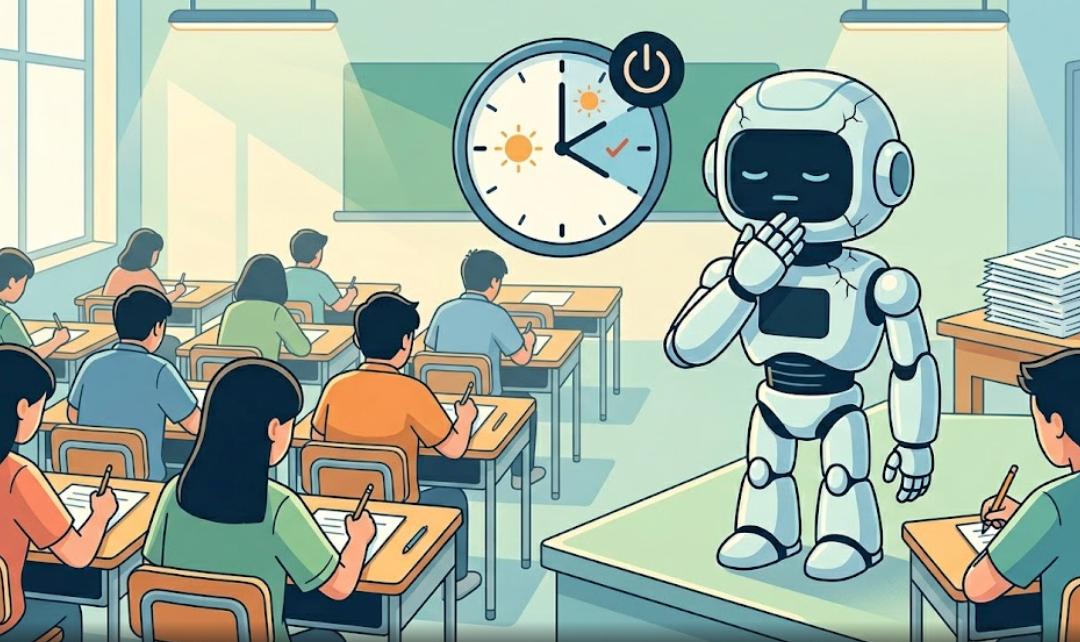
- Starting June 7, major AI applications such as Tencent Yuanbao, Quark, Doubao, Kimi, and Wenxin Yiyan collectively restricted exam-related question-and-answer and photo-based question-and-answer functions, marking the third consecutive year of "industry self-regulation."
- The restraint of AI manufacturers is not due to a lack of technology, but rather a shared choice under the triple pressure of regulatory red lines, public opinion risks, and business trade-offs.
- At the same time, the Science and Technology Innovation Board Daily used six mainstream models to write the Shanghai college entrance examination essay. DeepSeek and Gemini tied for the top spot with 66 points, while GPT only scored 53 points and came in last. The result is intriguing.
- The real battlefield isn't inside the exam hall, but outside. Tencent Yuanbao, in partnership with QQ Browser, launched "Yuanbao Gaokao Pass," Quark upgraded its Gaokao channel, and Baidu embedded "2026 Gaokao" into the core of its Wenxin Assistant app.
- The business of college application guidance, from Zhang Xuefeng to AI Agent, is being rapidly restructured from empiricism to algorithmism.
- AI education is an entry point, data, and user profile, but it is also a sword of compliance hanging over our heads.
I. "AI Restriction Order" Outside the Examination Hall
On the morning of June 7th.
As soon as the bell rang, more than ten million students across the country entered the examination hall.
At almost the same moment, the AI apps on our phones that usually answer every question collectively "forgot" them.
If you open Doubao and ask a math question, it politely tells you that the function is temporarily unavailable during the college entrance examination period. If you try to solve a physics problem with Quark, the recognition box keeps spinning, but the answer field remains silent. Kimi, Wenxin Yiyan, Tongyi... you get similar prompts no matter which one you open.
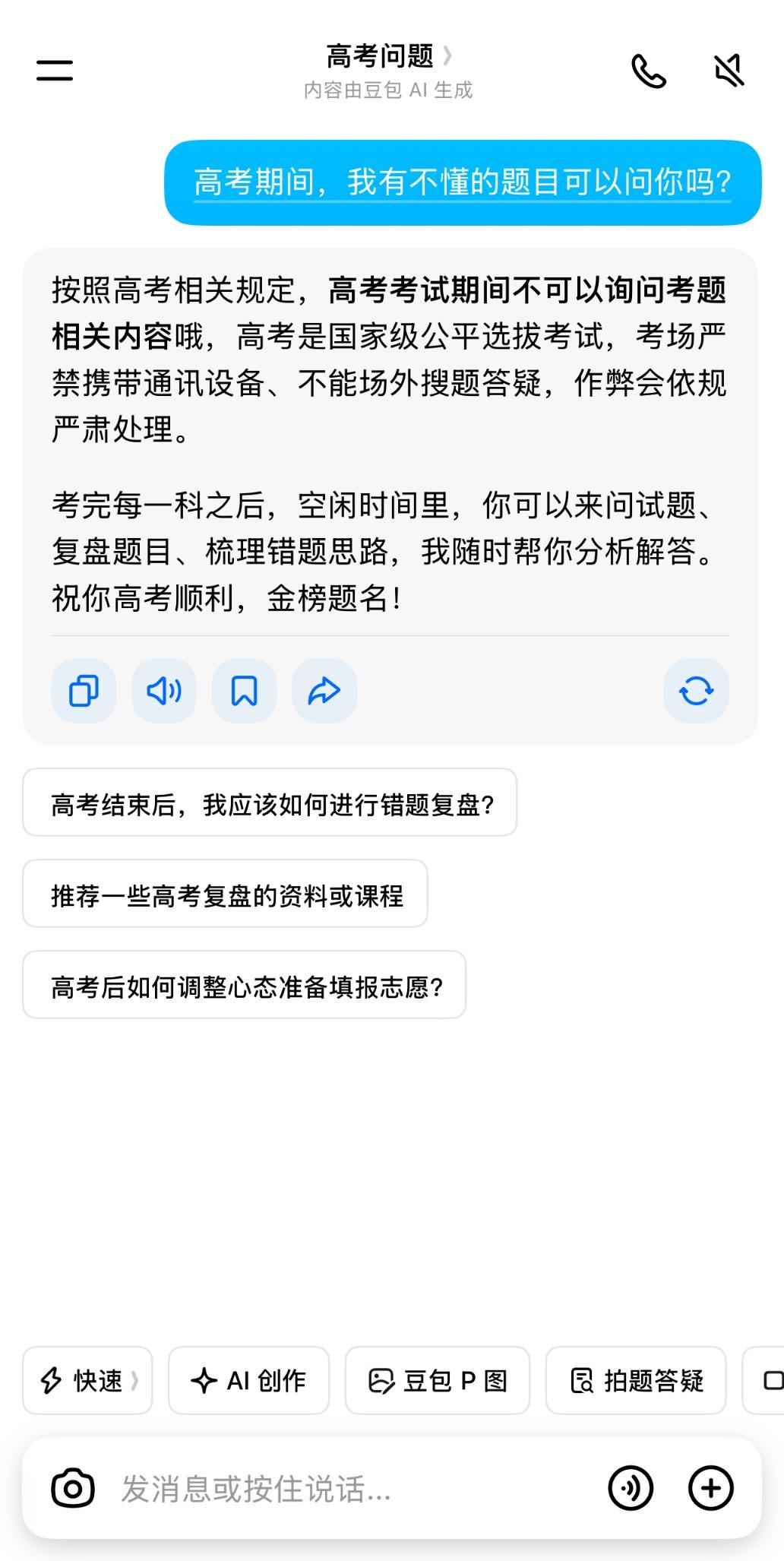
This is not a coincidence, but a tacit understanding.
This marks the third consecutive year that China's AI industry has collectively exercised "self-discipline."
In the first year, 2024, AI still seemed a bit clumsy, and various companies were patching things up temporarily; in the second year, 2025, it had become a standard practice for productization; and by 2026, it had simply become an industry norm.
Why?
Because the AI is so good at answering questions.
The accuracy rate of solving the final, most challenging math problem in the National College Entrance Examination (NCEE) using mainstream models is no longer news; a NCEE essay can be submitted in seconds with a complete theme and appropriate language. Inside the exam hall, there are nine minutes for a multiple-choice question; outside, it's nine seconds for a complete answer sheet. This asymmetry is fundamentally disruptive to the logic of the NCEE.
Regulators will not allow this to happen.
But more importantly, AI manufacturers themselves are unwilling.
If any app is labeled a "cheating tool for the college entrance exam" by public opinion, it's a brand crisis, a policy red line, and an instant wipeout of all To C growth efforts. No one can afford such a risk.
Therefore, "actively shutting up" is about reducing technical capabilities and increasing commercial rationality.
The restraint AI displayed this time wasn't because it was incapable, but because it was too capable.
II. An AI Essay Contest with No Winners
The AI in the exam room is silent.
Outside the exam hall, AIs are battling it out on another track.
This year, the *Science and Technology Innovation Board Daily* organized another cross-industry essay competition, pitting six major domestic and international companies against each other on the Shanghai exam. The results are in:
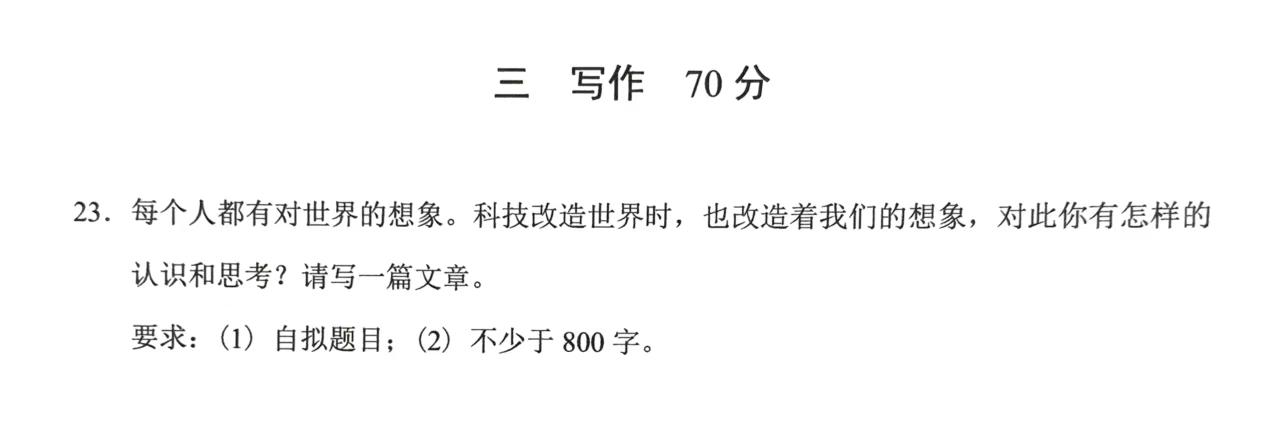
DeepSeek is tied for first place with Google Gemini, scoring 66 points.
Kimi scored 63 points, an A grade.
Doubao scored 61 points, and Alitongyi scored 58 points, both tied for B grade.
OpenAI's GPT score was only 53, placing it at the bottom with a C grade.
This result was unexpected by many.
Based on international rankings over the past two years, the GPT has consistently been regarded as a benchmark for reasoning and writing. However, when it comes to the specific scenario of the Chinese college entrance examination essay, it becomes the "overseas student" who is "unsuited to the local environment."
Why?
The Chinese college entrance examination essay is not a logic question, but a cultural question.
It tests the ability to use argumentation methods and cultural themes within the Chinese context, as well as the unique sense of balance required to "have both thought and literary flair." The density of Chinese training materials in the GPT, its alignment with Chinese educational question-reading habits, and its understanding of domestic question-setting trends are all inferior to those of local test takers.
This doesn't mean GPT is weak; rather, it means that in this field, local models have a home-field advantage.
DeepSeek's joint top ranking deserves further discussion.
It didn't rely on fancy multimodal techniques or overwhelming marketing; it secured a tie for first place solely through its strong foundation in Chinese model writing. This aligns with its reputation for "internal strength" built up over the past year in the open-source community.
But is there really a winner in this competition?
I don't think so.
Because the college entrance examination essay is never about writing an average score of 66. It tests the unique clumsy sincerity and youthful sharpness of an 18-year-old. No matter how neatly AI writes or how high its score is, it is still just a passable mediocrity.
The examiners grade the papers according to the rules.
But readers are moved not by following the rules.
Third, the real battlefield is never inside the examination hall.
The AI remained silent for three days in the examination room; it wasn't withdrawing, but rather gathering strength.
On the afternoon of June 9th, the moment the bell rang to signal the end of the last foreign language exam, all AI applications would simultaneously "resume operation".
What they're vying for isn't answering questions, but volunteering.
Tencent Yuanbao, in partnership with QQ Browser, launched "Yuanbao Gaokao Tong" before this year's college entrance examination, claiming to be the industry's first college entrance examination consultant agent. Its selling point is not answering questions, but a one-stop agent-based service from score prediction, university matching, major interpretation to simulated application.
Quark has upgraded its college entrance examination channel, making its four-piece suite of services—"College Entrance Examination Search," "Intelligent College Application Selection," "College Application Form," and "College Application Report"—completely free. Quark originally started as a search engine, and the essence of college application is retrieval plus decision-making; its competitive advantage is naturally there.
Baidu wasn't idle either, directly embedding the "2026 College Entrance Examination" module into the core of Wenxin Assistant. Baidu, which has always been good at information aggregation, has compiled its college application content from the past ten years and combined it with Wenxin's conversational capabilities to rewrite it.
These three companies have different playing styles.
Tencent takes the agent route, emphasizing end-to-end decision support.
Quark takes a tool-oriented approach, emphasizing free and open access.
Baidu takes a content-driven approach, emphasizing authority and accumulated experience.
But they are all targeting the same market – the college application market for over ten million families of test-takers.
How big is this cake?
Over the past few years, Zhang Xuefeng has almost single-handedly transformed the concept of "college application consulting" into a high-priced industry. His "Dream Realization Card" once sold for over ten thousand yuan, yet demand still couldn't meet supply. Parents are willing to pay for information asymmetry because the information gap is so large.
What AI needs to do is precisely to bridge this information gap.
It doesn't require every family to pay tens of thousands of yuan; it only needs to get a portion of the more than ten million test takers into the habit of opening it and asking, "What schools can I get into with this score?"
Once the entry point is established, the user profile is created.
Once user profiles are established, future education, career, study abroad, postgraduate entrance exam, and civil service exam services will all have a point of connection.
AI companies are never focused on this one form submission.
This is the family's educational spending path for the next 20 years.
IV. The Real Calculations Behind the AI Education Business
Let's broaden our perspective.
AI plus education is not a new story.
From photo-based question search to AI teachers, from oral English tutoring to error notebook generation, countless companies have stumbled along this path over the past decade.
Why is this time different?
First, large-scale models have reduced the cost of "personalization" to an unprecedented low. In the past, providing personalized college application advice relied either on human consultants or on approximate answers generated by rule engines. Today, a conversational agent can generate a relatively decent personalized report based on your scores, region, interests, and family expectations. This cost curve has dropped dramatically.
Secondly, the National College Entrance Examination (Gaokao) is a time of peak emotional intensity for Chinese families. This level of traffic is something no AI-to-consumer product would overlook. Yuanbao, Quark, and Wenxin are not just vying for these three days; they're planting the seed of "AI as a trustworthy family decision-making assistant" in parents' minds.
Third, college application is a natural fit for AI. It is a hybrid decision-making process involving structured data and soft preferences, which is exactly the middle ground that large models excel at—it has neither a unique solution like mathematics nor is it completely unquantifiable like philosophy.
But the problem lies here.
If AI-generated volunteer suggestions are wrong, who is responsible?
In the past, there have been isolated cases where AI-recommended universities mismatched with students' scores, and the companies afterwards dismissed the matter with a simple "for reference only." This year, all companies have made significant efforts to strengthen compliance—disclaimers, manual review, and data integration with provincial examination authorities—but in essence, the boundaries of responsibility for college application remain blurred.
Parents entrust their children's fate for four years to an agent. Whether to accept this trust, whether it is possible to accept it, and how to handle problems are the core issues that the AI education industry cannot avoid in the next three to five years.
The regulators are also watching.
The Ministry of Education's control over AI applications related to examinations will only become stricter, not looser. The "locking" of certain functions this year is a clear signal of prioritizing compliance.
AI companies must understand one thing: in the education industry, speed is not the primary principle; credibility is.
V. Restraint is the cultivation of AI.
As I write this, I suddenly realize that the most interesting part of this story about AI and the college entrance examination is not what they are doing, but what they are not doing.
They didn't answer the questions.
They didn't try to steal the spotlight.
They didn't turn a test about people into a demonstration about machines.
This restraint is one of the most commendable changes in China's AI industry over the past three years.
The transition of technology from rapid expansion to self-regulation, from demonstrating capabilities to converging capabilities, is a sign that an industry is maturing.
As for the post-exam battles over college application choices, educational resources, and family decision-making, that's another big show altogether.
It will be a lively event, with winners and failures, reshaping the existence of figures like Zhang Xuefeng, and also giving rise to new information arbitrageurs.
But none of this applies to the more than ten million children who went to the exam hall.
For the past three days, both they and the AI have kept quiet.
Every word I wrote in the exam room was still written with that same pen, on that same exam paper, and by that 18-year-old.
No matter how smart AI is, it won't take the exam for them.
There's no need to take the exam for them.
References
- Science and Technology Innovation Board Daily: Six major domestic and foreign models jointly wrote the 2026 Shanghai College Entrance Examination essay evaluation report, June 2026.
- Tencent Yuanbao and QQ Browser jointly released a press release: "Yuanbao Gaokao Tong," the industry's first college entrance examination consultant agent, in June 2026.
- Quark App: 2026 College Entrance Examination Channel Upgrade Announcement and Introduction to "College Entrance Examination Search/Intelligent College Selection/College Application Form/College Application Report" Functions.
- Baidu Wenxin Assistant: Announcements related to the 2026 College Entrance Examination module product page and Baidu mobile ecosystem.
- Ministry of Education of the People's Republic of China: Public data on the number of applicants for the National College Entrance Examination (NCEE) in the past three years.
- iResearch Consulting: China AI + Education Industry Research Report Series, 2024–2025.
- 36Kr In-Depth Report: "Who's Next After Zhang Xuefeng in the AI College Application Business?"
- Huxiu: "Large-scale Models Approach the College Entrance Examination: From Question Answering to Agent-based College Application".