Written by: Oluwapelumi Adejumo
Compiled by: Chopper, Foresight News
TL;DR:
- Sam Bankman-Fried (SBF) has officially applied for a presidential pardon, and the FTT token has surged by more than 50% in 24 hours.
- The surge has nothing to do with the actual value of the token; it is purely a speculative bet on the market regarding its pardon application.
- Trump has repeatedly refused to grant pardons, and the market predicts that the probability of approval is only 8%, making the trade extremely risky.
Sam Bankman-Fried (SBF), the disgraced founder of the cryptocurrency exchange FTX, is serving 25 years in federal prison for orchestrating one of the largest financial frauds in U.S. history. However, cryptocurrency speculators are betting that a newly filed presidential pardon could turn his fate around.

SBF seeks Trump pardon
This week, SBF formally submitted an administrative pardon application through the U.S. Department of Justice's Office of Pardon Attorneys website. This move marks a formal escalation of months of secret lobbying efforts by his family and legal team, a practice that deviates from conventional legal practice and breaks the rule that a five-year waiting period must pass after a verdict before an application for a pardon can be made.
However, the likelihood of approval is extremely slim, as President Trump has repeatedly refused to grant SBF any pardon. It's worth noting that traders on the blockchain-based prediction market Polymarket currently believe there is only an 8% chance Bankman-Fried will receive a presidential pardon by the end of the year.
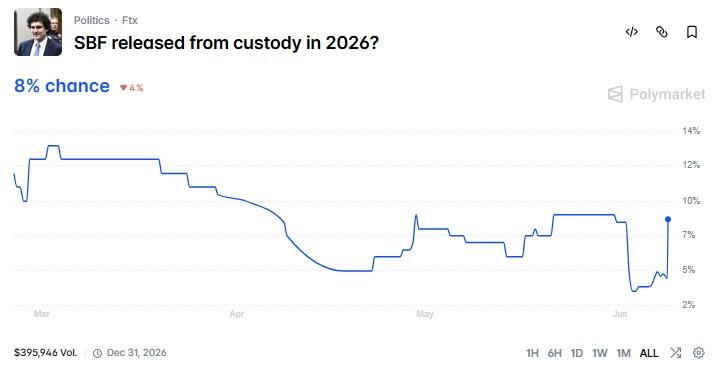
The probability of SBF receiving a pardon before the end of the year on Polymarket.
Speculative surge in ghost tokens
Although political analysts and prediction markets believe the chances of a pardon being approved are extremely low, the mere news of "submitting an application" is enough to trigger a speculative frenzy on digital asset exchanges.
CryptoSlate data shows that SBF's legal actions directly benefit FTX's native token, FTT. FTT is now a ghost asset: since FTX's collapse and bankruptcy in November 2022, the token has no real-world applications, no development team to maintain it, and no underlying business support.
However, the crypto market is always driven by sentiment, plight narratives, and algorithms. Following the news of the amnesty application, FTT surged over 50% in 24 hours, reaching a high of $0.35, a significant rebound from its previous all-time low of $0.2141. Meanwhile, CoinMarketCap data shows that the trading volume of this bankrupt token skyrocketed by over 600%, exceeding $16 million.
Market data shows that about 30% of speculative trading occurs on Binance, a competitor that triggered a run on FTX in late 2022 by liquidating its FTT holdings.
This recent surge suggests that some market participants view FTT as a political option to bet on the fate of SBF. Traders believe that if the amnesty is passed, the market may briefly rekindle interest in FTX-related assets, making FTT a direct betting tool.
It must be made clear that this type of transaction is unrelated to legal proceedings or bankruptcy proceedings. A presidential pardon cannot restore FTX's operations, restart FTT's original functions, or change the structure of creditor claims; it can only affect SBF's personal freedom and political narrative.
SBF's defense
In March 2024, a jury found SBF guilty of two counts of wire fraud, two counts of conspiracy to commit wire fraud, and conspiracy related to securities fraud, commodities fraud, and money laundering. Federal prosecutors accused him of misappropriating billions of dollars from FTX clients, defrauding exchange investors, and misleading Alameda Research lenders.
Ultimately, U.S. District Judge Lewis Kaplan sentenced him to 25 years in prison, three years of supervised release, and forfeited over $11 billion in assets.
However, SBF has consistently denied the outside world's characterization of FTX's collapse. In interviews and online statements, he claimed that the exchange experienced a liquidity crisis rather than true insolvency, and that the recovery of assets after the bankruptcy proved that customer funds could have been fully redeemed.
Their core argument focuses on the remaining assets and venture capital value of FTX, claiming that assets exceeded liabilities at the time of bankruptcy and that control of the company should not be transferred to external restructuring advisors. This claim completely contradicts the evidence presented by the prosecution during the trial.
Government evidence suggests that FTX customer deposits were secretly transferred to Alameda to cover trading losses, investments, real estate purchases, political donations, and debt repayments. Several former FTX executives have testified against SBF. Former FTX General Counsel Ryne Miller also publicly refuted the company's claim of being "capital-to-cover," stating that when the collapse occurred in November 2022, the company's assets were far from sufficient to cover its debts, and internal staff were still urgently piecing together an asset list and raising funds for survival.
Trump pardons crypto peers, SBF is an exception
Despite aggressive lobbying efforts, the political reality facing the SBF is extremely dire. In January 2026, Trump explicitly refused to pardon the SBF in a New York Times interview, and the White House subsequently maintained this position.
While Trump has frequently invoked his pardon power, including pardoning Binance founder CZ in October 2025 and previously commuting sentences for Silk Road founder Ross Ulbricht and BitMEX executive Arthur Hayes, the SBF case is entirely different in nature. Previous pardons have often been interpreted as correcting over-regulation, addressing anti-money laundering technology issues, or promoting criminal justice reform.
The SBF case is widely recognized as a blatant case of misappropriation of public funds amounting to tens of billions of dollars, causing devastating losses to millions of ordinary retail investors. Even among Republicans in Congress who support cryptocurrency, the pardon proposal faced strong opposition. Senator Bernie Moreno bluntly stated, "This man should not be pardoned; he should rot in jail."
Many crypto industry professionals share the same view: "Pardoning SBF is not releasing one scammer, but rather condoning thousands more. This sends a dangerous signal: misappropriating billions of dollars, repackaging yourself as MAGA in prison, and you can regain your freedom."