A French engineering student took home the biggest check in DeFi history during a bear market.
Written by: Sanqing, Foresight News
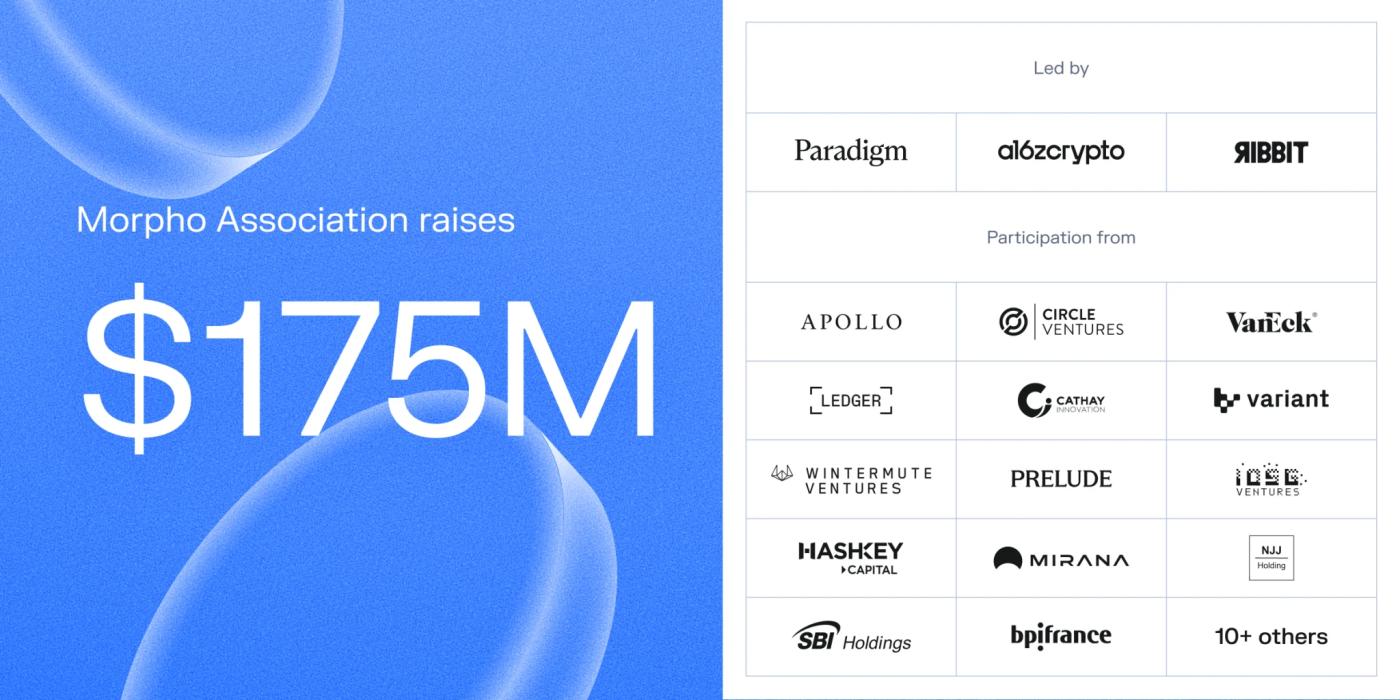
On June 9th, DeFi lending protocol Morpho announced the completion of a $175 million strategic funding round, valuing the company at $2 billion post-money. The round was co-led by Paradigm, a16z crypto, and Ribbit Capital, with participation from over ten institutions including Apollo Funds, Circle Ventures, VanEck, Ledger, Cathay, Wintermute Ventures, HashKey, SBI Group, and Bpifrance, the French public investment bank. The funds will be used to deepen technological and business integration with strategic partners and to continue developing and strengthening the infrastructure needed for building programmable lending products.
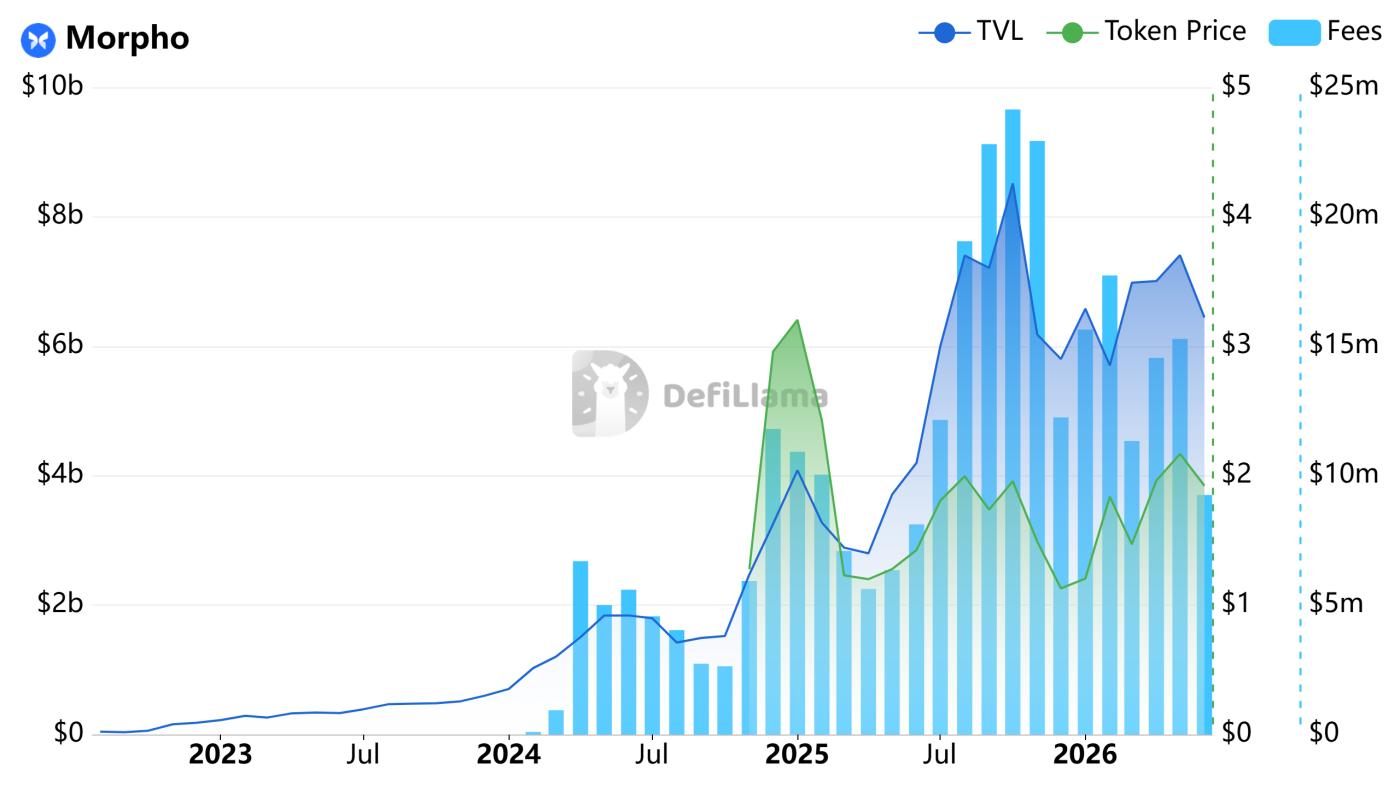
Morpho is the largest on-chain lending protocol after Aave. According to DefiLlama data, its peak TVL reached $8.518 billion in October 2025, with monthly protocol fees of $24.15 million. As of the date of this funding announcement, its TVL was $6.445 billion.
Starting with 1.35 million, it completed four rounds of financing in five years.
Where does $175 million stand in the history of DeFi funding? According to CryptoRank data, it surpasses Uniswap's $165 million in 2022 and is tied for first place with 1inch's $175 million Series B funding round completed during the 2021 bull market (post-money valuation of approximately $2.25 billion).
In October 2021, founder Paul Frambot, then a graduate student at École Polytechnique, launched the project with co-founders Merlin Egalite, Julien Thomas, and Mathis Gontier Delaunay in a $1.35 million seed round led by Semantic Ventures and Nascent.
Less than a year later, in July 2022, a16z and Variant jointly led an $18 million funding round. At that time, Frambot had just earned his master's degree and was only 21 years old, and the Morpho mainnet had only been online for a few months.
In August 2024, Ribbit Capital, with a traditional financial background, led a $50 million strategic round, with more than 40 institutions including a16z, Coinbase Ventures, Pantera, Brevan Howard, and BlockTower participating.
This $175 million round is the fourth round of financing, bringing the total amount raised to over $244 million.
French engineering students initially only wanted to build an "interest rate optimization machine".
Morpho's four co-founders all graduated from renowned engineering schools in France and North America. Paul Frambot (founder and CEO) graduated from École Polytechnique de Paris, majoring in parallel and distributed systems; Merlin Egalite (co-founder) graduated from CentraleSupélec, focusing on computer science and artificial intelligence.
Julien Thomas (co-founder and chief engineer) holds a master's degree from Polytechnique Montréal; Mathis Gontier Delaunay (co-founder and head of research) graduated from Télécom SudParis, a top engineering school in France, and has long led the core research and technical architecture of the protocol.
Since its founding in 2021, the team has remained highly stable with no publicly disclosed departures, and remains the core driving force behind Morpho's product iterations and technological direction.
The evolution of Morpho's product logic can be divided into three stages.
Phase 1 (2022): Optimizer. Early Morpho didn't attempt to replace Aave or Compound, but rather to build upon them as an "interest rate optimization layer." Through peer-to-peer matching, it allowed lenders to earn more and borrowers to pay less, with excess funds remaining in custody of the underlying protocol. This was a Pareto improvement: it didn't change the risk, only the efficiency.
Phase Two (Early 2024): Morpho Blue. Morpho launched an independent underlying lending protocol on which anyone could create segregated lending markets with custom parameters: collateral types, liquidation thresholds, and interest rate models are all configurable, and risk management is outsourced to independent curators. Once deployed, the protocol code cannot be modified, and governance cannot interfere with the already launched market. The architecture is more modular than Aave's single-pool model and is better suited to institutional-level risk isolation needs. The concurrently launched MetaMorpho Vaults allows retail investors to entrust their funds to professional curators and enjoy optimized returns.
In April 2026, Kelp DAO's rsETH experienced a technical crisis. Due to Aave's pooled architecture, the risk spread rapidly, leading to a panic sell-off. Its TVL plummeted from $26.396 billion to $14.181 billion in a single month, a loss of over $12 billion (according to DefiLlama). In contrast, Morpho's isolated market design strictly limited the risk to a single market, preventing a chain reaction.
Phase Three (2026): Morpho Midnight. About two weeks before the funding announcement, Merlin Egalite released a white paper for its fixed-rate lending protocol, Midnight. Borrowers and lenders can agree on a fixed interest rate and maturity date in advance, with the product structure resembling traditional fixed-rate bonds or term loans. This is precisely the credit structure most familiar to institutions.
The timing of the funding window coinciding with the release of the Morpho Midnight product white paper is no coincidence.
The institutions have already voted with their feet.
The most intriguing aspect of this round of financing lies in the "out-of-the-box" nature of the list of investors.
Apollo Global Management, with over $900 billion in assets under management, is one of the world's largest alternative asset management companies. It not only participated in this funding round but also signed a cooperation agreement with Morpho as early as February 2026, committing to purchase up to 90 million MORPHO tokens, representing 9% of the total supply, through open markets or over-the-counter transactions within 48 months. Apollo's tokenized private lending fund, sACRED, was launched on-chain in April 2026 and included in Morpho's collateral whitelist.
In September 2025, SG-FORGE, the digital asset subsidiary of Société Générale, deployed its MiCA-compliant euro stablecoin EURCV and dollar stablecoin USDCV on Morpho for institutional lending. This marks the first time a European systemically important bank has integrated a compliant stablecoin into a DeFi lending protocol.
Coinbase launched its Bitcoin-secured lending product on the Base chain in January 2025, allowing users to convert BTC into cbBTC as collateral to borrow USDC directly, fully powered by the Morpho protocol. By mid-2026, the product had surpassed $1 billion in cumulative lending and continued to grow (according to The Block). Coinbase CEO Brian Armstrong stated that "the next goal is to reach $100 billion in on-chain lending." Morpho is the sole infrastructure layer for this business line.
These institutions aren't speculating on the price fluctuations of a DeFi protocol's token; they're laying the groundwork for their future on-chain lending businesses. Frankie, a partner at Paradigm, stated in the funding announcement: "In the future, every bank, asset management company, and pension fund will want to access the on-chain lending market, and Morpho's open infrastructure is laying the foundation for global financial on-chain integration."
As Frambot has repeatedly emphasized publicly, Morpho's positioning has never been to replace banks, but rather to become the on-chain credit backend for banks and institutions. This narrative happens to be the version most easily accepted by traditional institutions under the current regulatory environment.
Frambot, 25, and his team are turning their master's-level blockchain research project into a fully functional global credit infrastructure. From a graduate program at École Polytechnique to the underlying pipeline serving a trillion-dollar global credit market, Morpho's story continues.